


Many dogs feel extremely uncomfortable during thunderstorms. Lightning, the sound of thunder, heavy rain and sudden changes in their surroundings can make a dog anxious, while some four-legged companions may experience very intense fear. That is why it is important to know how to support your dog during this difficult experience.

A thunderstorm can be a frightening experience not only for people, but for dogs too. For some dogs, the noise of thunder, lightning and rain causes only temporary unease. Others begin to shake, pant, wander around the house, look for somewhere to hide or even attempt to escape.
If your dog is afraid of thunderstorms, the most important things are to reduce the intensity of the stimuli, give them access to a safe place and offer calm support without forcing them to interact, play or come out of their hiding place. If the fear is very severe, it is worth consulting a veterinary surgeon, as noise phobias can become worse over time [1][3].
What will you learn from this article? From this guide, you will learn:
- why dogs are afraid of thunderstorms,
- what the symptoms of thunderstorm anxiety look like,
- why some dogs sense a storm before their guardian does,
- how to prepare your dog before a thunderstorm arrives,
- how to create a safe place for them,
- whether you can stroke your dog during a thunderstorm,
- whether music and white noise can help,
- what to do if your dog pants, shakes or hides,
- whether play and treats are a good idea,
- what desensitisation and counterconditioning are,
- what not to do when your dog is very frightened,
- when you should seek help from a veterinary surgeon or behaviourist.
Your dog during a thunderstorm
A thunderstorm can be a frightening experience for many people, but also for dogs. For some of them, the noise of thunder, lightning and rain can cause intense fear and stress. In such situations, as dog guardians, we should understand our four-legged companion’s behaviour and provide appropriate support.
We know that a thunderstorm is a natural weather phenomenon and that it will eventually pass. A dog, however, does not understand what causes sudden thunder, flashes of light or rattling windows. If they perceive these things as a threat, their reaction is completely real to them.
It is also worth remembering that fear can vary greatly in intensity. One dog may flatten their ears, move closer to their guardian and fall asleep again after a few minutes. Another may remain highly aroused throughout the entire storm.
How can you tell if your dog is afraid of thunderstorms?
The symptoms of fear do not always look the same. Some dogs show their emotions very clearly, while in others the signals are much more subtle. Behaviours seen in dogs experiencing noise-related fear include shaking, hiding, freezing, restlessly moving around the house, barking, panting, attempting to escape and destructive behaviour [3][5].
Your dog may also:
- tuck their tail and flatten their ears,
- pant heavily despite not exercising and despite normal temperatures,
- drool,
- seek contact with their guardian,
- squeeze under the bed or table, or hide in the bathroom,
- refuse food,
- show no interest in toys,
- scratch at doors or windows,
- follow their guardian everywhere,
- struggle to calm down for a long time even after the storm has passed.
Severe panting, shaking and attempts to escape may indicate more than mild temporary unease. If your dog’s reactions are intense or become stronger with every subsequent thunderstorm, it is worth discussing them with your veterinary surgeon [3][5].
Why are dogs afraid of thunderstorms?
Dogs may be afraid of thunderstorms because of several factors occurring at the same time. It is not only the sound of thunder itself. Loud noise is one of the most obvious elements. Thunder appears suddenly, can be extremely intense and it is difficult to predict when the next rumble will occur. For a dog who does not understand what is causing the sound, it may signal potential danger.
Lightning can also disrupt the way a dog normally perceives their surroundings. Heavy rain, wind and other changes associated with a thunderstorm add further stimuli.
Veterinary behavioural sources point out that thunderstorm anxiety can be associated with an entire combination of signals. Over time, a dog may begin reacting not only to thunder itself, but also to darkening skies, rain, wind or other cues that predict the approaching storm [1][2].
Previous unpleasant experiences involving sudden and very loud noises may also play a part for some dogs. Noise sensitivity can also appear or become stronger later in life. If an adult or senior dog suddenly begins reacting strongly to sounds despite never having had this problem before, it is worth discussing the behavioural change with a veterinary surgeon [3].
Why does a dog know a thunderstorm is approaching before a person does?
Some guardians notice a change in their dog’s behaviour before they themselves hear the first rumble of thunder. The dog begins walking around the house, looks for somewhere to hide or becomes restless even though nothing appears to be happening outside yet. This does not have to involve any kind of “sixth sense”.
A thunderstorm consists of much more than lightning and loud thunder. It is also accompanied by changes in wind, rain, darkening skies and changes in atmospheric pressure. VCA Animal Hospitals points out that these additional elements may be relevant in dogs with thunderstorm anxiety [1].
A dog may therefore notice signals that their guardian has not yet registered. If they have also experienced thunderstorms many times before, individual cues that precede the thunder may themselves begin to trigger anxiety [2].
How can you help your dog during a thunderstorm?
The way the guardian behaves and how the environment has been prepared can greatly influence whether a dog is able to get through the storm in the most comfortable conditions possible.
There is no single method that works identically for every dog. One dog may want to hide in the bedroom, another may choose the bathroom, a third may lie close to their guardian, while another may look for their own bed. It is therefore important to observe your dog and find out what genuinely helps them.
– create a safe space for your dog
Provide your dog with a quiet place where they can take shelter during a thunderstorm. This may be a darkened room, the bathroom, bedroom or another part of the home where outside sounds are less intense. Closing curtains or blinds can help reduce flashes of light. It is also worth closing the windows and, where possible, limiting noise coming from outside [2][3].
The most important thing, however, is that the hiding place is familiar to your dog and has positive associations. Do not try to shut a frightened dog in a new space simply because it appears safe from a human point of view.
VCA Animal Hospitals and the Merck Veterinary Manual emphasise that a safe place is best established and reinforced before the thunderstorm occurs, while the dog is calm [1][2]. A familiar bed can be one element of such a space. If your dog enjoys resting in their dog bed, position it somewhere they naturally like to spend time and where you can reduce external stimuli.
A dog who naturally enjoys burrowing and seeks more enclosed resting places may prefer something that resembles a little hideaway. One example is the Bowl&Bone Republic DREAMY grey dog sleeping bag, where your dog can rest freely while deciding for themselves whether they want to partially hide inside its soft interior.
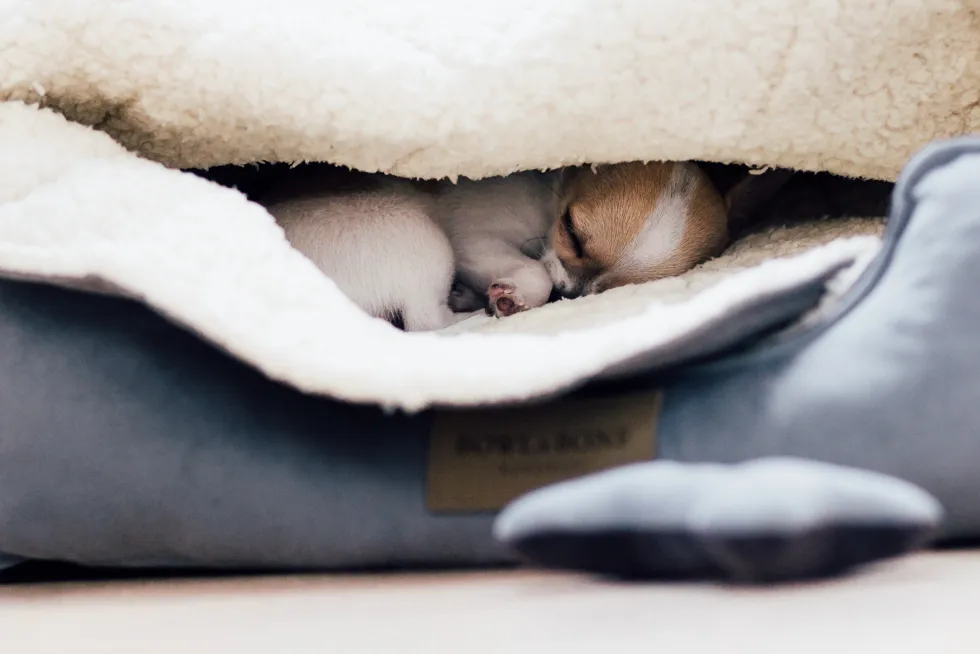
This does not, of course, mean that bedding treats thunderstorm anxiety. A familiar, comfortable place can, however, become one element of a safe space that has been prepared in advance.
– provide a calm background sound
Gentle music, the radio, television or white noise can partly reduce the contrast between a quiet home and the sounds coming from outside. People’s Dispensary for Sick Animals (PDSA – a UK veterinary charity helping animals) mentions the radio or television as one way of reducing the impact of outside noise [4].
It is important, however, not to make the volume too loud. Dogs perceive sounds differently from us, so adding another very loud source of noise could simply make the situation worse.
Background sound should therefore not be used to “drown out the thunder at all costs”. Its role is to create a more predictable and calmer environment.
– stay calm and provide support
During the storm, try to behave calmly and predictably. Do not shout, show frustration at your dog’s behaviour or try to force them to “pull themselves together”.
At the same time, you do not need to ignore your dog.
If your four-legged friend seeks your company, you can sit beside them, speak calmly or offer the type of contact they know and enjoy.
Can you stroke your dog during a thunderstorm?
Yes. If your dog actively seeks contact and touch helps them settle, you can calmly stroke them. It is still possible to come across the belief that comforting a dog “reinforces fear”. Fear, however, is an emotion rather than a behaviour performed in order to obtain a reward. PDSA clearly states that guardians can comfort an animal that seeks their support [4].
This does not mean that every dog wants to be touched. If your pooch hides under the table, turns their head away, avoids your hands or clearly chooses to be alone, allow them to remain where they feel comfortable. Do not pull them out of their hiding place or force them to cuddle.
Support should match the needs of the individual dog – one seeks closeness, while another primarily needs a calm place and some distance.
– distract your dog only if they want to engage
During mild anxiety, you can try to interest your dog in something they enjoy – a toy, a simple scent game or a treat.
If your dog is still happy to play, a familiar dog toy may help them focus on an enjoyable activity. For example, this could be the soft BAX dog toy, especially if your dog already knows it and associates it positively with playing together.

Do not, however, try to force a dog who is panicking to become interested in a toy. If your pooch refuses food, does not want to play and is primarily trying to find somewhere to hide, respect that. With very severe fear, distraction may simply not be possible.
What should you do before a thunderstorm arrives?
If the weather forecast indicates a possible thunderstorm, you can prepare your dog in advance. Where possible, plan their walk and toilet break before the weather deteriorates. A dog who reacts strongly to thunder may refuse to go outside during the storm or may attempt to escape.
Before the storm arrives, close windows, draw the curtains or blinds, prepare fresh water and make sure your dog has access to their safe place. Do not wait for the first crack of thunder to trigger panic.
If your dog has a history of severe reactions to thunderstorms, it is worth discussing the problem with your veterinary surgeon before storm season begins. Behavioural work is much easier when the dog is calm than in the middle of an actual episode of fear [1][5].
Can you leave your dog alone during a thunderstorm?
If you know that your dog is very afraid of thunderstorms, it is best – whenever possible – not to leave them alone during a forecast severe storm.
PDSA recommends that guardians remain with dogs that react strongly to noise [3]. This is particularly important if the dog attempts to escape, scratches doors, destroys objects or may injure themselves.
If you cannot be at home, prepare the environment in advance. Restrict access to places where your dog could injure themselves, leave them access to a familiar safe space and do not shut them in a crate or small area if noise causes them to panic there.
VCA points out that a crate may be a safe retreat for a dog who already likes it and has previously learnt to relax there, but it can become an additional danger for an animal that attempts to escape from it during panic [1].
How can you desensitise a dog to the sound of thunder?
One method used when working with noise-related fear is systematic desensitisation combined with counterconditioning [1][2][3]. Desensitisation involves presenting the stimulus at such a low intensity that the dog remains calm. In the case of thunder, this may involve playing a suitable recording at a very low volume at first.
Counterconditioning, meanwhile, involves creating a new association. A very quiet sound can therefore be paired with a treat, calm play or resting on familiar bedding. If the dog remains relaxed, the intensity of the stimulus can gradually be increased. Do not increase the volume if your dog begins to show fear. The aim is not to test how much they can tolerate, but to keep the dog below the level at which a fear response appears.
It is also important to remember that a recording of thunder does not recreate a complete real thunderstorm. A real storm also includes flashes of light, wind, rain and atmospheric changes, which means a dog may tolerate a recording far better than an actual thunderstorm [1].
With a severe phobia, a desensitisation plan is best developed with a veterinary surgeon or appropriately qualified behaviour professional.
What should you not do when your dog is afraid of thunderstorms?
Do not punish your dog for shaking, barking, hiding or trying to seek contact. These behaviours result from emotions that your dog cannot simply switch off at that moment. Do not pull them out of their hiding place if the place they have chosen is safe. Do not force your dog to watch the thunderstorm through the window or deliberately take them outside to “show them that nothing is happening”.

It is particularly inadvisable to deliberately expose an animal to an extremely intense stimulus in the hope that “they will eventually get used to it”. This approach is known as flooding and can deepen fear rather than reduce it [3][6]. Never give your dog human medication without veterinary advice.
Supplements and medication for a dog afraid of thunderstorms
In the previous version of this article, we mentioned various supplements and natural remedies. Today, it is worth approaching this subject more cautiously. There are supplementary products, pheromones and preparations containing ingredients used to support dogs experiencing mild anxiety. Their effects are not the same in every dog, however, and some preparations may interact with other medicines [1][3][6].
For this reason, do not give your dog a calming product solely on the basis of an online list of ingredients. If your dog reacts very strongly to thunderstorms, a veterinary surgeon can assess whether medication may be appropriate. Treatment of noise phobias can involve both behavioural strategies and – in selected patients – appropriately chosen medication [1][5].
Using medication does not mean that a guardian has failed. With severe panic, reducing the intensity of fear can be one element that makes further behavioural work possible.
What have 15 years of designing dog accessories taught us?
Over approximately 15 years of designing PREMIUM dog accessories at Bowl&Bone Republic, we have observed just how different individual dogs can be in the way they rest, respond to stimuli and look for a sense of security.
Hundreds of reviews, comments and suggestions, as well as feedback received from thousands of dog guardians and customers using Bowl&Bone Republic products, are also incredibly valuable to us. One of the most practical observations is very simple: a dog should be able to choose for themselves where they feel comfortable.
One dog wants to lie right beside their guardian when loud noises occur. Another goes to their own bed. Another chooses the bathroom, a wardrobe or a space beneath a piece of furniture. That is why, when designing dog beds, mattresses and sleeping bags, we focus not only on appearance but above all on a high level of everyday comfort. For the dog, their own bedding can become a familiar part of the household routine, while the guardian receives a durable, high-quality resting place designed to serve their pooch for a long time.

During a thunderstorm, however, your dog’s behaviour remains the most important thing. Do not move them to their bed simply because you think that is where they should rest. A safe place works best when your dog genuinely wants to use it.
When should you consult a veterinary surgeon?
If your dog is mildly unsettled during a thunderstorm but is still able to rest, accept a treat and return to their usual behaviour relatively quickly, appropriate management of the environment and gradual work on associations may often be sufficient.
It is worth seeking professional help, however, if your dog panics, tries to escape, damages doors or windows, takes a very long time to calm down, stops responding to their guardian or their fear becomes noticeably worse with each subsequent thunderstorm.
A veterinary consultation is particularly important if noise sensitivity appears suddenly in a dog who has never previously shown this problem. PDSA notes that increased sensitivity to noise may in some cases coexist with pain, so a sudden behavioural change should be assessed by a veterinary surgeon [3].
Your vet may also refer your dog to an appropriately qualified behaviour professional and help develop a plan that includes both environmental management and behavioural therapy.
What should you do with your dog after a thunderstorm?
The end of the thunder does not always mean that the stress ends immediately.
Some dogs quickly return to their normal routine. Others may remain aroused for some time, follow their guardian around the house or not yet be ready to play or go for a walk.
Give your pooch time.
Make sure they have access to water and a familiar resting place. If your dog wants to sleep, allow them to rest peacefully. Do not try to “burn off” the stress with very intense activity immediately after the thunderstorm.
If you would like to learn more about creating suitable conditions for recovery, read our guide How to help your dog rest after an active day?.
Supporting your dog during a thunderstorm
Fear of thunderstorms is a genuine problem, and some dogs are far more susceptible to it than others. The most important thing is to observe your pooch and adjust your support to their individual needs.
Prepare a calm space in advance, reduce noise and flashes of light, let your dog choose where they want to rest and offer contact if they seek it. Do not force them to leave their hiding place, play or face a stimulus at full intensity.
If your dog’s reaction is very severe, do not wait for the problem to disappear on its own. Noise phobias can become established and grow stronger, so an early consultation and appropriate behavioural work provide far more options for helping your dog [3][5].
If your dog also reacts strongly to fireworks, read our guide New Year’s Eve with a dog – how to take care of him.
And if you are creating a comfortable resting space for your pooch, discover Bowl&Bone Republic dog beds. We design them with exceptional canine comfort, years of use and guardians who want to combine the functionality of an exceptionally high-quality product with the aesthetics of their home in mind.
– the Bowl&Bone Republic team
FAQ – the most frequently asked questions about the article –
Is your dog afraid of thunderstorms? How can you help them cope with fear?
How can you calm a dog during a thunderstorm?
Reduce noise and flashes of light, close windows and curtains or blinds, give your dog access to a familiar safe place and remain calm. If your pooch seeks contact, you can stay beside them and stroke them. Do not pull your dog out of their hiding place [3][4].
Why is my dog afraid of thunderstorms?
The cause may be a combination of several stimuli: loud and unpredictable thunder, lightning, wind, rain and atmospheric changes associated with the storm. Some dogs experience only mild unease, while others develop a severe phobia [1][2].
Why does my dog pant during a thunderstorm?
Panting can be one of the signs of severe stress and arousal. If it occurs together with shaking, pacing around the house, attempts to escape or prolonged difficulty calming down, it is worth discussing the problem with a veterinary surgeon [3][5].
Can you stroke a dog when they are afraid of a thunderstorm?
Yes. If your dog seeks contact and touch helps them, you can stroke them calmly and stay close. You are not reinforcing the emotion of fear itself by doing so. Do not, however, force your dog to interact if they prefer to hide [4].
Why does my dog hide in the bathroom during a thunderstorm?
The bathroom may feel more isolated from outside sounds and flashes of light. If it is safe and your dog chooses it themselves, there is no need to force them to come out.
Can you leave a dog alone during a thunderstorm?
If your dog has a severe fear of thunderstorms, it is better to be at home whenever possible. This is particularly important for a dog who attempts to escape or could injure themselves. With milder reactions, preparing a safe environment in advance is especially important [3].
Can a dog sense a thunderstorm before a person can?
A dog may respond to things that occur before the first loud thunder, such as wind, rain, darkening skies or changes in atmospheric pressure. In a dog who has experienced many thunderstorms, these signals may themselves begin to predict the unpleasant event that follows [1][2].
Does music help dogs during thunderstorms?
Calm music, the radio, television or white noise may partly reduce the contrast between the sounds of the storm and a quiet home. They should not, however, be played very loudly [3][4].
Can recordings of thunder help a dog stop being afraid?
They can form part of a controlled desensitisation programme if they are initially played very quietly and do not trigger fear. It is important to remember, however, that a recording does not recreate every element of a real thunderstorm [1][3].
What can you give a dog who is afraid of thunderstorms?
Do not give your dog medicines or products intended for people without veterinary advice. With severe fear, a veterinary surgeon can recommend appropriate treatment or supportive products while taking your dog’s health and any other medication into account [1][3][6].
Can a dog’s fear of thunderstorms get worse?
Yes. Repeated strongly negative experiences can reinforce the fear response, so it is not worth waiting for a severe problem to disappear by itself. At the first signs of a significant phobia, it is worth consulting a professional [2][3][5].
Can you get a dog used to thunderstorms by playing thunder sounds very loudly?
No. Deliberately exposing a dog immediately to an intense stimulus may increase their fear. Desensitisation should begin at a level that does not trigger a fear response and the intensity should then be increased gradually [3][6].
Can a dog bed help during a thunderstorm?
A familiar dog bed can be one element of a safe space if your dog enjoys using it and associates it with rest. A dog bed does not, however, treat a thunderstorm phobia. The most important thing is to allow the dog to choose the place where they genuinely feel most comfortable [1][2].
When should a dog who is afraid of thunderstorms see a vet?
A consultation is advisable if your dog panics, attempts to escape, damages their surroundings, takes a long time to recover or their reactions become worse over time. It is also worth consulting a veterinary surgeon if noise sensitivity suddenly develops in a dog who has never previously displayed it [3].
Sources and inspiration used to write the article
Is your dog afraid of thunderstorms? How can you help them cope with fear?
- VCA Animal Hospitals, “Treating Fear of Storms and Fireworks in Dogs” – a resource prepared by veterinary professionals specialising in animal behaviour; used when discussing thunderstorm anxiety, safe spaces, desensitisation, counterconditioning and the potential use of veterinary treatment.
https://vcahospitals.com/sand-lake/know-your-pet/treating-fear-of-storms-and-fireworks-in-dogs - Merck Veterinary Manual, “Behavior Problems of Dogs” – a veterinary resource on behavioural problems in dogs, including noise phobias, safe spaces, the effect of repeated exposure on reinforcing fear, desensitisation and counterconditioning.
https://www.merckvetmanual.com/behavior/behavior-of-dogs/behavior-problems-of-dogs - People’s Dispensary for Sick Animals (PDSA – a UK veterinary charity helping animals), “Noise phobias in dogs” – guidance on the symptoms of noise phobias, how guardians should behave during loud noises, creating a safe space, desensitisation and when veterinary consultation is recommended.
https://www.pdsa.org.uk/pet-help-and-advice/pet-health-hub/conditions/noise-phobias-in-dogs - People’s Dispensary for Sick Animals (PDSA – a UK veterinary charity helping animals), “Dogs and phobias” – information on fear and phobias in dogs; used particularly when discussing supporting a frightened dog, contact with the guardian and the misconception that comforting reinforces the emotion of fear.
https://www.pdsa.org.uk/pet-help-and-advice/looking-after-your-pet/puppies-dogs/dogs-and-phobias - British Small Animal Veterinary Association (BSAVA), “Fireworks – Position Statement” – a position statement on animals’ fear responses to loud noises, including thunder; used when discussing symptoms, environmental management, behavioural therapy and the potential use of treatment.
https://bsava.com/position-statement/fireworks/ - Merck Veterinary Manual, “Treatment of Behavior Problems in Animals” – an up-to-date resource on treating behavioural problems, environmental management, desensitisation, counterconditioning, avoiding flooding, and the role of medication and supportive therapies in anxiety and behavioural problems.
https://www.merckvetmanual.com/behavior/behavioral-medicine-introduction/treatment-of-behavior-problems-in-animals











 or CANADA
 PLEASE join us at