


Are you wondering which material to choose for your dog bowl insert? The two most common options are metal and ceramic. Each has its own advantages and disadvantages. Understanding them will help you find the best solution for your dog.

Not sure which bowl insert will work better for your four-legged friend? We have prepared a comparison of the advantages and disadvantages of both options. It will help you make an informed decision and choose the solution that best suits your dog.
For most dogs, both a good-quality stainless-steel insert and a well-made ceramic insert can be a good choice. Stainless steel has an advantage in terms of durability and resistance to accidental damage. Ceramic is heavier and does not produce the characteristic metallic sound when, for example, a metal dog tag strikes it. In both cases, surface quality, lack of damage and regular cleaning of the insert are very important. [1][2][3]
What will you learn from this article? From this guide, you will learn:
- whether a dog bowl with a ceramic or metal insert may be the better choice for your dog,
- what the main advantages and disadvantages of both options are,
- whether a metal insert is a good choice for most dogs,
- why a dog may refuse to eat from a bowl with a metal insert,
- how to keep your dog’s bowl and insert hygienic,
- when a ceramic insert should be replaced,
- whether a metal or ceramic insert is more hygienic,
- which type of insert may best suit your dog’s individual needs,
- why Bowl&Bone Republic bowls are made from natural wood,
- how silicone non-slip feet improve stability during meals.
Dog bowl insert
Do you know just how important your four-legged friend’s bowl is? It is where you serve your dog their favourite meal, so it certainly plays an important role in their everyday life. That is why choosing one should never be a matter of chance.
For this reason, we would like to explain what is worth considering when choosing a dog bowl. In this article, we will focus primarily on bowl inserts. With many models, you can choose between a metal and a ceramic insert.
Both types can be a good solution, so the choice should depend on the needs and preferences of your four-legged friend as well as what you expect from the bowl as their guardian. We will explain both types of inserts in more detail to help you make the right decision.
If you are also interested in the size, shape and other features of a bowl, read our broader guide “How to choose the right dog bowl”: How to choose the right dog bowl. This article, however, focuses specifically on choosing between a dog bowl with a metal or ceramic insert.
Dog bowl with a metal or ceramic insert – a quick comparison
If you are mainly looking for a quick comparison of the two options, we have brought the most important differences together in one place.
| Feature | Stainless-steel insert | Ceramic insert |
|---|---|---|
| Resistance to being dropped | very high | lower – it may crack |
| Durability | very high | high with careful use |
| Ease of cleaning | very good | very good when the surface is undamaged |
| Dishwasher safe | depends on the specific product | depends on the specific product |
| Weight | usually lower | usually higher |
| Sound when touched by a metal dog tag | characteristic metallic sound | no metallic sound |
| Resistance to chipping | high | surface needs to be checked |
| Appearance | minimalist, modern | decorative, elegant |
| Main advantage | resistance to damage | greater weight and aesthetics |
| Main disadvantage | may be noisier for some dogs | may break or chip |
However, it is not worth choosing an insert on the basis of a single feature alone. The individual dog’s behaviour, feeding habits, condition of the insert’s surface, cleaning frequency and overall product quality also matter. [1][2][3]
Dog bowl with a metal insert
First, we would like to focus on a dog bowl with a metal insert. This type is very popular among bowl inserts for our four-legged friends. One reason is its versatility, as it can work very well for the vast majority of dogs.
One advantage of a metal insert is its high resistance to damage. Even if your dog knocks the bowl over while eating, it is very unlikely that a good-quality stainless-steel insert will suffer serious damage. This can be particularly important for energetic dogs that are still learning to eat calmly from their bowl.
If you would like to learn more about how to teach your four-legged friend to eat from a bowl, take a look at our article “How to teach a dog to eat from a bowl”: How to teach a dog to eat from a bowl.
Another clear advantage of a good-quality stainless-steel insert is its smooth, non-porous surface. This type of material is convenient to clean on a daily basis, which is particularly important for an accessory that regularly comes into contact with food and water.
A metal insert is very easy to clean. Food residue can be removed without much difficulty. Another convenient feature is that many stainless-steel inserts can be washed in a dishwasher, provided that this is permitted by the manufacturer of the particular product. The American Kennel Club (AKC) lists stainless steel among durable and easy-to-clean materials used for dog bowls. [1]

Is a dog bowl with a metal insert a good choice?
Yes, a good-quality dog bowl with a stainless-steel insert can be a very good choice for most dogs. Its main advantages are durability, resistance to accidental damage and the ease with which the insert can be cleaned regularly. [1]
In search results, you may come across questions such as ‘is a metal dog bowl good?’. In practice, the term ‘metal dog bowl’ is often used as shorthand. With Bowl&Bone Republic products, however, we specifically refer to a dog bowl with a metal insert, because the insert is only one part of the complete product.
This also does not mean that every metal insert available on the market will be the same. The quality of the material, smoothness of the surface, condition of the insert and the way it is maintained all matter. It is worth choosing products intended for contact with food and checking their condition regularly.
Nor should the insert material be treated as the only factor that determines hygiene. Research into the microbiological contamination of dog bowls shows that factors such as cleaning method and the type of food served also matter. [2][3]
Disadvantages of a metal dog bowl insert
Of course, everything has its advantages and disadvantages. The same applies to metal dog bowl inserts.
Some dogs may experience contact hypersensitivity to particular materials. Certain metals are also listed among potential contact allergens in animals. [5]
You may not have realised that dogs, like people, can react to contact with different materials. However, this does not mean that redness or irritation around the muzzle automatically indicates a reaction to a metal insert. Skin problems can have many causes, so persistent changes should be discussed with a veterinary surgeon.
When else might a metal insert not be the best solution for a dog? If your companion is particularly sensitive to sounds. You may be wondering what such behaviour could possibly have to do with a dog bowl. We will explain.
If your dog wears a collar with a metal ID tag or other metal elements, they may strike the sides of the insert while your dog is eating. Metal coming into contact with a stainless-steel insert can create a characteristic sound.
For particularly sound-sensitive dogs, this noise may be uncomfortable. Some dogs may move away from the bowl or stop eating when they hear it. So if you notice that your dog begins their meal but then leaves it shortly afterwards, it is worth checking this aspect of the situation as well.
Why does a dog refuse to eat from a bowl with a metal insert?
A dog may avoid a bowl with a metal insert for a number of reasons, and the material itself is only one factor worth considering. For particularly sensitive dogs, the metallic sound of an ID tag or other collar components hitting the insert may matter.
Another reason may be the bowl moving while the dog is eating, the location of the feeding area or an earlier unpleasant experience. It is also worth checking whether the insert has been thoroughly rinsed after washing and whether any strong detergent smell remains.
However, you should not assume that every refusal to eat is caused by the bowl. If your dog suddenly loses their appetite, appears to be in pain while eating or refuses food from other dishes as well, a health-related cause should be considered and the situation discussed with a veterinary surgeon.
Dog bowl with a ceramic insert
The second option is a dog bowl with a ceramic insert. It is a solution that combines everyday functionality particularly well with an elegant appearance.
First of all, it is worth considering the appearance of this type of bowl. A ceramic insert looks elegant and refined. Not everyone likes the appearance of metal, and if somebody pays close attention to their home décor, even a dog bowl can be an important part of the space.
A ceramic insert is easy to keep clean as long as its surface remains smooth and undamaged. Food residue can be washed away without difficulty. It is worth choosing high-quality ceramic intended for contact with food and regularly checking the condition of the glazed surface. [1]

Dogs have a highly developed sense of smell. Regardless of which type of insert you choose, regular hygiene and the thorough removal of residue from previous meals are therefore very important.
A ceramic insert may also be an alternative for a dog whose veterinary surgeon suspects a contact reaction to a particular material. It should not, however, be assumed that ceramic is completely ‘non-allergenic’, as skin problems can have many different causes.
There is no denying that a ceramic insert looks exceptionally elegant and stylish. It combines particularly well with natural wood, creating an accessory that, instead of looking like a purely functional dog product, can become a cohesive part of your home interior.
Is a dog bowl with a ceramic insert safe?
Yes, a dog bowl with a good-quality, undamaged ceramic insert intended for contact with food can be a safe choice for a dog. However, it is important to check the condition of its surface and stop using an insert that has cracked or become noticeably chipped. [1]
This matters for more than aesthetic reasons. Cracks and chips can make the surface harder to clean thoroughly, while sharp edges may be dangerous during everyday use.
It is therefore worth checking the condition of a ceramic insert whenever you wash it. If you notice clear damage, replacing it with a new one is the safer option.
Disadvantages of a ceramic dog bowl insert
Before deciding on a dog bowl with a ceramic insert, it is worth becoming familiar with the disadvantages of this solution as well. The main drawback is the possibility of breakage.
If you drop a ceramic insert onto a hard kitchen floor, particularly one covered with tiles, there is a significant chance that it may crack or chip. Stainless steel is considerably more resistant in this respect.
It is worth considering this if you are someone who occasionally drops things. The same applies if you have a child at home who sometimes gives your dog water or a meal. Younger children are more likely to drop objects they are holding.
In this situation, a bowl with a metal insert may therefore prove to be the more practical option. This does not mean that a ceramic insert is not durable during normal use – it simply requires a little more care when removing, washing and carrying it.
Is a metal insert more hygienic than a ceramic one?
This question cannot be answered solely on the basis of the material itself. The hygiene of an insert also depends on how and how often it is cleaned, the type of food served and the condition of its surface. [2][3]
A study published in BMC Veterinary Research in 2023 analysed, among other factors, the influence of food type, cleaning method and material on the microbiological contamination of dog bowls. The results indicate that all of these factors may matter and do not support the simple conclusion that one material is always the most hygienic. [2]

An earlier study published in PLOS ONE showed that using appropriate hygiene procedures significantly reduced bacterial contamination of bowls. [3]
In practice, the most important conclusion for a dog guardian is very simple: regardless of whether you choose a metal or ceramic insert, it should be cleaned regularly and thoroughly, and the condition of its surface should be checked.
How often should you clean a dog bowl insert?
The U.S. Food and Drug Administration (FDA) recommends washing dishes used for pet food with soap and hot water after each use. [4]
This is particularly important when your dog eats wet food or another type of food that leaves residue on the surface of the dish. There is no reason to wait until the insert looks visibly dirty before cleaning it.
If the manufacturer allows a particular insert to be washed in the dishwasher, this can make regular care more convenient. Both the stainless-steel inserts in selected Bowl&Bone Republic bowls and ceramic inserts used in the appropriate models can be dishwasher-safe in accordance with the product instructions.
Remember to clean the insert used for water regularly as well and replace the water with fresh water. Everyday hygiene is considerably more important than trying to find one material that will somehow solve the issue of contamination on its own.
Metal or ceramic insert – which should you choose for your dog?
We believe that both a metal and ceramic dog bowl insert can be a very good choice. The option you choose should depend on your four-legged friend’s individual preferences and on what you expect from the bowl as their guardian.
If maximum resistance to accidental drops and very easy everyday care are most important to you, stainless steel is worth considering. If you place greater value on the heavier weight of the insert, the appearance of ceramic and the absence of a metallic sound when an ID tag strikes it, a ceramic insert may be an interesting option.
If your dog is particularly sensitive to sounds, check whether metal components on their collar are hitting the steel during meals. If your dog is very energetic and the insert is likely to be dropped more often, the resistance of stainless steel to accidental damage may matter more to you.
In both cases, quality of manufacture, ease of regular cleaning and the condition of the surface are extremely important. There is therefore no single insert that will automatically be the best choice for every dog.
Wooden Bowl&Bone Republic bowls – natural material and unique character
At Bowl&Bone Republic, we have been designing PREMIUM dog accessories for almost 15 years. The knowledge we share in our guides comes not only from the design process itself, but also from hundreds of opinions and suggestions received from dog guardians and feedback from thousands of customers who use Bowl&Bone Republic products.
With our bowls, the choice between a metal and ceramic insert is not the only important consideration. The structure of Bowl&Bone Republic bowls is made from natural wood rather than wood-effect material or an imitation substitute. You can notice the difference from the very first contact with the product – the natural structure, texture and character of the wood mean that when you hold the bowl in your hands, you can genuinely feel the quality of the material from which it has been made.
Natural wood has another very special quality: no two pieces are completely identical. The grain pattern, subtle differences in shade and natural markings of the surface mean that every wooden Bowl&Bone Republic bowl is unique and, in a very real sense, one of a kind. These natural variations are one of the advantages of genuine wood and give each piece its own individual character.
This is particularly important at a time when many products that look like wood are actually manufactured from wood-effect materials or simply covered with a decorative surface designed to imitate the real thing. At Bowl&Bone Republic, we want the quality of the product to be apparent not only in photographs. When you pick up the bowl, you feel natural wood – not a cheap substitute.
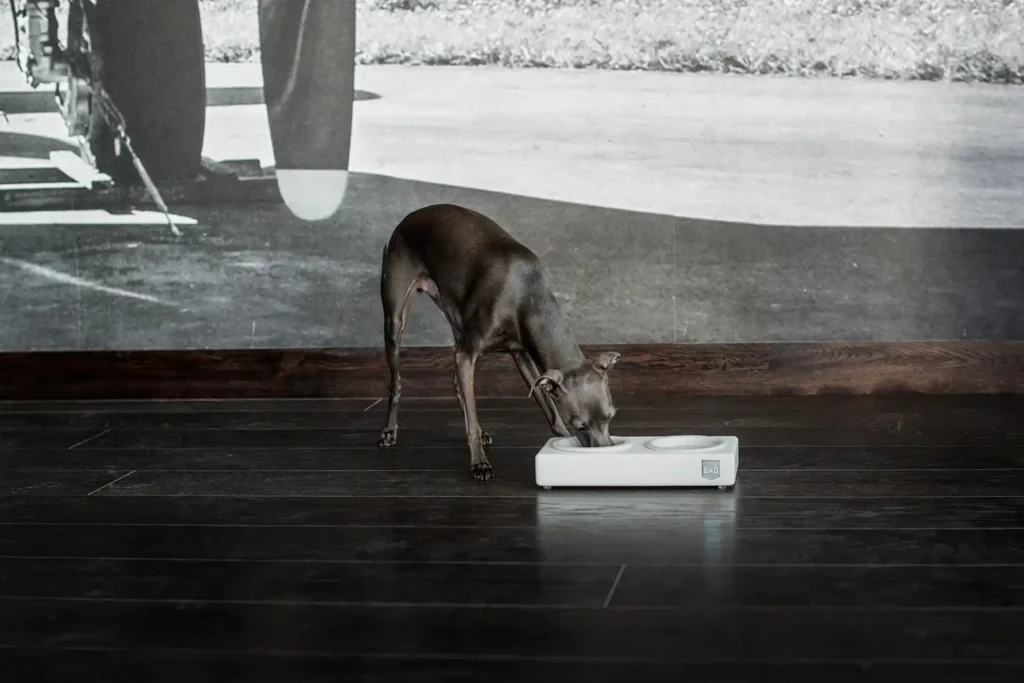
A wooden bowl does not have to be something you want to hide away once your dog has finished eating. Natural material, minimalist form and careful finishing make a Bowl&Bone Republic bowl an elegant addition to your interior. It can remain in the kitchen or living room and complement your home, while the PREMIUM quality of the product is noticeable from the very first glance.
Silicone non-slip feet – a more stable bowl during meals
Appearance should never come at the expense of functionality. That is why Bowl&Bone Republic bowls feature silicone non-slip feet, which help keep the wooden structure in one place.
While eating, many dogs press against the insert with their muzzle, move their food around or energetically try to reach the final pieces of their meal. With a lightweight bowl without any stabilising feature, this can result in the bowl travelling across the floor together with the dog.
The non-slip feet help reduce this problem and improve product stability. For the dog, this means more comfortable and calmer eating without having to follow a moving bowl. For the guardian, it means less sliding across the floor, less noise and greater convenience in everyday use.
These are exactly the kinds of details that reflect our approach to design. A product should look attractive, but at the same time it should be comfortable for the dog and practical for their guardian.
Bowl&Bone Republic bowls with metal and ceramic inserts
If you particularly value insert durability, take a look at the DUO chestnut dog bowl. The model combines a structure made from natural wood with stainless-steel inserts that can easily be removed for cleaning. Silicone feet help keep the bowl in place during meals.

For the dog, this means a stable and comfortable place to eat, while for the guardian it combines durability, easy care and an elegant, high-quality product. The natural wood also means that every piece has its own grain pattern and does not look like an identical mass-produced object made from a wood-effect material.
If you prefer ceramic, an alternative is the DUO CERAMIC jasmine dog bowl. The ceramic inserts can be conveniently removed for cleaning, while the natural wood creates an elegant and solid base for the entire product. Here too, the non-slip feet help limit movement while the dog is eating.
The combination of natural wood and ceramic inserts creates a distinctive visual effect. The product remains a practical accessory your dog needs every day, but at the same time it can become an interior detail that you deliberately choose to keep on display.
Bowl&Bone Republic offers SOLO and DUO bowl lines in different colour options and with different types of inserts. Regardless of the version you choose, the common elements remain natural wood, high-quality craftsmanship, stability in everyday use and design created to serve the dog while also enhancing the guardian’s home.
Which dog bowl insert should you choose?
We believe that both a metal and ceramic dog bowl insert can be a very good choice when the product is of suitable quality and meets the needs of a particular dog. The option you choose should depend on the individual preferences of your four-legged friend.
There is no single answer that will suit every dog. Stainless steel has a significant advantage in terms of resistance to being dropped, while ceramic may be a good choice for a guardian who appreciates its heavier weight, the absence of the characteristic metallic sound and its elegant appearance.
Our almost 15 years of experience designing high-quality dog accessories, hundreds of conversations with dog guardians and feedback from thousands of Bowl&Bone Republic customers show that apparently small details can make a significant difference in everyday use. That is why our bowls combine removable inserts with natural wood and silicone feet that help limit movement while the dog is eating.
For the dog, this means a comfortable and stable place to enjoy a meal, while for the guardian it means a durable, functional and elegant PREMIUM product whose quality can be seen and felt from the very first contact. Natural wood also means that every bowl has its own character and is slightly different from every other piece.
Which type of insert would work best for your dog? The most important thing is to choose a solution that is comfortable for your dog, easy to keep clean regularly and well suited to your everyday lifestyle together.
If you would like to learn more about other materials used in dog bowls, you can also read our guide “Dog bowl – does the material it is made from matter?”. I have left this title without a link because I could not confirm an English counterpart of the Polish article on bowlandbone.com.
For more advice on choosing dog accessories thoughtfully, visit the Bowl&Bone Republic blog. You can also discover our dog bowls: Dog bowls on bowlandbone.com, designed with your dog’s exceptional comfort, their guardian’s convenience, outstanding craftsmanship and timeless design in mind.
– the Bowl&Bone Republic team
FAQ – the most frequently asked questions about the article: Dog bowl with a metal or ceramic insert – which should you choose?
Which dog bowl is better – one with a ceramic or metal insert?
There is no single option that is best for every dog. A stainless-steel insert is highly resistant to accidental damage and easy to clean, while a ceramic insert is heavier and does not produce the characteristic metallic sound when it comes into contact with a metal ID tag. In both cases, you should choose a good-quality product and clean the insert regularly. [1][2][3]
Is a dog bowl with a metal insert a good choice?
Yes, a good-quality bowl with a stainless-steel insert can be a very good option for most dogs. This type of insert is durable, resistant to accidental damage and easy to clean regularly. [1]
What are the disadvantages of a metal dog bowl insert?
One practical disadvantage may be the metallic sound produced when an ID tag or other metal component of the collar strikes the insert. For most dogs, this will not be a problem, but it is worth observing the reaction of a particularly sound-sensitive dog.
Can a dog be allergic to a metal bowl insert?
Contact hypersensitivity to particular materials is possible, but you should not assume that every skin change around the muzzle is caused by a metal insert. Recurring redness, itching or other skin changes are best discussed with a veterinary surgeon. [5]
Is a dog bowl with a ceramic insert safe?
Yes, a bowl with a good-quality, undamaged ceramic insert intended for contact with food can be a safe choice. Its surface should be checked regularly and the insert replaced if cracks or significant chips appear. [1]
What should I do if a ceramic insert cracks or chips?
The safest option is to stop using it and replace it with a new one. A damaged surface can be harder to clean thoroughly, while sharp edges may present a risk during everyday use.
Why does my dog refuse to eat from a bowl with a metal insert?
There are several possible reasons. A dog may be bothered by the sound of an ID tag hitting the steel, by the bowl moving or by other aspects of the feeding area. If your dog has suddenly lost their appetite in other situations as well, however, it is worth ruling out a health-related cause.
How often should I clean a dog bowl insert?
The U.S. Food and Drug Administration (FDA) recommends washing dishes used for pet food with soap and hot water after each use. An insert used for water also requires regular cleaning. [4]
Can a dog bowl insert be washed in the dishwasher?
This depends on the specific product and the manufacturer’s instructions. Stainless-steel and ceramic inserts used in selected Bowl&Bone Republic bowls are suitable for dishwasher cleaning. The wooden structure should be cared for in accordance with the instructions for the particular product.
Does the material of the insert affect the number of bacteria?
The material may matter, but it is not the only factor affecting the microbiological contamination of a bowl. Research also indicates the importance of food type and cleaning method and frequency. Regular hygiene of the insert therefore remains fundamental. [2][3]
Is a ceramic insert better for a dog that is sensitive to sounds?
It may be more comfortable if a particular dog reacts to the metallic sound of an ID tag striking a steel insert. However, it is worth checking first whether that specific sound is actually the source of the dog’s discomfort.
Which dog bowl insert is the most durable?
In terms of resistance to accidental drops and impacts, stainless steel has an advantage over ceramic. A ceramic insert can also last for a very long time, but it requires greater care when being removed, carried and washed. [1]
Which bowl insert should I choose for a puppy – ceramic or metal?
Both options can work well. For a very energetic puppy, the high resistance of stainless steel to accidental damage is a practical advantage. In addition to the material, it is also worth choosing an appropriate size and overall bowl design.
Why are Bowl&Bone Republic bowls made from natural wood?
Natural wood combines durability, a pleasant tactile quality and timeless appearance. Its natural grain also means that every bowl is slightly different and has its own individual character. As a result, the product is not simply a dog accessory but also an elegant element of the home interior.
Does a wooden Bowl&Bone Republic bowl move while a dog is eating?
Bowl&Bone Republic bowls feature silicone non-slip feet designed to limit movement across the floor. This increases stability during meals and allows the dog to use the bowl more comfortably.
Sources and inspiration used to write the article
“Dog bowl with a metal or ceramic insert – which should you choose?”
- American Kennel Club, “Finding the Right Dog Bowl for Your Dog” – a resource covering different types of dog bowls and the properties of stainless steel, ceramic, plastic and other materials used in their manufacture.
https://www.akc.org/expert-advice/nutrition/choosing-right-dog-bowl/ - Raspa F., Schiavone A., Pattono D. et al., “Pet feeding habits and the microbiological contamination of dog food bowls: effect of feed type, cleaning method and bowl material”, BMC Veterinary Research, 2023 – a study used to discuss the influence of cleaning method, food type and bowl material on microbiological contamination.
https://link.springer.com/article/10.1186/s12917-023-03823-w
DOI: 10.1186/s12917-023-03823-w - Luisana E., Saker K., Jaykus L-A., Getty C., “Survey evaluation of dog owners’ feeding practices and dog bowls’ hygiene assessment in domestic settings”, PLOS ONE, 2022 – a study examining guardians’ hygiene practices and the effect of cleaning procedures on bacterial contamination of dog bowls.
https://journals.plos.org/plosone/article?id=10.1371/journal.pone.0259478
DOI: 10.1371/journal.pone.0259478 - U.S. Food and Drug Administration (FDA), “Tips for Safe Handling of Pet Food and Treats” – official guidance on the safe handling of pet food and cleaning bowls and feeding utensils after use.
https://www.fda.gov/animal-veterinary/animal-health-literacy/tips-safe-handling-pet-food-and-treats - Merck Veterinary Manual, “Hypersensitivity Diseases in Animals” – a resource covering hypersensitivity mechanisms in animals, used to discuss possible contact reactions to particular materials cautiously.
https://www.merckvetmanual.com/immune-system/immunologic-diseases/hypersensitivity-diseases-in-animals







 or CANADA
 PLEASE join us at