


Does your pooch love burrowing under their cushions or blanket when they sleep? If your answer is ‘yes’, there is a wonderful alternative to a traditional dog bed that may be just right for them – a dog sleeping bag!
A dog sleeping bag is a particular type of resting place that allows your companion either to lie on a soft surface or slip underneath the upper layer of fabric. Before choosing a specific model, however, it is worth looking at how your dog sleeps, how much space they need and whether they genuinely enjoy resting while wrapped in soft material.

In this guide, we explain which dogs may particularly enjoy a sleeping bag, how to choose the right size, which materials and construction details to look for and how different designs compare. We will also explain when a dog sleeping bag can work as an alternative to a classic dog bed and when it may be better used as an additional resting place.
What will you learn from this article? From this guide, you will learn:
- whether a dog sleeping bag will be suitable for your companion,
- what different types of dog sleeping bags are available,
- how to choose the right size dog sleeping bag,
- which design may work best for a dog who loves burrowing and snuggling in,
- which materials and washing options are worth checking,
- whether a dog sleeping bag can replace a classic dog bed,
- how DREAMY and BLISS dog sleeping bags differ,
- where to buy a lightweight and comfortable dog sleeping bag.
Dog sleeping bag
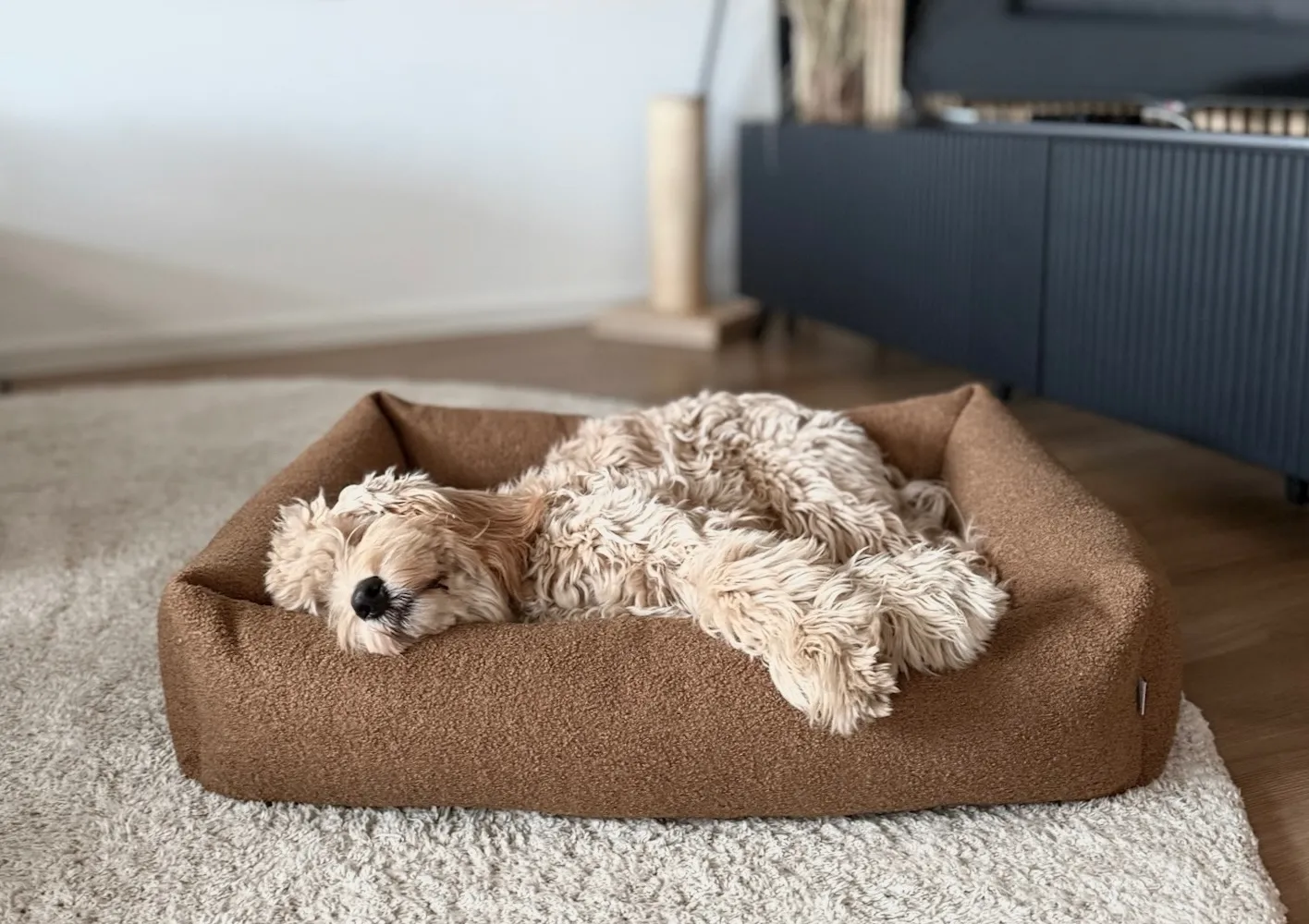
When choosing the right resting place for your companion, it is worth considering options that are slightly less conventional than a standard dog bed. A wonderful alternative is a dog sleeping bag. It is exceptionally comfortable and practical for everyday use. What is more, it can work particularly well for dogs who love burrowing and wrapping themselves up when they sleep. Some dogs especially enjoy the cosy feeling of being surrounded by soft fabric that a sleeping bag-style bed can provide.
This type of dog bed is also exceptionally easy to move around. It can work perfectly both at home and while travelling. A dog sleeping bag combines exceptional comfort with a practical design.
It is worth remembering, however, that not every dog will use one in exactly the same way. One companion may immediately slip underneath the soft layer of fabric, another may initially lie on top of the sleeping bag like a cushion, while another may simply prefer a more open bed. That is why the most important consideration is not your dog’s breed alone, but their everyday resting habits.
Dog sleeping bag – what does the term actually mean?
The term ‘dog sleeping bag’ can refer to products with slightly different constructions. Some resemble a traditional sleeping bag with an opening at one end, while others are designed more like an envelope, a soft cushion with a pocket or a bed made from overlapping layers of fabric.
For this reason, it is better not to base your decision solely on the name of the product. Its actual construction, the size of the resting surface, the type of fabric and whether your dog can easily get inside and come out again independently are much more important.
Throughout this guide, we use the term ‘dog sleeping bag’ to describe this broader category of soft resting places in which a dog can either lie on top or tuck themselves underneath a layer of material.
Will a dog sleeping bag be suitable for your companion?
If your dog regularly squeezes underneath a blanket, burrows into cushions, slips under a throw or chooses places where part of their body is covered, a sleeping bag may suit their preferences particularly well. The American Kennel Club (AKC) notes that dogs may burrow beneath blankets for reasons including warmth, shelter and the appeal of a cosy enclosed space [1].

This does not mean that every dog needs this type of bed. If your companion usually sleeps fully stretched out, chooses a cool floor or quickly emerges from underneath any covering, a more open dog bed or cushion may prove more comfortable.
It is therefore worth spending a few days simply observing where and in which positions your dog naturally chooses to fall asleep. You may also find our guide to what your dog’s sleeping positions can mean helpful.
The characteristics of a dog sleeping bag
There are several types of dog sleeping bags available on the dog accessories market. So how do you choose the right one for your companion? There are several important aspects to consider, always keeping your individual dog’s everyday preferences in mind.
1. First, look at how your dog usually rests
Before comparing sizes and materials, watch your dog when nobody is encouraging them to lie in a particular place. Do they curl up into a ball? Do they seek out a blanket? Do they push their nose between cushions? Or do they do the opposite – stretching their legs out and occupying as much space as possible?
A dog who regularly seeks out something to snuggle into may understand the idea of a sleeping bag more quickly. A companion accustomed to sleeping on an open surface may instead use the sleeping bag primarily as a soft mattress. Both are perfectly fine.
A good resting place should allow your dog to choose how they want to relax. Observing their everyday behaviour can therefore tell you considerably more than general recommendations that assign one type of bed to a particular breed.
2. The design of the sleeping bag
Dog sleeping bags generally come in two main types of construction: closed and open. The first resembles the sleeping bag we know from everyday life. It has an entrance on one side, while the opposite end forms a closed tunnel of fabric.
Another construction used in dog sleeping bags consists of two overlapping sections of material. The advantage of this solution is that the dog can easily slip underneath the fabric while still being able to find their way out without difficulty. Sleeping bags with this type of construction are available from Bowl&Bone Republic in the DREAMY range [4].
The current collection also includes the BLISS model, which has the form of a soft cushion with a section underneath which your dog can tuck themselves and snuggle into the material [5]. This means that before buying, you can match not only the size but also the way in which your dog prefers to use their resting place.

3. Which size dog sleeping bag should you choose?
Size matters even when the sleeping bag is soft and flexible. Your dog should be able to settle comfortably, turn around and come out from underneath the upper layer of fabric. For this reason, it is better not to choose a sleeping bag solely according to your dog’s weight or breed.
The best approach is to measure your dog in their natural resting position and see how much space they occupy when curled up and when slightly stretched out. If you would like to do this more precisely, take a look at our guide ‘How to choose the right size dog bed? Complete guide’ [7].
DREAMY and BLISS are currently available in size S at 50 × 50 cm, M at 70 × 70 cm and L at 85 × 85 cm, as well as in made-to-measure versions [4][5]. When comparing sizes, always check on the individual product page whether the stated measurements refer to the external dimensions or the actual resting area.
If your companion falls between standard sizes or has unusual proportions, automatically choosing the larger option is not always necessary. In some cases, an individually tailored size may be a better solution. You can find more information in our article ‘Made-to-measure dog bed — is it worth it? Pros, cons and practical tips’.
4. The material of a dog sleeping bag
A dog sleeping bag will usually consist of two different types of material. The outer layer should be made from a fabric that is reasonably resistant to everyday dirt while remaining soft enough for your dog to lie on comfortably. The inside is generally made from an exceptionally soft and pleasant-to-touch material. Dogs often love sleeping bags precisely because they can snuggle into their soft interior and enjoy a nap hidden away from the rest of the world.
When choosing a sleeping bag for your companion, make sure that its interior feels soft and gentle. It is also worth checking the composition of the materials and the manufacturer’s information regarding quality and care.
The current DREAMY and BLISS sleeping bags use, among other materials, polyester (PES), and the product pages state that the materials meet OEKO-TEX STANDARD 100 requirements [4][5]. OEKO-TEX describes STANDARD 100 as a certification system for textiles tested for harmful substances [3].
For a dog guardian, this provides considerably more useful information than a general statement such as ‘high-quality material’. When buying, it is therefore worth checking not only how the fabric looks, but also its composition, intended use and care instructions.
5. Check how the sleeping bag can be washed
When choosing the right dog sleeping bag, check whether it can be washed in a washing machine. This is an exceptionally convenient solution. It also makes it easier to keep your dog’s accessories clean, hygienic and in excellent condition. Remember, however, to follow the manufacturer’s washing instructions. Otherwise, the sleeping bag may lose its shape and the fabric may lose some of its original properties.
For the current DREAMY and BLISS models, the care instructions allow hand washing or machine washing on a gentle cycle at temperatures up to 30°C. The manufacturer also recommends avoiding chlorine, bleach and dry cleaning, and ensuring that the bed is thoroughly dried after washing [4][5].
It is worth checking these instructions for the specific model before purchasing, as care requirements can vary between products. In everyday life, easy cleaning often proves just as important as the appearance of the bed.
6. Consider how much warmth your dog needs
A sleeping bag can be particularly appealing to dogs who actively seek additional warmth and something soft to snuggle into. Some short-haired dogs, puppies and senior dogs may more frequently choose warmer resting places, although the temperature inside your home and the individual preferences of your particular dog should always be taken into account [2].
Most importantly, your dog should be able to decide whether they want to tuck themselves beneath the material or lie on top of it. If your companion sleeps underneath a covering, they should be able to get out freely. Material that is too heavy or arranged too tightly may make it more difficult for them to change position [1].
A dog sleeping bag intended for use at home should not automatically be treated as a technical outdoor sleeping bag with a specified temperature rating. If you are planning to sleep outdoors with your dog, you will need a product designed specifically for the relevant weather conditions and type of use.
7. Design matters too
There is no denying that we often pay attention to the design of the accessories we choose for our dogs. A dog bed becomes a permanent feature of our home, so naturally we want it to work beautifully with the rest of our furniture and décor. A dog sleeping bag should not only be comfortable and well suited to your companion’s needs. It is also worth choosing a stylish, thoughtfully designed model that you will enjoy seeing in your home every day.
DREAMY dog sleeping bags are currently available in several colour options, while the collection also includes various colours of the BLISS model [6]. Grey dog beds remain particularly popular, although it is certainly worth exploring the other shades available. A broad colour palette makes it easier for every dog lover to find a version that suits their expectations.
The outer fabric of the DREAMY sleeping bag features elegant, symmetrical stitching that forms a diamond pattern. The inside is made from an exceptionally soft and fluffy fabric. The overall effect is stylish and refined. BLISS, meanwhile, has a softer, more cushion-like form, so the two designs create a slightly different look within an interior.
8. Think about where your dog will use the sleeping bag
A sleeping bag can serve as an additional resting place in the living room, bedroom or home office. It can also be useful while travelling when you want to bring along a lightweight resting place that your dog already knows.
This type of dog bed is also exceptionally easy to move. It works well both at home and while travelling. If the sleeping bag will often accompany you on trips, consider not only its dimensions when unfolded but also its weight, how easily it folds, how simple it is to clean and how much room it takes up in your luggage.
A familiar bed can also help you create a recognisable resting place for your dog in a hotel, holiday cottage or while visiting family. The scent of familiar material and the opportunity to rest in their own space can become part of your companion’s everyday routine.
DREAMY or BLISS – which dog sleeping bag should you choose?
Both models are designed for dogs who enjoy soft resting places and the option of tucking themselves underneath a layer of fabric, although their constructions differ [4][5][6].
| Feature | DREAMY | BLISS |
|---|---|---|
| Construction | a more envelope-like design with overlapping layers | a softer, more cushion-like form with a section underneath which the dog can hide |
| Resting style | the dog can lie on top or slip between the layers | the dog has soft cushioning together with the option of snuggling underneath the material |
| Standard sizes | S 50 × 50 cm, M 70 × 70 cm, L 85 × 85 cm | S 50 × 50 cm, M 70 × 70 cm, L 85 × 85 cm |
| Made to measure | yes | yes |
| Care | hand wash or gentle machine cycle up to 30°C | hand wash or gentle machine cycle up to 30°C |
| Which dog may prefer it? | worth considering for a dog who enjoys an envelope-like design and burrowing between layers | worth considering for a dog who prefers softer, more cushion-like resting places |
There is no single answer as to which model is better. The best choice will be the one whose construction most closely resembles the types of resting places your dog naturally chooses for themselves.

Advantages of a dog sleeping bag
One unquestionable advantage of a dog sleeping bag is its light weight and ease of carrying and transporting. You can move it around the home effortlessly. What is more, thanks to its relatively flat form, it can look good both on the floor and on the sofa. The material from which a sleeping bag is made should be soft enough to give your dog a comfortable place to rest even when the bed is placed directly on a flat surface.
The fact that a sleeping bag can be folded easily also makes it particularly useful when travelling. You can fit it into a bag or suitcase without difficulty and set off on a trip with your beloved companion. This can be especially valuable if your dog does not cope particularly well with a change of environment, even a temporary one. In this situation, a familiar sleeping bag and its scent can provide one element of an environment your dog already knows.
A dog sleeping bag is particularly well suited to dogs who enjoy being wrapped in their bedding while they sleep. A sleeping bag performs this role perfectly. It gives your dog the opportunity to hide in a cosy place and rest in the way they choose. Wrapped in soft, pleasant-to-touch material, your companion can settle down for a peaceful nap, provided they can always change position freely and leave the sleeping bag whenever they wish.
Dog sleeping bag or classic dog bed – which should you choose?
You do not always have to choose only one of these options. A classic dog bed can be your companion’s main sleeping place, while a sleeping bag can provide an additional resting area for moments when they want to snuggle in or relax closer to members of the household.
If your dog enjoys resting their head on a raised side, needs a more stable surface or usually sleeps fully stretched out, a classic dog bed may suit their needs better. If, on the other hand, they regularly seek out blankets and soft little hiding places, a sleeping bag can be a very interesting addition to their resting options.
It is also worth observing whether your dog continues to use the new bed after several days rather than only immediately after it has been unpacked. If your companion consistently avoids their new resting place, our guide ‘Why does your dog not want to sleep in their bed, and how can you encourage them to use it?’ may be helpful.
If you would like to provide your dog with more than one resting area around the home, you can also read ‘How many beds should a dog have? One or several?’.
Where can you buy a lightweight and comfortable dog sleeping bag?
If you are looking for a lightweight and comfortable dog sleeping bag, check its exact dimensions, construction, material composition, care instructions and whether it can be made in a non-standard size before purchasing. It is also useful to look at photographs showing the product both on its own and being used by a dog.
At Bowl&Bone Republic, you can explore the complete collection of dog sleeping bags, including DREAMY and BLISS models in various colours and sizes. If none of the standard dimensions suits your companion’s needs, both collections are also available in made-to-measure versions [4][5].
Do not choose a sleeping bag purely because it looks good in a photograph. The best purchase is one in which attractive design is combined with sufficient resting space, straightforward cleaning and a construction suited to the way your individual dog sleeps.
Which dog sleeping bag should you choose for a small, medium-sized or larger dog?
Your dog’s size is an important consideration when choosing a sleeping bag, but it should not be the only one. Two dogs of a similar weight can rest in completely different ways. One may curl tightly into a ball, while the other stretches out their entire body.
For a small dog, it is particularly worth checking whether the opening is not unnecessarily large and whether your companion can easily find the space beneath the material. For a medium-sized or larger dog, the available surface for changing position becomes increasingly important.
The safest principle is therefore to choose the sleeping bag according to your individual dog’s actual measurements and sleeping style rather than relying solely on labels such as ‘small’, ‘medium’ or ‘large’.
Can a dog sleeping bag be used all year round?
This depends both on the particular product and on the conditions inside your home. A dog may use a sleeping bag throughout much of the year, although the way they use it may change with the temperature.
On cooler days, your companion may more frequently tuck themselves underneath the material, while during warmer weather they may use the sleeping bag mainly as a soft surface to lie on. A construction that allows the dog to decide for themselves whether to lie on top or underneath the material is therefore a practical solution.
Always observe your companion’s behaviour. If they come out from underneath the fabric, pant or clearly seek out a cooler location, they should not be encouraged to remain inside the sleeping bag.

A peaceful sleep for your dog wrapped in a sleeping bag
If you want to help your dog enjoy peaceful, undisturbed rest, the first thing to provide is an appropriate place to sleep. A dog sleeping bag offers a pleasant feeling of warmth and being gently surrounded by soft fabric, which can support comfortable rest for many dogs. It is a good alternative to a standard dog bed, particularly for companions who enjoy hiding beneath soft materials.
A sleeping bag is also a wonderful option if you are looking for a resting place that can accompany you wherever you go with your canine friend. Most importantly, however, the final choice should be based on observing your own dog: their size, sleeping positions, response to warmth and whether they genuinely seek out something soft to snuggle into.
If your dog rests best when nestled into soft fabric, explore the Bowl&Bone Republic dog sleeping bag collection and compare the available constructions, sizes and colours. If you are still considering which type of resting place best suits the way your companion sleeps, take a look at our collection of dog beds and our other guides to canine rest and sleep.
– the Bowl&Bone Republic team
FAQ, meaning the most frequently asked questions about the article –
How to choose the right dog sleeping bag? 8 things worth checking before you buy
How do you choose the right dog sleeping bag?
Start by observing the way your dog rests. If they enjoy burrowing underneath blankets and wrapping themselves in soft material, a sleeping bag may suit their preferences well. Then check the size, construction, material, washing instructions and whether your dog can enter and leave freely.
Which size dog sleeping bag should you choose?
Measure your dog in their natural resting position and compare their measurements with the actual dimensions of the product. Do not choose the size solely according to weight or breed. Your dog should be able to settle comfortably, turn around and independently come out from underneath the material.
Which dogs are most likely to enjoy a sleeping bag?
A sleeping bag may particularly appeal to dogs who actively seek something to snuggle into: those who crawl under blankets, burrow into cushions or choose soft, partially enclosed resting places. Not every dog will enjoy resting in this way, however.
Can you wash a dog sleeping bag in a washing machine?
It depends on the particular model. According to the current care instructions, Bowl&Bone Republic DREAMY and BLISS sleeping bags can be washed by hand or in a washing machine on a gentle cycle at temperatures up to 30°C [4][5]. Always check the information on the product page and care label.
Is a dog sleeping bag suitable for winter?
A sleeping bag can provide additional cosiness indoors, especially for dogs who naturally seek out warmer places. You should not assume, however, that every indoor dog sleeping bag is a technical sleeping bag designed for outdoor use in low temperatures.
Can a dog sleeping bag replace a dog bed?
Yes, provided your dog is comfortable using it and has enough room to rest freely. In many homes, however, a sleeping bag also works very well as an additional resting place alongside a classic bed, cushion or mat.
What is the difference between DREAMY and BLISS dog sleeping bags?
DREAMY has a more envelope-like construction and allows your dog to slip between overlapping layers of material. BLISS has a softer, more cushion-like form with a section underneath which your dog can tuck themselves. Both models are available in sizes S, M and L and can also be made to measure [4][5].
Where can you buy a lightweight and comfortable dog sleeping bag?
It is worth choosing a shop that provides exact dimensions, material composition, washing instructions and clear information about the product’s construction. Bowl&Bone Republic offers DREAMY and BLISS dog sleeping bags in various sizes and colours.
Can you order a made-to-measure dog sleeping bag?
Yes. Bowl&Bone Republic offers DREAMY and BLISS dog sleeping bags made to individual dimensions. Details should always be checked on the current page for the particular product [4][5].
Can a dog sleep completely hidden inside a sleeping bag?
If your dog chooses this position themselves, the most important thing is that they can breathe freely, change position and come out independently. The material should not restrict their exit or make it difficult for them to change resting position [1].
Can a dog sleeping bag be used in summer?
Yes, although much depends on the temperature indoors and the individual dog’s preferences. On warmer days, your companion may use the sleeping bag primarily as a soft mattress without tucking themselves underneath the fabric.
What is a dog sleeping bag?
A dog sleeping bag is a soft resting place that allows a dog to lie on top of the material or tuck themselves underneath part of it. Individual models can differ considerably in their construction, so when choosing one, it is worth checking its size, materials and how easily your dog can enter and leave.
Sources and inspiration used to create the article
How to choose the right dog sleeping bag? 8 things worth checking before you buy
- American Kennel Club (AKC), ‘Why Does My Dog Crawl Under the Covers?’ – material discussing why dogs may crawl underneath blankets and covers, as well as considerations for resting safely beneath material.
https://www.akc.org/expert-advice/advice/dog-crawl-under-covers/ - American Kennel Club (AKC), ‘Does My Dog Need a Blanket?’ – material discussing additional warmth, comfort and situations in which some dogs may be more inclined to use a blanket or soft covering.
https://www.akc.org/expert-advice/home-living/dog-blankets/ - OEKO-TEX®, ‘OEKO-TEX® STANDARD 100’ – the official description of the standard for textiles tested for harmful substances; used to explain the significance of STANDARD 100 information in relation to materials.
https://www.oeko-tex.com/en/our-standards/oeko-tex-standard-100 - Bowl&Bone Republic, ‘Dog sleeping bag DREAMY grey’ – current information about sizes, materials, care, construction and the option of having a DREAMY model made to measure.
https://www.bowlandbone.com/dog-sleeping-bag-dreamy-grey/ - Bowl&Bone Republic, ‘Dog sleeping bag BLISS cream’ – current information about sizes, filling, care and the option of having a BLISS model made to measure.
https://www.bowlandbone.com/dog-sleeping-bag-bliss-cream/ - Bowl&Bone Republic, ‘Dog sleeping bags’ – category page used to compare the current DREAMY and BLISS ranges and available sleeping bag variants.
https://www.bowlandbone.com/dog-sleeping-bag/ - Bowl&Bone Republic, ‘How to choose the right size dog bed? Complete guide’ – a guide to measuring your dog and matching the available resting area to their size and resting style.
https://www.bowlandbone.com/how-to-choose-the-right-size-dog-bed-complete-guide/ - Bowl&Bone Republic, ‘Dog’s sleeping positions’ – material discussing canine resting positions, the use of blankets and observing a dog’s individual preferences during sleep.
https://www.bowlandbone.com/dogs-sleeping-positions/









 or CANADA
 PLEASE join us at