


Your dog wakes up after a nap, slowly gets out of their bed, stretches their front legs far out in front, lowers their chest and keeps their bottom raised for a moment. A few seconds later, they straighten up, perhaps stretch their hind legs too, and follow you into the kitchen. Sound familiar? Stretching is one of those canine behaviours we see almost every day, yet it can still make us wonder whether our dog is trying to tell us something.

It becomes particularly interesting when your dog stretches as soon as they see you, repeats the movement several times or adopts a position that looks very similar to a bow. Most of the time, however, the explanation is simple. A dog may stretch after resting, before becoming active or during play. Stretching itself does not automatically mean pain or illness. What matters much more is when your dog does it, what the rest of their body looks like and what happens immediately before and after the behaviour.
There is, however, one important exception. A position in which the front legs and chest are lowered while the hindquarters remain raised can look almost identical to natural stretching or an invitation to play. If your dog holds this position, repeatedly returns to it and at the same time appears unwell or in pain, it may be the so-called prayer position associated with abdominal pain [3][5]. Instead of trying to translate a single movement as if it were one word, it is therefore much better to look at the entire “sentence” being communicated by your dog’s body.
What will you learn from this article? From this guide, you will learn:
- why a dog stretches after sleeping,
- what it may mean when a dog stretches when they see you,
- how ordinary stretching differs from a play bow,
- why a dog may extend their front legs and keep their bottom raised,
- what the so-called prayer position in dogs looks like,
- when frequent stretching may require consultation with a veterinary surgeon,
- what extending and stretching the hind legs may mean,
- why it is worth observing how your dog gets up after resting,
- which additional signs may indicate pain or stiffness,
- how to give your dog enough space for comfortable rest.
Why does a dog stretch?
There is no single answer that applies to every dog and every situation because a very similar movement can have completely different meanings. Context is always the best clue. If your dog has just woken up after a longer nap, stretches calmly, then walks normally and behaves exactly as usual, you are most likely seeing a normal part of the transition from rest to activity.
If, however, your dog is running around with another dog, suddenly stops, lowers the front of their body and then resumes the chase, it is very likely to be a play bow. Research into canine behaviour indicates that play bows often occur in connection with pauses in interaction and may be involved in restarting play [1][2]. In this situation, the meaning of the movement is suggested not only by the dog’s posture itself, but also by what they were doing moments earlier and how they behave immediately after the bow.
A dog who repeatedly assumes a similar posture, appears tense, does not want to eat, vomits, has diarrhoea or cannot settle needs to be viewed differently. In this situation, the resemblance to ordinary stretching can be misleading. The most important principle is therefore simple: do not interpret stretching in isolation from your dog’s overall behaviour.
The most common meanings of stretching in dogs
| When does the dog stretch? | What might it mean? | What should you observe? |
|---|---|---|
| after waking up | natural stretching after rest | whether they move freely afterwards |
| before a walk or another activity | transition from rest to movement | gait and general behaviour |
| during play | a play bow | relaxed body, dynamics of movement, the other dog’s response |
| when they see their guardian | part of getting up, greeting or inviting interaction | what the dog does immediately afterwards |
| much more frequently than usual | possible discomfort or stiffness | limping, difficulty getting up, changes in movement |
| with the front of the body lowered and clear tension | possible prayer position | vomiting, diarrhoea, abdominal pain, restlessness, loss of appetite |
Why does a dog stretch after sleeping?
This is probably the situation in which guardians observe stretching most often. A dog may spend several dozen minutes or even a few hours lying on their side, curled up or with their legs tucked under their body. When they wake up and decide to get up, they often extend their front legs first, lower the front of the body and then straighten up. Some dogs also separately stretch one hind leg and then the other.
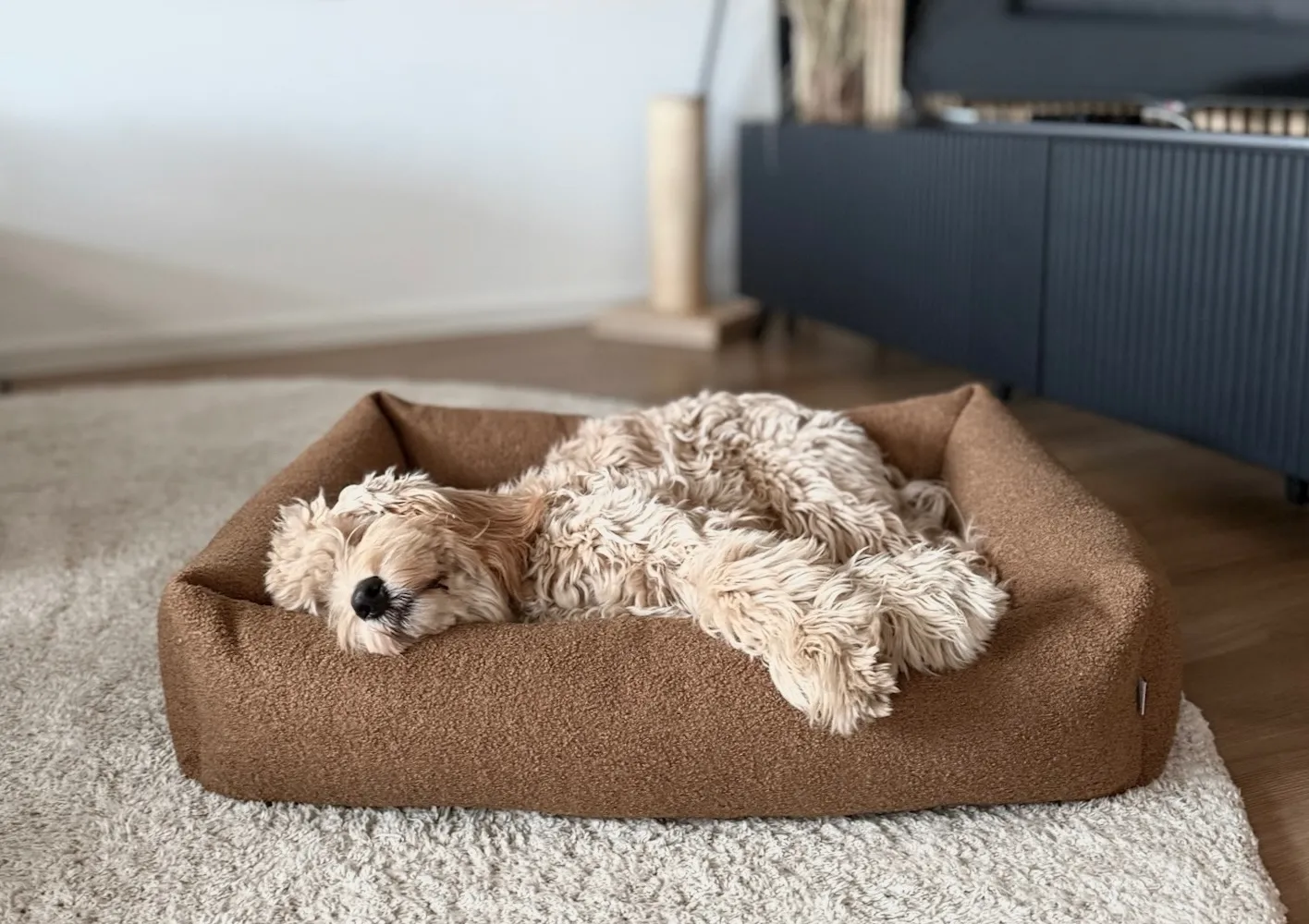
If your dog moves normally a moment later, does not limp, is not noticeably stiff and has no difficulty returning to their usual activities, there is no need to attach a special meaning to every stretch. It is also worth considering the place where your dog rests, because they should be able to change position freely and fully extend their body. If your dog likes sleeping fully stretched out, a dog bed that is too small may limit the space available to them.
It is therefore worth considering your dog’s stretching together with the position in which they normally sleep. One dog almost always curls tightly into a ball, while another takes up every available centimetre and extends their legs far in front of them. You can read more about the different ways our four-legged friends rest in our article Dog’s sleeping positions.
What does it mean when a dog stretches when they see you?
You return home or walk into a room. Your dog notices you, gets up from their resting place and almost immediately performs a long stretch. It is easy to think this is a special greeting behaviour, but it is worth being cautious about giving it one fixed meaning.
If your dog was sleeping or resting moments earlier, they may simply be getting up, stretching and only then coming over to you. If they subsequently bring you a toy, perform an energetic bow, bounce away or start running, the stretch may have been part of their transition into a shared activity. There is therefore no need to interpret every such behaviour as a coded message such as “I love you”.
It is much more useful to observe the whole sequence: your dog notices you, gets up, stretches, approaches you, wags their tail, picks up a toy or moves towards the door. Only this wider context allows you to understand their intention more accurately. If you would like to learn how to pay attention to other elements of canine posture as well, read our guide Dog body language – calming signals.
A dog extends their front legs and raises their bottom – do they want to play?
Very often, yes. The position in which a dog lowers the front of their body, stretches their legs forwards and keeps their hindquarters raised is the characteristic play bow. It is one of the most recognisable elements of canine social communication, although here too it is important to look at the entire situation rather than simply the shape of the body.
Research into the behaviour of adult dogs has shown that bows occur in connection with pauses in play and may be followed by further active interaction [1]. A similar function of the bow has also been studied in puppies [2]. During a typical play bow, the dog’s body is usually dynamic – they may bounce away a moment later, start running, perform another bow, bark or encourage another dog or person to move.
The important thing is not the shape of the body alone, but what happens immediately before and after the bow. Bowl&Bone Republic also has a separate guide devoted specifically to this behaviour: “Dog bow – what does this posture mean?”. If your dog brings you a tug toy after bowing or waits for you to join in, you can channel that energy into play using suitable dog toys, such as the BULLET yellow dog toy.

Stretching vs a play bow – how can you tell the difference?
At first glance, ordinary stretching and a play bow can look almost identical. In both cases, the dog may extend their front legs, lower their chest and keep the rear part of their body raised. The difference often only becomes clear when you look at the dynamics of the movement and the situation in which the behaviour occurs.
Ordinary stretching after rest is usually a single, calm movement. The dog gets up, extends their body, straightens and moves on to the next activity. A play bow, on the other hand, occurs in a social context – the dog watches another dog or person and often immediately moves, bounces away or continues playing after the bow.
If you are not sure what you are seeing, ask yourself three simple questions: what was your dog doing a few seconds earlier, what does their whole body look like and what do they do a few seconds later? These brief moments of context often tell you much more than the posture alone. They also make it considerably easier to avoid assigning the same meaning to every similar-looking movement.
My dog stretches frequently – is that normal?
If your dog has always stretched after every nap and continues to do so in exactly the same way, it is probably simply one of their habits. What deserves more attention is a sudden change in the frequency or way they stretch. It is particularly important to notice whether other changes in your dog’s behaviour or movement have appeared at the same time.
Look for stiffness after rest, limping, slower walking, difficulty getting up, reluctance to use stairs or jump onto the sofa. Frequently changing position, whining when getting up or becoming reluctant to be touched may also be relevant. Cornell University College of Veterinary Medicine lists changes in posture, stiffness, limping and difficulty getting up among possible signs of pain [4].
People’s Dispensary for Sick Animals (PDSA) also notes that stiffness after rest may accompany problems affecting the limbs, spine or joints [6]. Frequent stretching on its own is not enough to diagnose a problem involving the joints, muscles or spine. If, however, the behaviour has appeared suddenly and is accompanied by a change in the way your dog moves, it is worth discussing this with a veterinary surgeon.
Why does an older dog often stretch after getting up?
With a senior dog, it is particularly important to observe what happens immediately after rest. PDSA notes that with joint problems, stiffness may be more noticeable after lying down or after a walk [6]. Cornell also lists difficulty getting up, changes in gait and reluctance to move among possible signs of osteoarthritis [4].
This does not, of course, mean that every older dog who has a long stretch in the morning has joint disease. It is best to compare your dog’s behaviour primarily with their own normal pattern. If they previously got up in one smooth movement but now remain stiff for several seconds, struggle to take their first few steps or begin avoiding activity, it is worth consulting a veterinary surgeon.
The surface on which your dog rests can also matter in everyday life. At Bowl&Bone Republic, you will find a separate collection of orthopedic dog beds, including the HARMONY cream orthopedic dog bed. This type of bed can form part of a comfortable resting environment, but it does not replace diagnosis or treatment of pain, stiffness or musculoskeletal disease.

A dog stretches their hind legs – what does it mean?
Some dogs perform a very characteristic sequence after getting up. First, they stretch the front part of their body, then straighten up and extend one hind leg followed by the other. If your dog has always done this, the movement is smooth and symmetrical, and they subsequently walk, run and jump without difficulty, this behaviour alone does not necessarily provide any reason for concern.
It is worth paying closer attention if your dog consistently protects one limb, begins holding it up, limps after getting up or is reluctant to bend a particular joint. A clear response to touch or a noticeable change in the way they walk may also be significant. PDSA points out that limping and stiffness can have many different causes – from minor injuries to problems affecting the joints, muscles, ligaments or spine [6].
You should therefore not try to determine the cause of a problem at home based solely on your dog extending a leg. What matters much more is whether their movement has changed compared with their usual behaviour and whether other signs are present. If you are unsure, recording the way your dog gets up and walks can be useful during a veterinary consultation.
Can a dog stretch after an active day?
After a long walk, play session or trip, a dog may rest, have a nap and stretch when they get up in exactly the same way as after any other sleep. Stretching after activity does not therefore necessarily mean overexertion or pain. What matters much more is how your dog moves afterwards and whether their gait differs from normal.
It is worth paying more attention to stiffness, limping, clearly protecting a limb or difficulty getting up. These signs should not automatically be dismissed with the assumption that the dog “just needs to loosen up”. If your dog moves noticeably differently after a more active day, observe them carefully and consult a veterinary surgeon if the problem persists.
Good recovery is just as important as activity itself. If you are wondering how to create the right conditions for your dog to recover after a walk, play session or trip, read our guide How to help your dog rest after an active day?.
When can a dog stretching indicate abdominal pain?
This is a particularly important subject because the appearance of the posture can be very misleading. A dog experiencing abdominal pain may assume the so-called prayer position: they extend their front legs, lower the front of the body and keep their hindquarters raised. Seen for only a few seconds, this can look almost exactly like ordinary stretching or a play bow.
PDSA lists this posture among the possible signs of abdominal pain associated with pancreatitis [3]. A similar body position can also occur with other abdominal problems, so the posture alone cannot tell you what is causing it. The dog’s overall behaviour and any additional signs occurring at the same time are what matter most.
How can you tell the prayer position from a play bow?
During a play bow, a dog usually appears actively engaged in interaction. A moment later, they move, bounce away or start playing again, and the entire behaviour is dynamic. A dog in pain may remain in the posture longer, repeatedly return to it, appear restless or look noticeably tense.
Pay particular attention to vomiting, repeated attempts to vomit, diarrhoea, loss of appetite, a painful or tense abdomen and an increase in abdominal size. Excessive drooling, constant pacing, difficulty settling down, weakness or pale gums are also concerning signs. If your dog repeatedly assumes the prayer position and also shows signs of abdominal pain, vomits or appears unwell, contact a veterinary surgeon.
Dog stretching and gastric torsion – when should you act immediately?
Cornell University College of Veterinary Medicine lists the “praying position” as one of the possible signs of gastric dilatation-volvulus (GDV), commonly known as bloat [5]. The posture itself does not, of course, mean that a dog has GDV, so the full clinical picture still matters. This is, however, a situation in which additional signs must never be ignored.
Warning signs may include unproductive attempts to vomit, a suddenly enlarged abdomen, severe restlessness, drooling and panting. Abdominal pain, weakness, collapse or pale gums may also occur [5]. Suspected gastric dilatation-volvulus is an emergency requiring immediate veterinary attention.
Do not wait for your dog to “stop stretching” and do not try to diagnose the problem solely on the basis of information found online. Time is extremely important when GDV is suspected. The appearance of several of these signs at the same time should prompt immediate contact with a veterinary clinic.
How should you observe a dog who has started stretching more often?
If the behaviour does not look like an emergency but you have noticed a clear change, it is worth looking more closely at the pattern. Pay attention to what time of day your dog stretches and whether it happens mainly after sleep, after a walk, before eating or during play. Also observe how many times they repeat the behaviour and whether they place weight on all four legs in a similar way.
The first step your dog takes after getting up can provide a lot of useful information. It is also worth checking whether they still willingly use stairs, jump onto their usual places and whether their appetite, thirst and bowel movements remain unchanged. The more of these small observations you collect, the easier it becomes to judge whether something has genuinely changed.
Recording a short video on your phone can also be useful. Dogs do not always behave in a veterinary clinic exactly as they do at home, which means footage showing their natural way of getting up or walking can be very helpful. Cornell notes that photographs, videos and notes showing a dog’s behaviour in their normal environment can support the assessment of possible pain [4].
Does the dog bed matter if your dog likes to stretch out?
A dog should be able to position themselves comfortably in their resting place. If your dog loves sleeping on their side with their front and hind legs extending almost in opposite directions, they need more surface area than a dog who always curls tightly into a ball. When choosing a dog bed, you should therefore not look only at your dog’s weight or breed.
Observe how much space your dog actually uses when resting and stretching their body. A properly sized bed should allow them to extend their legs, lie on their side, turn around, change position and get up freely. The dimensions of a dog bed should therefore reflect not only the dog’s size when standing but, above all, the amount of space they need while sleeping.
If your dog regularly sleeps with part of their body outside the bed, it does not necessarily mean that they dislike it. The bed may simply be too small for the way they naturally prefer to rest. When choosing the next one, it is therefore worth considering their actual sleeping posture rather than relying only on general recommendations based on breed or body weight.
Your dog does not communicate with a single gesture
Stretching is a very good example of why canine body language should not be interpreted using a simple dictionary. We cannot automatically assume that stretching means contentment, that every bow means play or that every posture with the hindquarters raised indicates pain. The same elements of body posture can appear in completely different situations.
A much better approach is to observe the movement, context, the rest of the body and the dog’s behaviour both before and after the gesture. Movement + context + the rest of the body + behaviour before and after the movement = a much more complete picture. This approach is far more useful than assigning one fixed meaning to individual positions.
A dog who stretches after a nap and calmly walks into the kitchen is communicating something very different from a dog who has been restless for an hour, refuses food and repeatedly assumes a posture with their chest close to the floor. The better you know your own dog’s everyday behaviour, the easier it becomes to recognise that difference. A change from what is normal for that particular dog is often the most valuable piece of information.
What does it mean when a dog stretches? Summary
Most often, stretching is simply part of a dog’s normal everyday movement: it appears after rest, during the transition into activity or during play. If your dog extends their front legs, keeps their hindquarters raised and then immediately bursts into energetic play, you may be seeing a characteristic play bow. If they stretch after waking up and then move freely and behave normally, there is usually no need to search for a hidden message in the behaviour.
Pay closer attention when the way your dog stretches suddenly changes, when they do it unusually often or when stiffness, limping, difficulty getting up or other signs of pain appear. A posture resembling a bow becomes particularly significant when it is accompanied by gastrointestinal signs, abdominal pain, vomiting or marked restlessness. In such cases, the dog’s overall behaviour matters far more than the movement alone.
Everyday rest and play are good opportunities simply to observe how your dog moves. If you are looking for a comfortable resting space for them, explore our dog beds and orthopedic dog beds. And when stretching turns into an enthusiastic play bow and an invitation to enjoy an activity together, take a look at our collection of dog toys.
– the Bowl&Bone Republic team
FAQ – frequently asked questions about –
What does it mean when a dog stretches? How to tell stretching, a play bow and a pain posture apart
Why does a dog stretch?
Most often, a dog stretches after resting, while transitioning into activity or during play. The meaning depends on the context and on how the dog behaves before and after stretching. If the movement is normal for your dog and they move normally afterwards, there is usually no reason for concern.
What does it mean when my dog stretches next to me?
If your dog has just got up from their resting place, stretching beside their guardian may simply be part of getting up and beginning an interaction. If they then bounce away, bring a toy or perform a dynamic bow, they may also be transitioning into play. It is best to observe the dog’s complete behaviour rather than interpreting the stretch alone.
Why does a dog stretch after sleeping?
Dogs often stretch their body when getting up after rest. If your dog walks normally afterwards, does not limp and is not noticeably stiff, this is usually a natural part of their everyday behaviour. It deserves more attention only if the way they get up changes noticeably.
Does stretching mean that a dog is happy?
You cannot determine this from stretching alone. A relaxed body and normal behaviour after stretching may accompany comfort, but a single movement is not an unambiguous indicator of a dog’s emotions. The entire situation and other elements of body language provide much more information.
What does it mean when a dog stretches their front legs and raises their bottom?
It may be ordinary stretching or a characteristic play bow. If your dog is in a playful context and immediately continues with an activity after bowing, it is probably a play bow [1][2]. If, however, the posture is repeatedly assumed and accompanied by signs of illness, it needs to be interpreted differently.
How can you tell a play bow from the prayer position?
A play bow is usually dynamic and is followed by further activity. A pain-related prayer position may be held or repeated, while the dog may appear tense, restless or show additional signs such as vomiting, diarrhoea or abdominal pain [3][5]. Context is therefore more important than the appearance of the posture alone.
Why does my dog keep stretching?
If frequent stretching is a new behaviour, observe whether stiffness, limping, difficulty getting up, reluctance to move or gastrointestinal signs have also appeared. The frequency of stretching alone cannot identify the cause. A change compared with the individual dog’s previous behaviour is particularly important.
Can frequent stretching mean that a dog is in pain?
It can, but it does not necessarily mean pain. Additional changes such as unusual posture, stiffness, limping, difficulty getting up, sensitivity to touch or restlessness are more significant [4][6]. If stretching has suddenly appeared together with these signs, it is worth having your dog assessed by a veterinary surgeon.
What does it mean when a dog stretches their hind legs?
If your dog does this smoothly after getting up and moves normally afterwards, it may simply be part of their usual stretching routine. More attention is needed if they consistently protect one leg, limp or show signs of pain. In that situation, the stretching movement alone is not enough to identify the cause.
Can an older dog stretch more frequently after resting?
This behaviour may be seen in senior dogs, but it should not automatically be attributed to age. Stiffness after rest, difficulty getting up and changes in gait can be signs of musculoskeletal problems [4][6]. The most important consideration is how the dog’s current movement compares with the way they moved previously.
What is the prayer position in dogs?
It is a posture in which the dog lowers the front part of the body and extends their front legs while keeping the rear part of the body raised. It can look similar to a play bow, but in the context of illness it may indicate abdominal pain [3][5]. The posture itself cannot identify the exact cause.
Can a dog stretch because of abdominal pain?
Yes. PDSA lists assuming the prayer position as one possible sign of abdominal pain, including in dogs with pancreatitis [3]. If the posture is accompanied by vomiting, loss of appetite, abdominal tension or marked restlessness, contact a veterinary surgeon.
Does a dog stretch when their back hurts?
Stretching alone cannot tell you whether a dog has back pain. If, however, your dog is stiff, moves differently from before, has difficulty getting up, is reluctant to jump or reacts painfully when touched, they should be assessed by a veterinary surgeon [4][6]. It is the combination of several signs, rather than one individual movement, that matters.
Does a dog stretch before a walk?
It can happen, particularly if your dog was resting moments earlier. They may simply get up, stretch their body and transition into the activity associated with going for a walk. Stretching before going outside does not necessarily carry any additional meaning.
When does a dog stretching require a visit to the vet?
Consult a veterinary surgeon if stretching suddenly becomes frequent and is accompanied by stiffness, limping, difficulty getting up, loss of appetite, vomiting, diarrhoea or obvious pain. An enlarged abdomen, unproductive attempts to vomit, severe restlessness or weakness are particularly concerning signs. Suspected gastric dilatation-volvulus requires immediate veterinary attention [5].
Sources and inspiration used to write the article
What does it mean when a dog stretches? How to tell stretching, a play bow and a pain posture apart
- Sarah-Elizabeth Byosiere, Julia Espinosa, Barbara Smuts, “Investigating the function of play bows in adult pet dogs (Canis lupus familiaris)” – research into the function of play bows in adult dogs; used to describe the relationship between the play bow and the progression and restarting of play.
https://pubmed.ncbi.nlm.nih.gov/26923096/ - Sarah-Elizabeth Byosiere, Julia Espinosa, Sarah Marshall-Pescini et al., “Investigating the Function of Play Bows in Dog and Wolf Puppies” – research into the use of play bows in dog and wolf puppies; used in the section concerning communication during play.
https://pmc.ncbi.nlm.nih.gov/articles/PMC5199004/ - People’s Dispensary for Sick Animals (PDSA), “Pancreatitis in dogs” – veterinary guidance concerning the signs of pancreatitis, including abdominal pain and dogs assuming the prayer position.
https://www.pdsa.org.uk/pet-help-and-advice/pet-health-hub/conditions/pancreatitis-in-dogs - Cornell University College of Veterinary Medicine, “Recognizing pain in dogs” and “Osteoarthritis” – materials concerning the recognition of pain, changes in posture, stiffness, limping, difficulty getting up and changes in the way a dog moves.
https://www.vet.cornell.edu/departments-centers-and-institutes/riney-canine-health-center/canine-health-topics/recognizing-pain-dogs
https://www.vet.cornell.edu/departments-centers-and-institutes/riney-canine-health-center/canine-health-topics/osteoarthritis - Cornell University College of Veterinary Medicine, “Gastric dilatation volvulus (GDV) or ‘bloat’” – material concerning gastric dilatation-volvulus, its emergency warning signs and the prayer position as one possible sign of abdominal pain.
https://www.vet.cornell.edu/departments-centers-and-institutes/riney-canine-health-center/canine-health-topics/gastric-dilatation-volvulus-gdv-or-bloat - People’s Dispensary for Sick Animals (PDSA), “Limping and stiffness in dogs” – material concerning stiffness after rest, limping, changes in gait and situations that require veterinary consultation.
https://www.pdsa.org.uk/pet-help-and-advice/pet-health-hub/symptoms/limping-and-stiffness-in-dogs









 or CANADA
 PLEASE join us at