


You come home from a walk. Your dog stops in the hallway and suddenly shakes their whole body vigorously, even though it was not raining outside. Another time, they do exactly the same thing a few seconds after being petted, meeting another dog or finishing an energetic play session. If you know your companion well, you have probably seen this characteristic movement hundreds of times.

Shaking off is easiest to explain when a dog has just come out of the water. The rapid movement of the whole body helps remove a large amount of water from the coat and is a natural mechanism found in many furry mammals. Dogs also shake off, however, when their coat is completely dry. These are precisely the situations that are much more interesting from a dog guardian’s point of view. [1][2]
A dog shaking off does not have one universal meaning. It can help remove water or small particles of dirt, rearrange the coat after being touched, occur when the dog moves from one activity to another or appear after a situation involving greater arousal. Instead of interpreting a single shake-off as one clear message, it is therefore worth looking at what happened immediately beforehand and what the dog does a moment later. [1][3]
What will you learn from this article? From this guide, you will learn:
- why a dog shakes off even when they are not wet,
- what shaking off after petting can mean,
- why a dog shakes off after a walk or play,
- whether shaking off always means that a dog is stressed,
- why a dog may shake off after meeting another dog,
- what shaking off after removing a harness or clothing can mean,
- why a dog shakes off after getting up,
- how a full-body shake differs from frequent head shaking,
- when frequent shaking off should attract a dog guardian’s attention.
Why does a dog shake off? The short answer
A dog may shake their whole body for many different reasons. If they are wet, the main function of this behaviour is to remove water from the coat. If they are dry, a shake-off may appear after being touched, playing, a social interaction, resting or as part of the transition between two different activities. [1][2]
A study published in the journal Animals in 2024 is particularly interesting in this respect. Researchers observed 96 dogs and analysed 120 episodes of shaking off. The movement occurred most often between two different activities or categories of behaviour, supporting the hypothesis that it may act as a marker of the transition from one activity to another. [1]
This does not mean that shaking off is never associated with tension or arousal. Other studies have also observed this movement in situations involving emotions and arousal, but current knowledge does not allow every shake-off to be treated as a simple message saying: ‘the dog is stressed’. [3][4]
What does a typical dog shake-off look like?
Once you start consciously paying attention to it, this behaviour is difficult to mistake for anything else. The movement usually begins around the head and neck before travelling through the torso and the rest of the body. The whole sequence lasts only a very short time and closely resembles the movement a wet dog makes after coming out of the water. [2][4]
Biomechanical studies of the so-called ‘wet-dog shake’ show that loose skin and fur move very quickly in relation to the rest of the body during the shake. This allows droplets of water to be thrown effectively from the coat. Interestingly, smaller mammals perform this movement at a higher frequency than larger animals. [2]
It is important, however, to distinguish a brief full-body shake from trembling or prolonged shaking. These are not exactly the same behaviours. Their causes may also be completely different.
Why does a wet dog shake off?
Here the answer is the most obvious. Shaking off allows a dog to remove a large amount of water from their coat very quickly. It is not simply a matter of comfort, because wet fur provides significantly poorer insulation and drying it purely through evaporation would require additional energy. [2]
Researchers from the Georgia Institute of Technology analysed the mechanics of shaking in 33 animals belonging to 16 species, including five dog breeds. High-speed cameras were used to observe the movement of the skin, fur and water droplets. The results showed that animals can remove water from their fur very efficiently within just a few seconds and that the frequency of the movement is related, among other things, to body size. [2]
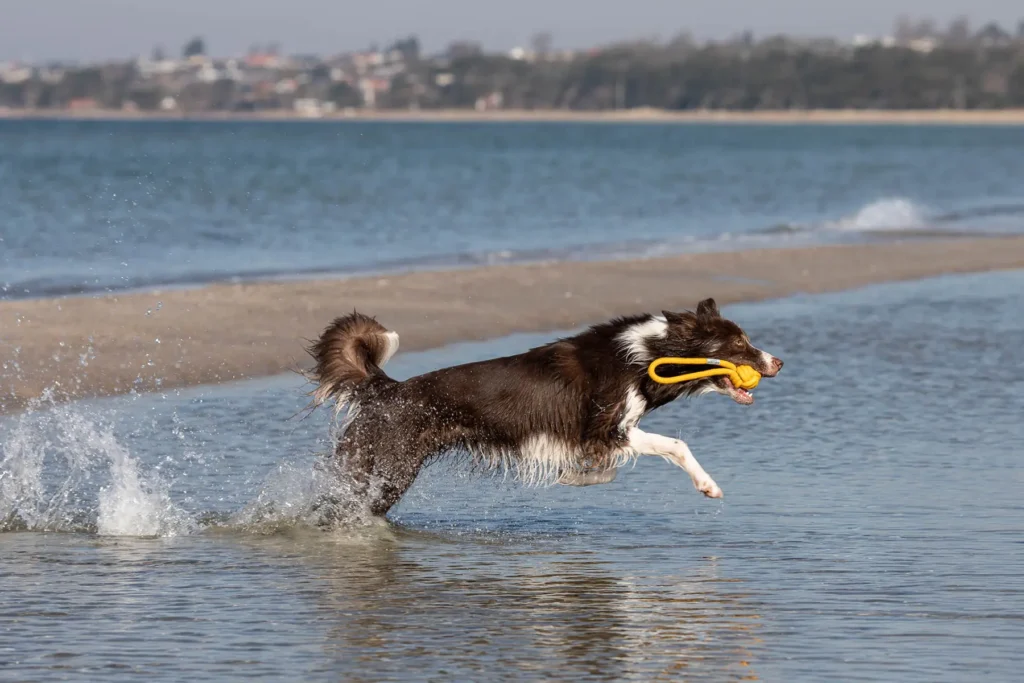
A dog shaking off after rain, swimming or a bath is therefore entirely natural. In this situation, there is no need to look for any additional emotional meaning. The simplest explanation is simply an attempt to dry the coat quickly.
Why does a dog shake off after being petted?
This is one of the most frequently asked questions and, at the same time, a situation that is very easy to interpret too quickly. Your dog approaches, allows you to pet them, walks two steps away and vigorously shakes off. Does that mean that the petting was unpleasant?
We cannot draw that conclusion on the basis of one shake-off alone. After physical contact, a dog may rearrange their coat, finish the previous interaction and move on to another activity, or shake off in connection with a change in their level of arousal. Research into canine behaviour clearly shows that an individual signal should not be interpreted without considering the whole context. [1][3]
Pay attention, therefore, to what your dog was doing during the petting itself. If their body was relaxed, they initiated contact themselves, approached you again after the touch stopped and remained calmly beside you after shaking off, it would be difficult to regard a single movement as evidence of discomfort. If, on the other hand, they turned their head away, tried to increase the distance, stiffened their body and immediately walked away once the interaction ended, the complete set of behaviours may suggest that the interaction was too intense for them.
That is why it is worth following one simple principle when interpreting canine communication: do not interpret one gesture in isolation from the whole dog and the situation they are in.
Does a dog shaking off mean stress?
Shaking off can appear in situations involving tension or increased arousal, but a shake-off on its own is not sufficient evidence of stress. This is an important distinction because popular guides sometimes present this movement as an almost unequivocal ‘stress signal’.
In a study using the Strange Situation Test, shaking off was recorded as a potential indicator of stress or a way of coping with it. The authors did not, however, treat this behaviour as an independent and unambiguous measure of the dog’s emotions. [4] A 2024 study examining short-term emotional states, meanwhile, showed that shaking off may be associated with arousal levels in particular situations, but its authors likewise stressed the need to analyse several indicators at the same time. [3]
An even more cautious interpretation was suggested by the study focusing directly on shaking off. Dogs performed this movement most often between different activities, while no clear change in body postures associated with emotional state was found before and after the shake-off. [1]
A dog may therefore shake off after a stressful event, but they may do exactly the same thing after play, a greeting, rest or a simple change of activity. If you would like to learn more about behaviours that may accompany tension, you can also read our guide ‘Stress in dogs – causes and symptoms. How can you help?’. I have intentionally left this title without a link because I could not verify an equivalent article URL on bowlandbone.com. Remember that several signals should always be considered together.
Why does a dog shake off after a walk?
A walk provides a dog with an enormous number of stimuli. There are smells, other dogs, people, traffic, grass, wind, rain, changing surfaces and dozens of pieces of information being processed almost continuously. When you return home, shaking off may appear precisely at the moment when the dog moves from an active walk into a calmer part of the day. [1]
If it has been raining or your companion has been running through wet grass, there is also the simplest explanation — the dog is getting rid of moisture. On rainy days, a well-fitting dog raincoat can be useful, protecting part of the coat from water and cold wind. The yellow STORM dog raincoat is made from waterproof material, while its construction has been designed with freedom of movement during walks in poor weather in mind.
A shake-off may also occur just after removing a lead, harness or item of clothing. This does not necessarily mean that the product was uncomfortable for the dog. The movement may simply be a response to a change in sensation on the skin, the coat settling back into place and the end of one activity.
Why does a dog shake off after their harness is removed?
Many dog guardians know this sequence very well: you return from a walk, unclip the lead, remove the harness and your dog immediately shakes their whole body vigorously. A single shake-off after removing an accessory should not automatically lead you to conclude that the harness is poorly fitted. Contact between the material and the coat changes the way the fur lies, while taking the harness off also marks the transition from one situation to another.
If, however, your dog shakes off repeatedly during the walk itself, tries to bite or scratch the harness, moves differently than they do without it, or you notice chafing or clear pressure marks on the skin once it is removed, it is worth checking the fit again. We discuss this subject in more detail in our guide ‘How to choose a comfortable harness for your dog?’.
For everyday use, the most important consideration is matching the product to the individual dog’s body shape. In Bowl&Bone Republic’s dog harness category, you will find different constructions designed for everyday walks. One example is the yellow GRADIENT dog harness in a guard-style construction, equipped with four adjustment points that allow it to be fitted more precisely to your companion’s body.
For the dog, this means greater comfort during natural movement, while for the guardian it provides an easier way to adjust the accessory to the dog’s actual measurements. High-quality materials, strong stitching and adjustability also increase comfort during everyday use.
Why does a dog shake off after playing or meeting another dog?
Energetic play can raise a dog’s level of arousal very quickly. Dogs run, change direction, stop, start chasing again and communicate with one another almost continuously. Shaking off after such a sequence has ended may appear at precisely the moment when the dog moves on to another activity.
Situations like these fit very well with the findings of the study investigating ‘shake-off’ behaviour. Dogs frequently shook off between different activities and after social behaviours had ended. This does not automatically mean that the preceding interaction was negative or stressful. [1]
If your companion shakes off after meeting another dog and then freely starts sniffing, carries on walking or calmly returns to you, it may simply be part of finishing the previous activity. If, on the other hand, they are simultaneously trying to increase the distance, avoiding further contact or clearly changing their body language, it is worth giving them more space.
Why does a dog shake off after getting up?
After lying down for a longer period, a dog’s coat may be flattened and sit differently from usual. Your companion stretches, changes position, gets up and quite often gives their body an energetic shake a moment later. This is one of the best examples of why not every shake-off should automatically be interpreted as stress.
From a behavioural perspective, getting up is also a very clear transition between two activities. The dog stops resting and begins something new — perhaps approaching their guardian, having a drink, showing interest in a walk or simply moving somewhere else. This context fits well with the hypothesis that shaking off may accompany a change in activity. [1]
A comfortable place to rest remains one of the fundamental elements of a dog’s everyday life. In Bowl&Bone Republic’s dog beds category, you will find beds designed with your companion’s high level of comfort and the guardian’s everyday convenience in mind. A properly selected surface and size allow the dog to change position freely while resting.

Does a dog shake stress out of their body?
This is a popular expression, but it is better understood as a metaphor rather than a literal description of a physiological process. A shake-off may occur after an intense or uncomfortable situation and may then be interpreted as part of the transition to a calmer activity. We do not, however, have grounds to conclude from the movement alone that the dog has just ‘removed stress from their body’. [1][3][4]
A more accurate way of describing it would be to say that shaking off may accompany a change in arousal or the end of a particular event. In one case, that event could be contact with an unfamiliar person, in another highly exciting play and in yet another simply getting up from a dog bed. From the outside, the movement can look almost identical.
That is precisely why context is so important. If you want to understand your dog better, observe not only the shake-off itself but also the position of the body, tail and ears, the way your companion moves and whether they actively seek further interaction.
Shaking off versus head shaking – an important difference
A brief full-body shake-off is different from frequent and repeated shaking of the head alone. A dog may occasionally shake their head after coming out of the water or when something temporarily irritates an ear. If the behaviour occurs very frequently or continues for a longer period, however, it is worth taking a closer look.
Otitis externa, or inflammation of the external ear canal, is a common problem in dogs, and head shaking is one of the possible symptoms. It may be accompanied by itching, pain, redness, an unpleasant smell or discharge from the ear. [5]
If you notice symptoms like these, consult a veterinary surgeon. Persistent head shaking should not be explained solely in terms of emotions or habit, because its cause may require diagnosis and treatment.
When should frequent shaking off attract your attention?
A single shake-off after a walk, getting up, physical contact or play is a very common behaviour. There is no need to search for a hidden meaning every time or interrupt what the dog is doing. What matters much more is a change from the normal behaviour of your particular companion.
Pay particular attention if your dog suddenly starts shaking off much more frequently than before or if other symptoms accompany the behaviour. Persistent scratching, redness of the skin, obvious discomfort when touched, frequent head shaking, ear problems, a change in movement or a clear reluctance to wear a particular accessory may all be relevant.
If the behaviour occurs mainly while the dog is wearing a harness or clothing, start by checking the fit. If, on the other hand, the shake-offs occur alongside signs that may indicate itching, pain or inflammation, the appropriate next step is a veterinary consultation.
One shake-off tells you something about a particular moment. A repeated pattern of behaviour gives you considerably more information about your dog.
How should you respond when a dog shakes off after contact with a person?
In most cases, you do not need to do anything in particular. Do not stop your dog just so that you can pet them again and ‘check’ whether they shake off this time as well. Allow them to decide for themselves whether they want to continue the interaction or would rather do something else.
You can use a very simple rule. Pause the petting for a moment and observe what your companion does. If they approach you again, lean against your hand or clearly initiate further contact, you have another piece of information indicating that they want the interaction to continue.
If, on the other hand, they move away, start sniffing, go to rest or occupy themselves with something else, respect that decision. We do not need to interpret every reaction from a dog as though it were a secret code. The best foundation for a good relationship remains observing your companion’s overall behaviour and allowing them to make choices.
Shaking off is a small movement, but it shows how important context is
At Bowl&Bone Republic, we have been designing PREMIUM dog accessories for almost 15 years. The knowledge we share in our guides is based not only on available research and specialist resources, but also on real-world experience gained through designing for dogs, hundreds of opinions and suggestions shared with us by their guardians and feedback from thousands of customers using Bowl&Bone Republic products.
Over those years, one thing has become very clear to us: an individual canine behaviour is rarely worth interpreting without considering the whole situation. A shake-off after a walk may mean something completely different from an identical movement performed after meeting an unfamiliar dog. Yet another explanation will be most likely when your companion has just come out of a lake.
That is why the best answer to the question ‘why does a dog shake off?’ is: first look at what happened a moment earlier. Water, touch, a change of activity, energetic play, social interaction and arousal can all result in a very similar movement. Only the wider context helps us better understand what the behaviour may mean for our particular dog. [1][3]
For more advice on canine behaviour and conscious dog guardianship, explore the Bowl&Bone Republic blog. You can also discover our dog accessories, designed with your companion’s exceptional comfort, outstanding quality and everyday convenience for their guardian in mind.
– the Bowl&Bone Republic team
FAQ – the most frequently asked questions about the article –
Why does a dog shake off? What does shaking off after petting, a walk and stress mean?
Why does my dog shake off even though they are not wet?
A dry dog may shake off after being touched, getting up from rest, playing, meeting another dog or while transitioning between different activities. A study of canine behaviour found that shaking off very often occurred precisely between two different activities. The behaviour alone therefore cannot tell us exactly what the dog is feeling. [1]
Why does my dog shake off after being petted?
A dog may be rearranging their coat after being touched or finishing one interaction before moving on to another activity. Shaking off may also occur alongside a change in arousal, which is why it is worth observing the dog’s entire body language. The movement alone does not prove that your companion disliked being petted. [1][3]
Does a dog shake stress out of their body?
Shaking off can occur after situations involving tension or increased arousal and is sometimes informally described as ‘shaking off stress’. Recent research does not, however, confirm that a shake-off on its own is a reliable, independent indicator of stress. The context and the dog’s other behaviours must always be considered. [1][3][4]
Why does a dog shake off after a walk?
A dog may be removing moisture or small particles of dirt from the coat, responding to the removal of a harness or simply moving from an active walk to a calmer activity at home. A shake-off may therefore have both a physical and behavioural explanation. [1][2]
Why does a dog shake off after their harness is removed?
A single shake-off may be a normal response to a change in tactile sensation and the coat settling back into place. If, however, the dog regularly shakes off while still wearing the harness, attempts to bite it, scratches themselves or moves differently when wearing it, it is worth checking the fit again.
Why does a dog shake off after meeting another dog?
This behaviour may appear after an intense social interaction has ended and accompany the transition to another activity. On its own, it does not tell us whether the meeting was pleasant or stressful. Pay attention to the dog’s behaviour both before and immediately after the shake-off. [1]
Why does a dog shake off after playing?
Energetic play involves a high level of arousal. A shake-off may occur when the dog finishes chasing or playing and moves on to a calmer activity. This behaviour is consistent with the observed possible function of shaking off as a marker of the transition between activities. [1]
Why does a dog shake off after getting up?
After sleeping, the coat may be flattened and the body has remained in one position for some time. Shaking off may help the coat settle back into place and can also appear during the transition from resting to being active. It does not necessarily have anything to do with stress.
Is it normal for a dog to shake off frequently?
The frequency of shaking off varies between dogs, which means that a sudden change in behaviour is more important than the number itself. If your companion starts shaking off considerably more often than before or develops itching, ear problems, pain or other signs of discomfort, it is worth looking for the cause.
Why does my dog keep shaking their head?
Repeated shaking of the head alone should be distinguished from a single full-body shake-off. It may be associated with irritation, an ear infection, an allergy or another problem involving the ear canal. If the behaviour is frequent or is accompanied by redness, discharge, an unpleasant smell or pain, the dog should be examined by a veterinary surgeon. [5]
Does a dog shake off when they do not like something?
A dog may shake off after an uncomfortable situation, but the movement alone is not enough to establish this. If your companion is also attempting to move away, avoiding further interaction or clearly changing their behaviour, it is worth giving them more space. If they return to the person after shaking off and initiate interaction again, the context is entirely different.
Is shaking off a calming signal in dogs?
It is better not to automatically assign one communicative function to shaking off. The behaviour can occur in many different situations, and recent research points, among other things, to its association with transitions between activities. It is therefore better to assess it together with the wider context and the rest of the dog’s body language. [1]
Sources and inspiration used to write the article
“Why does a dog shake off? What does shaking off after petting, a walk and stress mean?”
- Bryce A., Nurkin P., Horowitz A., “Shake It Off: Investigating the Function of a Domestic Dog Behavior in Social Contexts”, Animals, 2024, 14(22):3248 – a study of 120 shake-off episodes in 96 dogs, examining the relationship between the behaviour, transitions between different activities and possible changes in affective state.
https://pmc.ncbi.nlm.nih.gov/articles/PMC11591167/
DOI: 10.3390/ani14223248 - Dickerson A.K., Mills Z.G., Hu D.L., “Wet mammals shake at tuned frequencies to dry”, Journal of the Royal Society Interface, 2012 – a study of the biomechanics of shaking water from the coat in mammals, including several dog breeds, and the effectiveness of this movement in removing water from fur.
https://pmc.ncbi.nlm.nih.gov/articles/PMC3481573/
DOI: 10.1098/rsif.2012.0429 - Flint H.E., Weller J.E., Parry-Howells N., Ellerby Z.W., McKay S.L., King T., “Evaluation of indicators of acute emotional states in dogs”, Scientific Reports, 2024 – a study of indicators of short-term emotional states in dogs, including shaking off and its relationship with arousal levels.
https://www.nature.com/articles/s41598-024-56859-9
DOI: 10.1038/s41598-024-56859-9 - Ryan M.G., Storey A.E., Anderson R.E., Walsh C.J., “Physiological Indicators of Attachment in Domestic Dogs (Canis familiaris) and Their Owners in the Strange Situation Test”, Frontiers in Behavioral Neuroscience, 2019 – a study of dogs’ behaviour during separation, contact with an unfamiliar person and reunion with their guardian; shaking off was analysed as a potential indicator of stress or a coping response.
https://pmc.ncbi.nlm.nih.gov/articles/PMC6664005/
DOI: 10.3389/fnbeh.2019.00162 - Merck Veterinary Manual, “Otitis Externa in Animals” – a veterinary resource concerning inflammation of the external ear canal, its possible causes and symptoms, including frequent head shaking.
https://www.merckvetmanual.com/ear-disorders/otitis-externa/otitis-externa-in-animals











 or CANADA
 PLEASE join us at