


You are sitting at the table, working at your computer or simply relaxing on the sofa. At some point, you look up and realise that your dog has been watching you closely for quite a while. They are not barking or approaching you, and sometimes they are not even moving. They are simply looking at you.

It is hardly surprising that this behaviour makes us curious. Is your dog trying to tell you something? Are they asking for a walk, waiting for food, watching your emotions, or could looking directly into your eyes be a sign of an especially strong bond? The answer depends primarily on the situation and the rest of your dog’s body language.
A dog may look at their guardian for many reasons: to attract attention, ask for something, gather information about a situation, initiate an interaction or simply observe a person whose behaviour matters to them. A gaze does not have one universal meaning. To interpret it properly, you need to consider your dog’s entire body language and the situation in which the behaviour occurs.
After more than 10 years of designing premium dog accessories and thanks to the opinions and experiences of thousands of Bowl&Bone Republic customers, we see very clearly just how many different ways dogs use to communicate with people in everyday life. One dog arrives carrying a toy, another sits by the door, while a third simply looks at their guardian until the person realises that some kind of conversation has apparently just begun between them.
What will you learn from this article? From this guide, you will learn:
- why a dog looks at their guardian,
- what it means when a dog looks directly into your eyes,
- whether a dog’s gaze may be connected with bonding and trust,
- why a dog watches your face in unfamiliar situations,
- when a dog looks at you because they want something,
- why a dog watches you while you are eating,
- what it means when a dog looks at you and whines,
- why a dog looks at you while holding a toy in their mouth,
- how to distinguish a relaxed gaze from a hard stare,
- whether it is worth teaching your dog eye contact,
- when a sudden change in the way your dog looks at things may require veterinary advice.
Why does your dog look at you?
The most important thing to understand is that a dog’s gaze is part of a much broader system of communication. Dogs observe our body position, movements, face, direction of gaze and whether we are actually paying attention to them. Research shows that dogs are able to recognise differences in human attention and adjust their own behaviour accordingly [3][4].
A gaze can therefore mean something completely different when your dog is standing beside their bowl than when they look at you during an encounter with an unfamiliar person. It may mean something different again when your dog is lying comfortably in their bed and occasionally checks where you are. Do not automatically interpret every look as “love”, “dominance” or a “request”. Look at the context first.
Your dog wants to attract your attention
This is one of the simplest explanations. If your dog has learnt that looking at a person produces a response, they may increasingly use exactly this strategy. Imagine an everyday situation: your dog sits in front of you and looks at you, you ask “what do you want?”, then you stand up and your dog runs towards the door before you go out for a walk together.
If this pattern has been repeated many times, your dog may have learnt that looking at you is a very effective first step in the whole sequence. This does not mean that they are deliberately planning to manipulate you. It is simply the result of learning through the consequences of behaviour – an action that regularly leads to something valuable has a good chance of being repeated.
So sometimes the answer to the question “why does my dog keep looking at me?” is genuinely simple: because experience has taught them that watching you is worthwhile.
Your dog wants something from you
Looking at you very often appears alongside other clear signals. Your dog looks at you and then towards the door. They look at you and then at their bowl, or switch their gaze between you and a toy lying underneath a cupboard.
This alternating gaze between a person and an object may form part of referential communication. In studies where food was placed out of the dog’s reach, dogs used their gaze and shifted their attention between the human and the inaccessible object [3]. It may therefore be the canine equivalent of a very practical message: “look over there” or “I need your help”.
If your dog looks at you and then consistently directs their gaze towards one particular place, it is worth checking what has caught their attention.
Your dog looks at you because they know your daily routine
Dogs are excellent observers of everyday patterns. They know very well that putting on your shoes may mean a walk, opening a particular cupboard can signal food, and reaching for the lead suggests that you are about to go outside. Your dog may therefore sit and watch you long before anything interesting actually happens.
Perhaps the usual walk time is approaching, or you have just finished dinner and your dog knows that you normally sit together on the sofa afterwards. They may not need anything immediately – they could simply be monitoring a familiar sequence of events. If your dog not only watches you but also regularly follows you from room to room, read our guide Why does your dog follow you everywhere? What does this behaviour mean?.
Your dog looks at you to gather information
This is one of the most fascinating functions of a dog’s gaze. Imagine that an unusual object your dog has never seen before suddenly appears during a walk. Your dog looks at the object and then glances at you, almost as though they want to find out how you assess the situation.
In ethology, this type of behaviour is described as social referencing – using another individual as a source of information when assessing an unfamiliar situation. In studies by Merola, Prato-Previde and Marshall-Pescini, most dogs looked towards a person after encountering a potentially unsettling unfamiliar object [2]. What is more, the guardian’s response could influence the dog’s subsequent behaviour towards that object [2].
Sometimes your dog looks at you not because they want something, but because they are checking: “what do you think about this?”.
Why does your dog look into your eyes?
Eye contact between dogs and people is particularly interesting. Over thousands of years of living alongside humans, dogs have developed a high sensitivity to human social signals, and our eyes and direction of gaze are part of this communication.
A study published by Nagasawa and colleagues in the journal “Science” found an association between mutual gazing by dogs and their guardians and changes in oxytocin concentrations in both participants [1]. The authors described an oxytocin-gaze positive feedback mechanism that may contribute to maintaining the bond between dogs and humans.
This is a fascinating result, but it should be interpreted carefully. Not every look into your eyes means “I love you”. Eye contact may appear during closeness, training, anticipation of a response, a request, uncertainty or even tension. Its meaning always depends on the rest of the dog’s behaviour.
If you would like to learn more about how dogs show that they feel safe around a person, read How does a dog show trust in their guardian? 10 subtle signs.
Does your dog look at you because they love you?
It may form part of your close relationship, but a gaze alone is not a test of love. A relaxed dog lying beside their guardian with a soft facial expression and gentle eyes may feel very comfortable in that person’s presence. Mutual eye contact may also participate in mechanisms connected with the human–dog bond [1].
This does not mean, however, that we should attribute a complex human emotion to one single behaviour. A relationship is best assessed through many different elements: does your dog voluntarily seek your company, can they relax calmly around you, do they approach you for support in a difficult situation, and does their body remain relaxed during contact? Only the whole picture gives us a much fuller understanding.
Your dog watches your face because it is a source of information
Dogs pay attention to whether a person is available for communication. Research into referential communication has shown that the possibility of establishing eye contact with a guardian influences dogs’ communicative behaviours [3]. Other experiments have demonstrated that dogs can distinguish between situations in which a person is oriented towards them and paying attention and situations in which that person’s attention is directed elsewhere [4].
This may explain many everyday situations. Your dog might look at you before going through a doorway, glance at your face during training or watch you when someone rings the doorbell or an unfamiliar person enters the home. Your behaviour is one of the elements of the environment that your dog takes into account.
Why does your dog look at you with a toy in their mouth?
Here, the context is usually fairly easy to read. If your dog approaches with a soft toy, stops, looks at you and then jumps away or presents the object again, there is a good chance they are trying to begin a shared activity. It does not always mean “throw it” – your dog may want a game of tug, a chase, shared interest in the object or may simply be checking whether you will engage.

dog holding a plush bone during a walk
We have devoted a separate article to this behaviour: Why Does My Dog Bring Me Toys? 7 Possible Reasons. After more than a decade of designing dog accessories, we also know how important shared play can become within a relationship. A well-chosen dog toy can be more than simply something that occupies your dog – it can become a starting point for an activity you enjoy together.
A good example is the soft BAX dog toy, designed and sewn with shared play, carrying and everyday use in mind. High-quality workmanship matters to the guardian too – an accessory that is regularly used during shared play should be convenient to care for and cope well with normal everyday use.
Why does your dog look at you while you are eating?
This is a behaviour that probably every dog guardian knows. You sit down at the table, your dog appears beside you and looks at you. If they have received a piece of food in this situation even a few times in the past, watching a person during a meal may have become a rewarding behaviour.
Dogs can also adjust food-begging behaviour according to whether a person is actually looking at them and paying attention [4]. So you do not have to assume that your dog is suffering from terrible hunger simply because they have extraordinarily persuasive eyes. Sometimes they simply know the history of your previous interactions very well.
If you do not want to reinforce begging, consistency among all household members is particularly important. If one person ignores the dog’s gaze at the table while another regularly gives them a morsel, your dog has a very good reason to keep trying.
Why does your dog look at you and whine?
A gaze alone gives us limited information. Whining adds another element, but we still need to consider the context. Your dog may look at you and whine because they want to go outside, are waiting for access to something, are trying to initiate contact, feel excited, are frustrated, feel anxious or may be experiencing discomfort.
If the behaviour happens every day at the same time before a walk, the interpretation will be different from a situation in which an adult dog suddenly begins following you, staring at you, whining and being unable to settle. A new or rapidly intensifying behaviour should not automatically be treated as “asking for attention”. In particular, if there are also changes in appetite, movement, sleep, activity or other symptoms, it is worth consulting a veterinary surgeon.
Why does your dog watch you from their bed?
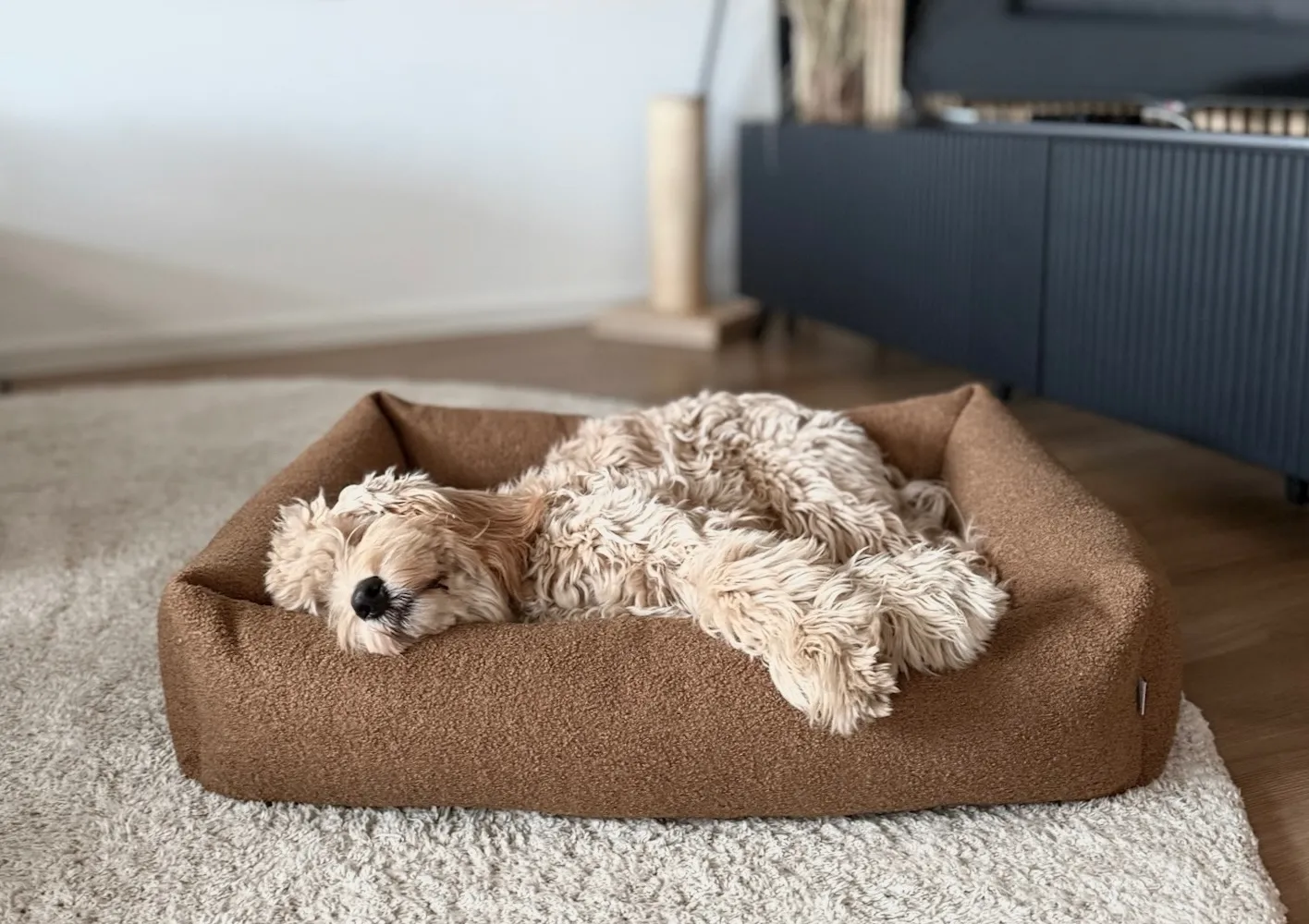
This is a very typical scene in the homes of our customers. The dog is resting but chooses a position from which they can occasionally check what is happening in the living room. This does not necessarily indicate excessive vigilance – if the body remains relaxed, the head rests on the bedding and your dog occasionally looks at you calmly, they may simply be resting in the presence of their family.
For this reason, when choosing a resting place, you do not automatically need to look for the most isolated corner of the home. Many dogs enjoy peace and quiet while still remaining close to everyday family life. A good dog bed allows you to create just such a personal space – comfortable for your dog while naturally fitting into the home.
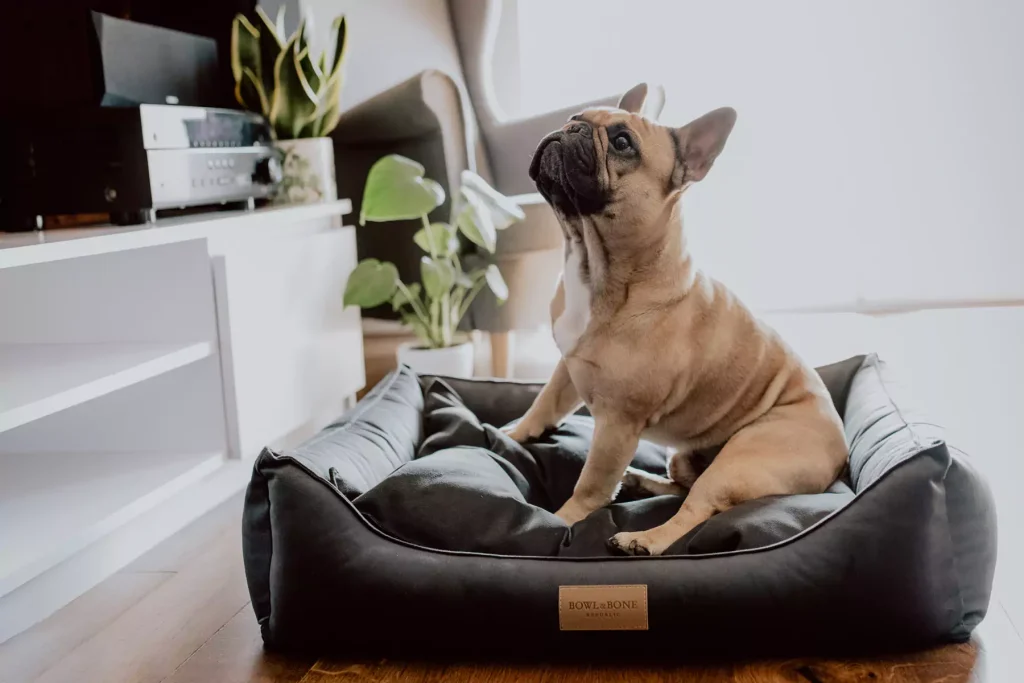
For example, the CLASSIC grey dog bed combines a soft resting place, durable materials and removable covers with a design that does not force the guardian to choose between their dog’s comfort and the aesthetics of the living room. Of course, we do not buy a dog bed so that a dog can watch us. The real benefit is giving them their own comfortable place that they can use in whichever way feels most natural to them.
A soft gaze and a hard stare are not the same thing
This is one of the most important parts of interpreting a dog’s gaze. The American Veterinary Society of Animal Behavior (AVSAB) draws attention to the difference between a dog’s soft gaze and what is known as a hard stare – an intense, fixed gaze that can appear alongside tension [5].
A relaxed gaze may occur with a loose mouth, soft eyes, natural ear position and relaxed posture. A hard stare, by contrast, may be accompanied by body stiffness, a closed mouth, a tense posture or guarding an object [5]. When interpreting your dog, always look at the whole animal rather than the eyes alone.
| What do you observe? | What else should you look for? | What might it mean? |
|---|---|---|
| soft, relaxed eyes | relaxed body | comfort, interest, anticipation |
| looking at you and an object | changing direction of gaze | a request or an attempt to draw your attention to something |
| looking during an unfamiliar situation | dog looks at the stimulus, then at you | seeking information |
| intense fixed gaze | stiff body, tense mouth | tension or warning |
| looking and whining | arousal, pacing, glancing towards the door | a need, frustration or anxiety |
| brief glances while resting | relaxed body position | ordinary monitoring of the surroundings |
Never interpret a dog’s eyes separately from the rest of their body.
Does a dog’s hard stare mean aggression?
Not every intense stare means that a dog is about to attack. If it appears together with body stiffness and other signs of tension, however, it should be taken seriously and the situation should not be escalated [5]. Do not lean over the dog, reach for an object they are guarding or try to “prove” that you can stare into their eyes for longer.
Increasing the distance is usually a much more sensible response. This is particularly important with an unfamiliar dog because relaxed eye contact between a dog and a trusted guardian is very different from prolonged direct staring at a tense dog you do not know.
Why does your dog look away?
Looking away is also part of canine communication. A dog does not have to maintain constant eye contact and should not be forced to do so. They may look to the side during an overly intense interaction, when a face moves too close, during hugging or simply when they want to end contact.
So “my dog does not look me in the eyes” is not automatically evidence of a lack of bonding or trust. Give your dog a choice, and if they turn their head away, do not move your own face to place it directly in front of their eyes again. Good communication also means recognising the moment when your dog is saying: “that is enough for now”.
Can you look a dog directly in the eyes?
With your own relaxed dog, brief and natural eye contact is a normal part of communication. There is no need to avoid it, but there is also no reason to force your dog into prolonged eye contact. If you are teaching your dog to voluntarily direct their attention towards your face during training, you can reward brief glances provided that your dog offers the behaviour themselves and remains comfortable.
Quick access to small rewards is useful during short training sessions like these. The MIDI black dog treat bag keeps them close at hand during a walk or training session without the need to keep reaching into your pockets. It may be a small detail, but from a guardian’s perspective the convenience of using a high-quality accessory can make it much easier to maintain a good rhythm during training.
Remember, however, that the aim is not to teach your dog to stare at you continuously. Eye contact should be one of many elements of communication.
Your dog looks at you during a walk – is that a good thing?
Very often, yes. If your dog spontaneously glances at you from time to time during a walk, they may simply be checking your position and the direction in which you are moving. This voluntary “checking in” can be useful in everyday life because it means that your dog is not moving exclusively within their own world of smells but remains aware of your presence.
That does not mean your dog should be looking at you throughout the entire walk. Sniffing, exploring the surroundings and observing the environment are equally important. A good walk is not based on uninterrupted eye contact.

Why does your dog look at you while you stroke them?
Again, everything depends on the rest of the body. If your dog has soft eyes, relaxes their body, remains beside you and voluntarily maintains contact, their gaze may simply be part of a pleasant interaction. If the body becomes stiff, the dog turns their head away, licks their nose, pulls their ears back or tries to leave, do not assume that looking at you is an invitation to continue touching them.
The most practical rule is simple: stop stroking your dog from time to time. If they independently move towards your hand again, lean into it or clearly ask for more contact, you have far more useful information than you would get from their gaze alone.
Why does your dog look at their guardian while toileting?
This question appears online remarkably often, but it is worth being careful with dramatic explanations. We do not have enough evidence to say that every dog looks at their guardian while defecating because they are “asking for protection” or because it is an inherited pack ritual. These interpretations are frequently repeated but should not be presented as established facts.
It is much safer to assume that a dog may be checking their guardian’s position, observing their reaction or simply have an established habit of looking towards a person in different situations. If they were heavily rewarded during toilet training in the past, the guardian’s presence and response may also have acquired significance. We do not need to attach deep symbolism to every canine glance.
Can a dog learn to look at their guardian?
Yes. Eye contact can be strengthened through training, and research shows that experience and training influence the way dogs direct their gaze towards the human face and respond to visual cues [3]. In practice, this process is easy to observe: your dog spontaneously looks at you, receives a reward and, after several repetitions, begins offering the same behaviour more frequently.
This can be useful when teaching calm communication or brief focus before carrying out a task. It should not, however, mean requiring your dog to look constantly at a person. A good connection with your dog does not mean that they stop being interested in the world around them.
When should your dog’s staring concern you?
Looking at a guardian is usually an ordinary part of communication. The situation is different when there is sudden, unusual staring into empty space, when the dog appears disorientated or when the behaviour occurs together with other worrying changes.
The Merck Veterinary Manual describes disorientation, changes in social interactions, disruption of the sleep–wake cycle, changes in activity and other behaviours as possible elements of canine cognitive dysfunction in older dogs [6]. It is worth speaking to a veterinary surgeon if you notice, for example:
- new and frequent staring at walls or empty space,
- disorientation in a familiar home,
- becoming stuck in corners,
- failing to respond to familiar signals,
- sudden clear changes in interactions with household members,
- new sleep disturbances,
- episodes during which the dog appears unresponsive to their surroundings.
This is a completely different situation from a dog sitting in front of you and clearly waiting for you to finally notice the lead lying beside the door.
How should you interpret your dog’s gaze?
The best approach is to ask yourself a few simple questions. What happened immediately beforehand? Where is your dog, what else are they looking at and is their body relaxed? Is there something between you – a bowl, toy or door – and what does your dog do after you respond?
After more than 10 years of designing premium dog accessories and thanks to feedback from thousands of dog guardians, we at Bowl&Bone Republic know that these small everyday observations often reveal a dog’s individual needs most clearly. One dog looks at their guardian just before bringing a toy, another watches the family from their bed, while a third seeks eye contact primarily when they need help.
Do not therefore try to learn one universal “dictionary of canine gazes”. The most important key to understanding your dog is combining their gaze with the body language of the whole dog, the situation and your knowledge of their individual behaviour.
Why does your dog look at you? Summary
A dog may look at their guardian because they want to attract attention, ask for a walk, food or play, check the guardian’s response, obtain guidance in an unfamiliar situation or simply observe a person who matters to them. Research shows that dogs pay attention to human availability for communication and use gaze during interactions with people [2][3][4].
Relaxed eye contact may also accompany a close relationship and participate in mechanisms connected with the human–dog bond [1]. This does not mean, however, that every gaze is a declaration of love. A hard stare combined with a stiff posture can have a very different meaning and should prompt the guardian to increase distance [5].
The best thing you can do is observe your own dog. Over time, you will probably notice that you understand some of their looks without even having to think about them. A dog does not need words to say “are we going?”, “can you help me?”, “shall we play?” or simply “I’m checking where you are”.
And if your shared communication leads to play, rest or a walk, choose dog accessories that match your companion’s real needs. At Bowl&Bone Republic, we design them with canine comfort, exceptional quality in everyday use and an aesthetic that their guardians can appreciate too.
– the Bowl&Bone Republic team
FAQ – frequently asked questions about the article –
Why does your dog look at you? What does their gaze mean?
Why does my dog keep looking at me?
Your dog may watch you because they are waiting for a response, know your daily routine, want something or have simply learnt that it is worth paying attention to what their guardian is doing. If they remain calm and relaxed, frequent looking by itself is usually not a cause for concern.
Why does my dog look directly into my eyes?
Eye contact may form part of communication, waiting for guidance, training or a relaxed relationship with a person. Research also suggests an association between mutual gazing by dogs and their guardians and oxytocin-related mechanisms involved in interspecies bonding [1]. A gaze itself does not, however, have one universal meaning.
Does a dog look into your eyes because they love you?
They may look at you during moments connected with closeness and a sense of safety, but we cannot say that every gaze means love. Its meaning should always be assessed together with the dog’s full body language and the surrounding context.
Why does my dog look at me and whine?
Your dog may need something, be trying to attract attention, feel excited, frustrated or worried. Look at what is happening around you and whether any other changes accompany the behaviour. Sudden or unusual whining deserves more attention than a familiar routine that occurs before a walk.
Why does my dog look at me while I am eating?
If your dog has received food from the table in the past, they may have learnt that watching a person during a meal can sometimes result in a reward. Dogs also pay attention to whether a person is actually watching them and is available for interaction [4].
Why does my dog look at me while holding a toy?
Most often, this forms part of an attempt to initiate interaction. Your dog may be encouraging you to throw the toy, play tug or begin another shared activity. Also observe what they do with the toy once you respond.
Why does my dog look at me during a walk?
They may be checking your position, direction of travel or seeking information before making a decision. Brief spontaneous glances towards the guardian are a normal element of communication during walks.
Why does my dog look at me while I stroke them?
Your dog may be interested in your face and remain comfortably engaged in the interaction. However, always look at the rest of their body language. If the dog is tense, turns their head away or attempts to leave, do not interpret the gaze alone as a request for more stroking.
Why does my dog look at me while they poo?
There is no single scientifically confirmed explanation for this behaviour. A dog may be checking their guardian’s position, observing their reaction or simply have an established habit of glancing towards people. It should not automatically be interpreted as asking for protection.
Can you look a dog directly in the eyes?
Natural eye contact with your own calm and relaxed dog is normal. You should not, however, force a dog to maintain prolonged eye contact or stare intensely at an unfamiliar or tense dog.
What does a hard stare from a dog mean?
A hard stare may form part of tension or warning behaviour, particularly if it is accompanied by body stiffness, a closed mouth or resource guarding [5]. In this situation, increasing the distance is the safest response.
Why does my dog look away from me?
Your dog may simply want to end the interaction or reduce its intensity. Looking away does not automatically mean a lack of trust. Do not force your dog to look back at you.
Does looking at a guardian mean that a dog trusts them?
It may occur within a secure relationship, but one individual behaviour is not sufficient evidence of trust. It is also worth considering voluntary contact-seeking, relaxed resting, overall body language and behaviour in unfamiliar situations.
Does a dog look at a person to check their reaction?
Yes, they may. Research into social referencing shows that dogs look towards people in unfamiliar situations and can use their reactions as additional information about the environment [2].
Can you teach a dog eye contact?
Yes. Brief, voluntary looks towards the guardian can be reinforced with a reward. You should not, however, require your dog to look constantly at a person’s face – they should remain free to observe their surroundings.
When can a dog’s staring indicate a health problem?
Looking at the guardian itself is usually not a health problem. Veterinary advice is warranted, however, when new behaviours appear such as frequent staring at empty space or walls together with disorientation, reduced responsiveness, sleep changes or other unusual symptoms, particularly in an older dog [6].
Sources and inspiration used to write the article
Why does your dog look at you? What does their gaze mean?
- Nagasawa Miho, Mitsui Shouhei, En Shiori et al., “Oxytocin-gaze positive loop and the coevolution of human-dog bonds”, Science – a study examining the relationship between mutual gazing by dogs and their guardians, oxytocin mechanisms and the human–dog bond.
https://pubmed.ncbi.nlm.nih.gov/25883356/ - Merola Isabella, Prato-Previde Emanuela, Marshall-Pescini Sarah, “Dogs’ Social Referencing towards Owners and Strangers”, PLOS ONE – a study examining dogs’ social referencing towards people and their use of human responses when encountering a potentially unsettling unfamiliar stimulus.
https://pubmed.ncbi.nlm.nih.gov/23071828/ - Savalli Carine, Resende Briseida, Gaunet Florence, “Eye Contact Is Crucial for Referential Communication in Pet Dogs”, PLOS ONE – a study examining the importance of a human’s availability for eye contact in dogs’ communicative behaviour when food is inaccessible.
https://pmc.ncbi.nlm.nih.gov/articles/PMC5023129/ - Virányi Zsófia, Topál József, Gácsi Márta, Miklósi Ádám, Csányi Vilmos, “Dogs respond appropriately to cues of humans’ attentional focus”, Behavioural Processes – a study examining dogs’ ability to recognise the direction and availability of human attention and adjust their own behaviour accordingly.
https://pubmed.ncbi.nlm.nih.gov/15110918/ - American Veterinary Society of Animal Behavior (AVSAB), “Understanding Canine Facial Expressions and Body Postures” – material concerning the interpretation of canine facial expressions and body posture, including the distinction between a soft gaze and an intense “hard stare”.
https://avsab.org/understanding-canine-facial-expressions-body-postures/ - Merck Veterinary Manual, “Behavior Problems of Dogs” – veterinary guidance concerning behavioural changes in dogs, including signs that may occur with canine cognitive dysfunction in older animals; used for the section concerning unusual staring and situations requiring veterinary advice.
https://www.merckvetmanual.com/behavior/behavior-of-dogs/behavior-problems-of-dogs








 or CANADA
 PLEASE join us at