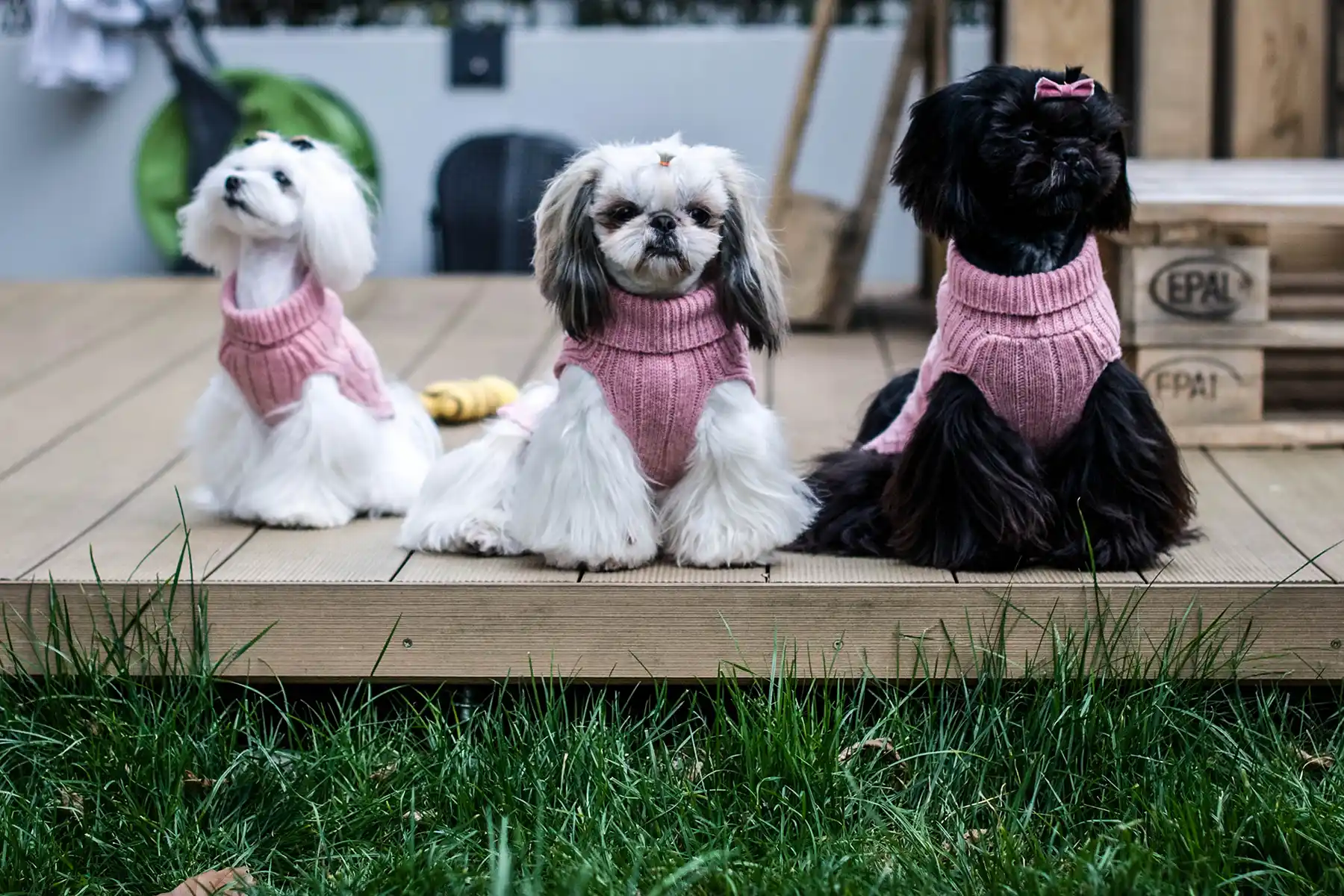
Only a few minutes ago, the most important game of the day was taking place in the middle of the living room. A soft rabbit landed beside the sofa, a ball rolled under the table and a tug toy was abandoned exactly where someone would soon be walking. Your dog looks at this small amount of chaos with complete calm. After all, every toy is exactly where they left it. From their perspective, everything is perfectly organised.

But what if playing together could end with one more task? Your dog picks up a soft toy, approaches their own basket and drops it inside. A moment later, they return for another item. Not because they understand the human need for a tidy living room, but because putting toys away has become an interesting game.
Teaching a dog to put their toys into a basket is possible, but the entire action needs to be divided into several simple stages. Your companion must learn how to pick up an object, carry it, approach the basket and release the toy directly above the opening. For one dog, the whole process will feel like a natural extension of retrieving. Another may need more time to understand each individual element. Short training sessions, clear rewards and a pace suited to the particular dog are what matter most.
What will you learn from this article?
• whether every dog can learn to put their toys away,
• what your companion should learn before training begins,
• how to choose a suitable dog toy basket,
• how to teach your dog to pick up and release objects,
• how to combine several simple behaviours into one action,
• when to introduce the “tidy up” cue,
• how to reward your dog during training,
• what to do when your dog does not want to release the toy,
• why your companion takes toys out of the basket immediately after putting them away,
• how long a single training session should last,
• which mistakes can make learning more difficult,
• why having a dedicated basket helps organise your dog’s space,
• what makes Bowl&Bone Republic dog toy baskets special.
Can a dog learn to put toys away?
Yes, many dogs can learn this skill. For your companion, however, it is not one simple cue but a sequence of several behaviours. The dog must:
- become interested in the selected toy,
- pick it up in their mouth,
- hold it while moving,
- approach the basket,
- position their mouth above the opening,
- release the object,
- and possibly return for the next toy.
If one of these stages is difficult, completing the entire task may be impossible. This does not mean that the dog is stubborn or unintelligent. They may simply not yet understand one particular part of the exercise. Putting objects into a container is a sufficiently complex task that it has also appeared in research into dog-training methods alongside retrieving and other multi-stage behaviours. [1]
What should a dog learn first?
Training will be easier if your companion can already pick up a toy and release it in response to a clear cue. They do not need to perform a formal retrieve or place the object perfectly into your hand. It is enough if they:
• show interest in the chosen toy,
• willingly pick it up,
• can hold it for a few seconds,
• do not run away with it every time,
• can release it without the object being taken by force.
If your dog does not yet know these elements, begin the training with them. Trying to move straight into the full sequence may cause frustration for both the dog and their guardian.
How to choose a dog toy basket
At the beginning of training, the basket for dog toys should make the task as easy as possible. It should not be too tall, unstable or so narrow that dropping the toy inside requires great precision. A good dog toy basket should:
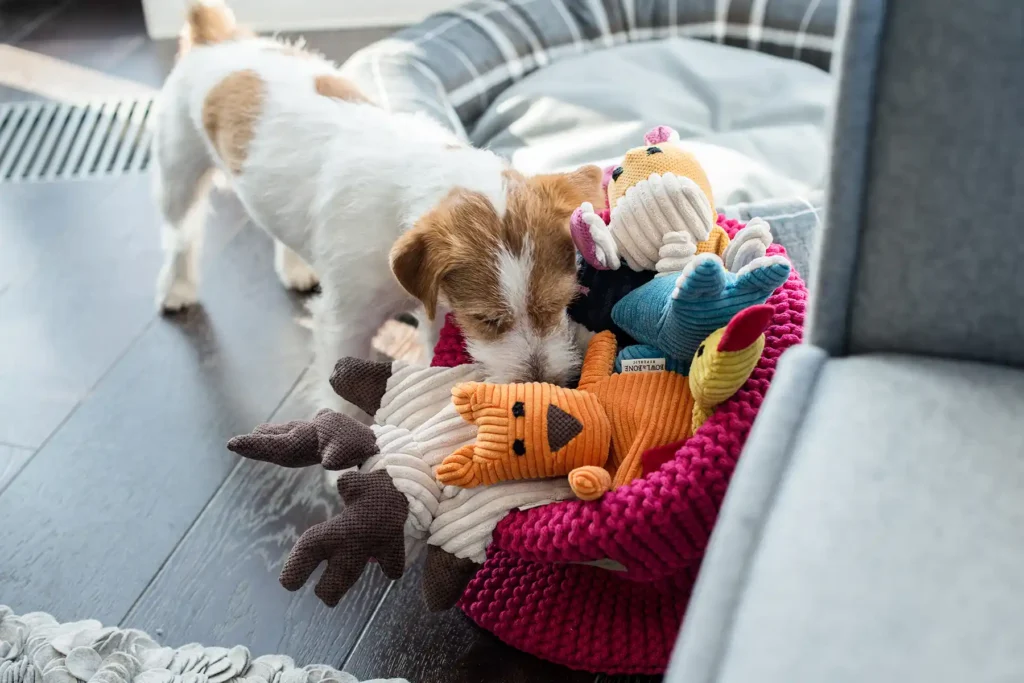
• have a wide opening,
• remain stable during training,
• have a height suited to the dog’s size,
• allow the dog to lower their mouth easily above the opening,
• have no sharp edges,
• hold the toys used most often,
• be positioned somewhere the dog can access.
During the first stages, you can also fold or lower the soft edge of the basket. The easier it is for your companion to drop the toy inside, the sooner they will understand the principle of the exercise.
Why choose a soft basket for dog toys?
When choosing a toy independently, a dog may rest their muzzle or neck against the edge of the container. A soft and flexible basket for dog toys is comfortable in everyday use, particularly for a smaller companion who needs to reach slightly deeper inside.
Bowl&Bone Republic baskets for dog toys are handmade from very thick, pleasantly soft cotton cord. They can be shaped and folded, making it easier to adjust their height to the number of items stored inside and the needs of the dog.
The collection includes the COTTON, RING and DOUBLE lines. They differ in colour and weaving style, so the basket can serve not only as a place for canine treasures but also as a harmonious element of the living-room interior.
The baskets can be cleaned by hand or in the washing machine on a delicate cycle, in accordance with the product-care instructions. This is a practical solution because fur, dust and small amounts of dirt brought in by the dog often end up inside together with the toys.
How to prepare for training
Begin in a calm place with few distractions. Prepare:
• a wide basket,
• one familiar toy,
• small treats,
• a marker word for correct behaviour, such as “yes”,
• a few minutes of free time.
It is usually easiest to begin with a soft toy that the dog willingly picks up but does not try to chew intensely or guard from their guardian.
Do not scatter every toy around the whole room immediately. During the first stages, one soft toy and a basket positioned directly beside it are more than enough.
Training should be based on rewarding behaviours that we would like to see again. The American Veterinary Society of Animal Behavior recommends reward-based methods for teaching all canine skills and advises against techniques that cause pain, fear or significant discomfort.
How to teach your dog to put toys into a basket step by step
Do not immediately say “tidy up” and wait for your dog to work out the entire task. Teach the individual elements separately first and only begin combining them later.
– step 1 – teach your dog to show interest in the toy
Place the toy in front of your companion. Reward them simply for looking at it, approaching it or touching it with their nose.
When your dog willingly moves towards the object, wait for them to try opening their mouth or lifting the toy. Mark the correct behaviour with the word “yes” and give the reward.
Gradually reward only behaviours that move closer to properly picking up the object:
- looking at the toy,
- approaching it,
- touching it with the nose,
- opening the mouth,
- gripping it,
- lifting it.
Building behaviour gradually in this way is known as shaping. You do not wait for the finished skill, but reward small steps that lead towards the goal.
– step 2 – increase how long your dog holds the toy
Once your dog begins picking up the toy, do not rush to introduce the basket. First, teach them to hold the object for slightly longer. Initially, mark and reward one second. Later, wait for two or three seconds.
If the dog immediately releases the toy, you have probably increased the difficulty too quickly. Return to a shorter duration. The exercise should remain easy. Your companion does not need to stand holding an object for a long time. A few calm seconds are enough to carry the toy to a nearby basket.
– step 3 – teach your dog to release the toy
Place your open hand beneath your dog’s mouth. When they release the toy, say “yes” and immediately give a reward. If they do not want to give it up, do not pull the object or force their mouth open. You can offer an exchange for a treat or another toy. After several repetitions, introduce your chosen cue, for example:
• “drop”,
• “give”,
• “leave”.
Say it just before you expect the dog to release the object. In this way, the word begins to predict a behaviour that the dog already knows.
– step 4 – place the basket beneath the toy
When your dog can pick up an object and release it on cue, place the basket directly beneath their mouth. At this stage, do not yet expect your companion to approach the container independently. You position the basket so that the toy will almost certainly fall inside when released.
Say the familiar “drop” cue. When the object lands in the basket, mark the success and offer a particularly valuable reward. After several repetitions, your dog may begin to notice that releasing the toy above the basket produces an especially positive result.
– step 5 – move the basket a few centimetres away
Now place the toy directly beside the basket. Encourage the dog to pick it up and then guide them so that their mouth is above the opening.
You can indicate the inside with your hand, but do not move the dog by force. When their mouth is above the basket, give the “drop” cue.
Initially, a distance of a few centimetres is enough. Then increase it gradually:
• the toy directly beside the edge,
• the toy several centimetres from the basket,
• the toy half a metre away,
• the toy somewhere else in the room.
Increase only one level of difficulty at a time.
– step 6 – wait for the dog to release the toy independently
Once your dog understands that the object should go inside, try not to use the “drop” cue every time.
Point towards the basket and give your companion a moment to think. If they release the toy independently, reward them especially clearly. This helps them understand the complete principle: the toy should be picked up, carried to the container and left inside.
– step 7 – introduce the “tidy up” cue
It is best to introduce a new cue only once the dog performs the entire behaviour fairly regularly. You might choose:
• “tidy up”,
• “toys”,
• “in the basket”,
• any other short phrase.
Say it immediately before indicating the toy, when the dog is likely to complete the task. In this way, the cue becomes associated with the whole sequence rather than simply looking towards the basket. Do not repeat the cue several times. If the dog does not respond, make the exercise easier, reduce the distance or return to an earlier stage.
– step 8 – add another toy
Once your companion can confidently put away one object, place a second one nearby. Initially, reward each toy separately. After the first one has been put away, allow the dog to eat the treat before asking them to pick up the next item.
Over time, you can reward after two and then three toys have been placed in the basket. Do not completely stop praising every correct action, however. A longer sequence requires greater concentration. Not every dog will want to tidy the entire living room during one session — and they do not have to.
How long should training a new dog cue last?
A single session may last only two to five minutes. It is better to finish after several successful repetitions than to continue until the dog loses interest. You can train once or twice a day, but observe your companion’s behaviour. End the session if the dog:
• turns their head away,
• begins sniffing the floor intensely,
• walks away,
• lies down,
• stops accepting treats,
• becomes excessively aroused,
• starts chewing the toy instead of carrying it.
This does not necessarily indicate disobedience. The dog may be tired, the task may have become too difficult or the reward may not be sufficiently attractive.
What should you do if your dog does not want to pick up the toy?
Not every dog enjoys carrying objects. If your companion does not pick up the toy, return to the simplest behaviours. Reward:
• looking at the object,
• approaching it,
• touching it with the nose,
• gently opening the mouth beside the toy.
You can also try a different item. One dog may willingly lift a soft toy, another may choose a ball and another a lightweight tug toy. Do not use a favourite chew that your companion does not want to release. A toy that is attractive but not overly arousing will work best for training.
What should you do if your dog does not want to give up the toy?
First of all, do not chase them around the home. This response may accidentally turn training into a game of running away with the object. Instead:
• offer an exchange for a treat,
• use another toy,
• practise in a smaller space,
• do not remove the object from the mouth by force,
• reward calm behaviour close to the guardian,
• practise the “drop” cue separately.
If the dog stiffens their body, growls, turns sideways or clearly guards the object, do not try to take it away. If resource guarding occurs repeatedly, consult an experienced canine behaviourist who works with reward-based methods.
Why does a dog take toys out of the basket after the exercise?
Because, from the dog’s perspective, the basket is still a place containing items intended for play. A dog does not understand that after tidying up, every object should remain inside until the following day. If they have unrestricted access to the basket, they may immediately choose the same toy and take it out again.
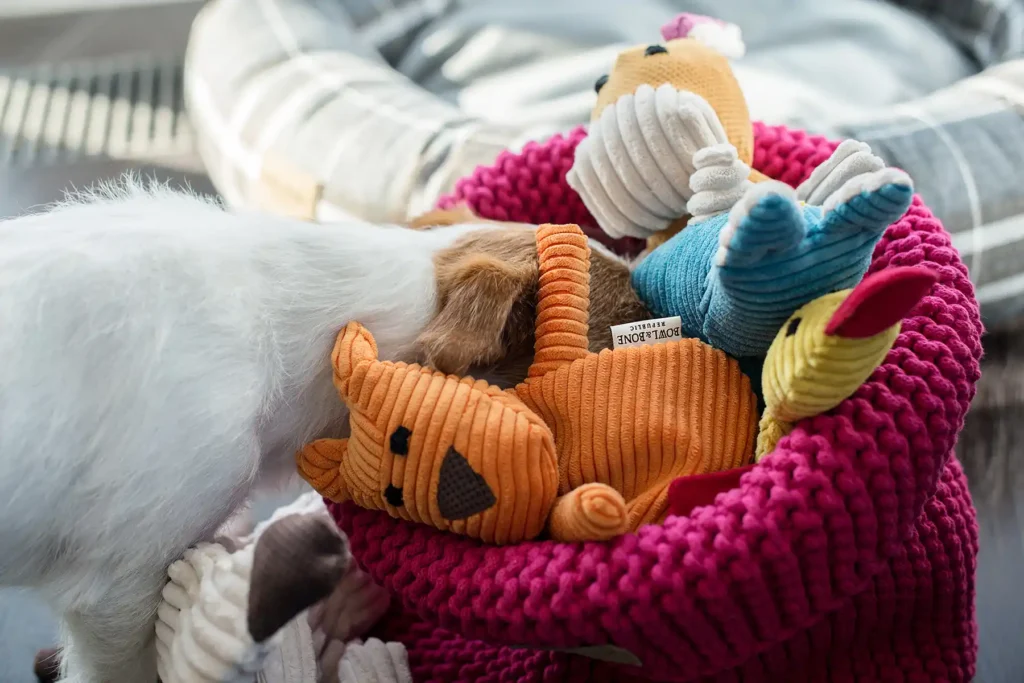
This is not spite or an attempt to spoil the result of the exercise. After training, you can:
• offer a period of rest,
• begin another calm activity,
• put some toys out of the dog’s reach,
• leave several items in the basket for independent selection.
The basket can serve two purposes: helping to organise the space and allowing your companion to choose toys independently. The guardian decides which objects remain available at all times.
Should all toys be kept in one basket?
Not always. If your companion has a large collection, some toys can be kept out of reach and rotated periodically. It is worth leaving items in the basket that are:
• safe for independent use,
• appropriate for the dog’s size,
• in good condition,
• free from loose or detached pieces,
• easy for the dog to remove without tipping over the container.
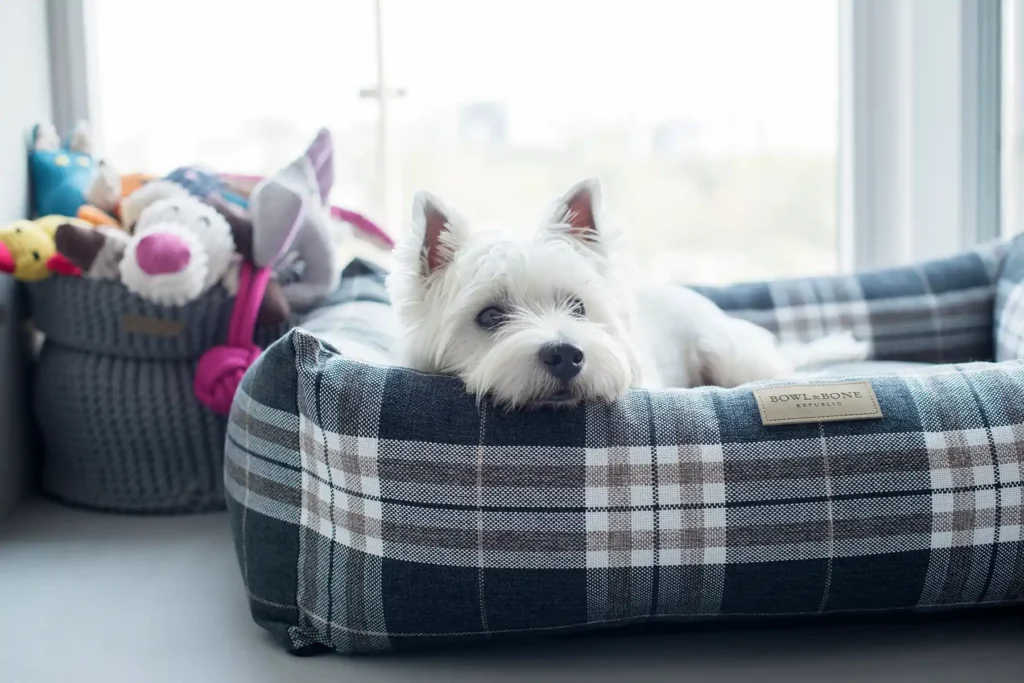
Toys that require supervision, damaged items or those intended only for shared activities should be stored separately. Check the basket regularly as well. It should not be treated as a chew toy. If your dog begins chewing the cord or pulling out pieces, interrupt the contact and secure the product.
Which mistakes most often make training difficult?
– expecting the entire behaviour on the first attempt
The dog does not know what “tidy up” means until you teach the individual elements. Repeating the word alone will not explain the task.
– increasing the distance too quickly
If the toy suddenly appears on the other side of the room, your companion may lose one of the stages in the sequence. Increase the distance gradually.
– scattering too many toys
A large number of objects can make concentration difficult. Begin with one toy and add more only when the first task is clear.
– rewarding too late
The reward should appear immediately after the toy lands in the basket. If you give it only once the dog has walked away, they may not understand which behaviour produced the benefit.
– taking objects by force
Doing this can increase tension and reduce the dog’s willingness to bring toys in the future.
– training for too long
A few minutes of successful learning are more valuable than a long session that ends in frustration.
– practising only in one place
The dog may initially connect the behaviour with one particular arrangement of the living room. Once they understand the task well, gradually change the position of the basket and toys.
Is it worth teaching a dog to put toys away?
This skill is not essential for a happy life. It can, however, become an enjoyable way to spend time together. During the exercise, the dog:
• focuses their attention on the guardian,
• makes simple decisions,
• practises picking up and carrying objects,
• learns several behaviours that form a sequence,
• develops self-control when releasing the toy,
• has opportunities to experience repeated success.
A more organised space is an additional benefit for the guardian. What matters most, however, is that the training remains a game rather than a daily duty requiring perfect performance.
A dedicated place for every canine treasure
Every dog has items that are particularly important to them. A soft toy carried to the bed. A ball that always appears before a walk. A tug toy that begins shared play as soon as the guardian returns home. A dedicated basket gives these small treasures a permanent place while keeping them available to the dog. There is no need to search beneath the sofa or move them from one corner of the living room to another.
The Bowl&Bone Republic collection of baskets for dog toys was designed to combine everyday functionality with the aesthetics of the home interior. Thick cotton cord, handmade construction, flexibility and carefully selected colours mean that the container does not need to be hidden once playtime ends. It can remain exactly where the dog genuinely uses it — beside the bed, near the sofa or in their favourite place in the living room.
And when the final toy drops inside, tidying up does not have to mean the end of your time together. It simply becomes the final, calm part of the game.
For more inspiration, knowledge and thoughtfully designed dog accessories, visit www.bowlandbone.com — a place created for dog guardians who wish to combine their companion’s everyday comfort with timeless style.
the Bowl&Bone Republic team
FAQ the most frequently asked questions from the article “How to teach your dog to put their toys away in their own basket?”
Can every dog learn to put toys away?
Many dogs can learn this skill, but the pace will vary. Dogs who willingly pick up and carry objects may find it easier. Other dogs may need more time to learn the individual stages.
Where should you begin when teaching a dog to put toys away?
First, teach your dog to show interest in the toy, pick it up and release it on cue. Only then introduce the basket and combine the behaviours into one sequence.
Which cue should you use for putting toys away?
You can choose “tidy up”, “toys” or “in the basket”. It is best to introduce the phrase only when the dog can already perform most of the behaviour.
How can you teach a dog to bring a toy to the basket?
Initially, place the toy directly beside the basket. Once the dog manages the task, increase the distance gradually by a few or several centimetres.
What should you do if the dog does not want to release the toy?
Offer a calm exchange for a treat or another object. Do not remove the toy from the mouth by force or chase the dog around the room.
Why does the dog drop the toy beside the basket?
The task probably requires more precision than the dog can currently achieve. Use a wider basket, position it closer and reward the first successful attempts.
How long should a training session last?
Two to five minutes are enough at the beginning. It is best to end after several correct repetitions, before the dog loses interest.
How should you reward a dog during training?
You can use small treats, praise or a short game. The reward should appear immediately after the toy lands in the basket.
Why does the dog immediately take the toys out again?
The basket is also a storage place for items intended for play. The dog does not understand the human need for everything to remain inside once the exercise has finished.
Which basket is best for training?
The basket should be stable, have a wide opening and a height suited to the dog. At the beginning, it is worth choosing a model with a soft edge that can be lowered or shaped.
Where should a dog toy basket be positioned?
It is best placed in a calm, easily accessible location where the dog can independently reach their favourite item. The basket should not block a main walkway.
Should a dog have access to every toy?
This is not necessary. Some toys can be stored separately and rotated periodically. Only safe toys in good condition should remain in a basket accessible to the dog.
Can the toy basket be washed?
Bowl&Bone Republic baskets can be cleaned by hand or in the washing machine on a delicate cycle at up to 30°C, in accordance with the care instructions for the particular product.
Can a dog play with the basket itself?
The basket is intended for storing toys and should not replace a chew. If the dog begins chewing the cord intensely or pulling out pieces, the contact should be stopped.
Sources and inspiration used to create the article
“How to teach your dog to put their toys away in their own basket?”
- Vieira de Castro A.C., Araújo Â., Fonseca A., Olsson I.A.S., “Improving dog training methods: Efficacy and efficiency of reward and mixed training methods”, PLOS ONE, 2021, 16(2), e0247321. The research protocol included retrieving and putting objects into a basket as multi-stage training tasks.
- American Veterinary Society of Animal Behavior, “Humane Dog Training Position Statement”, 2021, reaffirmed by AVSAB in 2025. Recommendations concerning reward-based methods and the avoidance of aversive techniques.
- Vieira de Castro A.C. et al., “Does training method matter? Evidence for the negative impact of aversive-based methods on companion dog welfare”, PLOS ONE, 2020, 15(12), e0225023. A study concerning the effects of aversive methods on stress and canine welfare.
- Bowl&Bone Republic, “Dog toy baskets – storage baskets for dog toys” and descriptions of the COTTON, RING and DOUBLE lines. Information concerning materials, handmade construction, flexibility and basket care.
This article is educational in nature and provides general guidance on dog training. The pace and method of training should be adapted to the dog’s age, health, previous experiences and individual needs.