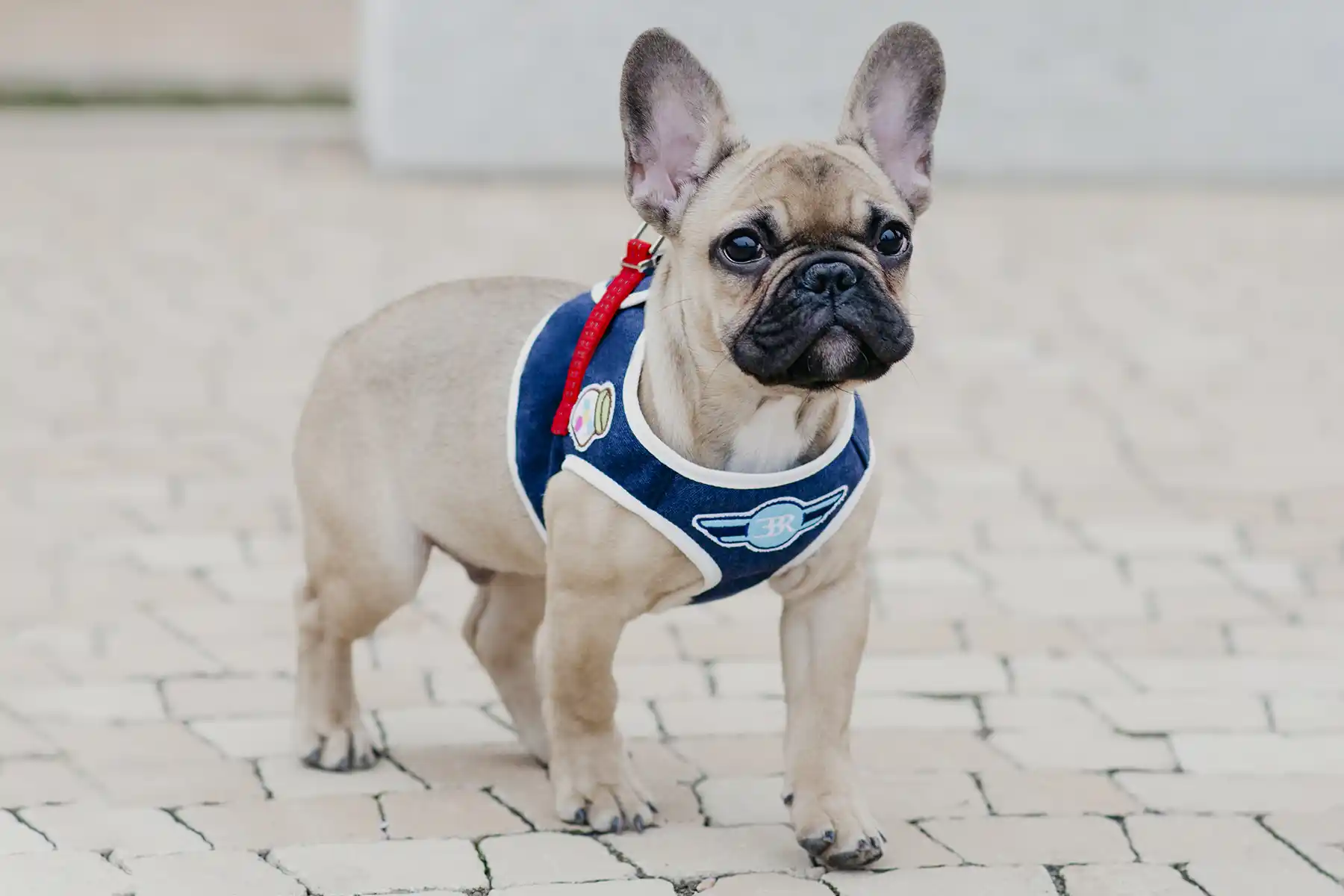
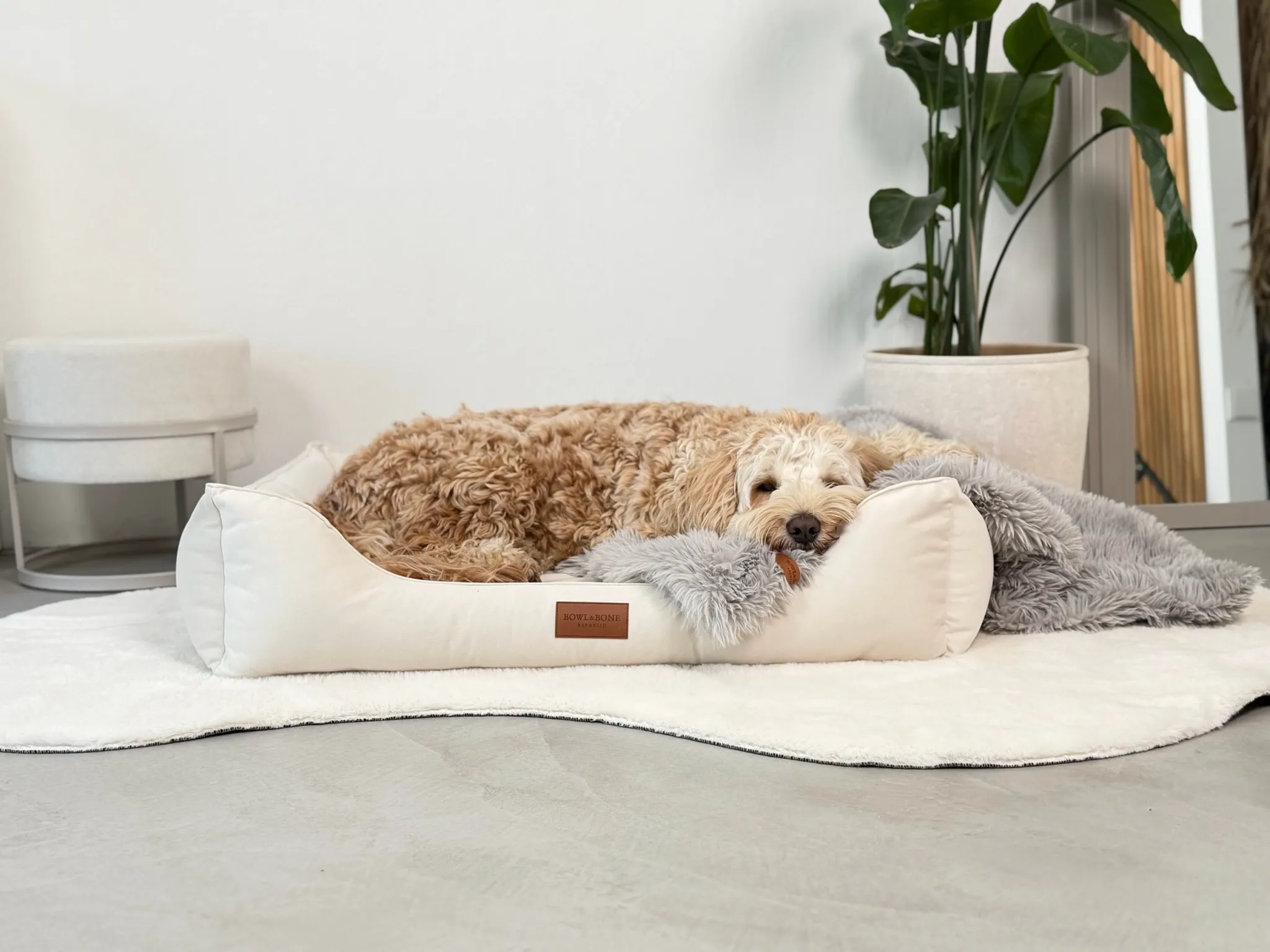
A harness is an essential part of your four-legged friend’s walking equipment. To fulfil its purpose properly, it needs to be in good condition, without damage, fraying or holes. A dog harness should be replaced as often as necessary. If you notice that it is in poor condition and could tear during a walk, you should certainly replace it with a new one.
There is no single point in time when every dog harness needs replacing. Some models remain comfortable and functional for several years, while others need to be replaced much sooner. The most important factors are the condition of the straps and stitching, the reliability of the buckles and fastenings, the stability of the adjustment, the fit against your dog’s body and your dog’s behaviour during walks. Even a harness that appears undamaged should be taken out of use if your dog can slip out of it, experiences pressure or develops chafing that cannot be resolved through correct adjustment [1][2].
When should your dog’s harness definitely be replaced? Much depends on whether you pay attention to the quality of the accessories you buy for your dog. A good-quality dog harness can serve your companion well for several years, provided it remains structurally sound and properly fitted. Rather than relying solely on the date of purchase, it is therefore worth learning to recognise specific warning signs.
What will you learn from this article? From this guide, you will learn:
- how often a dog harness should be replaced and why there is no universal replacement schedule,
- how to recognise wear in straps, stitching, buckles and metal fittings,
- when cleaning or adjustment is sufficient and when a new harness is needed,
- how to check the fit for a puppy, adult dog or senior dog,
- how to wash a dog harness without shortening its lifespan,
- whether a dog can wear a harness all day and when it should be removed,
- how to choose a new model that meets your dog’s individual needs.
How often should you replace a dog harness?
Getting straight to the heart of the matter, and answering the question of how often you should replace your dog’s harness: first and foremost, it needs replacing if you notice that it is damaged. If the fabric has started to fray, that should be a clear sign that it is time to buy a new model. You do not need to wait until a strap breaks completely or a buckle stops fastening. An accessory used to walk your dog on a lead should inspire confidence before every outing, including those moments when your dog suddenly changes direction or becomes frightened by a noise.
In practice, a harness may need replacing after just a few months of intensive use, while another may remain fully functional for several years. These are not guaranteed lifespans or recommended replacement intervals. A model used for short city walks will wear differently from a harness that regularly gets soaked during trips to the seaside, or one worn by a rapidly growing puppy. More important than the product’s age are its actual condition, how it has been used and whether it still fits your dog [1][4].
For a dog guardian, there is one simple rule worth following: before going out, check the fastenings and overall condition of the harness, regularly inspect the stitching and reassess the fit whenever your dog’s weight, body shape or coat length changes. If you notice a cracked buckle, weakened stitching around the lead attachment point or a noticeably worn load-bearing strap, do not test its strength during a walk. It is safer to use a reliable spare harness and replace the damaged one.
Dog harnesses – why is it worth having a choice?
How many harnesses does your dog have? I will happily admit that I like having a choice. My own dog has several different colours and styles in their collection. I choose between them depending on the weather, the season and the intensity of the walk we are planning. Does that mean every dog needs several different harnesses? Absolutely not. For me, it simply makes everyday life easier and adds a little colour to our routine.
But do you know how often your dog’s harness should be replaced? I can tell you that saying “when it is damaged” does not fully answer that question. There are several other factors that should encourage us to consider a replacement. I would be happy to tell you a little more about them. The most practical criterion remains everyday observation: does the harness stay in place, avoid pressure on the skin, remain stable around the body and allow your dog to move naturally?
If you have any questions about dog harnesses, be sure to leave them in the comments at the end of the article. I will be happy to answer them. After all, that is why I am here. It is particularly worth sharing situations where a seemingly suitable harness suddenly stopped fitting properly, as your experience may help other dog guardians recognise a similar problem sooner.
How many harnesses should a dog have?
The answer to this question is not entirely straightforward. Essentially, your dog should have as many harnesses as they need. What is more, your dog might not need a harness at all if they feel considerably more comfortable wearing a collar. That is also possible, although the choice of walking equipment should always take into account your dog’s build, health and behaviour. If your dog has neck or tracheal problems, or pulls strongly on the lead, it is best to discuss suitable equipment with a veterinary surgeon or appropriately qualified specialist [2].
Not every dog feels comfortable wearing a harness, and that is perfectly fine. If you would like to learn more about whether to choose a harness or collar for your dog, take a look at our guide to choosing a comfortable dog walking set, which also discusses this decision. Remember that reluctance to wear a harness does not necessarily mean your dog will never enjoy wearing one. Sometimes a different design, gentle familiarisation and rewarding voluntary cooperation can make a real difference [3].
And if your dog enjoys wearing a harness, how many should they have? First of all, it is absolutely true that one harness can be enough. However, having more than one to choose from can undoubtedly make life much easier. A second, reliable harness is particularly useful when the first is drying after a wash or when you suddenly need to stop using one because of a suspicious fastening. There is no need to buy several styles simply because they are fashionable.
Dog harnesses come in many different designs. Some are intended primarily for everyday walks, while others are created with more active outings in mind. It is therefore no surprise that your dog may benefit from having several different harnesses. Aesthetic preferences also come into play. My dog has harnesses in the same design but in different colours. Some are in more muted shades, which we tend to choose in autumn. During the summer months, meanwhile, my dog wears harnesses in more vibrant colours, including yellow and red.
Furthermore, for dogs that need additional protection against the cold, a more substantial, insulated harness can be a good option for winter days. This type of harness has an additional inner layer designed to provide a cosy, enveloping feel. The inner lining of an insulated dog harness may, for example, be made from a soft, faux-fur-like material. However, an insulated harness should not automatically be regarded as a substitute for a dog jacket in every type of weather.
Naturally, your dog would not usually wear this kind of harness in summer. That is another reason why having more than one harness can be useful. Wearing an insulated harness in summer could make your dog very uncomfortable. In high temperatures, excessive coverage may also make it harder for them to release body heat. If you are considering a seasonal walking set, read our guide to choosing a dog harness for winter and explore the red YETI dog harness, which was also featured in the original version of this article.
7 signs that your dog’s harness needs replacing
A properly fitted harness should remain in the correct position while your dog walks, sniffs, runs and stops calmly. If it no longer performs this function, looking attractive is not enough. The following seven warning signs will help you distinguish ordinary signs of everyday use from changes that may affect your dog’s safety. For each one, examine not only the product’s appearance but also how it behaves under gentle, controlled tension, without exposing your dog to a sudden pull.
– frayed straps and stitching coming apart
Why should stitching that is starting to come apart be a sign that your dog should stop wearing a particular harness? Because if your dog pulls more strongly during a walk, the harness could suddenly tear. If your dog reacts abruptly to something they see or something that frightens them, they might unexpectedly chase after it or, quite the opposite, try to run as far away as possible. Both situations could become extremely dangerous for your dog. That is why I want to emphasise that a torn harness can be a serious problem and lead to situations we would all rather avoid.
Take particular care when examining the places where a strap meets a buckle, adjuster or D-ring used for attaching the lead. These are areas where repeated tension and friction may be particularly noticeable. A single loose thread on a decorative finish does not necessarily mean the harness is failing, but a structural seam that is visibly coming apart or a strap that is becoming progressively thinner is reason enough to stop using it. We do not recommend attempting to stitch load-bearing components at home if the strength of such a repair cannot be verified.
– cracked buckles, clips and fastenings
A buckle may look perfectly fine yet no longer close securely. Check whether both sides work evenly, whether you hear the characteristic click when fastening it and whether it remains closed when gently handled. Cracks in plastic, a broken section of a clip, a fastening that jams or one that opens by itself are all signs that the harness should be taken out of use immediately. Its fastening should not give you cause for concern every time you go out, regardless of whether your dog is small or particularly strong.
After washing and after extended periods in storage, it is also worth inspecting the area where the buckle meets the strap. Fine particles of sand can interfere with its operation, so gentle cleaning in accordance with the product’s care instructions may sometimes be enough. However, if the structure itself is damaged, cleaning will not repair it. Choose designs that make fastening your dog’s harness convenient while, above all, keeping the fastening secure during movement [4].
– adjusters that no longer hold their position
A correctly adjusted harness should not gradually become longer during every walk. If you set the correct circumference before leaving home and the straps are noticeably looser after a short time, examine the adjusters and the surface of the webbing. The material may have become smoother where it comes into contact with the buckle, or the adjustment component may have lost its grip. Even a sturdy harness will then behave differently from the way its designer intended.
This gradual loosening is not merely a minor inconvenience. Overly loose harnesses can rotate around your dog’s body, move towards the armpits or make it possible for your dog to slip their legs out or back out of the harness altogether. If an adjuster no longer maintains its position, do not try to rescue the product with an improvised knot or clip. Replacing it with a fully functional harness is the more sensible choice [1][2].
– damaged D-rings and lead attachment points
The metal D-ring, the strap holding it in place and the surrounding stitching form a single system. Even if the metal itself seems sturdy, wear to the strap underneath it can significantly weaken the attachment. Check for sharp edges, bending, cracks or any changes that could damage the fabric or the lead’s snap hook. Examine these areas from different angles, as some signs of wear only become visible when you lift or move the strap.
Pay particular attention to the metal components of your dog’s harness. If the harness is already several years old and you frequently take your dog out in the rain without drying it properly afterwards, corrosion may develop on the buckles or D-rings. A superficial change in colour does not always mean that the metal has lost its strength, but deep rust, pitting, roughness and weakened attachments mean the harness should no longer be used. I am sure you would not want your dog to wear accessories showing signs of rust, so do not ignore this warning and check whether the component is genuinely still sound.
– chafing, redness and worn fur
A damaged harness can also be very uncomfortable for your dog to wear. Protruding threads or rough pieces of fabric may irritate your dog as they move. As a result, they may enjoy their walks far less. However, even equipment without any visible damage can cause problems: poorly fitted straps may rub against the skin with every step.
After a walk, inspect the armpits, sternum, chest and the areas beneath the adjusters. Recurring redness, patches of worn fur, excessive licking or reluctance to wear the harness are all reasons to check its size, design and material. If your dog has an open wound, obvious pain or skin lesions, stop using the harness and contact your veterinary surgeon. Skin irritation should never be treated as an unavoidable part of everyday walks [2][7].
– changes in body shape and an inability to achieve a proper fit
A harness does not have to be worn out to stop fitting properly. Puppies grow, adult dogs gain or lose weight, and senior dogs may experience changes in muscle mass and the way they move. Coat length, seasonal grooming and the way the harness sits over clothing can also make a difference. If the adjustment range has been exhausted and the straps are still too tight or too loose, a different size is probably needed.
Check not only your dog’s chest circumference but also the position of the chest strap and the distance from the armpits. Your dog should be able to walk, sniff and move their front legs freely without pressure concentrated in one place. Comparing their current measurements with the size chart for the specific model is a good starting point; a general S or M label is no substitute for measuring [2][5]. You can find more detailed instructions in our guide to choosing a comfortable dog harness that does not chafe or restrict movement.
– worn reflective elements and reduced visibility
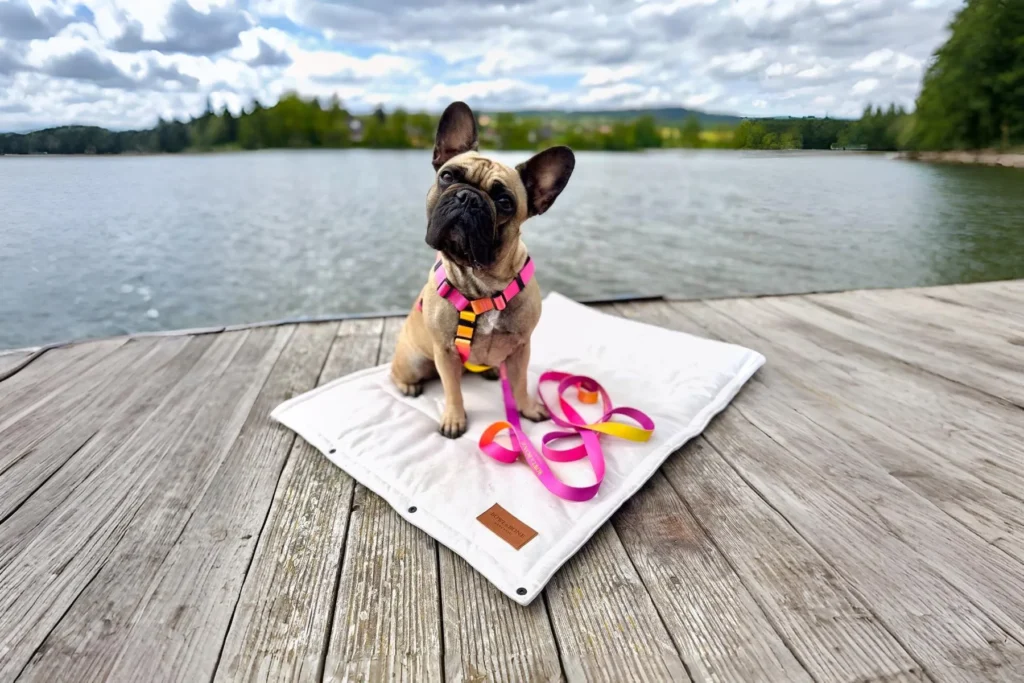
If your dog’s harness has reflective elements, you should regularly check their condition. If these details become worn or damaged, they may no longer perform their intended function properly. As a result, your dog may be much less visible after dark, which is certainly undesirable. Worn reflective elements do not automatically mean that the entire harness has lost its structural strength, but they do mean that you should reconsider how you keep your dog visible.
Carry out a simple check in low light to see whether the elements still reflect light. If they no longer work, you can use an additional, securely attached reflective accessory or walking light. If visibility was one of the main reasons you chose that particular harness, replacing it may be sensible. We also discuss the importance of reflective details in dog walking equipment in our other advice on visibility after dark. Remember, however, that reflective elements are no substitute for being careful near busy roads.
What if your dog’s harness is not damaged?
What should you do if your dog’s harness is not damaged, but you know they have been wearing it for a very long time? When should you replace it? First of all, examine the harness carefully, checking all the buckles, fastenings and clips. At first glance, everything may look perfectly fine. However, a closer inspection could reveal cracks or tears in the material that you had not previously noticed.
Pay particular attention to the metal components of your dog’s harness. If the harness is several years old and you frequently take your dog for walks in the rain without drying it properly afterwards, rust may develop on the buckles or D-rings. This does not mean that the entire harness must automatically be replaced at the first small mark, but it does mean you should assess the extent of the damage. Metal with deep pitting, a damaged connection or a sharp edge that rubs against the webbing makes the harness unsuitable for further safe use.
But what if the harness is in perfect condition? Is there any point in replacing it simply for the sake of doing so? I don’t think so. When you choose good-quality dog accessories, it is perfectly normal for a harness to serve your companion well for several years. Congratulations on making such a thoughtful purchase. Of course, this is only true if your dog’s body proportions have not changed, the harness still adjusts correctly and every component continues to work as intended.
Worn-out harnesses can also look rather unattractive. However, instead of worrying about what other people might think, concentrate on how your four-legged friend feels. More important than appearance is ensuring that the harness has no sharp edges, rough areas or pressure points that cause discomfort during a walk. Your dog does not need a new collection every season, but they do need equipment that feels comfortable.
When is adjustment or washing enough, and when is replacement necessary?
Not every problem with a dog harness requires you to buy a new one immediately. Sometimes removing sand from a buckle, correcting the position of the straps or readjusting the size after your dog has been groomed is enough. The important thing is to distinguish a cleaning or maintenance issue from damage to a component responsible for keeping your dog securely attached to the lead. If you have doubts about the structural integrity of the harness, it is not worth taking the risk of using faulty equipment on a walk.
| What have you noticed? | What can you do? | When should you replace the harness? |
|---|---|---|
| Mud, sand or an unpleasant smell | Clean according to the manufacturer’s instructions, allow to dry and check the adjustment | If the material remains damaged, stiff or irritating after cleaning |
| Straps are too loose after grooming | Measure your dog again and readjust the harness | If the adjusters cannot provide a secure fit |
| Your dog has outgrown the harness | Take new measurements and consult the size chart | If the harness remains too tight even after being adjusted correctly to its maximum size |
| A frayed load-bearing strap or stitching coming apart | Stop using the harness; do not test it during a walk | Immediately, if the damage weakens the structure |
| A cracked buckle or faulty fastening | Stop using the harness | Immediately, unless the manufacturer provides for a professionally carried out, verified safe replacement of the component |
| Worn reflective elements | Check visibility and provide additional reflective accessories | If the loss of reflectivity makes the product unsuitable for safe use in the intended conditions |
| Redness or skin chafing | Remove the harness and check the fit and your dog’s skin | If pressure or chafing continues despite adjustment; consult a veterinary surgeon if skin problems develop |
The table illustrates a simple difference: dirt can usually be removed, while damage to a component responsible for safety may not be repairable. A harness should not need constant readjustment during every walk, either. If it shifts towards the armpits, twists or becomes loose after only a few minutes, the absence of visible cracks does not mean that it is suitable. In that situation, start by measuring your dog again and examining the construction rather than simply tightening the straps further.

How often should you check the condition of your dog’s harness?
The best habit is not to put a replacement date in your calendar, but to check the product regularly. A quick inspection before a walk takes very little time and may reveal a problem that would be difficult to notice while you are out. Additional checks are worth carrying out after intensive use, washing, swimming in salt water or a particularly strong pull on the lead. Dogs Trust recommends regularly checking harnesses, collars and leads for signs of wear [1].
– a quick check before every walk
Before attaching the lead, make sure the buckles are fully closed, the straps are not twisted and the adjusters have not moved out of their secure positions. Take a quick look at the point where the lead’s snap hook connects to the D-ring. If something is clearly protruding, cracked or unusually loose, stop and inspect the equipment more carefully. This is particularly important before walking near a busy road, in woodland or anywhere your dog might react suddenly to something around them.
You do not need to carry out a complicated strength test every day. It is enough to develop the same kind of awareness you might have when checking the fastening on your own rucksack before a longer journey. This makes an unexpected failure less likely, although no inspection can provide a one-hundred-per-cent guarantee. If you notice a fault, do not assume that the harness will manage “just one more walk”.
– a thorough weekly inspection and checks after intensive use
It is worth examining the harness more closely once a week, especially if your dog wears it every day. Run your fingers along the entire length of the straps, inspect the stitching, lift the webbing around the buckles and check that the metal fittings have no sharp edges. This frequency is a practical suggestion for organising your routine, not a universal veterinary standard or a requirement for every harness design. If your dog uses their harness particularly intensively, a thorough inspection may be necessary more often.
Also check your dog’s skin beneath the straps, particularly if you notice scratching or reluctance to wear the harness. Even clean, seemingly soft fabric can cause discomfort if the way it sits against the body has changed. Inspect the product in good light and once it is dry, as wet material can be more difficult to assess. If you suspect that the adjusters are slipping, it may also be useful to compare their positions with those from the previous week.
– an additional check after washing, rain or a long break
After washing, make sure the fastenings still work and the harness is completely dry. Check that its shape has not changed and that the adjusters remain in their correct positions. After exposure to sand, seawater or mud, pay particular attention to the places where metal fittings connect to the straps. These contaminants can interfere with buckle mechanisms and accelerate the wear of certain components [4][8].
The same applies to a harness that has been stored in a cupboard for a long time. Do not assume that a model that has not been used for a year will automatically still be suitable for your dog. Your dog may have changed size, and plastic components may have been damaged during storage. Before returning to your usual walks, treat the harness as equipment that needs a full inspection and a fresh assessment of its fit.
How should you wash a dog harness to help it last longer?
Dog harnesses need to be washed or cleaned regularly, but there is no single washing temperature or method suitable for every model. Fabrics, linings, fastenings and stitching methods can differ, so the most important thing is to follow the care instructions for the specific product. Ordinary dirt is best removed reasonably quickly, before sand or dried mud begins to accumulate around the adjusters. The American Kennel Club (AKC), a US canine organisation, recommends checking buckles, hook-and-loop fastenings and signs of wear in the material when caring for a harness [4].
Before cleaning, remove loose dirt, fur and sand using a soft brush. If the manufacturer permits handwashing, use an appropriately mild cleaning product, rinse the material thoroughly and allow it to dry according to the instructions. Do not assume that every harness can go in the washing machine, be washed in hot water or be dried on a radiator. Incorrect care may damage the straps, linings and fastenings — precisely the components that determine whether the harness can continue to be used [4][8].
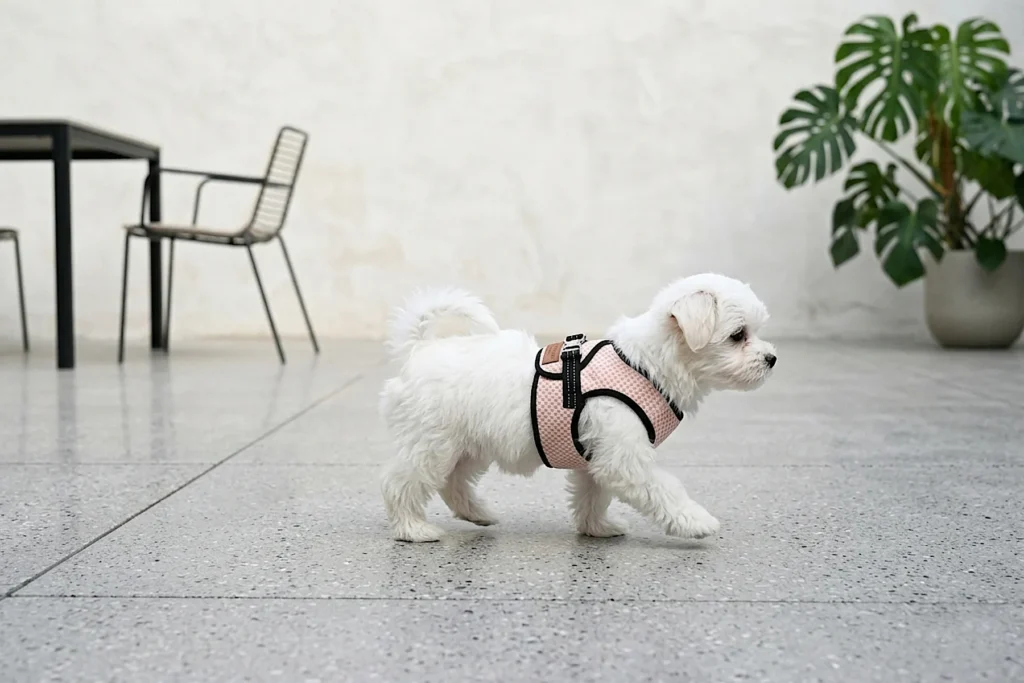
Once the harness is dry, examine the areas beneath the buckles and the stitching that may have been hidden before cleaning. Then put the harness on your dog and reassess the fit while they are standing and during a short, calm walk. If the material has become stiff, misshapen or rough, or the harness no longer sits securely against the body, do not ignore the problem simply because it now looks clean. Cleaning should help extend comfortable use, not disguise signs of damage.
When can a puppy start wearing a harness, and how often should you replace it?
Questions such as “when can a dog start wearing a harness?” and “when should a dog wear a harness?” also appear in the search data associated with this article. It is therefore worth separating two issues: when to begin introducing a puppy to a harness and when to buy the next size. Rather than specifying a single age that applies to all dogs, it is safer to consider the puppy’s readiness, correct fitting and your veterinary surgeon’s advice about their first outdoor walks. A young dog can begin becoming familiar with the process of wearing a harness at home, gradually and with rewards, without being forced [3].
Puppies often grow in spurts, which means their harnesses need to be measured and adjusted much more frequently than those worn by dogs whose bodies have reached their adult proportions. A strap that sits correctly one week may begin rubbing or putting pressure on the chest a little later. Do not buy an excessively large harness in the hope that your puppy will grow into it: a loose harness can move around and make it easier for them to escape. It is better to accept that a growing puppy may sometimes need a new size before the previous harness has shown any physical signs of wear.
Pay particular attention to your puppy after a long nap, energetic play or a change in coat length. If they try to back out of the harness, stop moving or begin scratching one particular area, check both their behaviour and the fit. Remember that reluctance to wear new equipment may result from a lack of familiarity rather than discomfort alone; both possibilities deserve a calm assessment. When teaching your puppy to wear a harness, use short exercises and positive reinforcement, in line with the recommendations of Battersea Dogs & Cats Home [3].
Can an adult or senior dog also outgrow their harness?
Although adult dogs no longer grow in the same way as puppies, their body shape does not necessarily remain unchanged throughout life. Weight gain, recovery from illness, returning to activity, muscle loss in senior dogs and long breaks from regular walks can all affect how a harness fits. Just because a harness fitted well two years ago does not guarantee that it will still sit correctly around the chest today. Your dog’s everyday needs may also change, so it is worth reconsidering the design from time to time.
For an older dog, avoiding painful pressure points and making the harness easy to put on are particularly important. If your dog has limited mobility, do not force their legs through openings that are too small or hold them too firmly while fastening the harness. Sometimes a simple adjustment is sufficient, while in other cases a differently designed model may be needed. If your dog has orthopaedic or neurological problems, or experiences pain, it is worth discussing the choice of equipment with a veterinary surgeon who knows their medical history.
Remember dogs that are returning to physical activity after treatment or a substantial reduction in exercise, too. Even a relatively small change in body proportions can matter where a strap passes close to the armpit. Careful observation is more useful than assuming that “it’s the same dog wearing the same harness”. Good equipment should fit your dog today, not just on the day you bought it.
Can a dog wear a harness all day?
This is another question that appeared in the Google Search Console report for the page discussed here. Just because your dog likes their harness does not mean that they should wear it throughout the day. Walking harnesses are intended primarily for guiding dogs on a lead and should not be left on unnecessarily, particularly during sleep or when your dog is unsupervised. There is a risk of the harness catching on something, while prolonged pressure and moisture may contribute to skin discomfort [2][7].
Once you return home from a walk, it is worth removing the harness and using the opportunity to check both the product and your dog’s skin. If the straps are wet, allow them to dry before the next use, in accordance with the manufacturer’s instructions. This means your dog can rest without wearing additional equipment, and you can spot any chafing more easily. We discuss this subject in more detail in our separate guide on whether a dog should sleep in a harness, so here we are focusing on the principles relevant to durability and regular harness inspections.
Do dog harnesses need replacing after winter or summer holidays?
The change of season alone does not mean that you need to buy a new harness. However, the beginning of spring, summer and autumn can provide natural opportunities to check your dog’s equipment. After winter, traces of dirt from wet pavements and signs of heavy use may remain. After summer holidays, sand and saltwater residue may have accumulated around the fastenings. This is a good time to clean the product according to its instructions, allow it to dry and assess the fit once again.
What may matter more is a change in the way your dog is dressed. During autumn and winter, some dogs wear jackets or jumpers, while in summer they go for walks without an additional layer. A harness adjusted over thicker clothing may be too loose when worn directly over the coat, while one fitted without clothing may become too tight when a jacket is added. Do not automatically assume that one harness will be equally comfortable in every combination. If you have any doubts, check the adjustment and the position of every strap.
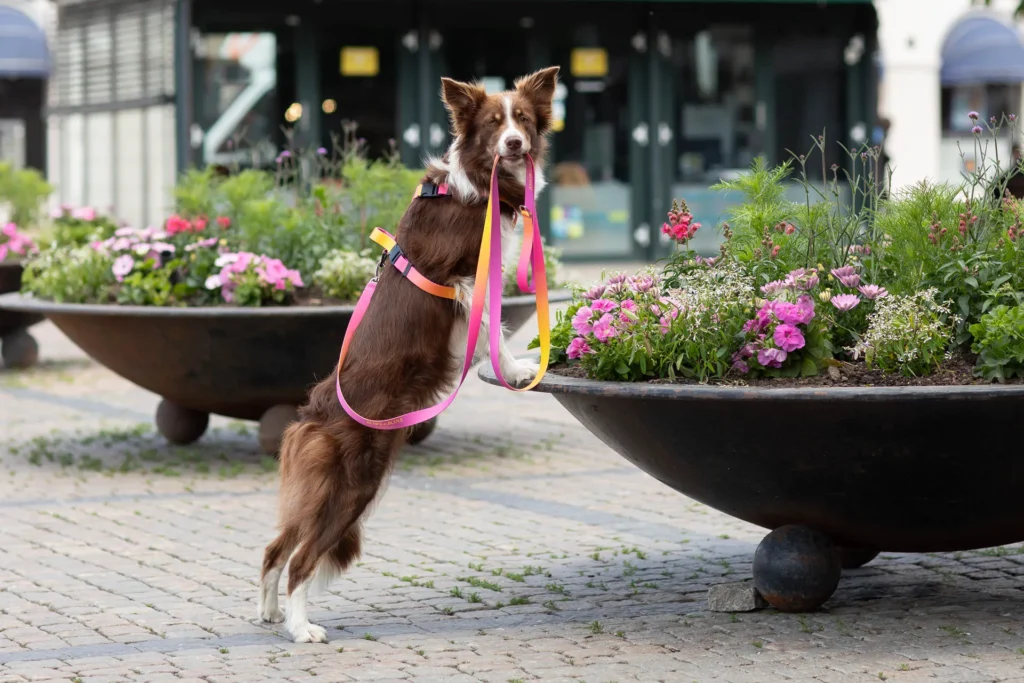
At Bowl&Bone Republic, we design different types of walking accessories because dogs vary in their needs, body shapes and everyday activity levels. More substantial winter harnesses and lighter walking models can serve different purposes, but neither should be chosen solely according to the season. Comfort comes from combining the right design, quality of workmanship and a genuinely good fit. A thoughtful choice helps you get your dog ready for a walk more calmly, without constantly having to readjust the straps.
How long can a good-quality dog harness last?
A good-quality harness can remain functional for several years, as the original version of this article also emphasised. However, this does not mean that every premium product has the same lifespan or that regular inspections are unnecessary. Durability depends on the materials, construction, intensity of use, the dog’s weight and temperament, how frequently the harness becomes dirty and the way it is cared for. The most sensible approach combines choosing a well-made product with checking its condition regularly.
When selecting a harness, it is worth paying attention to the quality of the stitching, how the ends of the straps are finished, the ease of adjustment and whether the buckles operate smoothly. The surface that comes into contact with your dog’s skin is equally important: rough or poorly positioned finishing materials can cause discomfort even when the main components are strong. A good design should consider not only how the product looks in a photograph but also how it behaves during a real walk. It is worth remembering that no material is completely resistant to mechanical wear.
Our recommendations are also supported by 15 years of experience designing PREMIUM dog accessories, together with hundreds of reviews and practical suggestions shared by dog guardians. Through our everyday contact with thousands of Bowl&Bone Republic customers, we have seen just how different people’s expectations of the same product can be. For one dog, convenient adjustment during relaxed walks is essential. For another, it is ease of putting the harness on, while for a third, it is the ability to adapt the harness to their changing body shape. This experience helps us design products in which quality, durability, exceptional comfort and aesthetics complement one another [9]. It does not, however, replace veterinary research or an individual assessment of a particular dog’s harness.
Research also shows that harness design can affect the way dogs move, and that differences between individual animals matter. A study by Williams and colleagues examined the movement of 66 dogs wearing different harness designs and highlighted the need for individual equipment selection [5]. An earlier study by Lafuente, Provis and Schmalz also identified changes in shoulder range of motion when testing different harness constructions [6]. It is therefore not reasonable to claim that one type of harness will always provide ideal freedom of movement for every dog.
How to choose a new dog harness that is comfortable and durable
When a replacement becomes necessary, start by measuring your dog again, even if you have been buying the same size for years. Compare the measurements with the size chart for the specific model and check whether its construction suits your dog’s build. A correctly fitted harness should remain stable, avoid moving into the armpits and not put pressure on sensitive areas. Once it is on, observe your dog in motion rather than judging the fit solely by how the harness looks when they are standing still [2][5].
When choosing new accessories, think about your everyday needs as well. Do you often fasten your dog’s harness in a hurry before a morning walk? Do you mainly walk around the city, or do you also enjoy woodland and beach outings? Does your dog wear an additional layer of clothing in winter, grow quickly or dislike having their legs guided through openings? Your answers will help you decide whether a harness with extensive adjustment, a softly finished vest-style model or another design suited to your activities would work best.
For example, the GRADIENT dog harness may appeal to guardians looking for a guard-style design with several adjustment points, while the ALLURE dog harness may suit those who prefer a more substantial vest-style construction. However, neither the name of a model nor a description such as “pressure-free” should be treated as a guarantee of a perfect fit for every dog. Only measuring, trying on the harness and observing your dog’s movement can help establish whether a particular design genuinely provides comfort. That is when excellent workmanship and elegant styling become a welcome addition to a carefully considered choice.
Dog walking accessories – what else is worth remembering?
Your dog can certainly have several harnesses. This means individual models can be given time to dry between walks, making proper care easier. You can also alternate between a harness and a collar, provided both options are suitable for your dog’s health, behaviour and the particular situation. What matters is checking comfort and safety whenever you change your dog’s equipment.
Do not forget about the lead, either. Its snap hook, stitching and webbing are subject to wear in much the same way as the components of a harness. Even a brand-new harness will not create a reliable walking set if the lead has a damaged attachment. A well-chosen combination allows you to focus on your dog, moving together and peacefully exploring your surroundings, rather than constantly adjusting equipment that does not work properly.
And how often do you replace your dog’s harness? Share your answer in the comments below. If you have any questions for me or would like me to explore a particular subject in a future article, be sure to leave your suggestions in the comments section. The experiences of dog guardians show that the most valuable lesson is not always about the age of a harness: sometimes the need for replacement comes down to one small change that can easily be overlooked.
Summary – when should you really replace your dog’s harness?
The right time to replace a dog harness is not determined simply by how many months have passed since you bought it. What matters is the condition of its construction, the security of the connection to the lead, the fit and your dog’s everyday comfort. Worn stitching, a cracked buckle, a faulty adjuster or a harness from which your dog can escape are reasons to stop using it immediately. On the other hand, dirt, seasonal changes in coat length or a minor adjustment to the circumference may sometimes require nothing more than appropriate cleaning and readjustment.
At Bowl&Bone Republic, we have been creating PREMIUM dog accessories for 15 years, combining craftsmanship, careful construction and a genuine commitment to listening to dog guardians. Hundreds of reviews and suggestions, together with our contact with thousands of customers, have taught us that true quality matters when it translates into your dog’s comfort and the ease of using a product every day. That is why we encourage thoughtful choices: select the right model, check the condition of the harness regularly and do not replace a fully functional product simply because time has passed. And when the moment for a change does arrive, treat it as an opportunity to reassess your dog’s needs and choose equipment that suits them today.
For more inspiration, knowledge and carefully designed dog accessories, visit www.bowlandbone.com — a place created for dog guardians who want to combine their pet’s everyday comfort with timeless style.
– the Bowl&Bone Republic team
FAQ – frequently asked questions about the article –
How often should you replace a dog harness?
How many months should you use a dog harness before replacing it?
There is no single number of months that applies to every dog and every harness. A harness should be replaced when it is damaged, no longer holds its adjustment, does not fit your dog’s body or causes discomfort. If the harness is safe, properly fitted and fully functional, the fact that it is a year old is not, in itself, a reason to replace it.
Can a dog harness last for several years?
Yes. A well-made harness can last for several years, provided the straps, stitching, buckles and lead attachment points are not damaged and it still fits your dog correctly. This does not mean that its lifespan is guaranteed, however. Intensive daily use, moisture and dirt can shorten the period during which it remains safe to use.
How can you tell if a dog harness is too small?
Warning signs include straps that put pressure on the body, difficulty fastening the harness, chafing, restricted leg movement and visibly stretched material. First, measure your dog again and check the adjustment and size chart provided by the manufacturer. If the harness remains too tight despite correct adjustment, a different size or design is needed.
How often should you replace a puppy’s harness?
As often as required by the puppy’s growth and changing body proportions. A puppy may outgrow their harness before it shows any signs of wear. Check the circumference and position of the straps regularly, avoid buying an excessively large harness “to grow into” and replace it when a correct fit is no longer possible.
How should you wash a dog harness, and can you put it in the washing machine?
The correct washing method depends on the material, lining and construction of the harness. Always check the manufacturer’s care instructions first, as not every model is machine washable. After cleaning, rinse it thoroughly, dry it as recommended and check the stitching, buckles and adjustment before your next walk.
Can a dog wear a harness all day?
In most cases, there is no need. A walking harness is best removed once the activity has finished, particularly before overnight sleep and whenever your dog is left unsupervised. This helps reduce the risk of the equipment catching on surrounding objects and makes it easier to inspect your dog’s skin and coat.
Is it safe to use a dog harness with a slightly cracked buckle?
No. A cracked buckle may open under tension even if it initially appears to work correctly. Stop using the damaged harness and choose a reliable replacement. Any replacement of individual components should only be carried out in a way approved and verified as safe by the manufacturer.
Should you replace a dog harness if it causes chafing?
First, remove the harness, inspect your dog’s skin and check whether the problem is related to the size, position of the straps, material or design. If chafing continues despite correct adjustment, choose a differently fitted model. If your dog has painful, extensive or damaged areas of skin, consult a veterinary surgeon.
Sources and inspiration used to write the article
“How often should you replace a dog harness? 7 signs it’s time for a new one”
[1] Dogs Trust, “How to train your dog to wear a harness” – guidance on fitting, gradually familiarising a dog with a harness and regularly checking harnesses, collars and leads for signs of wear.
https://www.dogstrust.org.uk/dog-advice/training/outdoors/harness-training
[2] VCA Animal Hospitals, “Collar and Harness Options for Dogs” – veterinary guidance on choosing walking equipment, the risks of chafing, restrictions to movement and safety considerations when using a harness.
https://vcahospitals.com/know-your-pet/collar-and-harness-options-for-dogs
[3] Battersea Dogs & Cats Home, “Train your dog to wear a collar, lead or harness” – recommendations on introducing a dog to walking equipment, achieving a proper fit and developing positive associations with wearing a harness.
https://www.battersea.org.uk/pet-advice/dog-advice/train-your-dog-wear-collar-lead-harness
[4] American Kennel Club, “Choosing the Right Harness for Your Dog” – guidance on checking buckles and materials, as well as cleaning and caring for different types of dog harness.
[5] Williams E., Hunton V., Boyd J., Carter A., “Effect of harness design on the biomechanics of domestic dogs (Canis lupus familiaris)”, Journal of Applied Animal Welfare Science – a study involving 66 dogs, highlighting the importance of selecting harness designs according to the needs of individual animals. DOI: 10.1080/10888705.2023.2259796.
https://pubmed.ncbi.nlm.nih.gov/37731281
[6] Lafuente M. P., Provis L., Schmalz E. A., “Effects of restrictive and non-restrictive harnesses on shoulder extension in dogs at walk and trot”, Veterinary Record – research examining the effects of two different harness constructions on shoulder range of motion. DOI: 10.1136/vr.104946.
https://pubmed.ncbi.nlm.nih.gov/30455191
[7] PetMD, “Surprising Dog Harness Dangers to Avoid” – veterinary advice concerning friction, skin irritation, wet harnesses and leaving dogs wearing harnesses for prolonged periods.
https://www.petmd.com/dog/care/surprising-dog-harness-dangers-avoid
[8] Maytag, “How to Wash Dog Leashes & Harnesses” – practical guidance on washing, following care instructions and drying dog harnesses safely.
https://www.maytag.com/blog/washers-and-dryers/how-to-wash-dog-leashes-and-harnesses.html
[9] Bowl&Bone Republic, “ALLURE pink dog harness” and the brand’s own practical experience – information about PREMIUM harness design, craftsmanship, materials and European manufacturing. The statements concerning 15 years of experience and customer feedback come from the brand’s own knowledge and records, not from independent scientific research.