You are choosing new clothing for your dog, measuring them carefully and starting to compare the results with the size chart. Their chest circumference fits size M, their back length is closer to L, while their neck measurement… seems to fall somewhere in between. It is precisely in situations like this that the question arises: should you try to fit your dog into one of the standard sizes, or would made to measure dog clothing be the better solution?

An individual size is not a solution every dog needs. A well-designed standard size range can work perfectly when your dog’s key measurements fit comfortably within a single size. Made to measure clothing starts to make more sense when the issue is not the dog’s overall size, but their proportions – for example, a broad chest combined with a shorter back, or a very slim torso with greater body length.
What matters most, therefore, is not whether the label says XS, M or “made to measure”, but how the garment actually fits the individual dog. A correctly fitted model should allow your dog to walk, sit, run and move naturally without obvious pressure, bunching or shifting of the fabric [1][2].
What will you learn from this article? In this guide, you will find out:
- when a standard dog clothing size will be sufficient,
- when it is worth considering made to measure dog clothing,
- why breed and body weight alone are not enough to choose the correct size,
- what to do when the chest, neck and back length indicate different sizes,
- which body proportions most often make ready-made clothing difficult to fit,
- how to tell whether dog clothing is too tight or too loose,
- how to measure your dog correctly before ordering clothing,
- whether made to measure is always better than a standard size,
- how dog clothing can affect harness fit,
- what to consider before ordering an individually made product.
Made to Measure Dog Clothing or a Standard Size? The Short Answer
Made to measure dog clothing is worth considering primarily when your dog’s key measurements do not fit comfortably within one standard size, or when ready-made garments regularly fit correctly in one area but are too tight or too loose elsewhere.
If, on the other hand, your dog’s chest circumference, neck circumference and back length all correspond to one size in the chart for a particular model, a correctly fitted standard product can be an equally practical solution. Made to measure clothing should not be a goal in itself – it should solve a genuine fitting problem.
| Situation | Standard size | Made to measure |
|---|---|---|
| all key measurements fit one size in the chart | usually a good choice | generally unnecessary |
| chest circumference and back length indicate different sizes | may require a compromise | worth considering |
| dog has unusual proportions | depends on the cut | often practical |
| dog is still growing rapidly | usually more sensible | may quickly become too small |
| standard clothing regularly feels tight in one area | worth trying a different cut | worth considering |
| clothing will be worn with a harness or an additional layer | the complete set needs checking | may make fitting easier |
| dog does not tolerate having clothing put on | changing the size may not be enough | calm familiarisation is needed first |
When Is a Standard Dog Clothing Size the Best Choice?
Made to measure sounds appealing, but it does not automatically mean that a standard size is a compromise. If the product is well designed, the size chart suits your dog’s proportions and the cut gives them sufficient freedom, a ready-made size can perform its role very well.
A good example is a situation in which, after measuring your dog, the neck circumference, chest circumference and body length all fit comfortably within one size. Once the garment is on, it remains stable, does not twist and does not visibly affect the way your dog moves. In that case, there is no need to complicate the choice simply for the sake of ordering an individual product.
– a standard size is sufficient when your dog’s proportions match the chart
It is best to treat XS, S, M or L simply as names for individual size variants. The actual measurements in centimetres provided in the chart for a particular product are far more important. This is why it is worth measuring your dog again before buying, even if clothing from another brand previously had exactly the same size label.
At Bowl&Bone Republic, detailed sizing information is provided directly with individual models. You can explore the complete current Bowl&Bone Republic dog clothing collection. If you need detailed instructions on taking measurements, you can also read our guide “How to choose the right size of dog clothes?”

Do not automatically transfer the same size between different cuts either. A jacket, sweater and raincoat can have a different construction, degree of elasticity and fastening system. Even within one brand, it is always worth checking the size chart assigned to the specific model.
– a standard size may be better for a dog that is still growing
With a puppy, it is worth remembering that their proportions may still change noticeably. Clothing made precisely according to today’s measurements may no longer suit the growing dog’s body after a few weeks or months. In such a situation, one of the ready-made sizes may be the more practical solution for this transitional stage.
This does not, of course, mean choosing clothing that is clearly too large “to grow into”. An excessively loose model can also shift during movement, rotate around the torso or interfere with freedom of movement. Rather, the point is to consider investing in an individual cut once your dog’s body shape has become more stable.
When Is It Worth Ordering Made to Measure Dog Clothing?
Most often, the deciding factor is not one unusual measurement, but the relationship between several measurements. Dogs vary enormously in both size and body structure [8], which means that even an extensive size chart cannot perfectly represent every possible body shape.
This is when made to measure dog clothing stops being simply an additional form of personalisation and begins solving a specific problem. The aim is not to create a product that is “more luxurious” than the standard version. The greatest value of made to measure clothing lies in the ability to alter the proportions between individual parts of the garment.
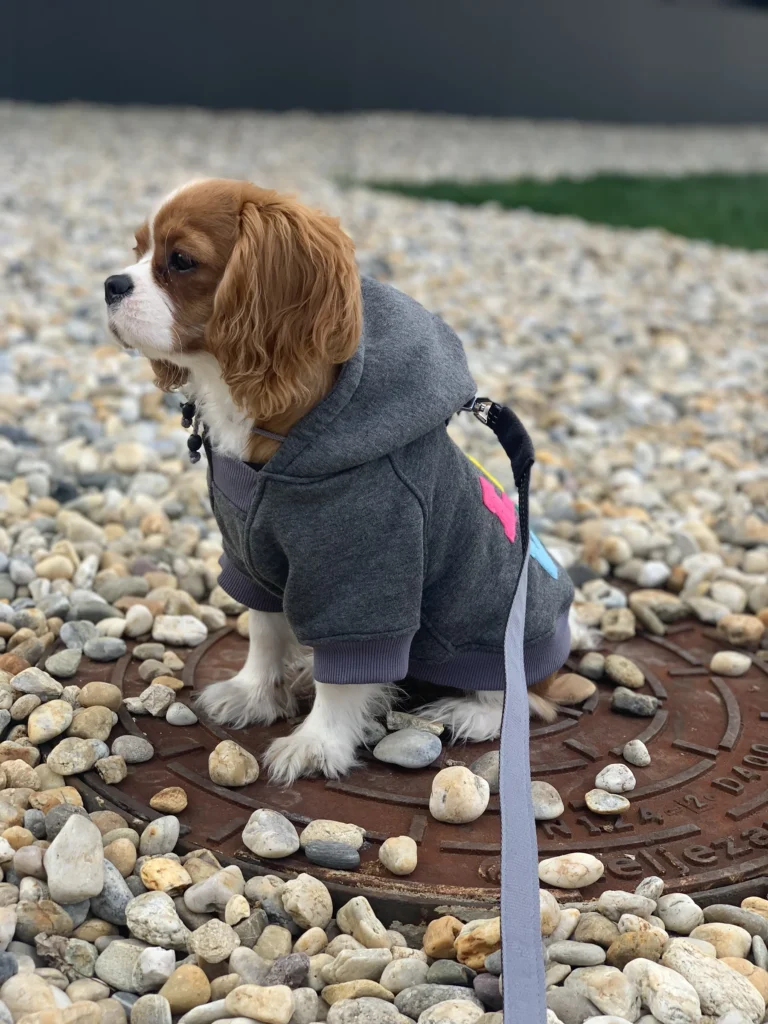
– when the chest circumference and back length indicate two different sizes
This is one of the clearest signs. Imagine a dog whose chest corresponds to size L, while their back length falls within size M. Choosing the larger model may result in clothing that is too long, while the smaller version may be too tight around the torso.
If this situation occurs repeatedly with different cuts, an individual size can help you avoid having to choose between two imperfect options. For the dog, this means a better balance between body coverage and freedom of movement, while for the guardian it can mean less need to keep adjusting the clothing during a walk.
– when the dog has a broad chest and a shorter back
Some dogs have a proportionally broad chest compared with the length of their body. This can create a characteristic problem with ready-made clothing: a model that fits correctly around the chest is too long, while the correct length comes with an insufficient circumference.
This body shape should not automatically be associated only with particular breeds. Even dogs of a similar size and weight can have very different proportions. In practice, it is always better to rely on the actual measurements of the individual dog and treat breed only as an approximate guide.
– when the dog is very slim with a long torso
The opposite situation occurs in dogs with a longer, narrower body shape. A product that is correct in length may be too loose around the chest or neck, while a model that fits correctly in circumference may finish much too early along the back.
PDSA points out that dogs with elongated body shapes, including some sighthounds, may require coats designed with those proportions in mind because a conventional cut may not always fit correctly [2]. Made to measure clothing is one way of addressing this type of problem.
– when the dog is smaller or larger than the standard size range
Not every size range starts small enough or extends far enough for every individual dog. If your dog’s measurements fall outside the available chart, choosing the nearest size is not always a sensible solution.
For situations like these, it is worth exploring Bowl&Bone Republic dog accessories made to measure. An individual approach makes it possible to consider producing selected items in measurements that better correspond to the needs of a particular dog.
– when ready-made clothing always moves in the same place
If successive garments regularly rotate around the torso, ride up towards the neck or shift while your dog walks, the cause may be either the size or a particular cut that does not suit your dog’s proportions. It is worth trying a different style first. If, however, the same issue occurs across several standard models, an individual option becomes much more justified.
A 2026 study using virtual 3D analysis of dog clothing found that, within the simulation, pressure distribution varied depending on the size of the dog model, movement and type of fabric, with relatively high values appearing, among other areas, around the chest and abdomen [6]. The authors did not conduct trials on live dogs, so the results should not be interpreted as proof that a particular type of garment will always create a specific pressure. The study does, however, illustrate why clothing construction should also be assessed during movement rather than only while the dog is standing still.
Made to Measure Does Not Mean “As Tight as Possible”
This distinction is very important because the phrase “perfectly fitted” can easily be interpreted as clothing that sits extremely close to the body. A dog should be able to perform natural movements, however, and clothing should not interfere with walking, running, sitting or toileting [1][2][5].
An individual cut should allow the proportions to be adjusted rather than eliminating all freedom of movement. The necessary amount of ease will depend on the construction and material, which is why it is not advisable to add one universal number of centimetres to every measurement yourself. Follow the instructions provided for the specific model.
– clothing that is too tight
A model that is too small can visibly restrict stride, become tight across the chest or cause the dog to move differently from how they do without clothing. Your dog may also try to bite the fabric, scratch themselves or rub against furniture. PDSA lists behaviours such as these as possible signs that the clothing is irritating the dog or does not fit correctly [2].
Do not assess clothing solely on whether you managed to fasten it. Observe your dog while walking normally, turning and sitting. Also check whether the fabric gathers around the armpits or interferes with the free movement of the front legs.
– clothing that is too loose
A size that is too large does not automatically mean greater comfort either. The material can shift, rotate or form folds in areas where harness straps will sit. Clothing that is too loose can also interfere with movement if a paw begins slipping into the wrong place.
The key to correctly fitted dog clothing is stability combined with freedom. Your dog should be able to move naturally, while you should not need to readjust the garment every few minutes.
How Do You Measure a Dog Correctly for Made to Measure Clothing?
Made to measure clothing offers considerably greater fitting possibilities, but the quality of the final result also depends on the quality of the measurements. If you provide incorrect values, individual production cannot automatically “correct” them.
It is best to use a soft tailor’s measuring tape and measure your dog while they are standing naturally on all four paws. Do not take measurements while your dog is sitting, lying down or bending their body significantly. PDSA and VCA Animal Hospitals identify back length, chest circumference and – depending on the design – neck circumference as key measurements when choosing a dog coat [2][5].
– chest circumference
For most dog clothing, this is one of the most important measurements. The measuring tape should be passed around the chest at the point indicated in the instructions for the specific model, usually around its widest part.
Do not tighten the tape into your dog’s coat or deliberately try to “reduce” the measurement. At the same time, do not add an arbitrary allowance yourself if the manufacturer asks for the dog’s actual measurement. The way constructional ease is incorporated can vary between different cuts.
– neck circumference
This measurement becomes particularly important with clothing that goes over the head, models with a roll neck or jackets with a more enclosed upper section. An opening that is too tight can make dressing more difficult and create unnecessary pressure.
If your dog dislikes having anything pulled over their head, remember that made to measure clothing does not in itself solve an aversion to the way the garment is put on. Dogs Trust recommends gradually and positively familiarising a dog with clothing, particularly when this is a new experience for them [3].
– back or body length
This measurement is most commonly taken from around the base of the neck to the base of the tail, but the exact start and end points may depend on the cut of the product. Always check the measuring diagram provided for the specific garment.
This is especially important for unusual proportions. A dog may have a circumference that fits a standard size perfectly, but a body length that causes the ready-made garment to finish too early or extend too far over the rear part of the body.
– it is worth taking measurements more than once
If a difference of one or two centimetres could determine which size you choose, do not rely on a single measurement taken in a hurry. Allow your dog to stand calmly, measure again and compare the results. Accuracy is particularly important with an individual order because the product will be made specifically on the basis of the values you provide.
If any result raises doubts, it is better to ask the manufacturer before production begins than to adjust the measurements yourself based on assumptions.
Is Made to Measure Dog Clothing Always Better Than a Standard Size?
No. A correctly chosen standard size is better than poorly measured clothing made individually.
Made to measure production allows the proportions of the product to be changed, but it does not replace an appropriate cut, suitable materials or accurate measurements. Nor will it automatically make a dog enjoy wearing clothing.
If a standard model fits very well and your dog can move freely in it, there is no need to order an individual version simply because it sounds more exclusive. At Bowl&Bone Republic, we treat made to measure production primarily as a way to solve fitting problems and only secondarily as a form of personalisation.
When Will Made to Measure Clothing Not Solve the Problem?
There are situations in which changing the measurements of a product is not the right first step. It is worth recognising these before placing an individual order, because even perfectly tailored clothing cannot solve every issue connected with a dog’s wardrobe.
– when the dog does not need clothing
Not every healthy dog needs an additional layer during colder walks. Factors such as coat type, age, size, condition, health and weather conditions all matter. Blue Cross and PDSA indicate that extra clothing may be more useful for, among others, short-haired, small, older, very young dogs or those that are more sensitive to cold [2][4].
Do not buy clothing simply because you can order a perfectly fitted version. First consider whether your dog genuinely needs additional protection in the conditions in which they will wear it.
– when the problem is the way the clothing is put on
A dog can have perfectly tailored clothing and still dislike putting their head through an opening, fastening underneath the stomach or the sensation of fabric touching the body. Dogs Trust recommends gradually building positive associations in such cases and allowing the dog to become calmly accustomed to the new item [3].
If your dog moves away, turns their head or clearly tries to avoid the clothing, do not try to solve the issue solely by changing the size. First consider whether the cut and the way the garment is put on may be the real cause.
– when the problem is the wrong cut
Two models in exactly the same size can fit a dog very differently. One may have a deeper cut around the stomach, another a different shape across the chest, while a third may be made from a more elastic material.
If a particular cut simply does not suit the way your dog moves, narrowing or lengthening it may not be enough. Sometimes choosing a different construction altogether is a much better solution than trying to adapt the first selected model as much as possible.
Standard and Individual Sizing Using the BLIZZARD Jacket as an Example
A good example illustrating the purpose of both solutions is the BLIZZARD grey winter dog jacket. The model is available in six standard sizes from XXXS to L, while the product page also provides the option to enquire about a made to measure version.
If your dog fits one position in the size chart, the standard version is the natural choice. If, however, one of the key measurements differs significantly from the others or the standard cut would require a substantial compromise between length and circumference, it is worth asking about individual production.
For your dog, the benefit is the possibility of obtaining clothing that better corresponds to their proportions. For the guardian, it means a greater chance that a high-quality PREMIUM product will be not only elegant but, above all, comfortable during real everyday walks.
A similar option to enquire about a made to measure version is available with the STORM yellow dog raincoat. This means individual tailoring can be treated as an additional option when the standard sizing of a particular model does not correspond well to your dog’s proportions.

Made to Measure Dog Clothing and Harnesses – Think About the Complete Set
This is particularly important with jackets and raincoats. Even correctly fitted clothing increases your dog’s circumference and changes the surface on which the harness straps sit. The complete set should therefore be assessed together.
If the harness will be worn over the jacket, check its adjustment range again once the jacket is on. If the harness will sit underneath the clothing, make sure that the jacket does not press adjusters, buckles or other elements against your dog’s body. Thick folds of fabric should not create additional pressure points either.
We discuss this subject in detail in our guide “Which dog harness for winter? Can a jacket and harness be comfortable together?”. If the garment is being made to measure, it is worth explaining at the stage of agreeing the details how your dog will wear their harness.
Almost 15 Years of Designing Dog Accessories Has Shown Us That the Problem Is Often Not a Dog’s “Size”, but Their Proportions
At Bowl&Bone Republic, we have been designing PREMIUM dog accessories for almost 15 years. During this time, we have received hundreds of questions, opinions and practical suggestions from dog guardians, while feedback from thousands of satisfied customers has allowed us to see just how different dogs’ body shapes can be, even when they have a similar weight or overall size.
One situation occurs particularly often: the clothing fits around the chest but is too long, or the length is correct but there is not enough freedom around the torso. This is exactly why simply saying “my dog weighs 8 kg” is not enough to choose a product precisely.
Made to measure production allows us to approach cases like these individually. The aim is not to create clothing that sits as tightly against the body as possible, but to maintain the correct proportions between individual elements. For the dog, this means a greater chance of achieving a comfortable fit; for the guardian, it offers the possibility of combining practicality, exceptionally high-quality craftsmanship and Bowl&Bone Republic’s characteristic elegant design.
Our design experience does not, however, replace observing the individual dog. Once the clothing arrives, it is still important to watch your dog moving in it and make sure that they behave naturally and that no part of the construction requires adjustment.
How Do You Check the Fit After Putting the Clothing On?
Do not finish the fitting the moment you fasten the final snap. Allow your dog to walk around the house, turn, sit and take a few quicker steps. Dogs Trust points out that a dog should have the opportunity to become gradually accustomed to the way clothing affects how their body feels and their natural movement [3].
Pay particular attention to the neck, chest, armpit and stomach areas. Check that the fabric remains stable, does not cut into the dog as their legs move and that the rear part of the garment does not interfere with walking. Also see how the product behaves as your dog turns and lowers their head.
If your dog starts moving in an unnaturally stiff way, tries intensively to remove the clothing, bites it or rubs against furniture, do not automatically assume that they “just need to get used to it”. First reassess the size, the way the garment is put on and the cut [2][3].
Made to Measure Dog Clothing – What Should You Establish Before Ordering?
Before sending measurements, make sure you know exactly which model you are ordering and which measurements the manufacturer requires. Do not assume that the same set of measurements needed for a sweater will also apply to a jacket or raincoat.
It is also worth explaining whether the clothing will be worn directly over your dog’s coat or combined with another layer, as well as how your dog wears their harness. Each of these details may matter when assessing whether an individual version is genuinely needed.
Do not increase measurements yourself “just in case” unless the instructions for the particular product clearly require it. If the manufacturer asks for your dog’s actual circumference, it is best to provide that exact value and allow the person making the product to incorporate the appropriate constructional ease.
Can Made to Measure Dog Clothing Be Returned?
This is something worth checking before placing an individual order. The Polish Office of Competition and Consumer Protection (UOKiK) points out that there are exceptions to the right to withdraw from a distance contract. One of these covers non-prefabricated goods made according to the consumer’s specifications or intended to meet their individual needs [7].
In practice, this means that with a product made specifically according to measurements you have provided, the right to withdraw may not apply in the same way as it does to a standard product. Before ordering, always read the current terms and conditions of the particular shop and carefully verify the measurements you submit.
The right to withdraw from a contract should not, however, be confused with consumer rights relating to goods that do not conform to the contract. These are separate issues.
Standard Size or Made to Measure – How Do You Make the Final Decision?
First measure your dog according to the instructions for the specific product. Then compare all required values with the size chart rather than concentrating on one measurement alone. If the neck, chest and body length all correspond well to one size, start with the standard version.
If, on the other hand, the individual measurements consistently point towards two different sizes, or previous clothing has always been too tight in one area and too loose in another, made to measure dog clothing may be a much more justified choice.
Do not treat the custom option as a luxury that every dog needs. Its greatest value is the ability to solve a specific issue with body proportions. When a standard size fits well, there is no need to replace it. When standard sizing forces a compromise at the expense of comfort or stable positioning, an individual cut provides much greater flexibility.
If you would first like to compare the available models, explore the complete Bowl&Bone Republic dog clothing collection. If your dog falls outside standard proportions, you can also explore our dog accessories made to measure and contact us before placing an individual order.
For more inspiration, practical knowledge and carefully designed dog accessories, visit www.bowlandbone.com – a place created for dog guardians who want to combine their dog’s everyday comfort with timeless style.
– the Bowl&Bone Republic team
FAQ – Frequently Asked Questions about the article –
Made to Measure Dog Clothing – When Is It Worth Ordering Instead of a Standard Size?
When is it worth ordering made to measure dog clothing?
Made to measure is worth considering primarily when your dog’s measurements do not fit comfortably within one standard size. A typical example is when the chest circumference corresponds to one size while the back length corresponds to another. An individual option can also be practical for dogs with particularly broad, slim, long or very small body shapes.
Is made to measure dog clothing always better than a standard size?
No. If all the important measurements fit comfortably within one size and the clothing remains stable during movement, a standard product can be an excellent solution. Made to measure makes the most sense when it solves a genuine fitting problem.
How do you measure a dog for made to measure clothing?
The most commonly required measurements are back or body length, chest circumference and neck circumference. It is best to measure your dog with a soft tailor’s tape while they are standing naturally on all four paws. Always follow the instructions for the specific model, as measurement points and the required amount of ease may differ.
What should you do if your dog falls between two sizes?
First check which measurement is causing the problem and whether the cut offers adjustment or elasticity that allows one of the standard sizes to fit correctly. If different parts of the dog’s body clearly correspond to different sizes and choosing one always requires a significant compromise, it is worth asking about the possibility of made to measure clothing.
Can you order a made to measure dog jacket?
Yes, if the manufacturer offers this service for the particular model. For example, the Bowl&Bone Republic BLIZZARD winter dog jacket is available in a broad standard size range, while its product page also provides the option to enquire about a made to measure version.
Should made to measure clothing fit very tightly around the dog?
No. Made to measure means adapting the proportions of the product to the dog’s body, not tightening the fabric as closely as possible around them. A dog should be able to walk, sit, run and perform natural movements freely [1][2][5].
How can you tell if dog clothing does not fit correctly?
Possible warning signs include restricted natural movement, visible tension in the fabric, clothing shifting out of position, a paw slipping into the wrong place, biting the garment, scratching or attempts to rub against the floor or furniture. After putting on a new product, always observe your dog while they are moving as well [2][3].
Is it worth ordering made to measure clothing for a puppy?
Not always. A puppy may grow quickly and change proportions, which means clothing made precisely according to their current measurements can become too small relatively soon. In many cases, a correctly chosen standard size will be more practical until the dog’s body shape becomes more stable.
Can made to measure dog clothing be returned?
Products made according to an individual specification may be subject to different rules from standard goods bought online. UOKiK indicates that one exception to the right to withdraw concerns non-prefabricated goods made according to the consumer’s specifications or intended to meet their individual needs [7]. Always check the seller’s current terms and conditions before ordering.
Can a harness be worn over made to measure dog clothing?
Yes, but the fit of the complete set needs to be checked. An additional layer changes the dog’s circumference and the way the straps sit. Once the clothing is on, readjust the harness and make sure that nothing creates pressure, shifts the product out of position or restricts movement.
Sources and Inspiration Used to Write the Article
“Made to Measure Dog Clothing – When Is It Worth Ordering Instead of a Standard Size?”
- PDSA – People’s Dispensary for Sick Animals, “Is it ok to dress up my pet?” – information concerning the practical use of clothing for dogs and the importance of freedom of movement, comfort and observing the animal’s response.https://www.pdsa.org.uk/what-we-do/blog/is-it-ok-to-dress-up-my-pet
- PDSA – People’s Dispensary for Sick Animals, “Vet Q&A: Does my dog need to wear a coat on winter walks?” – guidance on measuring a dog for a coat, correct garment fit and dogs that may benefit from additional protection against cold weather.https://www.pdsa.org.uk/what-we-do/blog/vet-qa-does-my-dog-need-to-wear-a-coat-on-winter-walks
- Dogs Trust, “How to get your dog used to wearing a coat” – guidance on gradually familiarising a dog with clothing and observing their comfort and natural movement.https://www.dogstrust.org.uk/dog-advice/life-with-your-dog/seasonal/coat
- Blue Cross, “Advice for Dogs and Puppies in Winter” – information concerning dogs that may be more likely to require additional protection from cold weather and individual differences in tolerance of low temperatures.https://www.bluecross.org.uk/advice/dog/dogs-in-winter
- VCA Animal Hospitals, “Do Dogs Need Coats In The Winter?” – guidance concerning measurements of back length, chest and neck circumference and the importance of correctly fitting a jacket or sweater.https://vcahospitals.com/resources/lifestyle-dog/supplies/what-to-consider-when-choosing-a-dog-jacket
- Kim J., Chae Y., “Comfort evaluation of dog apparel using 3D virtual fitting with clothing pressure across body size, movement and fabric”, Scientific Reports, 2026 – a simulation study analysing clothing pressure distribution according to the size of the dog model, movement and type of fabric.https://pubmed.ncbi.nlm.nih.gov/42036430/DOI: 10.1038/s41598-026-50013-3
- Polish Office of Competition and Consumer Protection (UOKiK), “Wyłączenia” – information concerning exceptions to the right to withdraw from a contract, including non-prefabricated goods made according to the consumer’s specifications.https://prawakonsumenta.uokik.gov.pl/prawo-odstapienia-od-umowy/wylaczenia-prawa-do-odstapienia/
- Boyko A.R. et al., “A simple genetic architecture underlies morphological variation in dogs”, PLOS Biology, 2010 – a publication concerning the considerable variation in size and morphological characteristics among dogs.https://pubmed.ncbi.nlm.nih.gov/20711490/DOI: 10.1371/journal.pbio.1000451