


There are moments when a dog guardian looks at their four-legged friend and wonders what exactly is going on inside that adorable head. The dog is standing on the grass, a toy lies just a few steps away — the very toy he proudly brought over with great enthusiasm a moment ago — and now, suddenly, he cannot see it. He looks left, he looks right, he sniffs, puts on the face of a very serious detective and appears as though the object has simply vanished into thin air.

The guardian sees the toy straight away. The dog, not necessarily. And it is not always about distraction, lack of attention or a dramatic loss of interest in his own collection of treasures. Sometimes it is simply because a dog sees the world differently from a human.
For many years, people repeated the idea that dogs see only in black and white. It is one of those myths that sounds simple, which is probably why it has lasted so long. In reality, however, things are much more interesting. Dogs do see colours, but not in the same way as humans. Their world is not a black-and-white film, but it is also not as rich in reds, greens and the full variety of colours as ours. For a dog, shades of blue and yellow are the most important, while many colours from the red, orange or green range may appear much less distinct.
This is fascinating knowledge, but it is also very practical. It can help you choose a toy that will be more visible to your dog on the grass. It may explain why a yellow ball is often easier to find than a red one. It can also make us look differently at dog accessories, walks and everyday situations in which our pet is not so much “failing to notice” something, but simply experiencing the world in his own way.
Because a dog does not see a less beautiful world. He sees the world differently. More through scent, more through movement, more through contrast. Colour is only one of many pieces of information for him — often less important than scent, movement, sound or the emotions of his guardian.
Can dogs see colours?
Yes, dogs can see colours. It is not true that dogs see only black, white and grey. However, their colour vision is limited compared with human vision. Humans usually have three types of cones responsible for seeing colours, which allows us to distinguish a wide range of shades of red, green and blue. Dogs have two types of cones, which is why their colour vision is described as dichromatic.
In the simplest terms: dogs recognise shades of blue and yellow best. Colours such as red, orange or green may appear less vivid to them and more similar to shades of grey, brown, beige or muted yellow. It is a little as if a dog’s colour palette were calmer, less contrast-rich in the areas that, for humans, are very intense.
For us, a red toy on green grass may be obvious. For a dog, not necessarily. If red and green are less distinguishable to him, such a toy may blend into the background. The dog may then rely more on his nose, movement and memory of the place than on colour alone.
This is very important because it helps us better understand our dog’s everyday behaviour. A dog who does not notice a toy does not have to be stubborn or distracted. He may simply be looking at the world through a completely different filter from ours. And because a dog’s nose is a far more important tool for discovering reality than human eyes, dogs very often “see” the world primarily through scent.
What colours can dogs see best?
Dogs see colours similar to blue and yellow best. These are the colours that are most readable for them. Blue, navy, yellow and some shades of violet or light blue may be easier to notice than red, orange or green.
This does not mean, however, that every dog will respond only to blue and yellow objects. Dogs do not choose the world with their eyes alone. Scent, texture, shape, movement, sound and association are hugely important to them. A toy may be a favourite not because it is the perfect colour, but because it smells of home, makes an interesting sound or was part of the best game with a guardian. And as we all know, in the dog world “that one slightly chewed toy” can have more emotional value than the most beautiful new model straight out of the box.
Even so, colour can have practical meaning. If you are choosing a toy for play on grass, in the park or on a walk, blue or yellow may be more visible to your dog than red. If you are practising fetch, searching for an object or simply want your dog to notice something more easily against the background, it is worth taking his way of seeing into account.
When it comes to walking accessories, colour matters not only for the dog, but also for the guardian. A dog may not perceive a particular colour as intensely as a human does, but we can see it very well. That is why the colour of a harness, lead or collar can help us spot the dog more quickly against the surroundings, especially during city walks, in the park or in places where a lot is going on.
Can dogs see the colour red?
Dogs do not see the colour red in the same way humans do. For us, red can be intense, energetic and very clear. For a dog, the same colour may look much less contrasting — more like a shade of brown, grey or darker yellow, depending on the background and lighting.
This explains why a red ball thrown onto green grass may be harder for a dog to notice than we might expect. From a human perspective, the contrast is obvious. From a dog’s perspective, it may be much weaker. If the ball is moving, the dog may follow it thanks to movement. Once it stops in the grass, finding it may become more of a task for the nose than for the eyes.
Does this mean that red accessories for dogs are a bad choice? Absolutely not. The colour of accessories has many functions. It can match the dog’s character, the guardian’s style, the season, a collection or the look of a walking set. A red lead or collar can be beautiful, elegant and very visible to humans. During an everyday walk, what the guardian, other people and the surrounding environment can see also matters.
It is simply worth remembering that if we are choosing an object that the dog is meant to notice independently on grass, sand or in water, blue or yellow may be more practical. If we are choosing a dog harness, a collar for a four-legged friend or a lead, colour can primarily be an element of style, visibility for humans and consistency within the whole set.
Can dogs see the colour green?
Green is also not as obvious to a dog as it is to a human. For us, grass, leaves and bushes have many shades of green. A dog may perceive them more as muted colours closer to yellow, brown or grey. That is why objects in red, orange or green may not stand out strongly against a natural background from a dog’s perspective.
This is especially interesting in the context of walks. We see a park as a space full of greenery. A dog experiences the park much more broadly: through the scent of soil, the moisture of grass, traces left by other animals, the direction of the wind, the movement of leaves, birdsong and the footsteps of people. Colour is only a small part of this vast canine map.
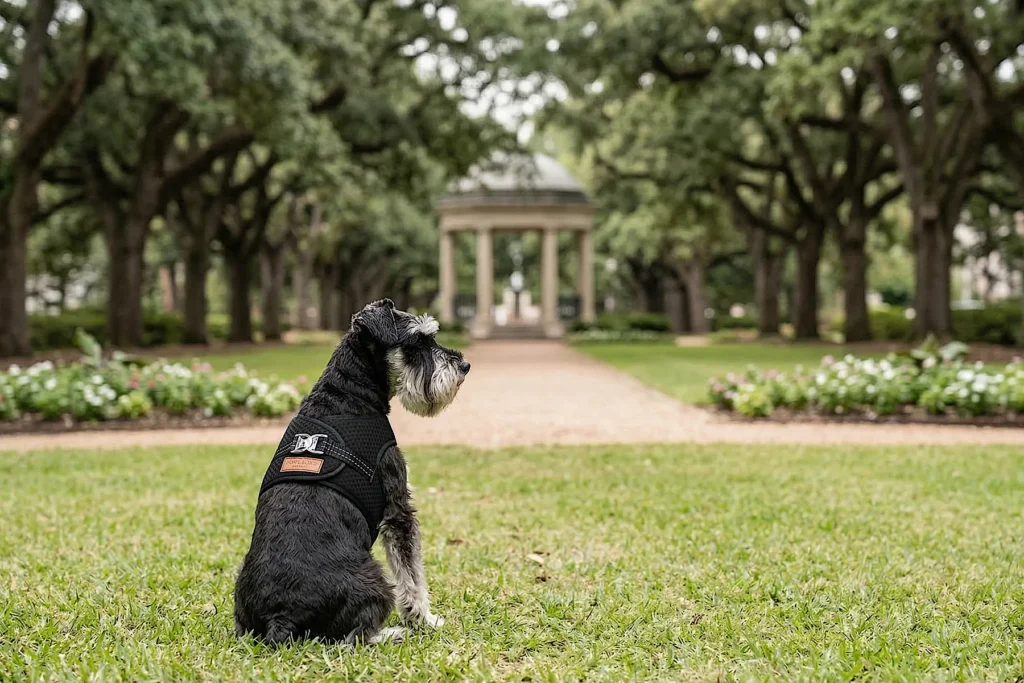
That is why, when a dog stops in one place for a very long time, even though the guardian sees absolutely nothing interesting there, it is worth remembering that the dog is “reading” information that we neither see nor smell. For him, that patch of grass may be more detailed than a long message on a phone. And probably far more interesting.
If you want your dog to notice a toy more easily during a walk, it is better to choose a colour that contrasts with the surroundings from his perspective. On grass, shades of blue or yellow may work well. At home, the contrast between a toy and the floor, rug or bed may matter more.
How does a dog see the world compared with a human?
Humans rely very strongly on sight. We look, compare, evaluate colours, details, compositions and shades. We choose clothes, accessories, interiors and objects with great attention to aesthetics. A dog looks at the world differently. Sight is important to him, but it does not dominate in the same way it does for humans.
For a dog, scent and movement may be much more important. A dog may notice a moving object faster than a stationary one that blends into the background. He may cope better in weaker light than a human, but see fewer details and fewer colours. His world is more dynamic, more scent-based and more connected with what is happening than with whether something has the perfect raspberry, olive or caramel shade.
This does not mean that colour has no meaning. It does, but in a different way than it does for us. For a human, the colour of a harness or lead may be part of style and elegance. For a dog, what matters more is whether the dog harness is comfortable, well fitted and does not restrict movement. For the guardian, a beautiful colour is an aesthetic pleasure; for the dog, everyday comfort matters most.
The best dog accessories therefore connect both worlds. They are comfortable and functional for the dog, while also being beautiful for the guardian. That is why colour should be treated as part of a bigger whole: alongside material quality, fit, safety, comfort and lifestyle.
What colours of dog toys are worth choosing?
If you are choosing a toy that your dog should notice easily during play, it is worth considering shades of blue or yellow. These colours are more readable for dogs than red or green. Especially when playing on grass, in a park, on the beach or in the garden, colour may influence how quickly your dog notices the object.
This does not mean that every toy has to be yellow or blue. Dogs choose toys according to many different criteria. Texture, scent, size, shape and the possibility of chewing, squeaking, tugging or carrying the toy in the mouth all matter. Sometimes a dog will choose the toy that, from a human point of view, is the least impressive, but from a dog’s point of view has “that something”. And how can you argue with such an expert?
It is worth matching the toy to where it will be used. At home, you can choose a toy that suits your dog’s preferences and is safe for everyday use. For outdoor play, colours that are easier to find against grass, sand or a path can work well. If your dog often loses toys on walks, changing the colour may turn out to be a simple and very practical solution.
In the Bowl&Bone Republic range you will find dog toys that combine aesthetics, quality and the joy of shared play. And if your dog belongs to those pets who have more toys than some guardians have mugs in the kitchen, a practical addition may also be a basket for dog toys, thanks to which all canine treasures have their own place.
Colour and walks — what does the dog see, and what does the guardian see?
During a walk, the colour of accessories works on two levels. Firstly, it can be part of the style of the dog and guardian. Secondly, it helps the human notice the dog, lead or elements of the walking set more quickly. For the dog, the colour of the harness or collar itself may not be the most important thing, but for the guardian it can have practical and aesthetic value.
A lot happens in city spaces. There are pedestrian crossings, cyclists, other walkers, children, scooters, parks, pavements and sudden encounters with dogs who appear from around a corner exactly when our pet has decided to inspect the scent by a lamp post. In such conditions, a clearly visible lead and comfortable harness can support a sense of control and organisation during the walk.
A good example is the dog leads by Bowl&Bone Republic, available in many fresh, energising colours. During an everyday walk, not only the shade matters, but also ease of use, lead length, carabiner quality, an additional handle and comfort when guiding the dog in different situations. Colour is a beautiful addition, but functionality remains the foundation.
The same applies to exceptional dog harnesses. The guardian may choose a colour that suits the dog’s character, the season or their favourite style. The dog, however, will appreciate most that the harness is well fitted, does not press and allows him to explore the world freely. If it also looks beautiful — all the better for the whole walking duo.
Does the colour of accessories matter to dogs?
The colour of accessories may matter to a dog, but usually less than scent, comfort, fit and association. A dog is unlikely to think: “today I am choosing a collar in tango because it highlights my temperament”. Although with some dogs, it is hard to resist the feeling that this is exactly what could be happening.
For the dog, what matters more is whether the accessory fits well, does not rub, does not shift and does not cause discomfort. A harness may be in a beautiful colour, but if it is poorly fitted, the dog will not feel good in it. A lead may have a fashionable shade, but if it is uncomfortable for the guardian or does not provide suitable control, the walk will be less pleasant.
Colour is therefore part of a shared experience. For the guardian — aesthetics, style, visibility and consistency within the set. For the dog — part of an object associated with walking, playing, going out, closeness and daily rituals. A dog may not perceive all colours as we do, but he recognises situations, emotions and repeated signals very well.
That is why, when choosing dog accessories, it is worth looking more broadly. The colour should please the guardian’s eye, but the product should above all support the dog’s comfort. It is best when the two meet: beautiful design, high quality and everyday comfort.
Blue and yellow — why are these colours especially readable for dogs?
Blue and yellow are more distinct for dogs because their eyesight is best at distinguishing this range of colours. This does not mean that a dog sees the world only in two simple colours. Rather, differences between shades of blue and yellow are more readable for him than differences between red and green.
In practice, this may mean that a blue toy on green grass will be easier for a dog to find than a red one. A yellow element may stand out more clearly against some surfaces. Violet may be perceived more like a shade of blue. Red and green may appear less contrasting.
This is valuable knowledge when choosing objects for activities. If the dog is meant to find something visually, it is worth thinking about colour. If the object is meant to be an element of style, the colour may be chosen more for the guardian and the overall aesthetic. If, however, safety and comfort are what matter most, the most important things will be the product’s construction, quality of workmanship and fit for the dog.
That is why walking accessory collections often combine different needs: colour, function, style and comfort. For example, the GRADIENT tango dog harness stands out with its colour and modern character, but its key role remains the dog’s comfort during walks. The colour catches the guardian’s eye, while the carefully designed construction supports everyday use.
Why does a dog sometimes not see a toy lying right next to him?
This is a situation many guardians know well. The toy is lying literally a metre away from the dog. The guardian points at it. The dog looks. Looks again. Then looks at the guardian with an expression suggesting that the entire matter is highly mysterious. Finally, he starts sniffing and suddenly — success. The toy has been found.
Why does this happen? There may be several reasons. Firstly, the toy’s colour may blend into the background from the dog’s perspective. Secondly, a stationary object may be less noticeable to a dog than something that moves. Thirdly, the dog may rely more on scent than sight. Fourthly, the surroundings may be full of other, more interesting stimuli.
This does not mean the dog sees badly. It means he sees differently and uses his senses in a different order from humans. We say: “but it is right there”. The dog answers with his behaviour: “perhaps for you, but I still have seventeen scents to check here”.
So it is worth not getting annoyed when your dog does not find an object immediately. It is better to help him with movement, a short cue or by choosing a more visible colour next time you play. If the problem appears suddenly, the dog starts bumping into objects, seems less able to orient himself in space or his eyesight clearly changes, it is worth consulting a vet.
Can dogs see well in the dark?
Dogs are better adapted to seeing in weaker light than humans. Their eyes have more cells responsible for detecting light and movement, as well as a special reflective layer that helps them see better in lower light. That is why a dog’s eyes may shine in the dark when light falls on them.
This does not mean, however, that a dog can see in complete darkness like night vision. He needs a certain amount of light, but he often copes better at dusk, dawn or in semi-darkness than a human. Movement may be especially important to him. A dog may notice a moving object faster than a stationary detail.
For a guardian, this matters during evening walks. After dark, it is not enough to assume that the dog “somehow sees”. It is worth ensuring a calm pace, control on the lead, safe routes and avoiding sudden situations. A well-chosen lead, comfortable harness and predictable walking rhythm help the dog feel more secure, even if the world looks different than it does during the day.
It is also worth remembering that a dog’s visibility to people after dark is a separate matter. Drivers, cyclists and other walkers do not see as a dog does. That is why colour, contrast and elements that increase visibility may be important mainly from the perspective of safety in the human environment.
How can you use knowledge about dog vision every day?
Knowing which colours dogs see best can help with small everyday decisions. You do not have to rearrange your home, replace every toy or create a world for your dog only in shades of blue and yellow. However, it is worth remembering a few simple principles.
Firstly, for outdoor play it is good to choose objects that the dog can notice more easily. Blue or yellow toys may be more practical than red ones, especially on grass. Secondly, during training it is worth taking the background into account. An object that a human can see very clearly may be less readable to a dog. Thirdly, when choosing walking accessories, colour may be important for the guardian and the surroundings, but for the dog comfort remains the priority.
Fourthly, it is not worth judging a dog only through human senses. What is visually obvious to us may be less clear to a dog. On the other hand, what we do not notice at all may be the most important information of the day for him. A dog’s world is full of scents, movements and signals that humans often do not perceive.
Fifthly, colour can build everyday joy for the guardian. If you love elegant, consistent walking sets, choosing a beautiful lead, harness and collar matters. Not because the dog analyses the colour palette, but because shared walks are part of your lifestyle. Your dog feels your attention, rituals and involvement. And beautiful accessories can make everyday life even more enjoyable.
Colours in a dog’s essentials — aesthetics, function and emotion
Choosing the colour of dog accessories is often a small pleasure for the guardian. Some choose calm beiges, graphites and classic shades. Others like energetic colours that add lightness to walks. Others still match a collar or lead to the dog’s coat, the season or their own style. And that is beautiful, because a dog’s essentials can be both practical and aesthetic.
For the dog, the most important thing is whether the accessory fulfils its function well. Is the harness comfortable? Does the lead provide freedom, but also control? Is the collar well fitted? Is the toy for your pet safe and pleasant to use? Colour is an addition that connects the world of the dog and the guardian — a little practicality, a little emotion, a little style.
At Bowl&Bone Republic, colour is never accidental. It is meant to create a coherent whole with the form, material and function of the product. That is why, when choosing a harness, a collar or a dog lead, it is worth looking not only at the shade, but also at the quality of workmanship, the details and your pet’s comfort.
A dog’s everyday life is made up of small rituals. A morning walk, an afternoon game, evening sniffing, a short training session, rest after an active day. The colour of accessories can be part of these rituals — not the most important part for the dog, but important for a shared lifestyle.
Do dogs have favourite colours?
This question comes up very often. Can a dog have a favourite colour? It is difficult to answer directly, because a dog does not choose colour in the same way as a human does. When a dog chooses one toy more often than another, it does not necessarily mean that he “likes blue”. He may like its scent, softness, sound, shape, the memory of playing together or the fact that it is easy to hold in his mouth.
It can be said, however, that a dog may respond better to colours that are more visible to him. If a yellow or blue toy is easier to notice, the dog may choose it more often during outdoor play. This is more a matter of readability than aesthetic preference.

At home, the differences may be less obvious. If a toy has an intense scent, an interesting texture or is associated with a favourite game, colour may be of secondary importance. In the dog world, emotions and experience often win over the colour palette.
That is why it is best to observe your own dog. If he is more eager to play with a particular type of toy, it is worth thinking about what really attracts him. Colour? Shape? Scent? Or perhaps the fact that this was the toy you played with together on the best summer evening?
The most common mistakes in thinking about dog vision
The first mistake is believing that a dog sees only in black and white. This is not true. Dogs see colours, but within a limited range. Their world is less saturated with certain colours than ours, but it is not colourless.
The second mistake is assuming that a dog sees exactly the same thing as a human. If we see a red toy on green grass, the dog does not necessarily perceive that contrast in the same way. What is obvious to us may be harder for him to notice.
The third mistake is attributing a human approach to aesthetics to a dog. A dog does not choose accessories according to colour trends. He does not judge whether a collar matches a lead, although the guardian can absolutely take joy in that. For the dog, comfort, associations and function are more important.
The fourth mistake is overlooking the other senses. A dog’s sight is important, but it does not work in isolation from the nose, hearing and movement. A dog may not notice a toy straight away, but find it by scent. He may not distinguish a subtle shade, but recognise the movement of the guardian’s hand perfectly.
The fifth mistake is thinking that because a dog sees differently, colour has no meaning at all. It does have meaning — just a different one. With toys, it may affect visibility. With walking accessories, it may influence aesthetics, visibility for the guardian and the consistency of the set. With everyday items, it may support organisation and comfort in shared life.
How to choose colours for dog accessories
It is best to combine three perspectives: canine, human and practical. The canine perspective means comfort, safety and function. The human one — aesthetics, style and the joy of beautiful objects. The practical one — visibility, ease of keeping clean and suitability for the daily routine.
If you are choosing a toy for outdoor play, think about a colour your dog will notice more easily. Blue and yellow are a good direction. If you are choosing a collar, lead or harness, you can follow your style, but do not forget construction and fit. If you are choosing home items, such as a toy basket, bed or blanket, colour can beautifully complement the interior while creating a fixed, friendly space for your dog.
Well-chosen accessories do not have to shout with colour to be exceptional. They can be subtle, elegant and timeless. They can also be energetic and full of summer joy. The most important thing is that they meet the dog’s needs and bring pleasure to the guardian.
Because life with a dog is an everyday world full of details. Sometimes it is the colour of a lead that lifts your mood during a morning walk. Sometimes it is a toy your dog can find more easily in the grass. Sometimes it is an elegant collar that makes your pet look even more dignified — although the one most interested in the matter is, of course, mainly waiting to go outside.
Summary — what colours can dogs see best?
Dogs see colours, but differently from humans. They distinguish shades of blue and yellow best. Red, orange and green may appear less clear to them and more similar to shades of brown, grey or muted yellow. That is why blue and yellow toys may be easier for a dog to notice, especially on grass, in a park or during outdoor play.
This does not mean, however, that a dog’s entire set of essentials should be only blue and yellow. A dog discovers the world through many senses. Scent, movement, texture, sound and associations are just as important to him, and often more important than colour itself. When choosing walking accessories, comfort, safety and fit matter most, while colour can be a beautiful element of the guardian’s and dog’s style.
Understanding how a dog sees the world helps us understand him better. It makes it easier to choose a toy, plan a walk, look with affection at the moment when the dog “does not see” an object lying right next to him, and remind ourselves that his reality is different from ours — but no less fascinating.
For more inspiration, knowledge and carefully designed accessories for dogs, we invite you to www.bowlandbone.com — a place created for guardians who want to combine their dog’s everyday comfort with timeless style.
The Bowl&Bone Republic team
FAQ — frequently asked questions about what colours dogs can see
Can dogs see colours?
Yes, dogs can see colours, but not in the same way as humans. Dogs have dichromatic vision, which means they distinguish shades of blue and yellow best. They do not see the full range of colours as humans do.
Do dogs see the world in black and white?
No. This is a popular myth. Dogs do not see the world only in black, white and grey. They see some colours, mainly from the blue and yellow range, but their colour palette is more limited than ours.
What colours can dogs see best?
Dogs see shades of blue and yellow best. These colours are more readable for them than red, orange or green.
Can dogs see the colour red?
Dogs do not see red in the same way as humans. Red may appear to them more like muted brown, grey or a darker shade of yellow. That is why a red toy on green grass may be less visible to a dog.
Can dogs see the colour green?
Dogs perceive green differently from humans. Green may be less vivid to them and more similar to muted shades of yellow, brown or grey. That is why objects against grass are not always as obvious to a dog as they are to the guardian.
What colours of dog toys are best?
For outdoor play, it is worth choosing toys in blue or yellow, as they may be easier for a dog to notice. However, colour is not the only criterion — safety, texture, scent, shape and style of play are also important.
Does the colour of a harness or lead matter to a dog?
For a dog, the most important things are comfort, a good fit and associations with a pleasant walk. The colour of a harness or lead matters more to the guardian, visibility and aesthetics. It is worth choosing accessories that combine the dog’s comfort with beautiful design.
Why does my dog not see a toy lying on the grass?
The toy may blend into the background from the dog’s perspective, especially if it is red, orange or green. The dog may also rely more on scent and movement than on colour alone. This is normal and results from a different way of perceiving the world.
Can dogs see well after dark?
Dogs often cope better in weaker light than humans, but they do not see in complete darkness. They are sensitive to movement and can orient themselves well at dusk, but during evening walks it is still worth taking care of safety, control on the lead and good visibility.
Sources and inspiration
[1] Neitz, J., Geist, T., Jacobs, G.H. — Color vision in the dog.
[2] VCA Animal Hospitals — Do Dogs See Color?
[3] American Kennel Club — Can Dogs See Color?
[4] American Kennel Club — How Does Dog Eyesight Work? What Do Dogs See?
[5] Merck Veterinary Manual — Eye Structure and Function in Dogs.
[6] Bowl&Bone Republic — harnesses, leads, collars, toys and walking accessories.










 or CANADA
  PLEASE join us at