


A puppy’s first walk is one of those moments a guardian remembers for a very long time. Your little companion stops every few steps, discovers scents they have never encountered before, watches a bicycle go past, listens to cars and sometimes needs a few moments before deciding to move on. For them, this is not simply leaving the house — it is an enormous amount of new information.

This is why choosing your puppy’s first harness should not begin with colour or with the question of which harness will last the longest. What matters far more is whether a particular model fits your puppy’s current body shape, remains stable while they move and does not interfere with their ability to explore the world freely.
For a first walk, it is best to choose a lightweight, well-fitted and preferably adjustable harness that does not put pressure on the neck, does not sit in the armpits, does not move excessively during activity and cannot easily be backed out of by the puppy. There is no single harness type that scientific evidence allows us to identify as the best choice for every young dog. Individual fit to the specific dog’s body shape is extremely important [1][5].
It is also worth introducing your puppy to their first harness before the first proper walk. Dogs Trust and the People’s Dispensary for Sick Animals (PDSA) recommend gradually getting a puppy used to a collar, harness and lead in a calm environment before they begin using them outside [1][2][3].
What will you learn from this article? In this guide, you will learn:
- which harness to choose for your puppy’s first walk,
- whether a harness or collar is better for a puppy,
- which type of harness is worth considering for a young dog,
- whether a GUARD harness is suitable for a puppy,
- whether pressure-free harnesses can work well at the beginning,
- how to choose the right harness size for a rapidly growing dog,
- why you should not buy a harness that is too large for your puppy to “grow into”,
- how to check whether a harness fits correctly,
- how to get your puppy used to a harness before their first walk,
- which lead to choose for the first harness,
- when a puppy can go for their first walk,
- how often to check harness size while your puppy is growing.
Which harness will be best for a puppy at the beginning?
The best first harness is, above all, one that fits the dog you have today. A puppy grows quickly, and their chest circumference, neck and overall body proportions change. A model that fits perfectly today may need readjusting or replacing with a larger size within a few weeks.
For this reason, harnesses that allow you to adjust the circumferences precisely can be particularly practical at the beginning. This does not mean, however, that a wider adjustment range automatically makes a product better. The harness still needs to sit securely on the individual dog.
When choosing, pay particular attention to several features:
| What should you check? | Why does it matter? |
|---|---|
| current size | a harness that is too large may shift and make it easier for the puppy to back out |
| adjustability | allows a more precise fit as the puppy’s body changes |
| harness weight | very heavy equipment may be uncomfortable for a small puppy |
| strap position | straps should not sit in the armpits or visibly interfere with movement |
| stability | the harness should not rotate during an ordinary walk |
| how it is put on | choose a method your puppy can tolerate calmly |
| material quality | soft, well-finished surfaces can improve everyday comfort |
| secure fastenings | particularly important if the puppy suddenly backs away or becomes frightened |
Research into different harness constructions shows that their effect on canine movement is more complex than simple divisions into “anatomical” and “non-anatomical” designs sometimes suggest. In a study involving 66 dogs, different harness constructions affected selected movement parameters in different ways, and the authors highlighted the importance of choosing a harness for the individual dog [5].
So rather than searching for one model that is “best for every puppy”, it is worth observing your own companion.
Harness or collar for a puppy’s first walk?
This is one of the questions new guardians ask most frequently. There is no basis, however, for a simple rule saying that every puppy should be walked exclusively on a collar or exclusively in a harness.
When preparing a puppy for their first walk, Dogs Trust identifies both a properly fitted collar and a properly fitted fixed harness as equipment the puppy should become familiar with beforehand [1]. Blue Cross recommends a standard lead attached to a harness, noting that this can reduce pressure on the neck if a young dog pulls [4].
A harness can be a very good choice for a puppy, provided that it fits correctly. A dog’s young age alone is not a reason to automatically avoid using one.
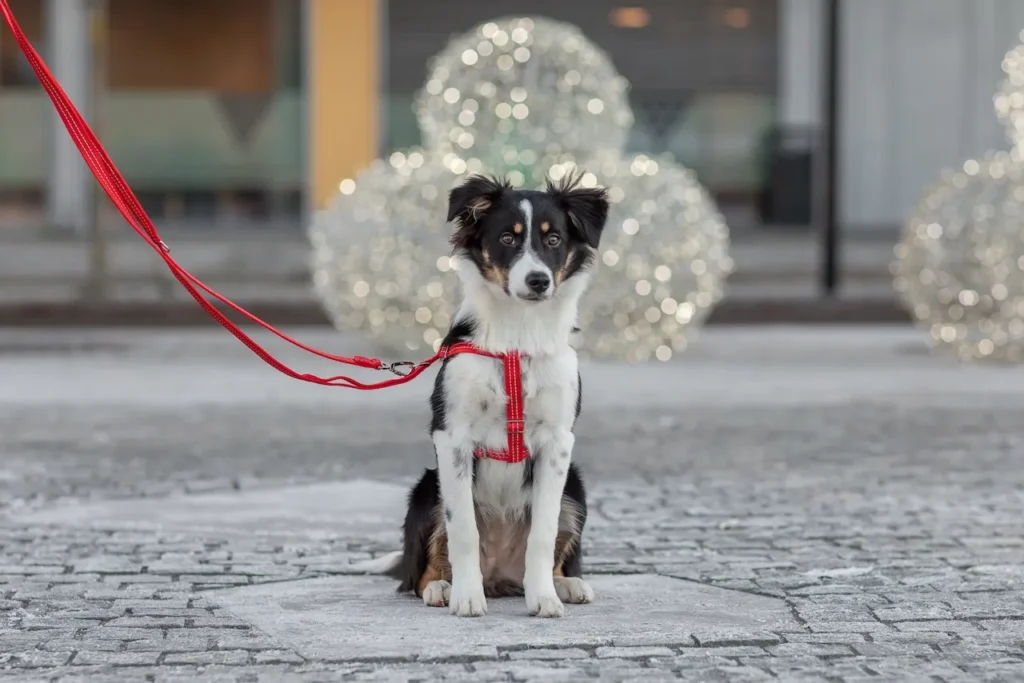
First walks can be unpredictable. A puppy may suddenly head towards an interesting scent, stop, become frightened by a lorry or jump aside when they see a bicycle. A correctly fitted harness allows you to guide the dog without concentrating all of the tension solely around their neck.
This does not, of course, mean that simply putting on a harness will solve pulling. Learning to walk calmly on a lead is a separate process. You can read more about it in our guide “How to teach a dog to walk on a lead?”.
Can a harness harm a growing puppy?
A poorly fitted harness can be uncomfortable for both a puppy and an adult dog. This does not mean that a correctly selected harness is inherently harmful to a developing dog.
Biomechanics studies show that different constructions may alter some parameters of limb movement, but the evidence available so far does not support a simple rule stating that one particular harness type is always best while another is always harmful [5][6].
A much more practical approach is to assess the individual dog while they are moving. Once the harness is on, check whether your puppy walks naturally, whether they constantly try to remove it, whether the straps rub around the armpits and whether the construction shifts with every step.
If you notice a clear change in gait, limping, a pain response or reluctance to move, do not immediately assume that your puppy is simply being difficult. Remove the harness, check the fit and, if the symptoms persist, consult your veterinary surgeon.
Are GUARD harnesses suitable for puppies?
A GUARD harness is one of the designs worth considering. One practical advantage may be the ability to adjust several circumferences, which can make precise fitting easier for a growing dog.
You should not assume, however, that the word “GUARD” alone guarantees an ideal fit on every dog. Chest proportions, body length and shoulder blade position vary both between breeds and between individual dogs [5].
The Bowl&Bone Republic dog harness collection includes different constructions, including GUARD models. One example is the BREEZE blue dog harness, whose construction and adjustability allow the product to be fitted to the measurements of the individual dog.
With a puppy, it is particularly important not to choose a product simply because the model is described as a GUARD harness. Measure your dog first and check the size chart for the specific product.
What about a harness with a wider adjustment range?
A growing body shape is one of the biggest challenges when choosing a puppy’s first walking set. Harnesses with several adjustment points can therefore be a practical option, provided that the current size actually fits the puppy.
One example is the Bowl&Bone Republic GRADIENT yellow dog harness, a GUARD-style design with four adjustment points. This construction allows the circumference around the individual dog’s body to be adjusted more precisely, while high-quality materials and careful finishing improve everyday comfort. For the guardian, this means greater control over fit instead of having to choose an excessively loose harness simply because it might “last longer”.
You do, however, need to check the current size ranges. If a small puppy’s measurements do not fall within the product’s size chart, do not choose an oversized model solely with the future in mind.
Room for a growing puppy should come from adjustability, not from wearing a harness that is too large.
Are pressure-free harnesses suitable for puppies?
Soft, more structured harnesses may be a comfortable solution for some young dogs, particularly if the individual puppy tolerates the way they are put on. You cannot assume, however, that the term “pressure-free” automatically means the best choice for every puppy.
The most important thing is the fit on the individual body. An oversized vest-style construction may move around, while one that is too small can reduce comfort. You should also check where its edges sit in relation to the armpits and how the harness behaves while the dog is moving.
If you would like to compare several different constructions available in the collection, take a look at our guide How to choose a comfortable harness for your dog?.
How do you choose the right harness size for a puppy?
Do not choose a size based solely on age or breed. Two four-month-old puppies of the same breed can differ in size and proportions.

Measure your dog according to the instructions provided by the particular manufacturer. Depending on the harness construction, you will most commonly need the chest circumference and, with some designs, the circumference at the base of the neck.
Take the measurement while the dog is standing and compare it with the size chart for the particular product. Do not assume that size S in one collection is identical to size S in another.
Once the harness is on, look at your puppy both while they are standing and while they are moving. Check:
- whether the harness slips towards one side,
- whether the straps sit directly in the armpits,
- whether the dog can walk freely,
- whether the construction is clearly too tight,
- whether the puppy can easily back out of the harness.
With Bowl&Bone Republic models, always use the size chart assigned to the particular collection. For example, with GRADIENT, the manufacturer recommends leaving a small amount of room so that a finger can slide comfortably underneath the strap.
Do not buy your puppy’s first harness “to grow into”
This is one of the most natural mistakes to make. You know your puppy will grow quickly, so you may think: I will buy a larger harness and it will last longer.
The problem is that the harness also needs to be safe today.
A construction that is too large may move around while the puppy walks, slip between the legs or allow the puppy to back out in a moment of fear. During those first walks, when your little companion’s reactions are still difficult to predict, equipment stability is particularly important.
It is worth remembering that the period of intense growth does not last forever. In our guide How long does the dog grow? we explain just how much development rates vary between small, medium, large and giant dogs.
Harness fit should be checked regularly as your puppy’s body changes. Once the adjustment range is no longer sufficient, it is time for the next size.
How often should you check a puppy’s harness fit?
Much more often than with an adult dog.
There is no single number of days that is right for every puppy, because growth rate depends on factors including expected adult size and age. During periods of rapid development, however, it is worth checking the harness very regularly and also whenever you notice a sudden increase in weight or change in body shape.
A check only takes a moment. Put the harness on, assess the tension of the straps, look at how they sit around the chest and observe your puppy while they move.
Do not wait until your puppy is clearly showing discomfort. With a rapidly growing dog, a few additional centimetres around the chest can appear more quickly than you expect.
How do you get a puppy used to a harness before the first walk?
The first time your puppy wears a harness should not be at the exact moment when you open the door and immediately head out onto a busy street.
The harness itself is already a new experience for a puppy. There is the sound of the buckle, being touched around the body, putting part of the harness over the head or paws, and the feeling of straps against the coat. Dogs Trust recommends breaking the process down into small stages and rewarding a calm response [2].

At first, show your puppy the harness and allow them to sniff it calmly. Then gradually get them used to the equipment touching their body. If the model needs to go over the head, you can use a treat to encourage your puppy to put their nose through the opening voluntarily.
Only once this stage causes no concern should you fasten the buckles. Initially, your puppy may wear the harness for only a short period. Play with them, reward them and take the equipment off before the experience becomes tiring. If the dog backs away, stops or clearly does not want to continue, return to an easier stage. Do not force your puppy into the harness.
PDSA also recommends getting a puppy used to the feeling of a harness at home before regular walks begin [3].
My puppy bites the harness – does that mean they do not like it?
Not always. A young dog explores many things using their mouth, so trying to catch a strap may simply be a normal reaction to a new object.
Look at the whole picture, however. If your puppy freezes once the harness is on, tries intensely to remove it, hides or becomes anxious as soon as they see it, the introduction process is probably moving too quickly.
In that situation, return to shorter, positive sessions. Over time, the harness should begin to predict something pleasant — contact with their guardian, play, a treat and later a walk.
Which lead should you choose for the first harness?
A classic, lightweight, fixed-length lead is a good starting point. Blue Cross recommends a standard non-retractable lead for early walks, allowing you to remain close to the puppy and making it easier to teach loose-lead walking [4].
A very long training line has its uses later, including recall training and exploration in a calmer environment. Dogs Trust does not recommend beginning a puppy’s first walks with a long line [1].
The Bowl&Bone Republic collection includes a range of dog leads that can be matched to the harness and the size of your companion. With a small puppy, it is worth considering not only lead length but also the weight of the carabiner and the entire set.
Your puppy’s first lead should not overwhelm them with its weight. The equipment should help them discover the world, not make every movement require additional effort.
When can a puppy go for their first walk?
The timing of the first walk should be agreed with your veterinary surgeon based on the individual puppy’s vaccination programme and the local risk of infectious diseases.
Dogs Trust states that first walks usually take place after the primary vaccination course has been completed and enough time has passed for protection to develop, while also clearly recommending that the correct timing is confirmed with a veterinary surgeon [1].
Do not decide when to take your puppy for their first walk based solely on an age you found online. Ask the veterinary surgeon caring for your dog.
This does not mean that your puppy cannot experience the world before then. You can safely get them used to a harness and lead at home, while the safest approach to socialisation before full vaccination protection should be discussed with your veterinary surgeon [1][3].

The first walk should test the harness, not cover several kilometres
You do not need to cover a specific distance on the first walk. Dogs Trust stresses that the most important goal is a positive experience and building confidence, and that the first outing should generally be short and calm [1].
Allow your puppy to stop. Give them time to sniff. Do not expect perfect heelwork.
It is also a good moment to observe the harness.
Look at it again after several minutes of movement. You may only notice during the walk that one strap moves more than it did at home or that the coat is sitting in a way that suggests the construction should be loosened slightly.
After returning home, also inspect the skin and coat in the areas that were in contact with the harness. If everything looks good and your puppy moved naturally and calmly, you have a good foundation for future walks.
Your puppy’s temperament matters when choosing their first harness
One puppy will stand calmly from the very first day while you put on the harness. Another will try to catch the buckle with their teeth. A third will not want to put their head through the opening.
This is why the way a harness is put on can matter just as much as its appearance.
If your puppy strongly dislikes movements over their head, it is better not to turn putting on the harness into a daily struggle. You can work gradually on creating a calm association with this movement or look for a construction that can be put on differently.
When choosing a first harness, observe not only your dog’s body but also their emotions. Equipment used every day should be as neutral as possible and, over time, ideally become a positive part of getting ready for a walk.
What should you take on a first walk apart from the harness?
Your walking set does not need to be complicated. You will need a lead, poo bags and a few small treats. Dogs Trust also identifies water and a portable bowl as useful equipment depending on the length of the outing [1].
If you are putting everything together from scratch, take a look at our guide New dog essentials – what to buy before your dog arrives? and our article How to put together a comfortable dog walking set?.
You do not need a dozen gadgets on the first walk. The fewer items you have to manage, the easier it will be to observe your puppy and respond to their emotions.
Buy the first harness for the puppy you have today
This is one of the most important principles that also comes directly from our practical experience.
At Bowl&Bone Republic, we have been designing PREMIUM dog accessories for nearly 15 years. During that time, we have received hundreds of opinions, stories and suggestions from dog guardians, while feedback from thousands of satisfied customers has allowed us to observe just how quickly a young dog’s body changes and how different the needs of two puppies of a similar age can be.
One thing becomes particularly clear when choosing a puppy’s first harness: guardians naturally want to buy a product that will last as long as possible. From the dog’s perspective, however, what matters more is that it is comfortable right now.
This is why, when designing harnesses, we pay close attention to material quality, adjustability, finishing and everyday comfort. For the dog, this means greater freedom while discovering the world; for the guardian, easier preparation for walks, durability and the ability to fine-tune the equipment more precisely.
At the same time, our design experience does not replace an individual assessment of a particular puppy. If your dog has unusual proportions, orthopaedic problems or specific health needs, it is worth discussing equipment choice with a veterinary surgeon or an appropriately qualified specialist.
The most common mistakes when choosing a harness for a puppy
The first is buying a size that is too large so the harness will last for the next few months. The second is choosing solely according to breed without measuring the individual dog.
We also frequently see the opposite problem: a guardian buys a correctly fitted harness but does not check the adjustment for several weeks. The puppy grows, their chest becomes larger and the equipment gradually becomes too tight.
Other mistakes include choosing a very heavy walking set for a small dog, failing to introduce the puppy calmly to buckles and putting on the harness, not checking the fit after the first walk and trying to solve pulling problems solely by changing equipment.
A harness is a tool. How your dog learns to walk also depends on calm training and experience. The Royal Society for the Prevention of Cruelty to Animals (RSPCA) recommends rewarding loose-lead walking and stopping when the dog begins to pull rather than using equipment that causes discomfort [7].
Which harness should you choose for a puppy’s first walk? Summary
For a first walk, choose a lightweight, stable harness that fits your puppy’s current measurements and allows them to move naturally. Do not buy a larger size simply for them to “grow into”.
Harness type matters, but it is not more important than individual fit. A GUARD design may be a practical choice because of its adjustability, but it still needs to be assessed on the particular dog. A soft, more structured harness may be comfortable for another puppy. There is no single model that is ideal for everyone [5][6].
Before the first walk, introduce your puppy to the harness at home. Let them investigate it, reward calm reactions and do not force it on. Once your veterinary surgeon confirms that walks can begin, treat the first outing primarily as a positive experience — not as a test of obedience or fitness.
If you are looking for your puppy’s first set, explore the Bowl&Bone Republic dog harness collection and matching dog leads. High-quality materials, carefully considered finishing and different constructions allow you to choose a solution suited to the needs of the individual dog rather than simply their age or breed.
The most important thing is for the first harness to help your puppy discover the world calmly and comfortably. There will be plenty of time later for a new colour or another model.
– the Bowl&Bone Republic team
FAQ – frequently asked questions about the article –
Which harness should you choose for a puppy’s first walk?
Which harness is best for a puppy?
The best harness is one that fits the puppy’s current body shape correctly, is lightweight and stable, and allows free movement. There is no single type of harness that is best for every puppy [5].
Can a puppy wear a harness?
Yes. A correctly fitted harness can be used by a puppy. Dogs Trust and PDSA also recommend introducing young dogs to wearing a harness before regular walks begin [1][2][3].
When can you start putting a harness on a puppy?
A puppy can gradually be introduced to a harness at home before regular walks begin. The timing of the first outdoor walk should be agreed with your veterinary surgeon in relation to the puppy’s vaccination programme [1][3].
Which harness should you choose for a 2-month-old puppy?
At this age, the puppy’s current measurements matter more than the number of months. The harness should be lightweight, stable and properly fitted. If the puppy cannot yet safely walk in public areas, this time can be used for calm harness training at home.
Harness or collar for a puppy?
Both can form part of a young dog’s equipment. When walking on a lead, a harness may reduce the load placed on the neck during a sudden pull. Correct fit and appropriate use are the most important factors [1][4].
Are GUARD harnesses suitable for puppies?
They can be. One advantage is often the possibility of precise adjustment, but a GUARD construction alone does not guarantee an ideal fit for every dog. The harness needs to be assessed on the individual body shape [5].
Are pressure-free harnesses suitable for puppies?
They may be comfortable for some young dogs if the size and construction fit properly. The product name does not replace checking how the harness actually sits while the puppy is moving.
How do you measure a puppy for a harness?
Follow the size guide for the specific manufacturer and model. Most commonly, you will need the chest circumference and, with some designs, the circumference at the base of the neck. Do not choose size solely according to breed or age.
Should you buy a puppy harness for them to grow into?
No. A harness that is too large may shift and increase the risk of the puppy backing out. It is better to choose the correct current size with suitable adjustability and check the fit regularly.
How often should you adjust a puppy’s harness?
Regularly throughout the growth period. There is no single frequency that is correct for every dog. It is particularly important to check the fit during rapid changes in body weight and chest circumference.
How do you get a puppy used to a harness?
Introduce it in stages. Allow the dog to sniff it, reward contact with the harness and then practise calm fitting and fastening. If the puppy backs away or becomes stressed, return to an easier stage [2].
Which lead is best for a puppy’s first walk?
A lightweight, standard fixed-length lead is a good choice for the first walks. Blue Cross recommends a classic non-retractable lead, which helps keep the puppy close and supports learning to walk calmly [4].
Is a retractable lead suitable for a puppy’s first walk?
At the beginning, a classic lead is usually the better choice. It makes it easier to control distance and practise loose-lead walking. Longer training lines and other options can be introduced later [1][4].
When can you take a puppy for their first walk?
This depends on the vaccination programme and local risk of infectious diseases. The safest approach is to ask the veterinary surgeon caring for your puppy when that individual dog can begin walking in public places [1].
How long should a puppy’s first walk be?
There is no single compulsory number of minutes for every puppy. Dogs Trust recommends keeping the first walk short, calm and primarily positive, while the appropriate level of activity can be discussed with your veterinary surgeon [1].
What should you do if your puppy does not want to walk in a harness?
Do not pull them by force. Return to calm harness training at home and reward small steps of progress. If your puppy clearly shows pain, changes the way they walk or the problem persists despite a gradual introduction, it is worth consulting your veterinary surgeon.
Sources and inspiration used to write the article
“Which harness should you choose for a puppy’s first walk?”
- Dogs Trust, “How to take your puppy for their first walk” – preparing a puppy for their first walk, introducing a collar, harness and lead, timing of the first outing and building a positive experience.
https://www.dogstrust.org.uk/dog-advice/puppy/first-walk - Dogs Trust, “How to train your dog to wear a harness” – gradually introducing a dog to a harness, fastening buckles and moving while wearing it.
https://www.dogstrust.org.uk/dog-advice/training/outdoors/harness-training - People’s Dispensary for Sick Animals (PDSA), “Puppy Socialisation” – guidance on introducing a puppy to collars, harnesses and everyday equipment from an early stage.
https://www.pdsa.org.uk/pet-help-and-advice/looking-after-your-pet/puppies-dogs/puppy-socialisation - Blue Cross, “How often should I exercise my puppy?” – guidance on preparing for a first walk, using a harness and standard lead, and gradually introducing a puppy to the outside world.
https://www.bluecross.org.uk/advice/dog/puppy-exercise - Williams E., Hunton V., Boyd J., Carter A., “Effect of harness design on the biomechanics of domestic dogs (Canis lupus familiaris)” – study examining the effect of different harness constructions on the movement of 66 dogs and the importance of individual fit.
https://pubmed.ncbi.nlm.nih.gov/37731281/ - Lafuente M.P., Provis L., Schmalz E.A., “Effects of restrictive and non-restrictive harnesses on shoulder extension in dogs at walk and trot” – study examining the effect of harnesses on shoulder joint range of motion.
https://pubmed.ncbi.nlm.nih.gov/30455191/ - Royal Society for the Prevention of Cruelty to Animals (RSPCA), “Teach your dog to walk without pulling” – guidance on reward-based loose-lead walking training.
https://www.rspca.org.uk/adviceandwelfare/pets/dogs/training/walknicely










 or CANADA
 PLEASE join us at