


You are only going to get a cup of tea. You rise from the sofa, take a few steps towards the kitchen and immediately hear the familiar sound of paws behind you. Your dog was resting peacefully just a moment ago, but now they are right beside you again. When you return to the living room, they follow you back. When you sit down at your desk, they settle near your chair. If you close the bathroom door behind you, you may soon see a dog’s nose appear beneath it or hear a quiet sigh from the other side.

Some dogs follow their guardian from time to time. Others behave like a small, four-legged shadow, unwilling to miss even the tiniest part of the day you share.
Why does your dog follow you everywhere? In most cases, it comes down to closeness, curiosity, everyday habits and anticipation of what may happen next. Your dog may also be looking for information, attention, an activity or a sense of security.
Following a guardian is not, however, the same as separation anxiety. What matters most is whether your companion can rest calmly at a certain distance, remain in another room and cope when members of the household are away.
What will you learn from this article – why does your dog follow you everywhere and what does this behaviour mean?
• why a dog follows their guardian throughout the home,
• why some dogs never leave a person’s side,
• why your companion follows you into the bathroom,
• why a dog may mainly follow one particular person,
• whether this behaviour is a sign of trust,
• when closeness is natural and when it may indicate a difficulty,
• how to teach a dog to rest calmly in their own space,
• when a sudden change in behaviour requires professional advice.
Why does my dog follow me everywhere?
There is no single answer that applies to every dog. The same behaviour may have several different causes, and individual reasons often overlap.
Your dog may follow you because they enjoy being close. At the same time, they know that when you get up from the sofa, it sometimes means a walk, a meal, playtime or the balcony door being opened. They may also simply be checking what you are doing. For a dog, their guardian moving around the home is part of everyday life and a source of valuable information.
| Your dog’s behaviour | What might it mean? | What should you observe? |
|---|---|---|
| They calmly follow you and lie down nearby | closeness, curiosity or habit | whether they can also rest independently |
| They get up every time you move | anticipation of a walk, food or attention | what usually happens a moment later |
| They mainly follow one person | a stronger habit or association with important activities | their relationship with other members of the household |
| They wait outside the bathroom door | a desire to remain close or keep track of what is happening | their response when the door is closed |
| They cannot settle when you disappear from view | anxiety or difficulty resting independently | panting, whining or scratching at the door |
| The behaviour appeared suddenly | a change in routine, stress, discomfort or a health problem | appetite, movement, sleep and other behavioural changes |
The table presents possible explanations rather than a diagnosis. Behaviour should always be considered in the context of the dog’s overall body language and previous habits.
Your dog wants to stay close to their guardian
The most natural explanation is simply the bond between a dog and a person. A guardian provides their companion with contact, security, predictability and many important elements of everyday life. Research into relationships between dogs and humans suggests that the guardian’s presence can serve as what is known as a secure base. This means that a dog may explore their surroundings more freely and undertake certain activities when a familiar person is nearby. [1]
This does not mean that every dog should spend the entire day lying beside their guardian’s feet. It does, however, show why our presence can be such an important point of reference. Your dog does not always have to be expecting a walk or treat. Sometimes simply sharing the same room with you is enough.
Your dog observes everyday routines
Dogs are excellent observers of recurring events. They quickly notice that certain actions lead to particular outcomes. Putting on your shoes may signal a walk. Opening a particular cupboard is associated with food. Switching off the computer often means that work has finished, while walking into the kitchen may come before preparing a meal. If your dog follows you everywhere, they may simply be trying to work out what will happen next.
Consider:
• whether you often give your dog food after entering the kitchen,
• whether getting up from the sofa usually means a walk,
• whether you stroke your dog when they lie beside you while you work,
• whether you take a toy with you when moving to another room,
• whether your dog receives attention when they begin following you.
The more often following you leads to something enjoyable, the more willing your companion will be to repeat the behaviour.
Your dog has learnt that following you brings rewards
Some behaviours become established because they lead to a particular result. This might be food, contact, a shared activity or simply a glance from the guardian. Imagine that every time your dog follows you into the kitchen, they receive a small piece of food. From their point of view, following you is an excellent decision.
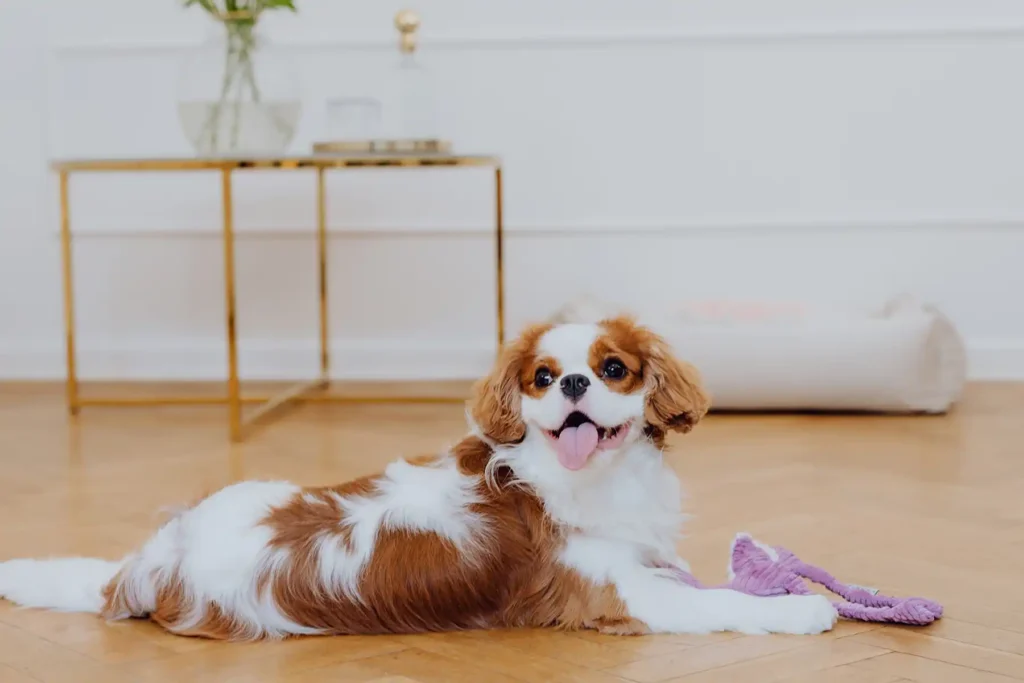
A similar mechanism may be at work when:
• you stroke your dog every time they approach,
• you begin playing when they bring you a toy,
• you speak to them when they stand beside your feet,
• you allow them into every room when they begin to whine.
This does not mean that you have to ignore your dog or avoid closeness. It is simply worth noticing which of your reactions may unintentionally reinforce constant following.
Your dog is looking for information and observing your reactions
Dogs pay attention not only to where we are going, but also to our gestures, tone of voice and emotions. In an unfamiliar situation, they may look at their guardian to gather information that helps them decide how to respond. Research into social referencing in dogs has shown that they can use emotional signals from people when encountering an unfamiliar or potentially unsettling object. [2]
At home, this may look far less dramatic. Your dog follows you to find out:
• who has entered the home,
• where a new sound is coming from,
• why you are moving objects,
• whether the situation is calm,
• whether you are about to go out,
• whether they should remain where they are.
Your behaviour helps your dog understand a world that has largely been arranged according to human rules.
Your dog is bored or needs an activity
Following you may also be an attempt to find something interesting. If very little is happening in the environment, every movement you make can become a potential sign that an activity is about to begin. Your dog may follow you because they are hoping for a walk, shared play, a short training exercise or an opportunity to sniff.
This does not mean that your dog should be entertained constantly. The ability to rest calmly is just as important as movement and play. It is nevertheless worth checking whether their day includes:
• walks suited to their age and physical condition,
• opportunities to sniff freely,
• contact with their guardian,
• calm mental activities,
• play,
• uninterrupted rest.
A dog who has nothing to do may follow a person out of boredom. A dog who is constantly stimulated may also find it difficult to remain in one place because they have learnt to expect another activity. Balance is what matters most.
Why does my dog follow me into the bathroom?
For a person, the bathroom is somewhere they may occasionally wish to be alone. A dog does not always understand why their guardian suddenly disappears behind a closed door. They may follow you for several simple reasons:
• they do not want to lose sight of you,
• they are used to doors remaining open at home,
• they are curious about new sounds and smells,
• the bathroom is a cool or peaceful place,
• they expect something interesting to happen when you come out.
For many dogs, following their guardian into the bathroom is simply part of everyday closeness. More attention is needed when closing the door leads to intense agitation. If your dog immediately begins whining, scratching, barking, panting heavily or cannot move away from the door, they may find even a very brief separation difficult.
Why does a dog mainly follow one person?
In a home with several people, a dog may follow one particular person especially often. This does not necessarily mean that they like the other members of the household any less. The chosen person may:
• usually serve the dog’s meals,
• take them for walks,
• play with them,
• work from home,
• allow them to remain closer,
• respond to their signals,
• provide the most predictable daily routine.
A dog may also feel calmer with someone whose movements, voice and responses are easier for them to understand. Sometimes they simply follow the most active member of the household. If one person frequently moves between rooms while everyone else remains seated, their behaviour is naturally more interesting.
Does following a guardian indicate trust?
Wanting to remain close can be one element of a positive relationship. The dog chooses the person’s presence, observes them and rests nearby. We should not, however, judge the entire bond solely by whether a companion follows us.
A dog who trusts their guardian may also:
• fall asleep peacefully in their presence,
• explore the environment freely,
• seek their support in a difficult situation,
• respect the need for rest,
• independently choose where they wish to spend time,
• remain at a certain distance without becoming anxious.
A healthy relationship does not mean that a dog must constantly be touching their guardian. What matters is that they can choose both closeness and peaceful rest in their own space.
Does a dog who follows their guardian have separation anxiety?
No. Following a person around the home is not enough to diagnose separation anxiety or another problem associated with being left alone. Some highly sociable dogs willingly follow their guardian but settle down peacefully once the person leaves. Others do not follow someone throughout the day but still react very badly to being alone.
Separation-related problems primarily appear when a dog is left alone or loses access to a person who is important to them. They may include intense vocalisation, pacing, panting, drooling, damaging areas around doors or windows, attempts to escape and toileting indoors. [3][4]
Other concerning signs may include:
• being unable to settle after the guardian leaves,
• refusing to eat a treat left behind,
• trembling,
• persistently waiting beside the door,
• injuring themselves while trying to escape,
• a sudden deterioration in behaviour following a change in routine.
Recording your dog while members of the household are away can help you understand what truly happens after the door closes. Many dogs behave differently from what their guardian might assume based solely on the greeting they receive upon returning.
If you suspect a separation-related problem, consult a veterinary surgeon and an experienced canine behaviourist. A dog should not be left to “get used to it” if being alone causes intense panic.
When should following you everywhere be a cause for concern?
Calmly following a person is usually natural behaviour. A change in behaviour is more important than the frequency itself. Consult a specialist if your dog:
• has suddenly started following you constantly,
• previously rested independently but can no longer settle without your presence,
• appears anxious or disorientated,
• pants despite the absence of heat or physical activity,
• frequently gets up and cannot find a comfortable position,
• whines,
• is reluctant to move,
• has experienced changes in appetite, thirst or sleeping patterns,
• is a senior dog and has begun behaving differently from usual.
A sudden need to remain close may sometimes be associated with pain, declining senses, stress, an environmental change or a health problem. Closeness alone does not reveal the cause.
How can you teach your dog to rest calmly without following you?
The aim should not be to push your dog away or prevent them from being close. Instead, it is worth showing them that resting elsewhere can also be safe and enjoyable.
– prepare a comfortable resting place
Your dog should have a space where they can settle peacefully without household members constantly moving around them. This may be a dog bed in the living room, a dog cushion beside your desk or another place your companion willingly chooses. The bed should be appropriately sized, stable and positioned away from draughts and main walkways.
Do not place it in a completely isolated part of the home if your dog needs to see members of the household in order to relax. The distance can be increased gradually. You can find more guidance in the article “How many beds should a dog have? One bed or several places to rest?” You may also find the guide “How to help your dog rest after an active day?” helpful when creating a calm and predictable resting routine.
– notice when your dog rests independently
We often respond to a dog when they approach us, touch us with a paw or begin following us. We may overlook the moments when they remain calmly in their own space. From time to time, you can approach your resting companion and place a small treat beside them. Do this calmly, without encouraging them to get up. In this way, you show your dog that remaining on their bed can also lead to something pleasant.
– introduce very short periods of distance
If your dog gets up every time you make the slightest movement, begin with very easy situations. Stand up, take one step and return before your companion has time to become concerned.
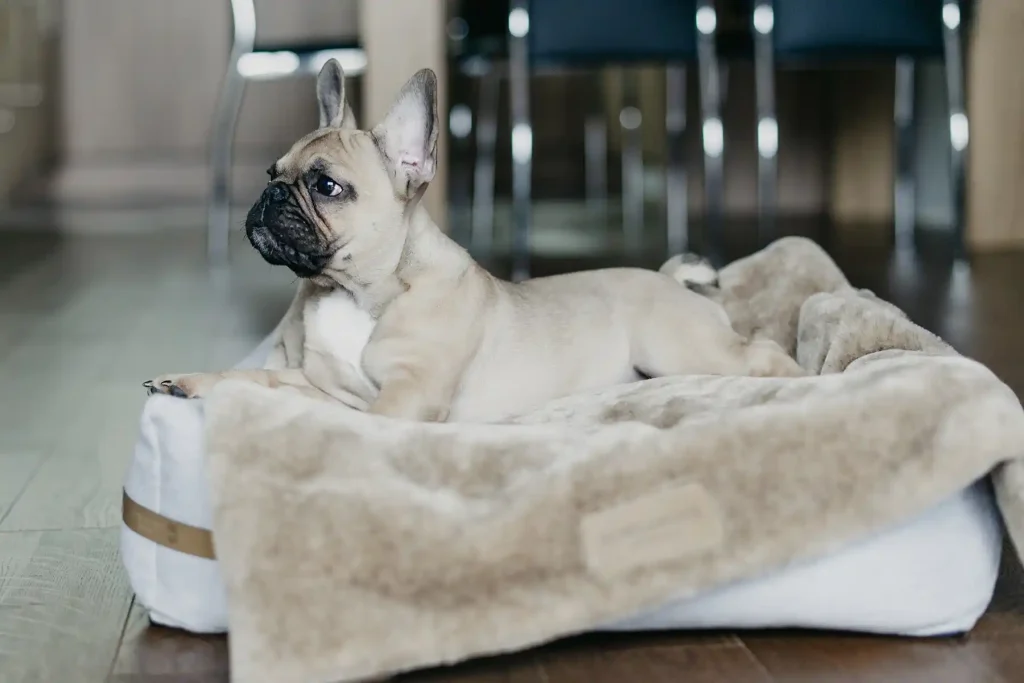
Gradually increase the distance and duration while always observing their response. The exercise should not involve repeatedly closing a door in front of an anxious dog. The purpose is to build the understanding that their guardian briefly moving away is an ordinary and safe part of the day.
– do not send your dog away in anger
Shouting, pushing your dog away and constantly using the instruction “go to your bed” may cause the resting place to become associated with rejection. If you wish to use a bed cue, teach it as a positive skill. Your dog should know where to go and receive a reward for remaining there calmly. The article “How to teach your dog the ‘bed’ command” explains how to introduce this cue step by step. Do not punish your companion for wanting to be close. Try to understand why they feel such a strong need to remain beside you at that particular moment.
– maintain a predictable daily routine
Regular walks, meals, play and peaceful rest help a dog anticipate what will happen next. If every part of the day is unpredictable, your companion may watch your every movement more closely to avoid missing something important. Predictability does not mean living according to a schedule that must be followed to the exact minute. It is enough for everyday life to have a clear structure and for your dog to receive an appropriate amount of movement, contact and rest.
Closeness without taking away independence
It is a wonderful feeling when your dog chooses your company. They lie beside you, move with you into the next room and wish to take part in even the smallest moments of an ordinary day. This closeness is worth appreciating. At the same time, it is helpful to show your companion that they do not need to monitor every step their guardian takes.
They can remain peacefully on their bed even when you go into the kitchen. They can fall asleep in the living room while you work in the next room. They can learn that a brief moment apart does not mean losing contact or safety. The most beautiful relationship is not one in which a dog is unable to function without us. It is one in which they want to be close while still feeling safe when a few steps of space appear between you.
For more inspiration, knowledge and thoughtfully designed dog accessories, visit www.bowlandbone.com — a place created for dog guardians who wish to combine their companion’s everyday comfort with timeless style.
the Bowl&Bone Republic team
FAQ – the most frequently asked questions in the article –
“Why does your dog follow you everywhere? What does this behaviour mean?”
Why does my dog follow me everywhere?
Your dog may follow you because of closeness, curiosity, habit or the expectation of a walk, food or attention. What matters is whether they can also rest calmly and independently.
Why does my dog go everywhere with me?
A guardian is an important point of reference for a dog and the source of many everyday events. Your companion may observe your routine, look for information or simply enjoy being nearby.
Why does my dog follow me into the bathroom?
They usually want to remain close, are curious or have become accustomed to having access to every room. If closing the door causes intense panic, it is worth considering how well the dog copes with being separated.
Why does my dog never leave my side?
This may result from a strong habit, a need for contact, a lack of activity or difficulty resting without the guardian’s presence. A sudden change in behaviour requires closer observation.
Does my dog follow me because they love me?
The desire to remain close may be part of a strong bond, but following alone is not simple proof of love. Your dog may also be expecting food, a walk, play or information about what is going to happen next.
Why does my dog follow only one person?
A particular member of the household may feed the dog more often, take them for walks, work from home or respond to their signals. The dog may also consider this person the most predictable.
Does following a guardian mean separation anxiety?
No. Separation anxiety and other separation-related problems primarily appear during the guardian’s absence. Important signs include panic, intense barking, destructive behaviour, panting and an inability to settle when left alone.
How can I find out what my dog does when left alone?
The simplest method is to record the first part of your absence using a camera or phone. Observe whether your dog can lie down, eat and rest or whether they remain agitated for an extended period.
How can I teach my dog not to follow me everywhere?
Reward calm rest in their own space, introduce very short periods of distance and maintain a predictable daily routine. Do not punish your dog or suddenly shut them in a separate room for a long time.
Should I allow my dog to follow me around the home?
If the behaviour does not disturb members of the household and your dog can also rest independently, there is no need to stop it completely. It is nevertheless worth developing their ability to remain on their bed and cope calmly with brief separation.
Why has my older dog suddenly started following me?
A sudden change in a senior dog may be associated with stress, declining eyesight or hearing, pain, disorientation or another health problem. The behaviour should be discussed with a veterinary surgeon.
When should I consult a canine behaviourist?
A consultation is advisable if your dog cannot rest without their guardian, reacts very badly to a closed door, panics when alone or if the behaviour interferes with the everyday life of the dog and household members.
Sources and inspiration for the article “Why does your dog follow you everywhere? What does this behaviour mean?”
- Horn L., Huber L., Range F., “The Importance of the Secure Base Effect for Domestic Dogs – Evidence from a Manipulative Problem-Solving Task”, PLOS ONE, 2013, 8(5), e65296. A study examining the guardian’s role as a secure base for a dog.
- Merola I. et al., “Dogs’ Social Referencing towards Owners and Strangers”, PLOS ONE, 2012, 7(10), e47653. A study examining dogs’ use of emotional information communicated by a person in a new situation.
- Merck Veterinary Manual, “Behavior Problems of Dogs”. A resource describing behaviours associated with intense anxiety during a guardian’s absence, including vocalisation, destructive behaviour, pacing and toileting indoors.
- American Animal Hospital Association, “Separation Anxiety in Pets: Signs, Causes, and Solutions”. A resource discussing signs of separation-related problems and the importance of recording an animal’s behaviour while they are alone.
- Lenkei R. et al., “Separation-related behavior of dogs shows association with their reactions to everyday situations that may elicit frustration or fear”, Scientific Reports, 2021, 11, 19207. A publication indicating that separation-related behaviours may arise from different emotional states, including fear, panic and frustration.
This article is educational in nature and provides general information about canine behaviour. It is not a substitute for an individual consultation with a veterinary surgeon or an experienced canine behaviourist.










 or CANADA
  PLEASE join us at