


There is a certain moment before a summer trip that almost every dog guardian knows. The suitcase is already standing in the hallway, the shoes are waiting by the door, the last coffee is being finished in the kitchen, and the dog… the dog knows. He does not need a calendar, a to-do list or a phone reminder. It is enough for him to see the bag, the lead and that slightly excited movement of the household to understand that something bigger than a regular walk around the neighbourhood is about to happen.
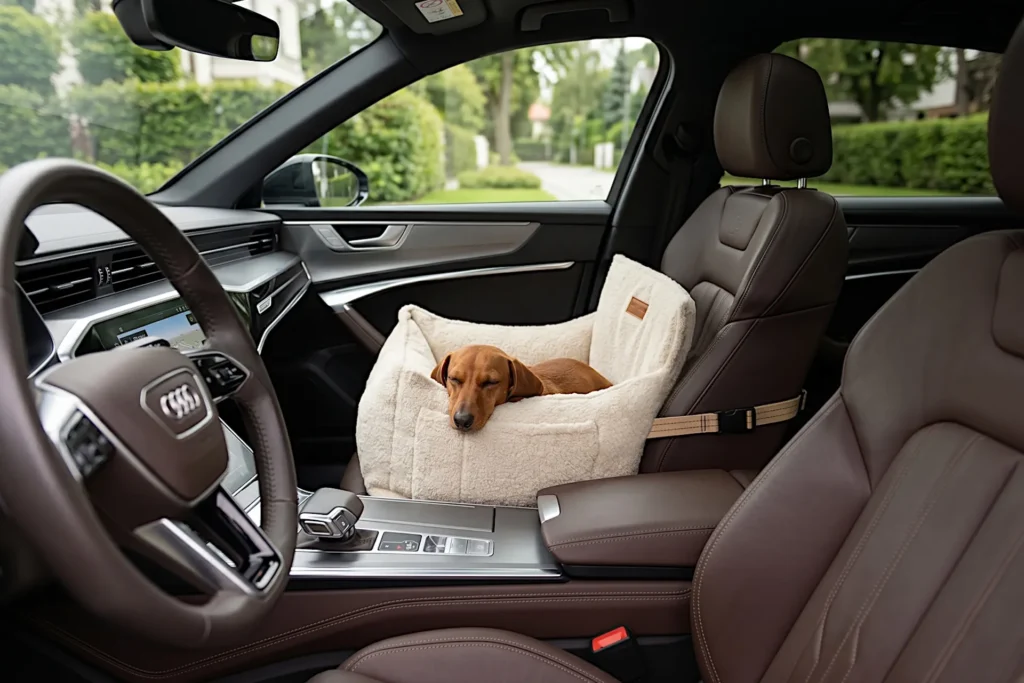
Travelling with your dog by car can be the beginning of a beautiful shared adventure. It may mean a holiday by the sea, a weekend in a house outside the city, a visit to family, a trip to the mountains or a peaceful drive to a favourite place where your dog already knows every scent, yet still checks everything from the beginning each time. Like a true inspector of grass, bushes and suspiciously interesting sticks.
Before the joy of discovering new places begins, however, it is worth taking care of what matters most: your dog’s safety and comfort in the car. For us, driving is often part of everyday life. For a dog, it can be exciting, tiring, stressful or simply strange. The car moves, hums, brakes, accelerates, smells different from home, and the world outside the window passes by at a speed that a dog’s nose and mind cannot always make sense of straight away.
That is why a good journey with your dog does not begin on the motorway. It begins earlier: with preparing a place in the car, planning breaks, taking water, choosing the right accessories and approaching the journey calmly. Dogs very often read our emotions faster than we read our own packing list. If we rush, they may also switch into the mode of: “something is happening, I do not know what, but I am going to stay alert.” If we prepare calmly, we give them a better chance of entering the journey with a greater sense of security.
Why is dog safety in the car so important?
Safe car travel with a dog is not only about comfort. It is also about caring for the dog’s health, the driver’s peace of mind and the safety of all passengers. A dog moving freely around the car may distract the driver, jump onto the front seat, try to look out of the window, get under a passenger’s feet or suddenly change position during braking.
Even a calm dog may react unexpectedly when he hears a horn, sees another dog in a car park, smells food at a petrol station or simply loses balance during a sharper manoeuvre. That is why a dog in the car should have his own designated, stable place. One that limits chaotic movement, gives him comfort and helps him understand: “this is where I rest, this is where I travel, this is where I am safe.”
In practice, this means that a dog should not travel loose in the car. Depending on the dog’s size, the type of car and the length of the journey, you may consider a carrier, transport crate, special seat belts, car harness, barrier separating the boot space or a comfortable car dog seat combined with additional securing. The most important thing is that the solution is suited to the dog, the car and the way you travel.
For small and medium-sized dogs, a very comfortable solution may be the HARMONY car dog seat by Bowl&Bone Republic, which creates a cosy, stable resting space inside the car. This is especially important for dogs that like to have a clearly defined place and feel better when they do not constantly have to search for balance on the seat. It is worth remembering, however, that a comfortable place is only one part of the preparation.
A dog should also be properly secured in line with safe transport principles and the instructions for the accessories being used.
Where should a dog sit while travelling by car?
The best place for a dog in the car depends on several factors: the dog’s size, temperament, the type of car, the length of the journey and the chosen method of securing him. A small or medium-sized dog may travel both on the rear seat and — with a properly selected solution — on the front passenger seat. What matters is that he has his own designated, stable place and is secured in such a way that he cannot move freely around the car.
A large dog often needs more space, which is why in many cars a properly prepared boot area in an estate car or SUV works well, secured with a barrier or a large transport crate.
For small and medium-sized dogs, a very comfortable solution may be the HARMONY car dog seat by Bowl&Bone Republic, designed so that your dog can travel comfortably also on the front passenger seat. This is particularly practical when the guardian wants to keep the dog close, while also ensuring that the dog does not walk around the car, climb onto their lap or distract the driver during the journey.
The soft, enveloping sides of the dog seat and the stable resting space help create the dog’s own safe place in the car.
Regardless of whether your dog travels at the front or at the back of the car, the most important thing is to attach the dog seat correctly and provide additional securing for your dog in line with the product instructions and safe driving principles. It is also worth making sure that the position of the seat, seat belts and elements of the car’s equipment allow your dog to travel comfortably and safely. The dog should be able to lie down or sit calmly, but should not be free to move around the cabin.
The rear seat, the front passenger seat with a properly fitted dog seat, or a prepared boot space can all be good solutions — provided they are suited to the dog’s size, the type of car and the way you travel. For many small and medium-sized dogs, their own car dog seat works like a small travelling sanctuary. The dog can observe the surroundings, rest or nap, while at the same time having a clearly defined place that helps him feel more secure during the journey.
It is also worth making sure that the dog has access to fresh air, but is not exposed to a strong draught. Sticking his head out of the window may look adorable and very cinematic, but it is not a safe habit. The dog may be hit by small debris, sand, an insect or a twig, and during a sudden manoeuvre this position becomes particularly risky. It is better to provide good ventilation, a comfortable temperature inside the car and a calm, stable place for the journey.
How to prepare your dog for
a longer car journey
If your dog rarely travels by car, it is not worth starting with a journey lasting several hours. For many dogs, the car is something they need to learn. Just as a child learns to ride a bike, a dog may need time to understand that the car does not mean stress, noise and loss of control, but calm movement together with their guardian.
It is best to start with short, positive contact with the car. You can allow your dog to approach the car, sniff it, get inside with the engine switched off, lie down in his place and receive calm praise or a treat. Then you can switch on the engine, still without moving. The next step is a very short drive — literally just a few minutes. Only when the dog begins to react more calmly is it worth gradually extending the journeys.
This is especially important for sensitive dogs, adopted dogs, young dogs or those that previously associated the car mainly with visits to the vet. If every journey ends with something difficult, the dog may start to feel stressed at the very sight of the car. That is why it is a good idea to sometimes take him by car to somewhere pleasant: for a peaceful walk, to the forest, by the water or to a familiar park. Then the car begins to signal something enjoyable, rather than being only a “mobile waiting room before an examination”.
It is worth placing something familiar in the car: your dog’s favourite blanket, a small cushion, a toy or a dog travel mat that smells of home. It does not have to be the whole living room packed onto the back seat — although some dogs would probably be delighted by such extravagance. One item is enough to give your dog the signal: “this is mine, I know this, I can rest here.”
What to take when travelling with your dog by car
A well-packed dog bag can save a journey. And this is not about taking half the house, three spare blankets, five bowls and a toy collection worthy of a dog nursery. It is about a practical set of things that may genuinely come in useful.
When travelling with your dog by car, it is worth taking water and a bowl first of all. A travel bowl, light and easy to use during breaks, will work best. Water should be available regularly, especially in summer. Not every dog will want to drink at every stop, but it is worth giving him the opportunity. In warm weather, hydration is one of the most important elements of a safe journey.
The second important item is a lead. Even if your dog is very well behaved, at a car park, petrol station or in a new place he should always get out under control. New smells, the noise of lorries, other people, dogs and cars can make even a calm dog react faster than we can think. A well-chosen dog lead gives the guardian control and gives the dog a safe space to stretch his legs briefly.
A well-fitted dog harness will also be useful. During breaks on the road, a harness often works better than a collar alone, especially for energetic, young dogs or those easily excited by new surroundings. A harness helps you control your dog better when getting out of the car, walking through a car park or taking a short walk near the road.
It is also worth packing waste bags, a small towel, a supply of food or treats, medication if your dog takes any, a health booklet or necessary documents, as well as the number of a vet. If the trip is longer, it is good to have a basic first-aid kit close at hand. Not because we assume problems will happen, but so that we are not nervously looking for the nearest shop or clinic when the dog steps on something sharp or a minor issue suddenly appears.
In practice, a travel list may look like this:
- water for the dog,
- a travel bowl,
- a lead,
- a well-fitted harness or collar,
- a car dog seat, carrier or another secured place,
- a blanket or mat,
- waste bags,
- a towel,
- the dog’s documents,
- food or light treats,
- medication, if the dog needs it,
- a basic first-aid kit,
- a favourite toy or chew.
This list is not complicated, but it helps avoid many small holiday dramas. And every dog guardian knows that a small drama can sometimes begin with the words: “but it is only a short journey.”
Travelling with your dog in summer
— the biggest risk is overheating
In summer, dog safety in the car requires particular attention. A car heats up very quickly, and a dog does not cool his body in the same way as a human. He does not sweat in the same way, which makes it harder for him to cope with high temperatures. Overheating can be very dangerous for a dog and, in extreme cases, life-threatening.
The most important rule is: never leave your dog alone in a parked car. Not even for a moment. Not even in the shade. Not even with the window slightly open. Not even if “it is only a quick stop for water”. A car can heat up rapidly, and a dog shut inside has no way to get out, find shade or drink water. This is a situation that must be avoided without exception.
During the journey, you should ensure good ventilation. Air conditioning should reach not only the driver and the front of the car, but also the place where the dog is travelling. It is worth checking whether strong sunlight is falling on the place where your dog is sitting. Sunshades on the windows may improve your dog’s comfort, especially during longer journeys.
Breaks are best planned in shaded places. During a stop, your dog should have the opportunity to drink water, get out calmly on the lead and stretch his legs. Not every break has to mean a long walk. Sometimes a few minutes in the shade, a short toilet break and a calm return to the car are enough. In hot weather, less is often better. Your dog does not need to “run it off” at every petrol station, especially when the tarmac is hot.
It is also worth watching for signs of overheating: intense panting, weakness, drooling, unsteady walking, restlessness, apathy, vomiting or a change in gum colour. If your dog looks unwell, do not wait for it to “pass on its own”. Stop the journey, move the dog to a cooler place, offer water and contact a vet.
How often should you stop when driving with a dog?
There is no single perfect number for every dog. It all depends on age, health, temperament and how used the dog is to car journeys. A puppy, senior dog, anxious dog or dog with travel sickness may need more frequent breaks. An adult, calm dog who copes well with travelling may need to rest less often. Even so, on a longer journey it is worth planning regular stops roughly every two to three hours.
A stop should not be chaotic. First park in a safe place. Only then attach the lead, check the surroundings and let your dog get out calmly. This is especially important in car parks near fast roads, where there are many cars, people and noises. Your dog may be disorientated after a longer drive, so jumping out “in a rush” is not the best idea.
During the break, allow your dog to sniff the area, drink water and take care of his needs. Sniffing is a natural way for a dog to regulate emotions. A few minutes of calmly sniffing the grass can be more relaxing than nervous walking on a short lead. If it is very hot, choose shade and avoid tarmac. If the surface burns your hand or foot, it may also be unpleasant or dangerous for your dog’s paws.
After returning to the car, give your dog a moment to settle. Do not drive off immediately if you see him turning around, looking for a position or drinking water. A calm rhythm to the journey helps your dog understand that breaks are predictable and that the drive is not an endless stream of stimuli.
My dog is afraid of car journeys —
what should I do?
Not every dog jumps into the car with the expression of a world conqueror. Some dogs are afraid of the car, whine, pant, drool, yawn, lick their lips, tremble or try to move around. Sometimes this is due to travel sickness, sometimes to lack of experience, and sometimes to bad past experiences. It can also be the case that the dog is not so much afraid of the car itself as unsure of what is happening and where he is going.
In this situation, the worst solution is to force the dog and expect that “he will get used to it somehow”. Yes, some dogs really do become calmer after a few journeys, but in others the stress may become more fixed. Gradual familiarisation works much better. Short moments in the car, rewarding calm behaviour, journeys lasting just a few minutes and trips to pleasant places — all of this helps build new associations.
It is also worth taking care of a stable place. A dog who slides around on the seat or has to keep tensing his body to maintain balance may become more stressed. A well-prepared resting space, such as a car dog seat, carrier or non-slip mat, helps reduce uncertainty. Predictability is very important for a dog: the same place, a similar routine, the calm tone of the guardian.
If your dog copes very badly with car journeys, vomits, drools heavily, panics or cannot calm down, it is worth consulting a vet or behaviourist. Sometimes specialist support is needed, especially when the problem is intense or increasing. This is not a dog’s “whim”. It is real discomfort, and it can and should be worked with.
Should you feed your dog before travelling?
It depends on the dog and the length of the journey, but it is usually better not to give a large meal immediately before driving. A full stomach may increase the risk of discomfort, nausea or vomiting, especially in dogs sensitive to the movement of the car. A good solution is a light meal a few hours before departure and avoiding heavy feeding during the journey.
You can have small treats close at hand while travelling, but it is worth using them sensibly. Treats can help with calm getting into the car or during breaks, but they should not replace the normal feeding rhythm. If your dog tends to suffer from travel sickness, it is better to consult your vet about feeding before the journey.
Water is a completely different matter. Access to water is very important, especially in summer. Offer it during stops and observe whether your dog drinks. Do not force him, but offer regularly. Some dogs drink less in new places, so it is worth taking water from home or bottled water, especially on longer journeys.
Car dog seat — when is it worth choosing one?
A car dog seat works particularly well when the dog travels on the rear seat or front passenger seat and needs a comfortable, clearly defined place. For many small and medium-sized dogs, this kind of space is more comfortable than the car seat alone. Soft sides give a feeling of being gently enclosed, while a stable surface makes resting easier.
The HARMONY car dog seat by Bowl&Bone Republic has been designed with small and medium-sized dogs in mind. The central part of the seat is fitted with an orthopaedic foam mattress, which adapts to the dog’s body and supports comfort during longer journeys. This is especially important when a dog spends more time in the car — during summer trips, weekend journeys or regular travel outside the city.
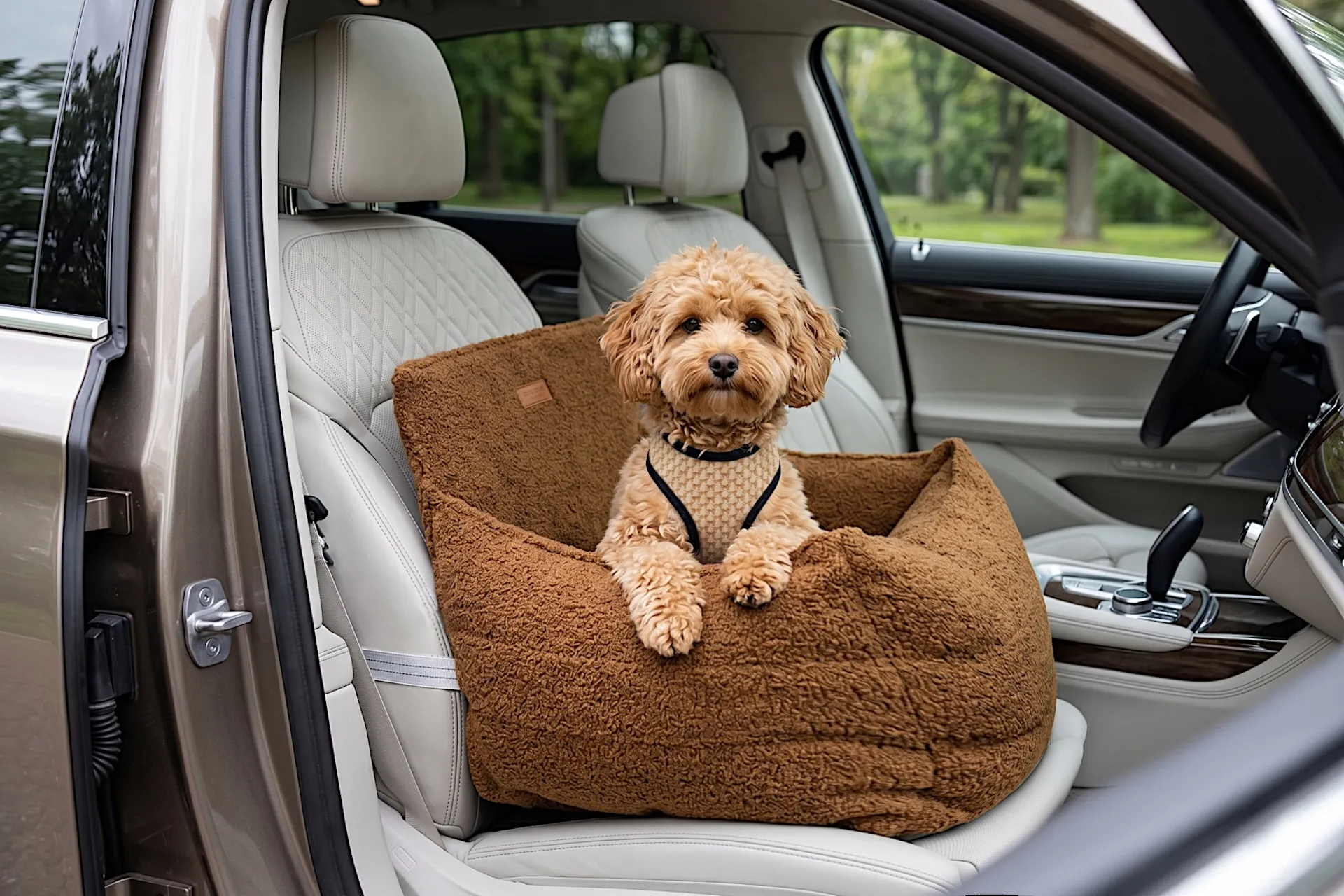
It is worth thinking of a car dog seat not only as a travel product, but also as part of a routine. If your dog knows his place in the car and associates it well, it is easier for him to enter rest mode. Instead of walking around, changing places and searching for a position, he can lie down in a space intended especially for him.
When choosing such a solution, it is worth paying attention to several things: the dog’s size, the method of attachment, stability, ease of cleaning and the possibility of additional securing. In the Bowl&Bone Republic car dog seat, a special car lead clipped into the seat belt can also be used. This solution helps increase control over the dog during the journey and limits his movement.
It is important to remember, however, that every travel accessory should be used according to its intended purpose and instructions. Dog safety in the car is the sum of several elements: the right place, appropriate securing, calm driving, regular breaks and the guardian’s attentiveness.
How to take care of your dog’s comfort
after arriving
The journey does not end the moment the car is parked. For the dog, a new place is another wave of stimuli. Different smells, different sounds, new stairs, a new garden, new dogs behind the fence, and sometimes even a new floor that, from a dog’s point of view, may seem suspiciously slippery. That is why, after arriving, it is worth giving your dog a moment to calmly find his way in the new space.
Do not begin by unpacking everything in a rush if your dog is clearly excited. First, a short walk, water, a moment of sniffing and a calm entrance into the place where you are staying. Your dog needs to find out where his guardian is, where he can rest and whether the situation is safe.
A good idea is to lay out your dog’s familiar blanket, travel mat or dog bed. If you take a dog mat or dog blanket with you, you can create a small homely point for your dog in the new place. This is especially helpful for dogs that like routine. A familiar scent and familiar place say to the dog: “you can rest here.”
After a long journey, not every dog will be ready for intense exploring. Some dogs have plenty of energy after getting out of the car, while others need quiet and sleep. Observe your dog. If he lies down and falls asleep, let him rest. If he is excited but tired, a calm walk on the lead can help him release tension. Holidays with a dog are most enjoyable when the plan includes not only attractions for people, but also the dog’s need for recovery.
The most common mistakes when travelling
with your dog by car
The first mistake is leaving the dog alone in the car. This is particularly dangerous in summer, but it is worth avoiding all year round. A car is not a safe place for a dog to wait alone, even if the guardian plans to return “in a minute”.
The second mistake is transporting the dog loose. Even if the dog is calm, this does not mean he will be safe during sudden braking. A dog moving freely may also distract the driver, and this increases the risk of dangerous situations.
The third mistake is lack of breaks. A long journey without a stop can be physically and mentally tiring for a dog. A dog needs water, the opportunity to change position, take care of his needs and have brief contact with the surroundings.
The fourth mistake is feeding the dog a large meal just before departure. In many dogs, this may increase nausea or discomfort. It is better to plan feeding earlier and take light treats for later.
The fifth mistake is assuming that the dog will “manage somehow”. Of course, dogs are often brave. Sometimes even too brave, because they do not always show discomfort in an obvious way. That is why a guardian should observe subtle signals: panting, licking the lips, yawning, body tension, inability to lie down, restlessness or excessive excitement.
The sixth mistake is failing to prepare a resting place at the destination. After the journey, the dog should have his own calm corner. It may be a dog bed, travel mat, blanket or another familiar element of his travel kit. For the dog, this is not a detail. It is information that he also has a safe space in the new place.
How to travel more calmly with your dog?
Small rituals that help
Dogs like predictability. Even the very energetic ones whose life plan seems to be: “run, sniff, eat, repeat.” Predictability gives a sense of security, and during travel it is particularly important.
Before departure, it is worth taking your dog for a calm walk. It does not have to be an intense training session or an hour-long trip. The point is for the dog to take care of his needs, sniff a little and release the first emotions. A dog who gets into the car after a calm walk often finds it easier to settle.
A fixed place works well in the car. If the dog always travels in a similar configuration — the same seat, the same bed, the same blanket — it is easier for him to understand the situation. It is also worth speaking to the dog in a calm tone, but without overdoing constant reassurance. Some dogs interpret excessive “it’s all right, calm down, nothing is happening” as a sign that perhaps something is happening after all. Sometimes the best message is simply calm presence.
During stops, it is good to keep to a simple rhythm: lead, getting out, water, short walk, return. Without nervous rushing, but also without too many attractions. A motorway car park does not need to become a dog amusement park. A safe moment for your dog’s needs is enough.
After arriving, it is worth giving your dog something familiar. A dog bed, mat, blanket or toy creates a bridge between home and the new space. It is a small gesture that can mean a great deal to a dog.
Travelling with a dog and the lifestyle
of his guardian
More and more guardians treat travelling with their dogs as a natural part of everyday life. The dog comes with us for the weekend, to visit friends, on holiday, to a café outside the city, to a dog-friendly hotel. This is a beautiful change, because it shows that the dog is a full member of the family. But with this closeness comes responsibility.
A conscious guardian does not ask only: “can I take my dog?” They also ask: “will my dog be safe there?”, “will he cope well with the journey?”, “does he have his own place?”, “have I planned breaks?”, “will he be too hot?”, “is the accommodation truly dog-friendly?”
That is exactly why travel accessories should not be random. A well-chosen harness, a sturdy lead, a comfortable car dog seat, a blanket or a mat are not just additions. They are part of a shared lifestyle with a dog — one in which aesthetics meet functionality, and the dog’s comfort is just as important as the guardian’s convenience.
Bowl&Bone Republic creates products for people who want to care for their dog consciously, beautifully and practically at the same time. Travelling with a dog can be calm, stylish and well organised. And the dog? The dog will most likely remember most of all that he was close to you. And perhaps also that one exceptionally interesting patch of grass at the stop.
Summary — how to travel safely
with your dog by car
Safe travel with your dog by car requires preparation, but it does not have to be complicated. The most important things are proper securing of the dog, a comfortable place in the car, good ventilation, regular breaks, access to water and a calm pace throughout the journey.
Before a longer route, it is worth gradually familiarising your dog with the car. Short drives, positive associations and familiar accessories help reduce stress. In summer, special care must be taken to avoid overheating, and you should never leave your dog alone in a parked car. During stops, your dog should get out on the lead, in a safe place and under the guardian’s control.
If you are travelling with a small or medium-sized dog, a good solution may be a car dog seat, which creates a stable and cosy resting space. Combined with appropriate securing, calm driving and regular breaks, it can significantly improve travel comfort.
Holidays with a dog are more than just a shared route. They are everyday gestures of care: water offered during a stop, shade chosen instead of full sun, a calm place in the car, a soft blanket brought from home and attentiveness to what the dog is trying to tell us through his behaviour.
For more inspiration, knowledge and carefully designed accessories for dogs, we invite you to www.bowlandbone.com — a place created for guardians who want to combine their dog’s everyday comfort with timeless style.
The Bowl&Bone Republic team
FAQ — frequently asked questions about travelling with your dog by car
How can you transport a dog safely in the car?
A dog should travel in a designated place and be properly secured. Depending on the size of the dog and the car, you can use a carrier, crate, seat belts, a car harness, a barrier or a car dog seat combined with suitable securing. The dog should not move freely around the car.
Can a dog travel on the front seat?
A dog should sit on the front seat only in a car dog seat specially designed for this purpose — for example, the HARMONY car dog seat by Bowl&Bone Republic. It is important to remember that it is worth switching off the airbag, unless the car manufacturer recommends another solution.
How often should you take breaks when travelling with your dog?
On a longer journey, it is worth planning breaks roughly every two to three hours, although the frequency depends on the dog. Puppies, senior dogs, anxious dogs and dogs with travel sickness may need more frequent breaks.
Can you leave a dog alone in the car?
No. A dog should not be left alone in a parked car, especially in summer. A car can heat up very quickly, even when it is in the shade or has a window slightly open. This can be very dangerous for a dog.
What should you take on a summer journey with your dog?
It is worth taking water, a travel bowl, a lead, a harness or collar, waste bags, a towel, your dog’s documents, food or treats, medication if your dog needs it, a blanket, mat or bed, and a basic first-aid kit.
Is a car dog seat a good solution for travel?
Yes, especially for small and medium-sized dogs that need a stable, comfortable place. A car dog seat should, however, be used according to its intended purpose and preferably in combination with appropriate securing of the dog.
What should you do if your dog is afraid of travelling by car?
It is best to familiarise your dog with the car gradually. Start with short contact with the car, reward calm behaviour, take very short drives and gradually extend the journey. If your dog copes very badly with travelling, it is worth consulting a vet or behaviourist.
Can a dog eat before a car journey?
It is better to avoid giving a large meal immediately before driving, especially if the dog is prone to nausea. A good solution is a light meal a few hours before departure. During the journey, regular access to water during stops is the most important thing.
Sources and inspiration
[1] AVMA — Pet safety in vehicles.
[2] Blue Cross — Travelling with your dog in the summer.
[3] Blue Cross — Travelling with your dog by car.
[4] ASPCA — Travel Safety Tips.
[5] Bowl&Bone Republic — HARMONY car dog seat and travel product categories.









 or CANADA
  PLEASE join us at