


In the evening, everything seems ready for rest. The home becomes quieter, the light feels softer, and a comfortable dog bed waits in a peaceful corner. Your dog approaches it, sniffs the soft edge for a moment, then turns away and lies down on the floor a few steps away. Sometimes they choose the sofa. On other occasions, they fall asleep beside the bedroom door, on the rug or directly next to your feet. The dog bed remains empty, even though it was selected with the greatest care.

Why does your dog not want to sleep in their bed when, from their guardian’s perspective, it should be the most comfortable place in the entire home? There can be many reasons. The bed may be the wrong size, positioned somewhere too warm or isolated, have a construction that does not suit the dog’s sleeping style or simply not yet feel associated with safety. Your companion may also prefer a cooler floor, a larger surface or remaining close to members of the household.
It is important to remember that a dog does not reject their bed “out of spite”. Their choice provides information about their needs, habits or wellbeing. Instead of moving the dog onto the bed by force, it is better to consider what makes another place feel more appealing.
What will you learn from this article?
• why a dog may not want to sleep in their bed,
• what it means when a dog refuses to lie in their bed even during the day,
• whether the cause may be an unsuitable size or construction,
• how the position of the bed influences the dog’s choice,
• why a dog may prefer the floor, sofa or their guardian’s bed,
• how to recognise negative associations with the dog bed,
• whether an unfamiliar scent can discourage a dog,
• when reluctance to lie down may indicate pain,
• how to help a dog become accustomed to their bed using reward-based methods,
• how to teach a dog to sleep in their bed at night,
• which mistakes to avoid during training,
• whether a dog should have more than one resting place,
• which recommended dog beds may be worth considering,
• when an orthopaedic mattress may be helpful,
• when to consult a veterinary surgeon or canine behaviourist.
Why does a dog not want to sleep in their bed?
There is no single cause shared by every dog. Even two companions of a similar size may choose completely different resting places. One dog may enjoy curling up and resting their back against a soft side. Another may need an open surface where they can fully extend their paws. A third may sleep most peacefully somewhere they can see their guardian and the entrance to the room. Before beginning to teach your dog to remain in their bed, observe their everyday choices carefully. Pay attention to:
• where they most often fall asleep,
• whether they choose a soft or firm surface,
• whether they curl up or stretch their whole body out,
• whether they seek a cool or warm place,
• whether they want to remain close to members of the household,
• whether they avoid the bed throughout the day or only at night,
• whether they willingly sit in it but leave quickly,
• whether they previously used the bed but have suddenly stopped.
The answers can help you distinguish a problem with the bed itself from one involving its location, the dog’s habits or their health.
Your dog may refuse to lie in their bed because it is positioned in the wrong place
Location is extremely important. Even a very comfortable bed may remain empty when it is placed somewhere the dog would not naturally choose for rest. A dog may avoid a bed positioned:
• in a draught,
• directly beside a radiator,
• in full sunlight,
• beside a loud television,
• next to a frequently opened door,
• in a walkway where household members regularly pass close by,
• in a completely isolated room,
• somewhere they cannot see an important part of the home.
Dogs need opportunities for peaceful, uninterrupted rest, but many also want to remain close to family life. A good solution may be to place one bed in a quieter part of the home and another where guardians spend most of their time. The Royal Society for the Prevention of Cruelty to Animals recommends providing a dog with a comfortable, dry, quiet resting place protected from draughts. It also notes that some dogs may benefit from having both a peaceful corner and somewhere close to the family.
Before deciding that your companion dislikes the bed itself, move it for several days to a place they regularly choose on their own. If they begin using it, the location was probably the problem rather than the construction of the product. You can find more guidance in the article “Where should a dog’s bed be placed?”.
The dog bed may be too small
A dog should be able to enter freely, turn around, lie on their side, curl up and change position.
If the bed is too small, your companion may:
• be unable to fit their torso between the sides,
• leave a large part of their body on the floor,
• be unable to straighten their paws,
• quickly stop lying in the bed,
• choose the sofa, rug or human bed instead,
• remain in only one restricted position.
A single paw extending beyond the edge does not necessarily indicate a problem. Some dogs simply enjoy resting this way. What matters is whether your companion can fit their entire body inside and voluntarily choose between different sleeping positions.
With beds featuring soft sides, your dog’s measurements should be compared with the internal sleeping area rather than only the overall external dimensions. The sides may occupy a considerable amount of space. Bowl&Bone Republic recommends measuring the dog and allowing additional room so they can position their body comfortably. You can find detailed instructions in the guide “How to choose the right size dog bed?”.
The bed may be too large or too open
A large size is not automatically a disadvantage. Dogs who sleep on their side and extend their paws fully often need a spacious surface. Some companions, however, prefer a more enclosed resting place. If your dog naturally curls up tightly, rests their back against furniture or settles between cushions on the sofa, a very open surface may not suit their sleeping style. In this situation, it may be worth considering a dog bed with soft, raised sides. The aim is not to restrict the dog within a small space, but to give them the option of supporting their head, back or side.
On the other hand, a dog who prefers complete freedom and a clear view of the surroundings may avoid high sides. A cushion or flat mattress may be more suitable.
The construction of the bed does not suit the way your dog sleeps
The appearance of a bed may appeal to the guardian, but the dog ultimately decides whether it will be used every day. Observe how your companion positions themselves in other places:
| Your dog’s resting behaviour | Possible preference |
|---|---|
| Curls up | a dog bed with soft sides |
| Rests their head against a cushion or piece of furniture | a bed with a raised edge |
| Sleeps fully stretched out | a cushion, mattress or bed with a larger internal surface |
| Frequently sleeps on their back | a wide, open surface |
| Moves onto cool tiles | a less enclosed construction or cooler location |
| Has difficulty entering | a low or lowered entrance |
| Frequently changes position | a larger area for turning around |
| Wants to observe the room | a cushion or bed with a lower front |
You can read more about common resting positions in the article “Dog’s sleeping positions”.
Your dog prefers a cool floor
On a warm day, a soft and enclosed dog bed may lose out to cool tiles, floorboards or a place beside a balcony door.
The dog does not necessarily reject the bed permanently. They may simply be regulating their temperature and choosing a surface that helps them cool down more quickly.
Consider whether your companion:
• uses the bed in the morning and evening but not during the warmest part of the day,
• moves between the bed and the floor,
• looks for shaded areas,
• stretches out rather than curling up,
• chooses the floor noticeably more often during summer.
Do not force a dog to lie in a warm bed. Provide access to fresh water and a cooler place, and move the bed away from direct sunlight and sources of heat.
A new dog bed smells different from the home
A dog’s sense of smell is extremely sensitive. A new bed may smell of its material, packaging, warehouse or substances used during production and transport.
The scent may be almost unnoticeable to a person but remain very distinct to a dog.
After unpacking the bed:
• leave it in a well-ventilated place for a while,
• do not use strongly scented products,
• place a familiar blanket on it,
• temporarily add a piece of fabric carrying the scent of the home or guardian,
• allow your dog to investigate it calmly.
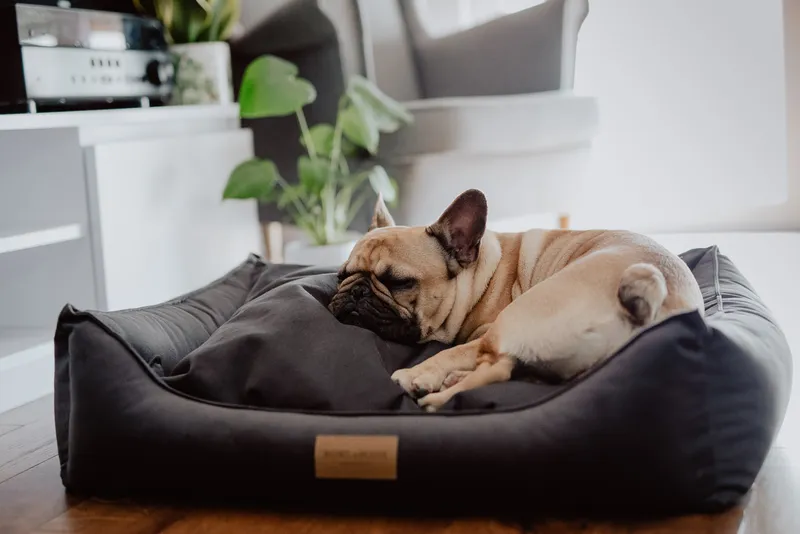
A familiar scent can make it easier for the dog to accept a new place. The Royal Society for the Prevention of Cruelty to Animals notes that an item carrying a familiar scent may help a dog feel more secure during changes and when staying in an unfamiliar environment. Do not place the dog inside the bed and hold them there. Their first interaction should be voluntary.
The material or filling does not suit the dog
Some dogs enjoy sinking into a soft cushion, while others prefer firmer support. A dog may avoid the bed if:
• the surface is too soft or unstable,
• the filling moves beneath the weight of their body,
• the material makes a rustling sound,
• the fabric creates static in the coat,
• the surface feels slippery,
• the bed moves when the dog steps into it,
• too much heat builds up inside,
• the sides prevent the paws from being positioned comfortably.
If the bed slides across floorboards, use a stable base or place it on a rug. An unexpected movement beneath the paws may make the dog approach the bed more cautiously.
Your dog has become accustomed to the sofa or their guardian’s bed
If a dog has rested on the sofa, human bed or directly beside their guardian for a long time, a new dog bed may not immediately compete with a place that has strong and pleasant associations. A sofa may be:
• raised above floor level,
• soft,
• warm,
• filled with the scent of household members,
• positioned at the centre of family life,
• a place where the dog receives attention and physical contact.
Do not expect your companion to abandon a long-established habit after being shown the new bed once. Begin by helping their own resting place develop associations with comfort and calmness. You can initially position the dog bed beside the sofa or human bed. Only once the dog uses it regularly and voluntarily should you decide whether to move it gradually elsewhere.
The dog bed is associated with force or punishment
A dog may avoid their bed if they have previously:
• been sent there in a raised voice,
• been physically moved onto it,
• been held there when they attempted to leave,
• associated the bed with being excluded from family life,
• been disturbed while resting,
• been regularly bothered there by children or other animals,
• experienced unpleasant procedures while lying on it.
A dog’s own resting place should not be used as a punishment. They must be able to enter, rest and leave freely. If the negative associations are strong, it may sometimes be easier to begin again. Change the position of the bed, place a different blanket on it and avoid giving any command for a while. Reward voluntary interest without immediately expecting the dog to remain there for a long time.
Reward-based methods are recommended by the American Veterinary Society of Animal Behavior when teaching new behaviours and addressing behavioural difficulties.
Your dog is too aroused to settle down calmly
Sometimes the problem is not the bed. The dog may simply be unable to settle after a day filled with stimulation. After an intensive walk, meeting other dogs, travelling or having visitors, your companion may:
• walk repeatedly around the home,
• bring toys,
• respond to every sound,
• follow their guardian,
• lie down and stand up repeatedly,
• look for another activity.
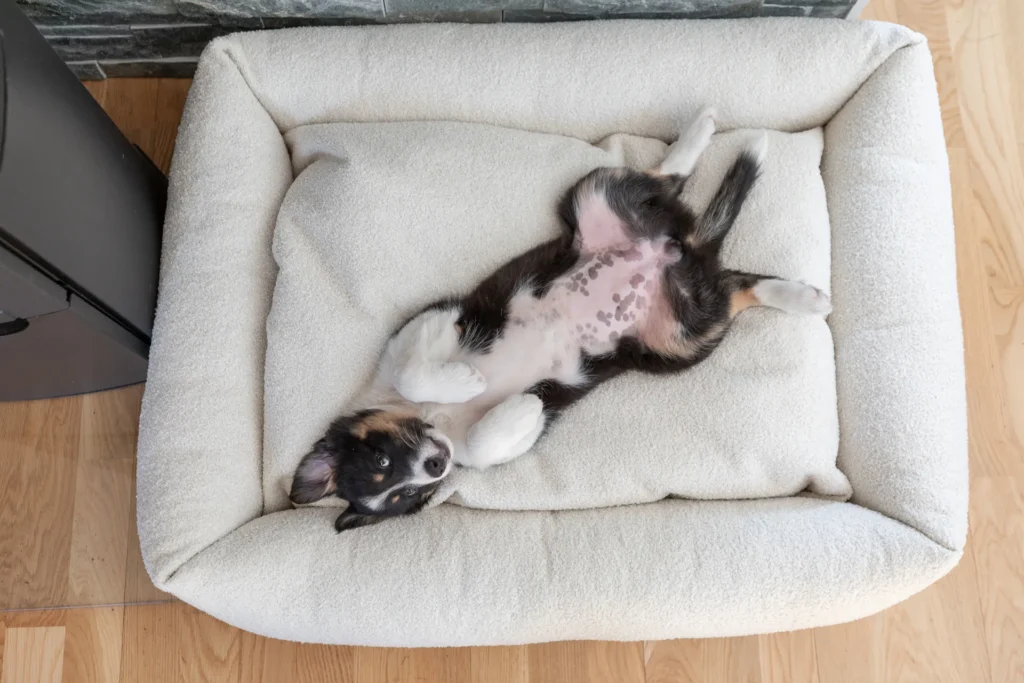
Sending the dog to their bed may not be enough. They may need a calm routine: a short opportunity to sniff, access to water, reduced noise, dimmed lighting and time without further stimulation. You can find more guidance in the article “How to help your dog rest after an active day?”.
Reluctance to use the bed may result from pain
If your dog previously used their bed willingly but has suddenly started avoiding it, consider their health.
The problem may not be the bed itself. Your dog may have difficulty:
• stepping over a high side,
• turning around on a soft surface,
• lowering or lifting their body,
• maintaining balance,
• finding a position that does not cause discomfort.
Other concerning signs include:
• stiffness after resting,
• reluctance to stand up,
• lameness,
• repeatedly lying down and standing up,
• panting without physical effort,
• whimpering,
• avoiding stairs and jumping,
• sudden irritability when touched,
• reduced interest in walks.
Difficulty finding a comfortable position, repeatedly standing up and lying down, and reluctance to raise the body can be signs of pain. In this situation, do not attempt to solve the problem solely by buying a new bed. The first step should be a consultation with a veterinary surgeon.
How to help your dog become accustomed to their bed step by step
The aim is not to force the dog to remain in the bed, but to create positive associations and show them that it is a safe resting place.
Choose a calm moment when your dog is not excessively aroused, extremely hungry or occupied with observing the surroundings.
– step 1: allow your dog to investigate the bed independently
Position the bed somewhere the dog often chooses. Do not place them inside. Allow your companion to:
• sniff the material,
• walk around the bed,
• touch it with a paw,
• enter and immediately leave,
• lie down beside it.
At this stage, every calm and voluntary interaction is valuable.
– step 2: reward interest
Place a treat beside the bed. The next one can be placed on the edge, and another slightly further inside. Reward:
• looking towards the bed,
• approaching it,
• sniffing it,
• placing one paw inside,
• entering with the whole body,
• remaining calmly for a moment,
• lying down voluntarily.
Do not lure the dog inside and then block their exit. They should know that they are free to leave at any time.
– step 3: reward calm remaining
Once your dog begins entering the bed willingly, reward them for remaining there briefly. At first, this may be only one or two seconds. Increase the duration gradually, but finish the exercise before your companion becomes impatient.
Place the treat low between the dog’s paws. This avoids encouraging them to stand up immediately. When teaching a dog to remain calmly, the Royal Society for the Prevention of Cruelty to Animals recommends initially rewarding the dog for staying on their bed while the guardian remains nearby, before gradually increasing the distance and duration.
– step 4: introduce a calm cue
Only once your dog regularly enters the bed should you add a cue, such as:
• “bed”,
• “your place”,
• “settle”.
Say it calmly just before the behaviour your dog already understands. The cue should not sound like a reprimand.
– step 5: encourage natural rest
When the dog lies down voluntarily, do not immediately overwhelm them with enthusiastic praise. An intense response may arouse them again.
You can calmly place a treat between their paws or quietly say your chosen praise word. If your companion falls asleep, allow them to rest. Do not wake them simply to repeat the exercise.
– step 6: practise during everyday situations
The dog bed can become a calm resting place while you are:
• reading a book,
• watching a film,
• working at a desk,
• preparing a meal,
• spending time with a calm visitor,
• relaxing after a walk.
The dog should gradually discover that they do not need to perform a task while on the bed. They can simply remain close and rest.
How to teach a dog to sleep in their bed at night
Night-time rest may be more difficult, particularly if the dog is accustomed to sleeping with their guardian.
Do not begin by suddenly shutting the dog in another room. For some companions, an abrupt loss of closeness can be stressful.
– position the bed close to where you sleep
At first, place the bed beside your own bed or somewhere the dog can see and hear you. Once they begin sleeping peacefully through the night, you can leave the bed in that position or, when necessary, move it gradually by a small distance at a time.
– create a calm evening routine
Helpful elements may include:
• a calm walk,
• an opportunity to toilet,
• access to water,
• reducing energetic play immediately before bedtime,
• dimming the lights,
• a consistent time for rest,
• a familiar blanket on the bed.
The routine does not need to be identical every day, but predictability helps the dog understand that the active part of the evening is ending.
– do not send the dog back angrily
If your companion gets up, calmly indicate the bed or reward them again for entering. Do not raise your voice, push them or confine them to the bed.
If the situation repeats many times, consider what the dog may need. They may be too warm, need to go outside, feel anxious or be unwell.
– establish consistent household rules
If one person allows the dog onto the human bed and another sends them away every night, it will be difficult for the dog to understand what is expected. Household members should agree where the dog may sleep, but the rules should never be based on fear or punishment.
What should you avoid when your dog refuses to use their bed?
– do not move the dog by force
Picking your dog up and placing them on the bed does not teach them that it is comfortable. It may increase uncertainty and make them want to leave more quickly.
– do not prevent them from leaving
A dog held on the bed may begin viewing it as a trap. They should always be free to end the interaction voluntarily.
– do not use the dog bed as punishment
A cue delivered in a harsh tone and sending the dog to the bed “as punishment” weakens positive associations with rest.
– do not suddenly remove every alternative resting place
Preventing access to the sofa, rug and cool floor will not automatically make the dog bed appealing.
First build the value of the dog’s own space, and only then introduce rules concerning furniture.
– do not disturb the dog once they finally lie down
If every visit to the bed ends with stroking, cuddling, grooming or putting on a harness, the dog may stop treating it as somewhere they can rest peacefully.
– do not expect immediate sleep
You can teach a dog to enter the bed and remain there calmly, but you cannot order them to fall asleep.
Sleep will come when the dog is calm enough and feels secure.
Recommended dog beds for a dog who refuses to use their current bed
There is no single model that is best for every companion. Recommended dog beds should be chosen according to the dog’s sleeping style, size, preferred temperature, age and ease of access. Rather than starting with a colour or shape that suits the interior, consider what your dog chooses independently.
– for a dog who enjoys feeling enclosed
A dog who curls up, settles between cushions and rests their back against furniture may enjoy a bed with soft sides.
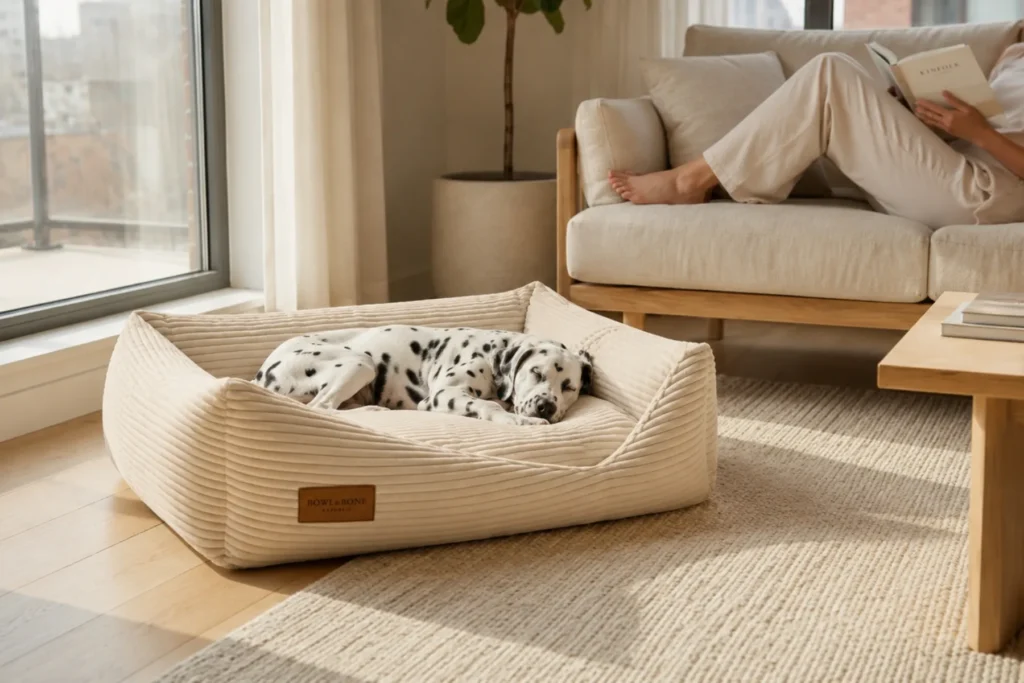
A good example is the DECO corduroy dog bed. Its soft edges allow the dog to support their head and body, while the availability of several sizes makes it possible to match the internal sleeping area to the individual companion.
– for a dog who sleeps fully stretched out
If your dog regularly sleeps on their side, extends their paws and avoids restrictive sides, a dog cushion may be more suitable. Its open construction provides greater freedom of movement and does not restrict visibility. Bowl&Bone Republic dog cushions are available in several sizes, while selected models can also be ordered according to individual measurements.
– for a senior dog or a companion needing stable support
An older dog or one who has difficulty changing position may need a more stable surface and easy access.
An orthopaedic dog bed may provide more even support than a very soft cushion that sinks significantly beneath the body. HARMONY models are available with removable covers and can also be prepared according to individual measurements.
An orthopaedic dog bed does not treat joint or spinal conditions. If the dog experiences pain or mobility problems, veterinary advice is necessary.
– for a dog who falls between standard sizes
If the smaller model restricts movement while the next option is considerably too large, it may be worth considering a made-to-measure dog bed. Bowl&Bone Republic offers the option of producing many dog beds and cushions according to individual measurements. The products are handmade in European Union, making it possible to adapt both the size and selected collection.
Should a dog have more than one bed?
Some dogs use different resting places depending on the time of day.
During the day, your companion may want to rest in the living room close to their guardian. At night, they may choose a quieter place in the bedroom. During summer, they may move to an open cushion, while in winter they may prefer an enclosed bed with sides. Two resting places can be particularly useful:
• in a larger flat or house,
• when the dog spends time with household members in several rooms,
• in a home with more than one dog,
• for a senior dog who finds it difficult to move between floors,
• when the dog has different preferences during the day and at night.
This does not mean that several identical products are necessary. The main bed can be supplemented with a cushion, mat or blanket. You can read more about this in the article “How many beds should a dog have? One bed or several resting places?”.
When is professional help needed?
Contact a veterinary surgeon if your dog:
• suddenly stops using their bed,
• has difficulty standing up or lying down,
• limps or moves stiffly,
• frequently changes position and cannot fall asleep,
• pants or whimpers while resting,
• avoids being touched,
• has a reduced appetite,
• appears lethargic,
• refuses to climb stairs or jump,
• sleeps considerably less or more than before.
If medical causes have been ruled out but the dog remains extremely afraid of the bed, guards the resting place, cannot settle or reacts with panic when the guardian moves away, a qualified canine behaviourist using reward-based methods may be able to help.
A dog’s own bed should be an option, not an obligation
A dog does not need to spend every nap in their own bed for it to be regarded as a safe place. They may occasionally choose the rug, cool floor or a place beside their guardian. What matters most is that their own bed remains an available, comfortable and positively associated space.
If your dog refuses to lie in it, begin with observation. Check the size, construction, temperature and position. Consider whether your companion can enter freely, turn around and leave. Pay attention to whether the problem appeared suddenly or is accompanied by signs of pain. Proceed with training without rushing. Reward approaching, entering and remaining calmly. Do not move your dog by force and do not use the bed as a place of punishment.
A well-chosen Bowl&Bone Republic dog bed may be enclosed or open, soft or more stable, standard-sized or made to measure. The best option, however, is one that suits not only the interior but also the way the individual dog genuinely rests. The range includes models with soft sides, cushions, orthopaedic options and products prepared according to individual dimensions.
Sometimes the breakthrough is not a new product or another training session. Simply moving the bed closer to the sofa, placing a familiar blanket on it and allowing the dog to discover it at their own pace may be enough.
For more inspiration, knowledge and thoughtfully designed dog accessories, visit www.bowlandbone.com — a place created for dog guardians who wish to combine their companion’s everyday comfort with timeless style.
– the Bowl&Bone Republic team
FAQ, meaning the most frequently asked questions about the article –
Why does your dog not want to sleep in their bed, and how can you encourage them to use it?
Why does my dog not want to sleep in their bed?
The cause may be an unsuitable size, inappropriate construction, a location that is too warm or isolated, an unfamiliar scent or previous negative associations. Some dogs also prefer a cool floor, an open surface or somewhere closer to their guardian.
Why does my dog refuse to lie in their bed even during the day?
The bed may be positioned far from household members, in a noisy area or in a draught. The dog may also prefer a different temperature or type of surface. It is worth moving the bed somewhere your companion regularly chooses for rest.
How can I help my dog become accustomed to their bed?
Allow your dog to investigate the bed independently and reward every voluntary approach, entry and calm period of remaining there. Increase the duration gradually and never hold the dog inside.
How can I teach my dog to sleep in their bed?
Begin by teaching the dog to enter and rest calmly during the day. In the evening, position the bed close to where you sleep and introduce a calm, predictable routine.
How long does it take a dog to become accustomed to a bed?
There is no single timeframe. Some dogs begin using the bed after several days, while others need several weeks. The pace depends on previous experiences, the bed’s construction and the way training is carried out.
Can you place a dog in their bed?
The dog should not be moved by force or prevented from leaving. Such actions can create negative associations. It is better to encourage voluntary decisions and reward them.
Where should a dog bed be positioned?
Choose a calm, dry place protected from draughts and excessive heat, but not necessarily completely isolated. Many dogs want to rest somewhere they can observe household members.
Why does my dog prefer sleeping on the floor?
The floor may be cooler and more stable. A dog may choose it particularly during warm weather or when the bed is very soft, warm or too small.
Why does my dog prefer the sofa to their bed?
The sofa is soft, carries the scent of household members and is close to the guardian. It may also offer a larger surface or more comfortable support. Initially, positioning the dog bed beside the sofa may help.
Can a dog bed be too soft?
Yes. Some dogs dislike a surface that sinks deeply beneath their weight. This may be particularly relevant for some senior dogs and companions who have difficulty moving steadily.
Can a dog bed be too large?
A large bed is not harmful, but a dog who prefers enclosed spaces may favour a more closely fitted model with soft sides. A companion who sleeps on their side may appreciate the additional surface.
Which bed is suitable for a dog who sleeps fully stretched out?
A cushion, flat mattress or bed with a larger internal sleeping area may be suitable. The dog should be able to fit their entire torso and extended paws on the surface.
Which bed is suitable for a dog who sleeps curled up?
A more enclosed bed with soft, raised sides may suit them, allowing them to support their head and back.
Can an older dog suddenly stop using their bed?
Yes. The cause may be pain, stiffness, difficulty stepping over a high side or an unstable filling. A sudden change should be discussed with a veterinary surgeon.
Should a dog have two beds?
This is not essential, but two resting places may be useful when the dog wants to remain with household members in different parts of the home or has different preferences during the day and at night.
Can a dog bed be used as a place of punishment?
No. The bed should be associated with calmness and security. Sending the dog there in a harsh voice may cause them to avoid it.
Can treats help a dog become accustomed to their bed?
Yes. They can be used to reward approaching, entering and remaining calmly. Treats should support voluntary behaviour rather than lure the dog into the bed before preventing them from leaving.
When does reluctance to use the bed require professional advice?
Advice is needed when the change occurs suddenly or is accompanied by difficulty standing up, lameness, stiffness, panting, whimpering, lethargy or a clear change in behaviour.
Sources and inspiration used to create the article
Why does your dog not want to sleep in their bed, and how can you encourage them to use it?
- Royal Society for the Prevention of Cruelty to Animals, “Choosing the Perfect Dog Bed”. Guidance on choosing the construction and location of a dog bed and providing several resting options.
- Royal Society for the Prevention of Cruelty to Animals, “Creating a Good Home For Your Dog”. Recommendations concerning a comfortable, clean, dry and quiet resting place protected from draughts.
- Royal Society for the Prevention of Cruelty to Animals, “How to Train Your Dog to Stay Home Alone”. Instructions on gradually rewarding a dog for remaining calmly on their own bed and increasing time and distance.
- American Veterinary Society of Animal Behavior, “Humane Dog Training Position Statement”, 2021. Recommendations concerning reward-based training and avoiding techniques that cause pain or fear.
- VCA Animal Hospitals, “How Do I Know if My Dog is in Pain?”. Information concerning restlessness, difficulty finding a comfortable position and reluctance to stand as possible signs of pain.
- VCA Animal Hospitals, “How to Recognize Pain in Aging Dogs” and “Degenerative Joint Disease in Dogs”. Information concerning behavioural and mobility changes that may accompany pain in senior dogs.
- Bowl&Bone Republic, “Dog beds for large and small dogs”. Information concerning the selection of size and construction and possible reasons why a dog may avoid their bed.
- Bowl&Bone Republic, “How to choose the right size dog bed?”. Guidance on matching the sleeping area to the size and resting style of the individual dog.
- Bowl&Bone Republic, “Orthopaedic dog beds for small and large dogs”. Information concerning the construction of orthopaedic models and available options.
- Bowl&Bone Republic, “Made-to-measure dog bed — is it worth it?”. Information concerning matching individual dimensions to the dog’s build and the available space.
This article is educational in nature and provides general information about rest and helping a dog become accustomed to their bed. It is not a substitute for an examination, diagnosis or recommendations from a veterinary surgeon or an individual consultation with a qualified canine behaviourist.











 or CANADA
  PLEASE join us at