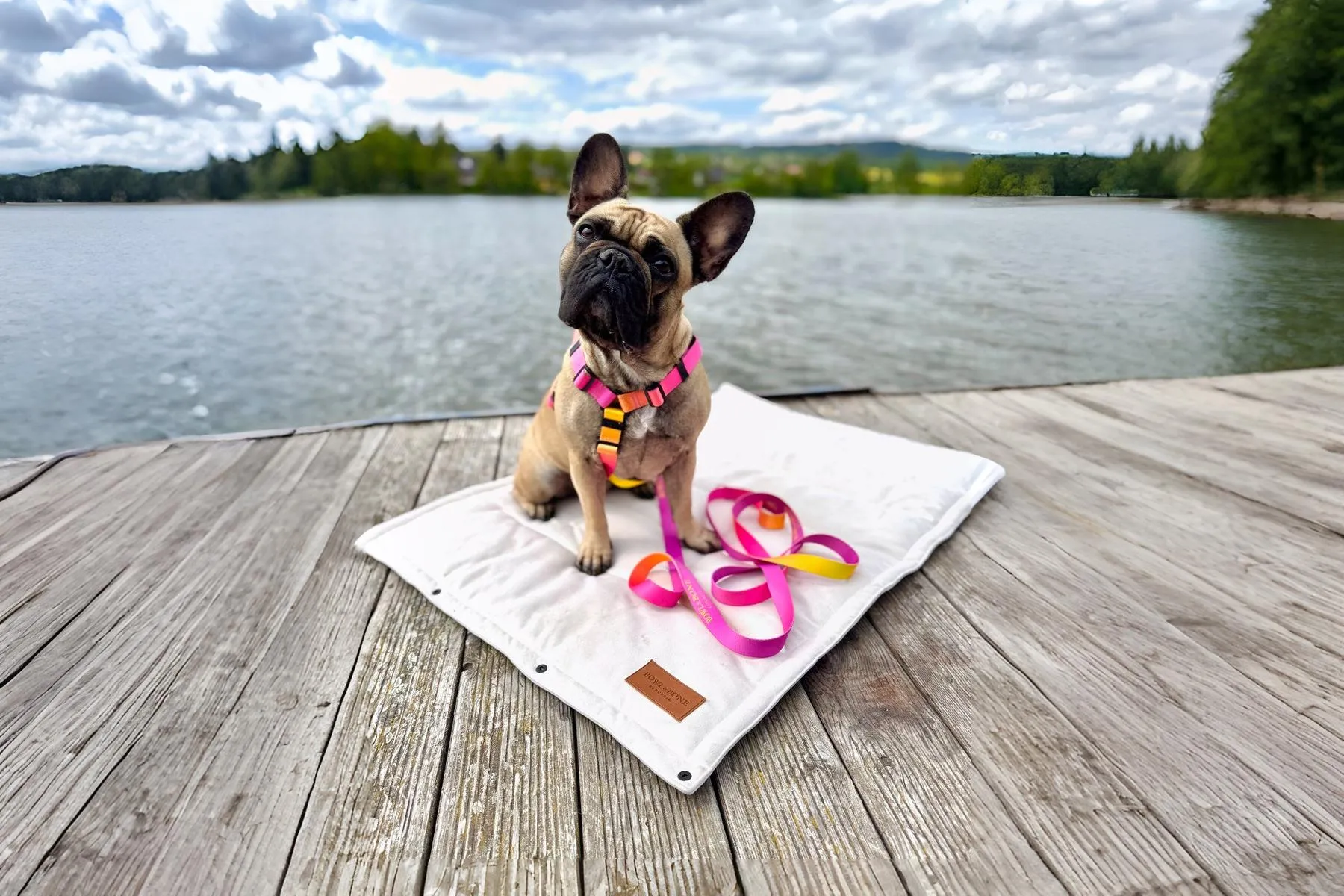
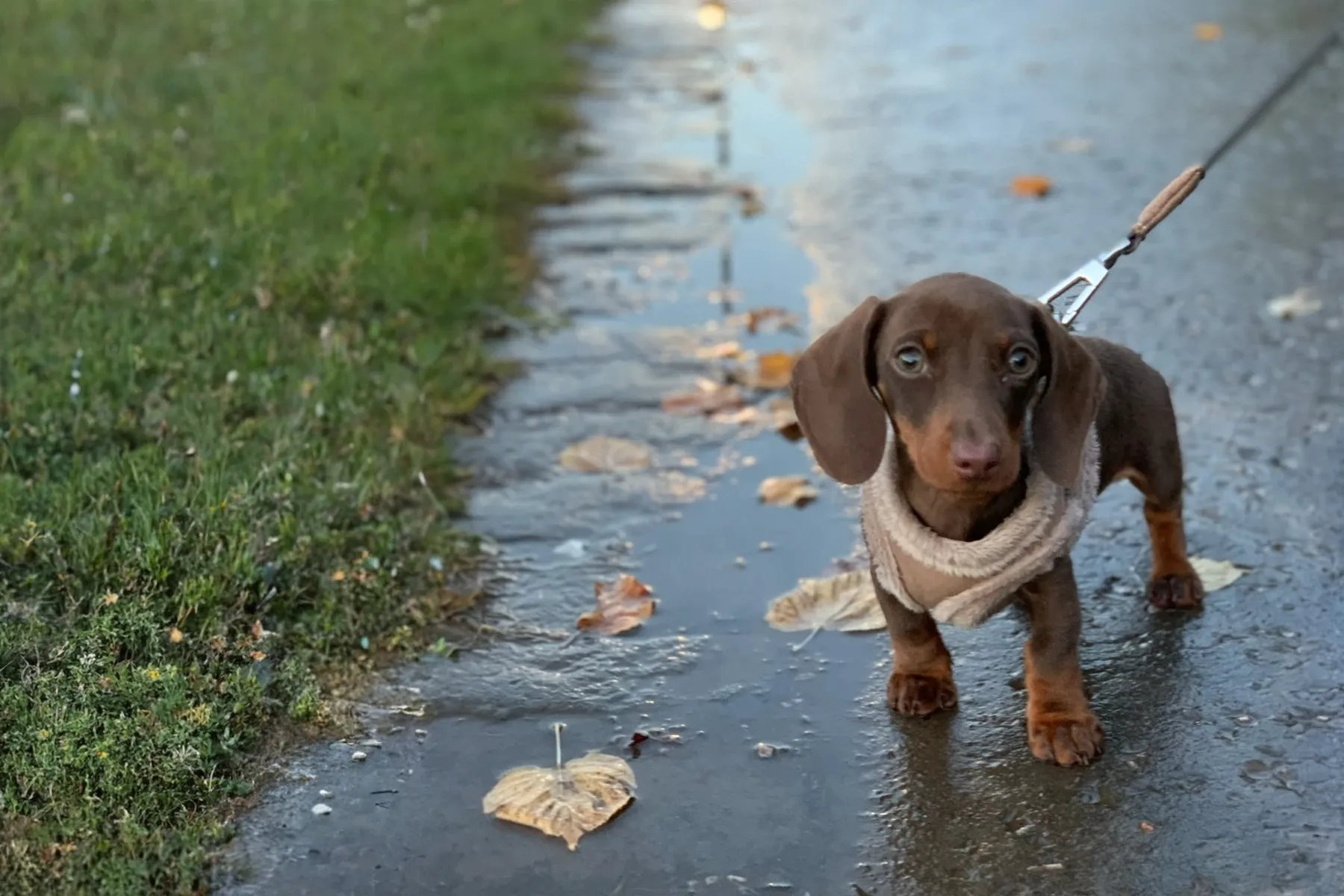
You go for a walk along a familiar route. For you, it’s the same street, the same square, and the same bench beneath the tree. Your dog, however, stops every few steps. They carefully investigate a patch of grass, return to the spot beside a lamppost, and then spend a long moment sniffing somewhere that appears to hold nothing of interest. You see an ordinary corner of the city. Your dog is reading messages left behind by others who have passed through the neighbourhood.

A dog’s sense of smell means that no two daily walks are ever exactly the same. Even when the surroundings look familiar, their scent is constantly changing. It carries traces of people, dogs, other animals, plants, food, moisture and the weather. For a dog, sniffing is not merely an addition to a walk or an unnecessary reason to stop. It is one of the most important ways in which they explore and understand the world.
In brief: how does a dog’s sense of smell work?
A dog’s nose detects scent molecules suspended in the air and resting on different surfaces. Specialised receptors then transmit this information to the brain. Thanks to the complex structure of the canine nose and the active process of sniffing, dogs can distinguish between scents with far greater precision than humans.
Smell helps a dog to:
- explore their surroundings,
- identify people and animals,
- remember places,
- follow interesting scent trails,
- assess unfamiliar situations,
- make everyday decisions.
A dog’s sense of smell – their most important guide to the world
Humans usually look first. We notice shape, colour, movement and distance before paying attention to smell. For dogs, the order is often entirely different. A dog’s sense of smell is one of their primary tools for gathering information. As a result, many things that appear identical to us may have a completely different scent signature to them.
Scientific studies and reviews suggest that dogs may have approximately 125–300 million olfactory receptors, depending on factors including breed and skull structure. Humans are estimated to have around 5 million. The number of receptors alone does not explain the full phenomenon of the canine nose, but it clearly illustrates the scale of the difference between the way we experience scent and the way a dog does.
This does not, of course, mean that dogs do not use their sight. Hearing, touch, taste and visual observation of their surroundings are also important. However, when we consider how a dog experiences the world, we cannot assess it solely from a human perspective. For a dog, scent can be information, memory, guidance and communication all at once.
How does a dog’s sense of smell work?
When a dog takes a short, active breath through their nose, air containing scent molecules is directed towards specific areas of the nasal cavity. Its complex structure and characteristic airflow help transport scent towards the olfactory epithelium. Research into airflow dynamics has shown that, during sniffing, specialised pathways form inside a dog’s nose, supporting the transport of scent molecules to the areas responsible for analysing them.
Sniffing is therefore an active process of gathering information rather than simply a form of breathing. A dog can alter the pace and manner in which they draw in air depending on whether they are investigating a trail on the ground, a scent carried on the breeze or a particular object. The information collected is then transmitted to the brain, where it is compared with previous experiences. A dog may recognise a familiar scent, become interested in something new or decide that a particular trail is not relevant. This is why your dog may suddenly stop in a place that seems entirely ordinary to you. A subtle change in scent may be enough for them to discover that another dog recently passed by, someone placed a bag of food on the ground or a wild animal appeared there during the night.
Scent as a message left in the environment
To a dog, a lawn, pavement or tree trunk can resemble a noticeboard filled with recent messages. Scent traces left behind allow them to distinguish between other dogs and gather information about who was previously present in a particular place.
Researchers have observed that the way dogs investigate and leave scent marks may depend on factors including age, sex, size and social context. This is why two dogs may spend a considerable amount of time investigating the same patch of grass, even though the animal that left the scent is nowhere to be seen. Scent lasts longer than an image. It allows a dog to gather information even when its source has long since disappeared.
In the canine world, a scent is therefore not simply pleasant or unpleasant. It may indicate a direction, reveal the presence of another animal, evoke a familiar association or encourage further exploration.
Why do dogs sniff so much during walks?
Dogs sniff because it helps them orient themselves in their surroundings and discover what happened before they arrived. Stopping beside bushes, walls or lampposts does not necessarily mean that a dog is being disobedient or deliberately slowing down the walk. Most often, they are simply fulfilling a natural need to explore their environment.
Of course, not every walk can continue indefinitely. Sometimes we are rushing to work, it is raining or we are in a place where we need to keep moving. Nevertheless, it is worth ensuring that at least some daily outings give your dog enough time to sniff calmly.
A simple distinction may be helpful:
- a practical walk allows you to go out efficiently and meet your dog’s basic needs,
- an exploratory walk provides more time for stopping, choosing a direction and discovering scents,
- an active walk may include brisk walking, training or playing together.
Not every outing needs to fulfil all of these purposes at once. What matters is ensuring that your dog’s daily routine also includes space for unhurried exploration.
Sniffing is not a waste of time
A dog guardian may feel that spending a long time investigating one place is wasting part of the walk. From the dog’s perspective, however, something important is happening. They are concentrating, comparing scents, searching for their source and deciding whether they wish to continue following a particular trail.
One study found that regular nosework activities were associated with dogs assessing ambiguous situations more positively than exercises based on walking to heel. The researchers highlighted the importance of allowing dogs to perform natural behaviours and make independent choices as part of supporting their wellbeing. This does not mean that every scent-focused walk will solve behavioural difficulties. It does, however, demonstrate that using the nose is far more meaningful to a dog than a momentary form of entertainment.
Therefore, provided that the situation is safe, we should avoid constantly interrupting a dog while they sniff. Repeatedly pulling them away from every scent, continually rushing them and expecting them to follow only a human pace may restrict one of their most important forms of natural exploration.
Can a dog recognise their guardian by scent?
Yes, dogs can recognise familiar people by their scent.
In one magnetic resonance imaging study, twelve conscious dogs were presented with their own scent, the scent of a familiar and unfamiliar dog, and the scent of a familiar and unfamiliar person. The scent of a familiar person triggered a distinctive response in an area of the brain associated by researchers with positive expectations — even when that person was not in the room.
This helps explain why your dog may sniff you so carefully when you return home. Your clothes and shoes carry the story of the previous few hours: the scents of places you have visited, people you have met, other animals, food and your surroundings. Before you have had time to explain where you have been, your dog has already gathered their own set of information.
Familiar scents may also contribute to a sense of predictability. A dog bed, cushion or blanket carries the scent of home and of the dog themselves. For this reason, frequently applying strongly perfumed products to their resting area is not always a good idea. Hygiene is, of course, important, but a neutral, gentle laundry scent may be kinder to a sensitive canine nose than heavily fragranced products.
Does a dog see the world or smell it?
Dogs use all of their senses, but scent often provides them with information that humans cannot see. We might say figuratively that a dog “sees with their nose”, provided that we remember this is a metaphor rather than a literal description.
We see a wet pavement. A dog may detect who walked across it earlier and where the scent trail begins to fade.
We notice an empty park. To a dog, it may be filled with information left behind by previous visitors.
We recognise a familiar person by their face and voice. A dog may combine appearance, sound and a characteristic scent into one complete picture.
Research has even shown that dogs can distinguish their own scent from the scent of other dogs and spend longer investigating it when it has been altered. This is one example of why research into canine perception needs to be adapted to the sense that is most important to the species.
The world of scent begins at home too
Although the greatest variety of scents usually awaits outdoors, dogs also use their noses at home. They investigate shopping bags, visitors’ clothes, a work bag brought home at the end of the day and every unfamiliar object. They may sniff a newly delivered parcel or a place where another member of the household was sitting only moments earlier. It is worth allowing your dog to explore safe new objects calmly. Instead of immediately moving them away from every bag or cardboard box, you can give them a moment to collect information — under supervision and after checking that there is nothing dangerous inside.
Extra care should be taken with essential oils, strongly scented air fresheners, household chemicals and heavily perfumed products. What seems like a delicate fragrance to a person may be overwhelming for a sensitive canine nose. Should your dog walk away, sneeze, narrow their eyes or clearly avoid a room after a product has been used, ventilate the space and remove the intense fragrance. Any worrying or persistent symptoms should be discussed with a veterinary surgeon.
After sniffing comes time to rest
A walk filled with scents does not need to be exceptionally long or fast to provide a dog with a wealth of stimulation. Throughout the outing, they analyse their changing surroundings, select interesting trails, return to certain places and choose to leave others behind. After returning home, a dog may have a drink of water, walk through the house and then settle in their own familiar corner.
This transition from exploration to rest is an important part of the daily rhythm. A dog should have a place where they are not constantly disturbed and can lie in their preferred position. For one dog, this may be a soft dog bed surrounded by supportive sides. Another may prefer a more open dog cushion bed.
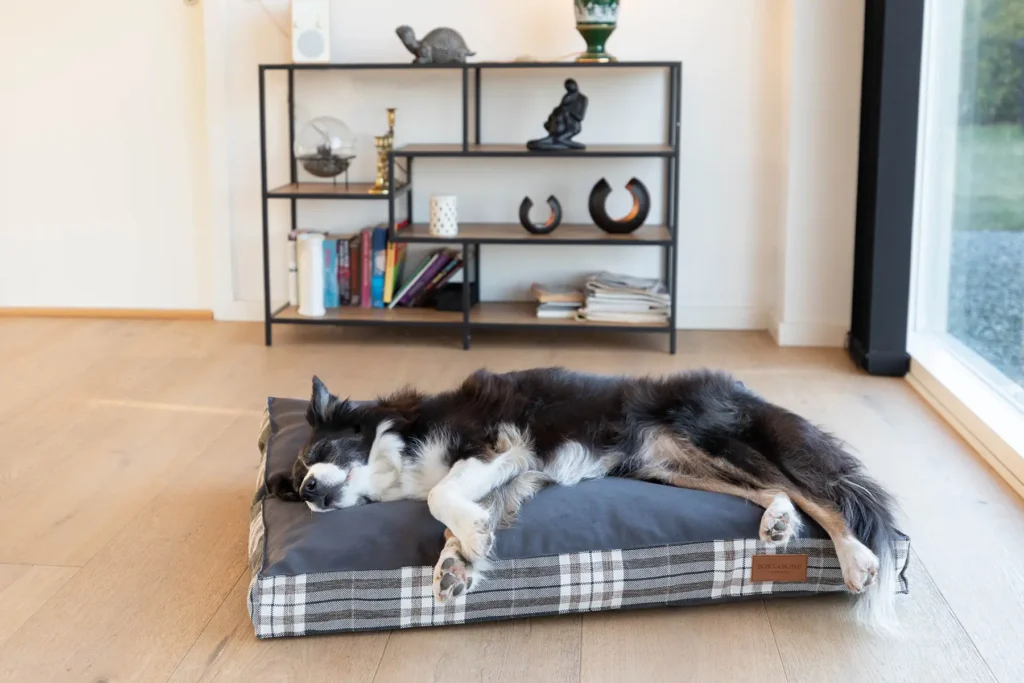
For senior dogs, larger breeds, highly active dogs or those needing more stable support, an orthopaedic dog bed may be worth considering.
The resting place should be chosen according to the dog’s size, preferred sleeping position, age and individual needs. A bed does not, however, replace diagnosis or treatment. Any signs of pain, difficulty standing up or a sudden change in behaviour should be discussed with an appropriate specialist.
How can you support your dog’s natural need to sniff?
You do not need an elaborate training plan to enrich your dog’s daily life with meaningful scent-based activity. Regularity, safety and careful observation are what matter most.
– allow your dog to stop at interesting scents
You do not have to wait for several minutes at every location, but try not to interrupt every attempt to explore. Sometimes just a few additional seconds are enough for a dog to finish investigating a scent calmly.
– choose a different route from time to time
Even a short walk along another street can create an entirely new map of scents. This does not mean organising a long journey every day. A small variation to a familiar route may already be fascinating to your dog.
– give your dog an opportunity to choose
In a safe environment, occasionally allow your dog to decide which direction to take or which patch of grass to investigate. The ability to make simple choices is an important part of independent exploration.
– adapt the pace to age and physical condition
A puppy, a senior dog and an active adult dog may need different walk lengths and different numbers of breaks. Avoid comparing your dog’s pace with that of other dogs.
– observe their level of arousal
Sniffing often helps dogs focus on their surroundings, but every dog responds individually. If your dog becomes increasingly unsettled, finds it difficult to move away from stimuli or cannot relax for a long time after returning home, consider simplifying the walk and discussing their behaviour with an experienced canine behaviourist.
– end the walk calmly
Once you return home, provide access to fresh water, avoid introducing too many additional activities and allow your dog to rest in their own space.
Did you know…?
- A dog’s nose is not simply a more sensitive version of the human nose. Its internal structure and airflow are specialised for actively gathering and analysing scents.
- Dogs can distinguish between the scents of people and other dogs, even when the source of the scent is no longer nearby.
- Olfactory memory can be remarkably long-lasting, although its effectiveness depends on factors including experience, training, environmental conditions and the particular scent involved.
- Sniffing is not reserved for working dogs. Every dog uses their nose to gather information and make everyday decisions.
- Olfactory abilities vary between individual dogs. Nasal structure, age, health, experience and environmental conditions can all play a part.
A dog’s nose reminds us that sometimes it is worth slowing down
The next time your dog stops beside an apparently ordinary patch of grass, try to look at the moment differently. Perhaps they are not delaying the walk. Perhaps they are discovering the story of the place you are passing through together.
By allowing your dog to sniff, you give them more than an opportunity to use an extraordinary sense. You give them time for independent observation, choice and a form of behaviour that is an essential part of their nature. And once every scented message has been read, it is good to return home, have a drink of water and rest in a familiar, safe place.
For more inspiration, knowledge and thoughtfully designed dog accessories, visit www.bowlandbone.com — a place created for dog guardians who wish to combine their companion’s everyday comfort with timeless style.
The Bowl&Bone Republic team
FAQ (frequently asked questions) about
a dog’s sense of smell
How good is a dog’s sense of smell?
A dog’s sense of smell is considerably more specialised than a human’s. Dogs have an extensive olfactory epithelium, a large number of receptors and a characteristic pattern of airflow through the nose.
Its precise sensitivity depends on the scent, breed, nasal structure, age, health, experience and testing conditions. It would therefore be an oversimplification to claim that every dog can always smell a fixed number of times better than a human.
Why does a dog sniff grass?
Grass holds scent molecules carried by people, dogs, other animals, wind and rain. A dog investigates them to gather information about their surroundings and discover what happened in a particular place before they arrived.
Should dogs be allowed to sniff for a long time?
Yes, provided that the location is safe and the dog is not investigating a substance that could harm them. Not every outing needs to be an unstructured exploratory walk, but regular opportunities for calm sniffing support a dog’s natural needs.
Does sniffing tire a dog?
Sniffing requires concentration and the processing of numerous stimuli. After an intensive scent-focused walk, a dog may need calm and rest, although their response will depend on age, temperament, experience and level of arousal.
The aim should not be to exhaust a dog at all costs, but to offer meaningful activity that suits their individual needs.
Can a dog recognise a person by scent?
Yes. Dogs can distinguish between the scents of familiar and unfamiliar people. Neuroimaging research also suggests that the scent of a familiar person can trigger a distinctive response in a dog’s brain associated with positive expectations.
How long does a dog remember a scent?
Dogs can retain olfactory memories for a long time, especially when a scent has particular significance or has been reinforced repeatedly. However, there is no single universal period describing how long every dog remembers every scent.
Why does my dog sniff me when I return home?
Your skin, clothes and shoes carry scents from the places, people, animals and objects you encountered while away. For your dog, sniffing is a natural way of gathering information about your absence.
Should a dog be prevented from sniffing other dogs?
Any interaction should take account of the safety and comfort of both dogs. Brief mutual sniffing is a natural element of canine communication, but dogs should never be forced into close contact.
If either dog turns their head away, stiffens their body, attempts to leave or clearly appears uncomfortable, the guardian should increase the distance between them.
What could a sudden reduction in a dog’s sense of smell mean?
A sudden loss of interest in scents, nasal discharge, sneezing, breathing difficulties, reduced appetite or a change in behaviour can have various causes and should be discussed with a veterinary surgeon.
Olfactory problems should not be diagnosed solely on the basis of behaviour observed at home.
What does the world smell like to a dog?
We cannot recreate a dog’s experience of scent exactly. We do know, however, that a dog’s world is far richer in olfactory information than a human’s.
Scents help dogs recognise people and animals, analyse places, revisit memories and make everyday decisions.
Sources and inspiration
The following scientific publications concerning the structure of the canine olfactory system, the processing of scents and the importance of sniffing in a dog’s daily life were used in preparing this article:
- Kokocińska-Kusiak A. et al., “Canine Olfaction: Physiology, Behavior, and Possibilities for Practical Applications”, Animals, 2021, 11(8), 2463. DOI: 10.3390/ani11082463. A comprehensive review of canine olfactory physiology, sniffing-related behaviours and the factors that influence dogs’ olfactory abilities.
- Craven B.A., Paterson E.G., Settles G.S., “The Fluid Dynamics of Canine Olfaction: Unique Nasal Airflow Patterns as an Explanation of Macrosmia”, Journal of the Royal Society Interface, 2010. DOI: 10.1098/rsif.2009.0490. A study explaining how the characteristic airflow inside a dog’s nose supports the collection and analysis of scent.
- Berns G.S., Brooks A.M., Spivak M., “Scent of the Familiar: An fMRI Study of Canine Brain Responses to Familiar and Unfamiliar Human and Dog Odors”, Behavioural Processes, 2015, 110, 37–46. DOI: 10.1016/j.beproc.2014.02.011. A study examining canine brain responses to the scents of familiar and unfamiliar people and dogs.
- Duranton C., Horowitz A., “Let Me Sniff! Nosework Induces Positive Judgment Bias in Pet Dogs”, Applied Animal Behaviour Science, 2019, 211, 61–66. DOI: 10.1016/j.applanim.2018.12.009. A publication exploring the relationship between scent-based activities, opportunities to make choices and canine wellbeing.
- Horowitz A., “Smelling Themselves: Dogs Investigate Their Own Odours Longer When Modified in an ‘Olfactory Mirror’ Test”, Behavioural Processes, 2017, 143, 17–24. DOI: 10.1016/j.beproc.2017.08.001. A study showing that dogs distinguish their own scent from those of other dogs and notice when it has been altered.
- Lazarowski L., Waggoner P., Hutchings B., Angle C., Porritt F., “Maintaining Long-Term Odor Memory and Detection Performance in Dogs”, Applied Animal Behaviour Science, 2021, 238, 105301. DOI: 10.1016/j.applanim.2021.105301. A study focusing on long-term olfactory memory and dogs’ ability to recognise previously learned scents.
This article is educational in nature and presents current knowledge about canine behaviour and sensory perception. It is not a substitute for an individual consultation with a veterinary surgeon or canine behaviourist.