


You are looking for a new harness for your dog and, after just a few minutes, it becomes clear that the decision is about much more than colour or size. GUARD, WALK IN, STEP IN, walking harnesses, pressure-free harnesses – there are plenty of names, and each type looks slightly different. Two models can be equally well made, yet one may be considerably more comfortable for a particular dog and their guardian.

With GUARD and WALK IN harnesses, the main differences lie primarily in their construction, how they are put on and the possibilities for adjustment. A GUARD harness is usually put over the dog’s head and then fastened around the torso, whereas with a WALK IN harness, also known as a STEP IN harness, the dog places their front paws into the openings and the harness is fastened on the back. This single difference can already be very important for a dog that dislikes having anything passed over their head or, conversely, does not enjoy having their front paws handled.
If you are looking for extensive adjustment options and a stable fit around the dog’s body, a GUARD harness is worth considering. If, on the other hand, your dog dislikes having a harness put over their head and moves calmly during walks, a WALK IN harness may be a practical option. There is, however, no single type that will be best for every dog. Biomechanical research shows that the specific construction, fit and individual build of the dog all matter [1][2][3].
What will you learn from this article? In this guide, you will find out:
- how GUARD and WALK IN harnesses differ,
- how both types of harness are put on,
- which harness offers greater adjustment possibilities,
- which harness to choose for a dog that dislikes having things passed over their head,
- which option may work well for a small dog,
- what to choose for an active dog or a dog that pulls on the lead,
- whether a GUARD harness really always allows greater freedom of movement,
- what to look for when measuring your dog and checking the fit,
- which GUARD and WALK- IN models you can find at Bowl&Bone Republic,
- how to recognise when a particular harness type simply does not suit your dog.
GUARD or WALK IN – the short answer
Both GUARD and WALK IN harnesses can work very well for everyday walks, but they meet slightly different needs. A GUARD harness usually offers more possibilities for adjusting individual straps, while the biggest practical advantage of the WALK IN construction is the way it is put on – without passing the harness over the dog’s head.
| Feature | GUARD harness | WALK IN / STEP IN harness |
|---|---|---|
| How it is put on | usually over the head, then fastened around the torso | the dog places their front paws inside, with the fastening on the back |
| Adjustment | often several adjustment points | depends on the specific model |
| Fit for unusual body proportions | usually easier with models featuring several adjusters | depends more heavily on the construction and the dog’s proportions |
| Dog dislikes having things passed over their head | may require gradual familiarisation | often the more comfortable option |
| Dog dislikes having their paws touched | usually easier to put on | placing the paws inside may be a problem |
| Active walks | can work well when correctly fitted | may work well for a calmer-moving dog |
| Most important factor | correct adjustment | correct size and stability once fastened |
Do not choose a harness solely on the basis of the name of its construction. A correctly fitted WALKcIN model may be more comfortable for one dog than a poorly adjusted GUARD harness, while a properly selected GUARD harness may fit much better than an unsuitable STEP IN model.
That is why it is worth looking at the individual dog rather than only at the product category when making your choice.
What is a GUARD dog harness?
A GUARD harness consists of connected straps surrounding the front and rear parts of the dog’s torso. In many models, the front section is passed over the head, after which the construction is positioned on the body and fastened around the chest. We have already described this type of construction in detail in our guide What is a GUARD dog harness?, so here we will focus mainly on comparing it with a WALK IN harness.
One of the major practical advantages of GUARD harnesses can be the ability to adjust several different elements. This makes it easier to fit the construction more precisely to a dog with a narrower neck, a broad chest or simply less standard proportions. This does not mean that every GUARD harness will automatically fit every dog – the adjustment range, strap length and spacing between individual elements still vary between models.
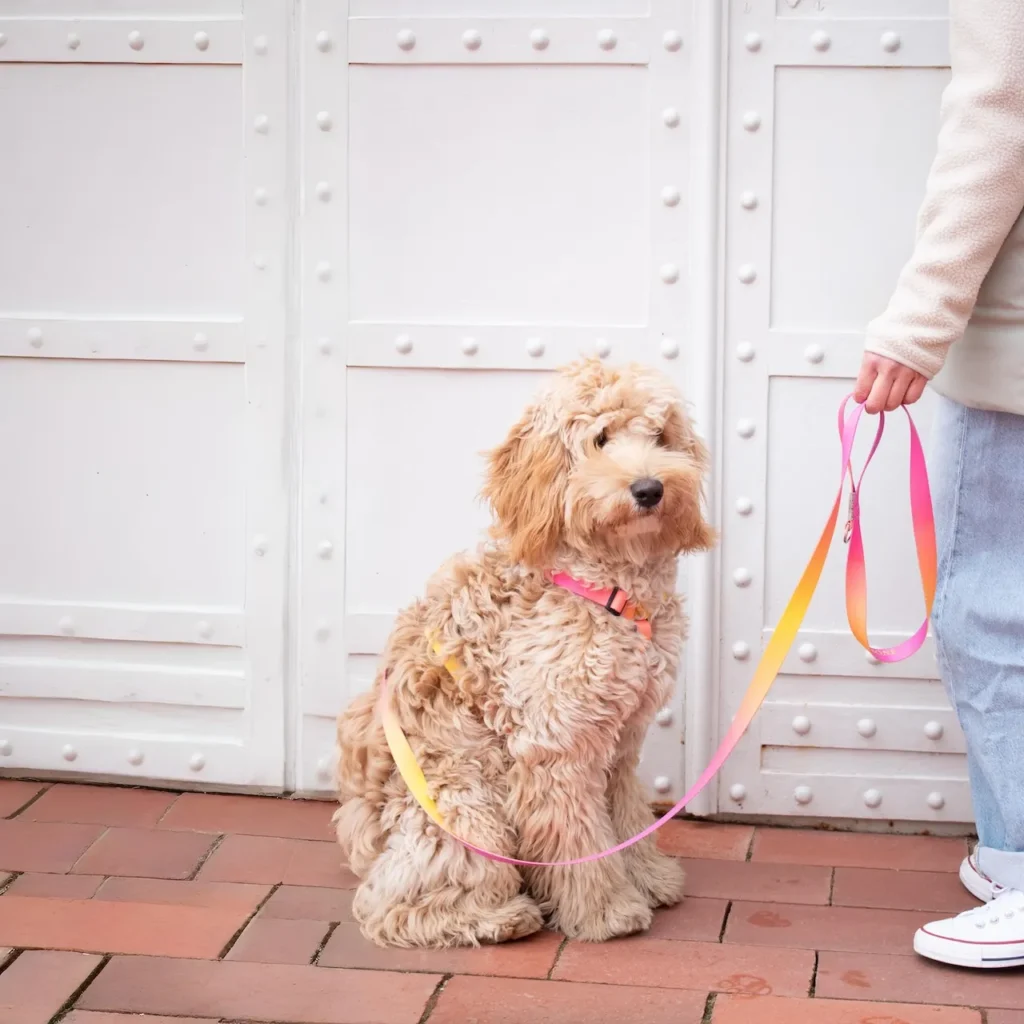
At Bowl&Bone Republic, you will find a separate category of GUARD dog harnesses with four-step adjustment. This range of adjustment can be particularly useful when you want to fit the harness as precisely as possible to your dog’s individual proportions.
What is a WALK IN harness?
WALK IN harnesses, often also referred to as STEP IN harnesses, take their name from the way they are put on. You lay the harness out, the dog places their front paws into the designated openings, then you lift the construction and fasten it on the dog’s back. There is no need to pass a loop over the dog’s head.
This feature can be the greatest advantage of a WALK IN harness. Some dogs pull their head away, freeze or become stressed when their guardian tries to pass a harness over it. If, at the same time, the dog calmly allows their front paws to be touched and positioned, a WALK IN harness can make everyday preparation for a walk considerably easier.
At Bowl&Bone Republic, models of this type can be found in the STEP IN dog harness category. It includes, among others, the ACTIVE harness in several colour options.
GUARD or WALK IN harness – how do they differ in everyday use?
You will notice the difference most clearly not when the harnesses are sitting on a shelf, but when you put them on your dog before every walk. If your dog patiently puts their head through the loop and calmly waits for you to fasten the buckle, a GUARD harness can be a very convenient option. If, however, your dog moves their head away every time, this everyday activity can quickly turn into an unnecessarily stressful ritual.
With a WALK IN harness, the situation is reversed. You do not need to touch the dog’s head, but you do need to guide both front paws into the correct openings. For most calm dogs this is not a problem, but a dog that dislikes having their paws touched or immediately pulls them away may tolerate an over-the-head model much better.
Dogs Trust points out that, regardless of the construction, dogs should be calmly introduced to wearing a harness and guardians should respond to signs of discomfort [4]. This is an important point, because the easiest harness is not necessarily the one with the fewest buckles, but the one that the individual dog calmly allows you to put on.
Which harness for a dog that dislikes having things passed over their head?
In this situation, a WALK IN harness is one of the first options worth considering. The dog does not need to push their head through a loop, removing the moment that some dogs find most uncomfortable. This can make putting the harness on calmer and quicker.

This does not mean, however, that a WALK IN harness will automatically solve every problem associated with putting on a harness. If your dog dislikes having their paws touched, lifted or positioned inside openings, they may instead tolerate a familiar GUARD harness better. Observe not only how quickly you manage to put the product on, but also your dog’s body language throughout the entire process.
If your dog has previously reacted badly to harnesses, introduce the new model gradually. Let your dog look at it and sniff it, reward calm behaviour and do not force the equipment onto them. This approach helps create positive associations regardless of which construction you choose [4].
Which harness is easier to fit – GUARD or WALK IN?
This cannot be answered based solely on the name of the harness type, because the adjustment range is a feature of the individual product. In practice, classic GUARD harnesses often offer several independent adjustment points, giving more possibilities when fitting dogs with unusual proportions. This is where a GUARD harness can have a clear advantage.
One example is the yellow GRADIENT dog harness from Bowl&Bone Republic. The model was designed in the GUARD system and features four adjustment points, allowing it to be set more precisely to the body shape of an individual dog. For your pet, this means the possibility of achieving a comfortable fit, while for the guardian it provides greater control over how the harness sits during everyday walks.
A WALK IN harness can also feature adjustment, but its construction will usually depend more heavily on whether the ready-made shape suits the dog’s proportions. If two of your dog’s measurements fall on the boundary between different sizes, check the size chart of the specific model carefully rather than assuming that an M or L is universal.
Are GUARD harnesses always more anatomical?
No. This is one of the simplifications that is very easily repeated in guides about dog harnesses.
We cannot assume as a universal rule that the word “GUARD” automatically means that a harness does not affect shoulder blade movement. Research by Lafuente and co-authors showed changes in shoulder extension in both constructions described by the researchers as restrictive and non-restrictive [2]. A more recent study involving 66 dogs also found that different harness types altered some of the movement parameters analysed, with results varying between individual dogs and breed types [1].
Another study analysing different harness constructions using three-dimensional motion analysis led the authors to conclude that it is not possible to identify one absolutely best type of harness for every dog [3]. It is therefore much more sensible to observe a specific model on a specific dog.
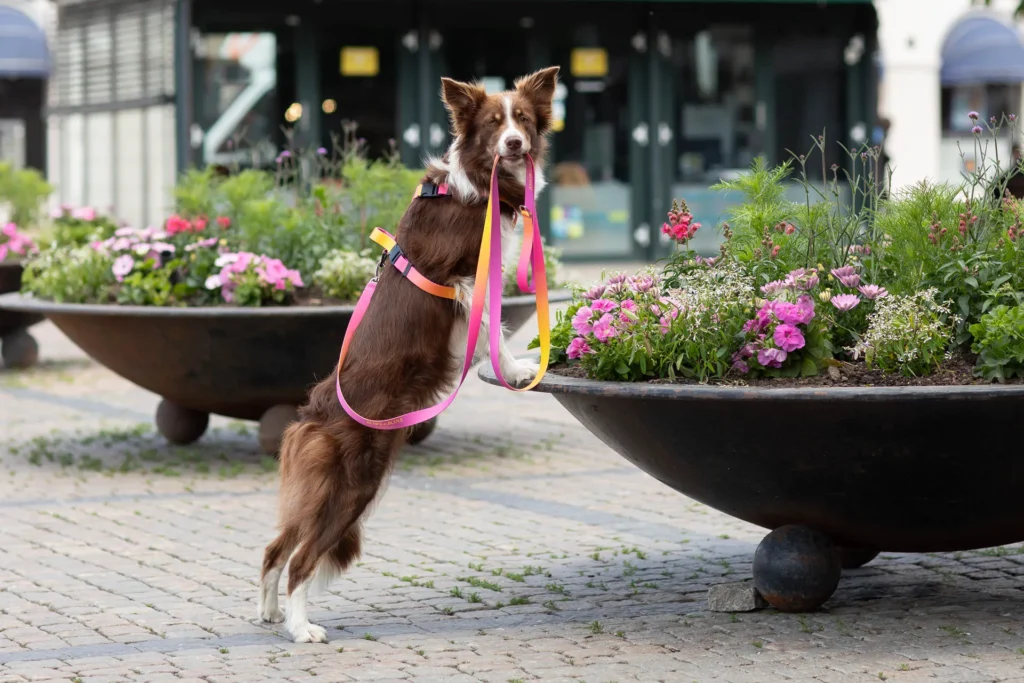
Once the harness is on, observe your dog while they are moving. If they begin shortening their stride, move noticeably differently, the harness shifts, moves into the armpit area or causes rubbing, do not dismiss the problem simply because “this type is supposed to be anatomical”. The issue may be the size, adjustment or simply a construction that does not suit your dog’s build.
GUARD or WALK IN for a dog that pulls on the lead?
The type of harness alone will not teach a dog to walk on a loose lead. A dog that pulls strongly will still need calm training, regardless of whether you choose a GUARD or WALK IN harness. A harness should not be treated as a substitute for teaching your dog how to walk calmly.
With a very dynamic dog, stability and the ability to adjust several elements may be particularly useful, which is why a correctly fitted GUARD harness can sometimes be more convenient for the guardian in this situation. This is not, however, an automatic advantage of every GUARD harness over every WALK IN model. If your dog pulls suddenly, jerks or backs up while wearing the harness, check particularly carefully whether the construction remains securely in place.
Do not treat an ordinary GUARD harness as escape-proof equipment either. If your dog tries to back out of their harness when panicking, seeking advice on a dedicated escape-resistant construction will be more sensible than choosing a model solely because it is described as “GUARD”.
GUARD or WALK IN for a small dog?
Both options can work very well for a small dog. Far more important than the name of the construction are the weight of the harness, the size of the buckles, the width of the straps and whether all the elements are proportionate to the dog’s small body. A large metal component that a Labrador may barely notice can be clearly noticeable to a dog weighing only a few kilograms.
A WALK IN harness is often a convenient solution for a calm small dog, particularly if they dislike having equipment passed over their head. A small GUARD harness with a suitable adjustment range may, in turn, be more practical when the dog has unusual proportions and a ready-made STEP IN construction does not sit securely.
Do not choose solely on the basis of breed. Two Maltese dogs or two Yorkies of similar weight may have different circumferences and different chest shapes. Always choose the product according to the actual measurements of the individual dog.
GUARD or WALK IN for an active dog?
If you take lots of walks together, spend time in the woods or your dog moves very dynamically, stable positioning of the harness during movement will be essential. In this situation, the possibility of adjusting several straps more precisely may favour a GUARD harness. This does not mean, however, that an active dog cannot use a correctly fitted WALK IN harness.
During a fitting, do more than let your dog take a few steps around the room. Observe them during normal walking, turning, sitting and gentle trotting. The construction should not rotate excessively around the torso or shift position with every movement.
The quality of workmanship is equally important for an active dog. Well-finished materials, robust buckles and careful stitching improve everyday comfort, while for the guardian they mean greater product durability during frequent walks.
Bowl&Bone Republic WALK IN – a solution designed for easy dressing
Among Bowl&Bone Republic models, the red ACTIVE dog harness is an example of a WALK IN construction. With this system, the dog steps into the harness with their front paws and the guardian fastens it on the back. This can be particularly practical for a dog that dislikes having elements passed over their head.
You can find the full range of this type of model in the STEP IN dog harness category. Individual ACTIVE variants are available in different colours, so once you have selected the correct size, you can also match the appearance of your walking set to your own style.
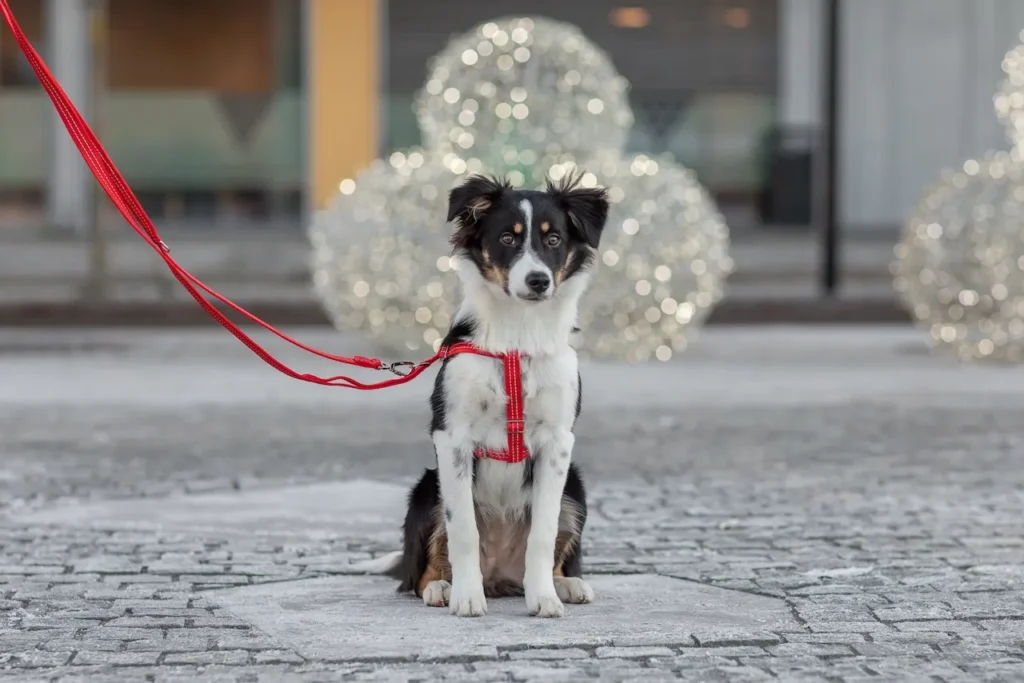
<span style=”color:#d00000″>🔴 IMAGE PRODUCT LINK: ACTIVE red dog harness</span>
Your dog’s comfort remains the most important consideration. Easy dressing is a significant advantage only when the finished construction actually sits securely and comfortably on the dog’s body.
Bowl&Bone Republic GUARD – when is a wider adjustment range useful?
If your priority is the most precise possible fit across several elements of the harness, take a look at GUARD harnesses with four-step adjustment. One example is the GRADIENT model mentioned earlier, where the individual adjustment points can be set according to the measurements of a particular dog.
This type of solution can be comfortable for the dog because it helps avoid situations in which the entire construction has to be tightened excessively simply because one measurement does not fit correctly. The guardian also gains more opportunities to correct the position of the harness, particularly when the dog’s body shape differs from typical proportions.
Other GUARD models are also available, including the blue BREEZE dog harness and BLOOM. When choosing between them, look first at the size chart and construction, and only then at the colour.
How should you measure your dog before choosing a GUARD or WALK IN harness?
Measurements are more important than the name of the harness type. Do not assume that because your dog previously wore a size M, the next product should also be an M. Size charts can differ between collections, even within the same brand.
Measure your dog according to the instructions for the specific model and then compare the result with its size chart. A GUARD harness with several adjustment points may require more measurements than a simple WALK IN construction. We discuss this subject in detail in our guide How to choose a comfortable dog harness that doesn’t chafe or restrict movement?.
Once the harness has been adjusted, do not assess it only while your dog is standing still. Check how it behaves during a normal walk, whether the straps shift towards the armpits, whether any elements twist and whether your dog moves naturally. If you need to tighten every adjuster very strongly just to keep the model in place, you may need a different size or a different construction.
Almost 15 years of designing harnesses has shown us that there is no single construction for every dog
At Bowl&Bone Republic, we have been designing PREMIUM dog accessories for almost 15 years. During this time, we have received hundreds of opinions, stories and practical observations from dog guardians, while feedback from thousands of satisfied customers has allowed us to observe dogs with very different body shapes, temperaments and walking habits.
One thing comes up particularly often: a model that one guardian considers the easiest to put on may be uncomfortable for another dog before the walk has even begun. Some dogs happily put their head through a GUARD harness, while others clearly prefer stepping into a WALK IN model. There are also dogs that pay no attention whatsoever to how the harness is put on, with the most important factor for them being how the product sits while they move.
That is why, when designing harnesses, we focus not only on appearance but also on material quality, finishing, adjustability and everyday comfort. For the dog, this means exploring the world more comfortably, while for the guardian it means a durable product that is easier to adapt to their pet’s needs. Our design experience does not, however, replace individual assessment of a particular dog or biomechanical research, which is why we do not present any single construction as the best solution for every dog.
The most common mistakes when choosing a GUARD or WALK IN harness
One of the most common mistakes is making the decision before measuring the dog. A guardian reads that a GUARD harness is “the most anatomical” or that a WALK-IN harness is “the most comfortable”, chooses a particular type and only then tries to fit their dog into it. It should be the other way round – the construction should suit the dog.
The second mistake is assessing a harness only while the dog is standing still. A model may look perfect during the fitting but begin rotating or shifting after five minutes of walking. Pay attention to your dog’s behaviour when putting it on as well, because everyday stress associated with the equipment is just as important as the appearance of the product itself.
The third mistake is buying a harness that is too loose “for comfort”. A loose product is not necessarily more comfortable – it can move around, rub and change position during movement. Comfort means a correct fit, not maximum looseness.
GUARD or WALK IN – how do you make the decision?
If your dog dislikes putting their head through a harness, calmly allows you to touch their front paws and fits comfortably within the size chart of a particular model, start with a WALK IN harness. If several adjustment points are important to you, your dog has less standard proportions or you want greater control over the positioning of individual straps, a GUARD harness may be more practical.
If both types fit your dog well, you do not need to treat the choice as a lifelong decision. Many dog guardians own more than one model and use them depending on the type of walk or situation. The most important thing is for the harness to be correctly adjusted each time and comfortably accepted by the dog.
A GUARD harness is not automatically better than a WALK IN harness, and a WALK IN harness is not automatically more comfortable than a GUARD. The best harness is the one that properly fits the individual dog, remains stable while they move and is calmly accepted by them. [1][3]
If you would like to compare all available constructions, explore the full Bowl&Bone Republic dog harness collection. You will find models with different constructions, adjustment ranges and ways of putting them on, allowing you to choose an option that suits not only your style but, above all, the real needs of your dog.
– the Bowl&Bone Republic team
FAQ – frequently asked questions about the article –
GUARD or WALK IN dog harness – which should you choose for your dog?
GUARD or WALK IN harness – which is better?
There is no single type that is better for every dog. A GUARD harness often offers greater adjustment possibilities, while a WALK IN harness may be easier to put on for a dog that dislikes having equipment passed over their head. The key is matching the harness to the individual dog’s body shape [1][3].
What is the difference between a GUARD and WALK IN harness?
A GUARD harness is usually put on over the head and surrounds the torso using a system of connected straps. With a WALK IN harness, the dog places their front paws into the openings and the harness is usually fastened on the back.
Are WALK IN and STEP IN harnesses the same thing?
Yes. The terms WALK IN and STEP IN are commonly used for harnesses that a dog steps into with their front paws instead of having the construction passed over their head.
What type of dog is a WALK IN harness suitable for?
It may be a good choice for a dog that walks calmly on the lead, tolerates having their paws touched well but dislikes having a harness passed over their head. You should still check whether the specific model remains stable while the dog moves.
What type of dog is a GUARD harness suitable for?
A GUARD harness can be particularly practical when precise adjustment and matching the product to the dog’s individual proportions are important. The specific construction should still be assessed on the individual dog.
Are WALK IN harnesses safe?
They can be safe when they are the correct size, properly adjusted and the dog cannot easily slip out of them. Safety depends on the specific model and fit, not solely on the name of the harness type.
Are GUARD harnesses escape-proof?
An ordinary GUARD harness should not be treated as an escape-proof harness. If your dog has a tendency to panic, back up and free themselves from their equipment, it is worth choosing a construction specifically designed for this purpose.
Do GUARD harnesses restrict shoulder blade movement?
This cannot be answered solely on the basis of the name of the construction. Research shows that different harness models can influence a dog’s movement parameters, while fit and individual body structure are also important [1][2].
Are WALK IN harnesses suitable for a dog that pulls?
The type of harness alone will not solve a pulling problem. With a very dynamic dog, particular attention should be paid to the stability of the construction while working at the same time on calm walking on the lead.
GUARD or WALK IN for a small dog?
Both types can be suitable. With a small dog, pay particular attention to the weight of the product and buckles, the width of the straps and the appropriate size range.
How do you put on a WALK IN harness?
Lay the harness out in the correct position, have the dog place their front paws into the two openings, then lift the construction and fasten it on the back. The exact method may differ between models, so always check the manufacturer’s instructions.
How do you put on a GUARD harness?
With many models, the front loop is passed over the dog’s head, the lower strap is positioned between the front legs and the harness is then fastened around the chest. Individual constructions can, however, differ between models.
How can you check whether a harness fits correctly?
The harness should remain stable while the dog moves and should not shift into the armpits, rotate excessively or create obvious pressure. The dog should move naturally, while the guardian should follow the adjustment instructions provided by the manufacturer of the specific model.
What should you choose if your dog dislikes harnesses that go over the head?
Consider a WALK IN harness or another construction that does not require passing any element over the dog’s head. Remember, however, that the dog must also tolerate having their front paws touched and guided into the harness.
Sources and inspiration used to write the article
“GUARD or WALK IN dog harness – which should you choose for your dog?”
- Williams E., Hunton V., Boyd J., Carter A., “Effect of harness design on the biomechanics of domestic dogs (Canis lupus familiaris)” – a study involving 66 dogs, examining the effects of different harness constructions on movement parameters and the importance of individual fit.
PubMed – 37731281 - Lafuente M.P., Provis L., Schmalz E.A., “Effects of restrictive and non-restrictive harnesses on shoulder extension in dogs at walk and trot” – a study examining the effects of two harness constructions on shoulder extension during walking and trotting.
PubMed – 30455191 - Pálya Z., Rácz K., Nagymáté G., Kiss R.M., “Development of a detailed canine gait analysis method for evaluating harnesses: A pilot study” – an analysis of the effects of different harnesses on gait kinematics; the authors indicate that it is not possible to identify one absolutely best harness type for all dogs.
PubMed – 35263359 - Dogs Trust, “How to train your dog to wear a harness” – guidance on choosing a correctly fitting harness and gradually introducing a dog to wearing it using positive associations.
Dogs Trust – How to train your dog to wear a harness









 or CANADA
 PLEASE join us at