


In the evening, your dog approaches their bed, turns around several times and searches for the most comfortable position. First, they try to curl up, then stretch out their front paws, and a moment later roll onto their side. Their head rests on the soft edge, but their back paws remain outside the bed. Perhaps this is simply how they like to sleep. It is also possible, however, that their bed is just too small.
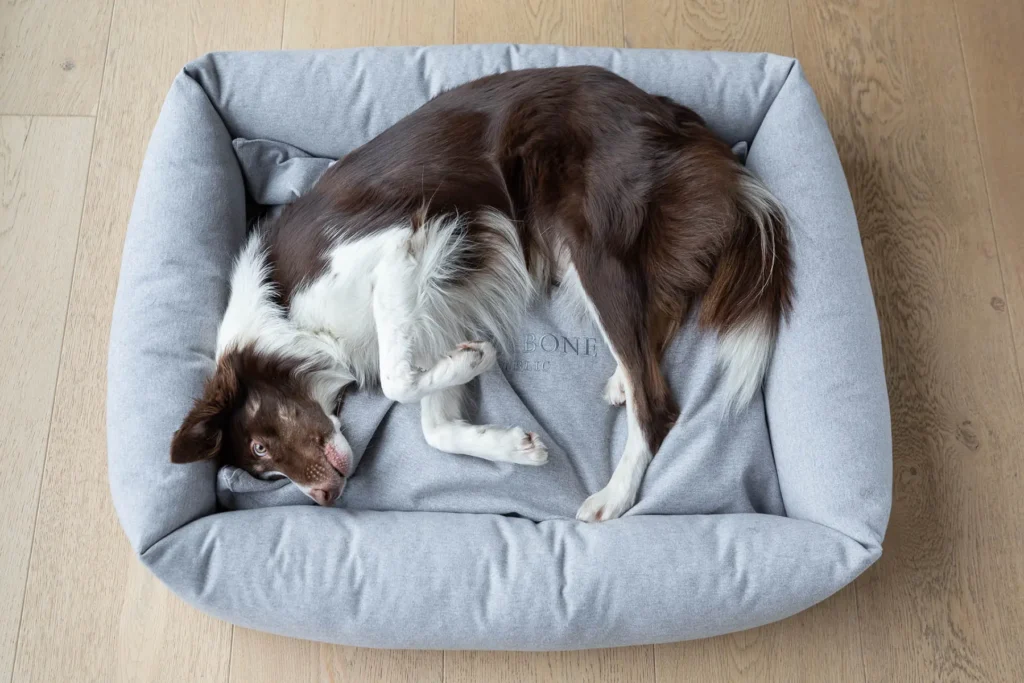
Choosing the right size dog bed may seem simple. A small dog needs size S, a medium dog size M and a large dog size L — at least in theory. In practice, two dogs of a similar weight and height may rest in completely different ways. One curls up into a tight ball, another stretches out to their full length, while a third sleeps on their back with their paws pointing in every direction.
This is why breed and weight alone are not enough when choosing a bed. The most important factors are the dog’s actual measurements, their favourite sleeping positions and the construction of the particular model. A well-fitted dog bed should allow your companion to lie down comfortably, turn around, change position and stretch out. At the same time, it may provide soft support around the sides if your dog enjoys resting in a more enclosed and cosy space.
What will you learn from this article?
• why choosing the right dog bed size matters,
• how to observe your dog before buying a bed,
• how to measure your dog correctly for a bed,
• how many additional centimetres you should allow,
• why you need to check the internal dimensions,
• how the measurements of a bolster bed, cushion and mat differ,
• whether you can select a size based solely on breed or weight,
• how to recognise that a dog bed is too small,
• whether a dog bed can be too large,
• which size to choose when your dog falls between two options,
• how to choose a bed for a puppy,
• what to consider when choosing a bed for a senior dog,
• how to choose a bed for two dogs,
• when it is worth ordering a made-to-measure dog bed,
• how to choose the right Bowl&Bone Republic dog bed size.
Why is the size of a dog bed so important?
A dog bed should provide a place where your companion can rest without continually having to adjust their body to a limited space. If the bed is too small, they may be unable to stretch out their paws, lie comfortably on their side or change position freely. This does not mean that every paw extending beyond the edge proves that the size has been chosen incorrectly. Some dogs love resting their head on the side of the bed or leaving their front paws on the floor even when they have plenty of space available.
The dog’s overall behaviour is what matters. If your companion willingly uses the bed, sleeps peacefully, turns around freely and can fit their entire body inside, the chosen size probably suits their needs. A problem may arise when your dog:
• regularly slides onto the floor,
• cannot straighten their body,
• finds it difficult to turn around,
• avoids the bed despite being tired,
• chooses a larger sofa, rug or the floor,
• lies only in one restricted position,
• cannot fit their torso between the sides of the bed.
Size is, of course, not the only factor affecting where a dog chooses to sleep. Softness, temperature, material, the position of the bed, the construction of its sides and the dog’s individual habits also matter.
The most important rule: check the internal dimensions of the dog bed
One of the most common mistakes is comparing the dog’s length with the external dimensions of the entire product. In a dog bed with soft sides, part of the overall area is taken up by the side cushions. A bed with external dimensions of 75 × 60 cm may, for example, offer a sleeping area measuring 55 × 40 cm.
Before making a purchase, check two measurements:
• external dimensions — these show how much space the bed will occupy in the room,
• internal dimensions — these describe the actual sleeping area available to the dog.
It is the internal dimensions that should be compared with your dog’s measurements. In the case of cushions, mattresses and mats, the difference is usually smaller because almost the entire upper surface can be used for resting. With dog beds featuring high, soft sides, the difference between the external dimensions and the internal sleeping area is considerably greater.
How to measure your dog for a bed
The best measurement is not taken while your dog is standing perfectly straight. A dog bed is designed for rest, so it is worth measuring your companion in the position in which they actually sleep. You do not have to complete the measurement during a single nap. Observe your dog for several days and notice whether they most often:
• curl up,
• sleep on their side,
• stretch out their front and back paws,
• lie on their stomach,
• sleep on their back,
• rest their head on a raised edge,
• frequently change the position of their body.
If your dog chooses several positions, use the one in which they occupy the most space.
– step 1: measure your dog’s length while resting
Measure the distance from the tip of the nose to the base of the tail. If your dog regularly extends their back paws beyond the line of their body while sleeping, include their length as well. You do not need to add the full length of the tail, particularly if your companion usually rests it loosely beside their body. The aim is to determine the space required to position the torso, head and paws comfortably.
– step 2: measure the width of the occupied space
Check how much space your dog occupies at their widest point. When sleeping on their side, this may be the distance from the back to the ends of their extended paws. When curled up, it will be the width of the entire curled body. It is worth taking two or three measurements during different naps and then selecting the largest reliable result.
– step 3: add extra space for changing position
Add a practical allowance to the length and width occupied by your dog. An additional 10–20 cm usually works well, depending on the size of your companion, their sleeping style and the construction of the bed. A smaller dog may need approximately 10 cm of extra space. For a larger dog who sleeps with their paws extended and changes position frequently, an allowance closer to 15–20 cm may be more appropriate.
This is not a rigid mathematical rule. A dog who sleeps tightly curled up may feel comfortable in a more closely fitted bed. A companion who loves stretching out to their full length will generally need a larger sleeping surface. Bowl&Bone Republic recommends allowing approximately 10–20 cm of additional space when choosing a dog bed size.
– step 4: compare the result with the internal dimensions
Suppose your dog occupies an area of approximately 48 × 34 cm when sleeping comfortably. A bed with an internal sleeping area of 45 × 35 cm will probably be too short. A 55 × 40 cm option may suit a dog who prefers a more closely fitted bed. If your companion frequently stretches out their paws or changes position, however, it is worth considering a larger model.
Do not automatically select a size marked with the same letter as your dog’s harness, clothing or a bed from another brand. S, M and L are not standardised measurements. Always compare the specific figures given in the product size chart.
How does your dog’s sleeping position affect the size you should choose?
| How your dog rests | What should you consider? | Which type of bed may work well? |
|---|---|---|
| The dog curls up | they need enough space to turn around but may enjoy feeling enclosed | a dog bed with soft sides |
| The dog sleeps on their side | the length of the torso and space for the paws are important | a larger dog bed, cushion or mattress |
| The dog stretches out fully | the ends of the front and back paws should be included | a cushion, mat, mattress or longer dog bed |
| The dog rests their head on the edge | the side should be soft and positioned at a comfortable height | a dog bed with raised sides |
| The dog frequently changes position | they need enough room to turn around | an option with a larger internal sleeping area |
| The dog sleeps on their back | they may also occupy considerable space across the width | a wider dog bed or cushion |
You can read more about the ways dogs position their bodies while resting in the article “Dog’s sleeping positions”.
Can you choose a dog bed size based on the dog’s weight?
Weight can provide a useful initial indication, but it should not be the main criterion. Two dogs weighing 12 kilograms each may have completely different body shapes. One may be short, long and stocky, while the other is tall, slender and compact. The length of their paws and torso, as well as the way they rest, may also differ.
A similar problem occurs when choosing a dog bed solely on the basis of breed. Dogs of the same breed can differ in build, weight and individual preferences. Information stating that a particular size generally fits a Maltese, Cavalier King Charles Spaniel or Labrador can help with the initial selection. The final decision should always be based on the measurements of the individual dog and the internal sleeping area of the bed.
How to choose the right Bowl&Bone Republic dog bed size
The measurements of individual collections may differ, so you should always check the size chart assigned to the selected product before making a purchase. A good example is the DECO corduroy dog bed, which is available in four sizes:
| Size | External dimensions | Internal dimensions |
|---|---|---|
| S | 60 × 50 × 16 cm | 45 × 35 cm |
| M | 75 × 60 × 21 cm | 55 × 40 cm |
| L | 95 × 75 × 23 cm | 70 × 55 cm |
| XL | 115 × 95 × 24 cm | 90 × 70 cm |
The external dimensions allow you to check whether the product will fit in the selected place in your home. The internal dimensions show how much space the dog will have between the soft sides. The current DECO range includes sizes from S to XL, and the product can also be made to individual measurements.
For example:
• a dog occupying approximately 32 × 25 cm while sleeping may fit comfortably in size S,
• with a measurement of approximately 47 × 33 cm, size M may be worth considering,
• a dog occupying approximately 62 × 47 cm may need size L,
• with a result of approximately 80 × 60 cm, size XL may be more suitable.
These are only examples. A dog who sleeps with their paws fully extended may need a larger option than a similarly built companion who usually curls up.
A bolster bed, cushion or mattress — how does the measuring method change?
The construction of the bed affects which dimensions should be treated as the most important.
– dog bed with soft sides
With this type of model, compare your dog’s measurements primarily with the internal dimensions. The sides occupy part of the overall area, but they can also provide comfortable support for the head and back. This can be a good option for dogs who enjoy curling up, resting their body against an edge or sleeping in a more enclosed space.
– dog cushion
With a dog cushion, almost the entire upper surface can be used for resting. This type of bed may suit dogs who enjoy extending their paws, changing position or prefer not to be surrounded by raised sides.
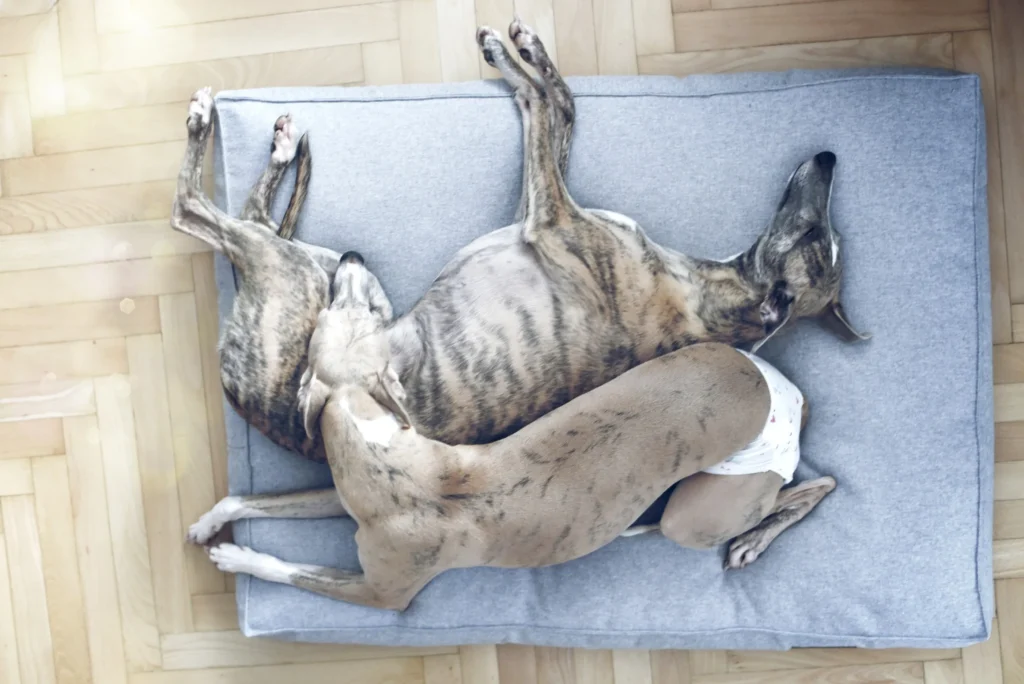
LOFT cushions are available in sizes including 70 × 50 cm, 80 × 60 cm and 95 × 70 cm, as well as in a made-to-measure version.
– orthopaedic mattress
With a mattress, both the length and width of the sleeping area and its stability are important. The dog should be able to place their entire torso, head and paws on the mattress without sliding onto the floor. For an older or larger dog, or one who has difficulty moving, it is also worth considering ease of access, the height of the product and whether the dog can turn around freely.
– dog mat
A mat can be used at home, while travelling or as an additional resting place. Its surface should allow the dog to position their entire torso on it, but it does not always need to provide the same amount of space and support as their main bed.
Can a dog bed be too small?
Yes. A bed that is too small limits the choice of sleeping positions and may cause a significant part of the dog’s body to remain outside the designated sleeping area. Signs that a dog bed may be too small include situations in which:
• the torso does not fit between the sides,
• the dog cannot straighten their paws,
• your companion has difficulty turning around freely,
• most of the body remains on the floor,
• the dog tries to move or push the sides apart,
• they clearly choose larger surfaces more often.
Resting the head on the edge or leaving one paw outside the bed does not necessarily indicate a problem. Some dogs simply enjoy resting this way.
Can a dog bed be too large?
A large dog bed is not inherently harmful or uncomfortable. Many dogs enjoy having plenty of space, particularly if they like sleeping on their side, extending their paws or frequently changing position. A bed that is excessively large may, however, be less practical. It occupies more room in the living area, is more difficult to move and may not provide the same enclosed feeling for a dog who enjoys resting against soft sides.
Some dogs use only a small section of a large bed. This does not automatically mean that they feel anxious. They may simply prefer a particular corner, edge or place closest to their guardian. What matters most is whether your companion willingly uses the bed and can adopt their natural sleeping positions.
What should you choose when your dog falls between two sizes?
If your dog’s measurements are very close to the maximum internal dimensions of the smaller model, it is generally safer to consider the larger option. A larger size will be particularly useful if your dog:
• sleeps on their side,
• extends their paws,
• frequently changes position,
• is still growing,
• has a stocky build,
• occasionally shares the bed with another dog,
• needs more room to turn around comfortably.
A smaller, more closely fitted option may suit a dog who consistently curls up into a small ball, enjoys soft surrounding sides and does not use the additional space. If any of your dog’s measurements exceed the internal sleeping area of the smaller model, do not choose it solely because it will fit the interior more neatly.
What size dog bed should you choose for a puppy?
A puppy changes quickly, so buying a bed that fits only their current measurements may mean having to replace it after just a few months. When choosing a size, consider:
• the expected adult size of the dog,
• the growth rate of the particular breed or crossbreed,
• the size of the parents, if known,
• ease of access to the bed,
• whether the covers can be removed and washed,
• the material’s durability during everyday use.
This does not mean that a small puppy should always receive the largest available bed. You can choose a model that allows for their expected growth and temporarily fill part of the space with a soft, safe blanket. If the adult size of a crossbreed is unknown, a sensible solution may be to begin with a smaller, easy-to-clean bed and purchase the final model later.
How to choose a dog bed for a senior dog
For an older dog, the sleeping area is not the only important consideration. Your companion should be able to enter the bed, turn around and lie down without squeezing through a narrow opening. It is worth considering:
• a suitably wide or lowered entrance,
• a stable sleeping surface,
• no need to lift the paws too high,
• enough space to change position,
• a removable and easy-to-wash cover,
• protection of the inner filling against moisture,
• the option of choosing an orthopaedic mattress.
Bowl&Bone Republic HARMONY orthopaedic dog beds have a mattress made from a combination of supportive foam and memory foam, removable covers and an additional waterproof layer protecting the foam. They are available in sizes S, M and L, as well as in a made-to-measure version.
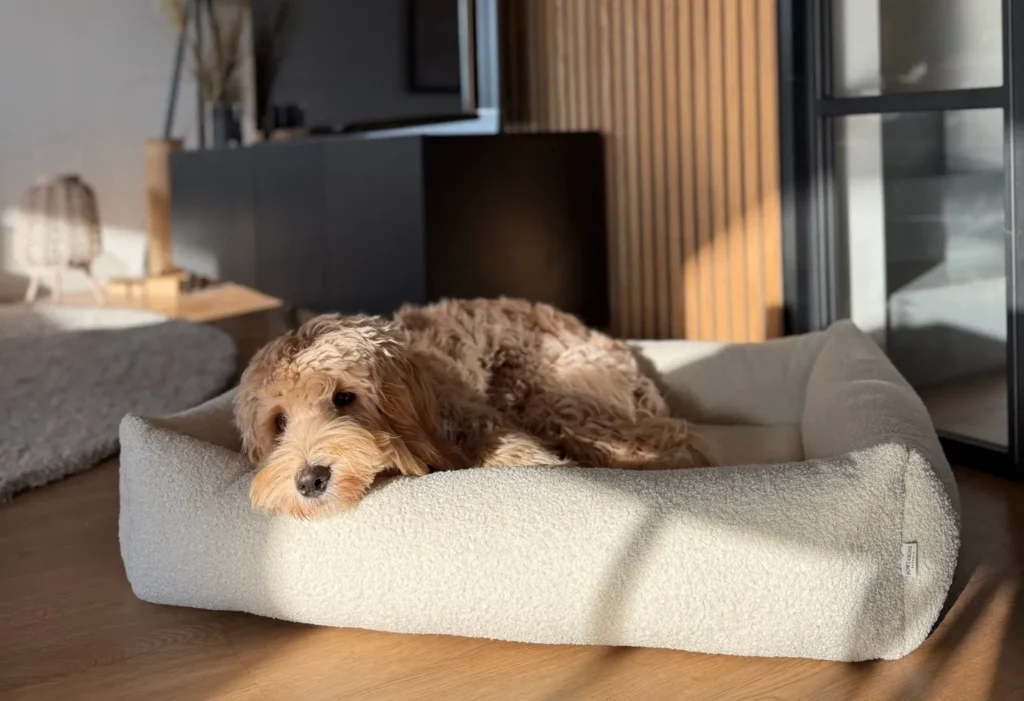
If your dog is experiencing pain, stiffness, difficulty standing up or reluctance to change position, it is worth discussing their needs with a veterinary surgeon. Choosing a dog bed does not replace diagnosis or treatment.
How to choose a dog bed size for two dogs
If two dogs enjoy sleeping together, the surface should accommodate both of their bodies even when they lie on their sides or change position. Measure the dogs while they are resting together or add together the areas each of them occupies separately. Remember, however, that choosing to fall asleep together does not mean that the dogs will always want to share their space.
Even if they willingly lie together, each dog should also have access to a separate resting place. This allows them to choose distance when one dog wants to sleep while the other continues to observe the surroundings or seek contact. You can read more about this in the article “How many beds should a dog have? One dog bed or several resting places?”.
When is it worth choosing a made-to-measure dog bed?
Standard sizes meet the needs of many dogs. There are, however, situations in which individual measurements may provide a better solution. It is worth considering when:
• your dog has an unusually long or stocky torso,
• they are very tall but slender,
• the standard size is slightly too small while the next option is considerably too large,
• the bed needs to fit within a particular alcove or piece of fitted furniture,
• two dogs regularly sleep together,
• your companion needs an unusually wide entrance,
• the guardian wishes to combine a particular size with a selected collection and colour.
Bowl&Bone Republic offers the option of preparing many dog beds and cushions according to individual measurements. The products are handmade in European Union, allowing the size to be adapted to the dog’s needs and the available space in the home. You can find more information in the guide “Made-to-measure dog bed — is it worth it?”.
The most common mistakes when choosing a dog bed size
– choosing solely on the basis of breed
Breed can help estimate size, but it does not account for the dog’s individual build or sleeping style.
– considering only weight
Weight does not show how long the dog’s torso is or how much space their extended paws occupy.
– comparing the dog with the external dimensions
In a bolster bed, the actual sleeping area is smaller than the product’s overall dimensions.
– failing to allow space for changing position
A dog does not remain motionless throughout the night. They should be able to turn around and position their body comfortably.
– buying the same size as with another brand
The labels S, M and L may represent completely different measurements.
– overlooking the space available in the home
Before making a purchase, it is worth marking the bed’s external dimensions on the floor, for example with masking tape. This allows you to assess whether the product will block a walkway.
– choosing a size based on the puppy’s current measurements
For a growing dog, consider their expected adult measurements or plan to replace the bed later.
How to check the size before buying
Before making your final decision, carry out a simple test at home:
- Find the internal dimensions of the selected model.
- Mark a rectangle of the same size on the floor or a blanket.
- Encourage your dog to lie down within the marked area.
- Check whether they can adopt their favourite sleeping positions.
- Mark the external dimensions separately to assess how much space the product will occupy in the room.
Do not force your dog to remain inside the marked area. The test is intended only to help you visualise the surface of the future bed.
A well-chosen size gives your dog freedom of choice
The ideal dog bed does not have to look enormous. It should, however, be spacious enough for your dog to lie on their side, curl up, rest their head against a soft edge and change position without continually sliding onto the floor. The best starting point is not the breed or the number of kilograms, but observing the individual dog. The way your companion genuinely rests will tell you how much space they need.
When choosing a Bowl&Bone Republic dog bed, you can compare the external and internal dimensions of the individual models, select a soft filling made from certified synthetic down or an orthopaedic mattress and, when needed, order a product prepared to individual measurements.
Removable covers make everyday care easier, the option of purchasing an additional cover allows you to refresh the appearance of the product, and handmade production in European Union combines functionality with refined design. A well-fitted dog bed gives your companion more than a soft surface. It provides their own place where they can choose the most comfortable position and bring the day to a peaceful close.
For more inspiration, knowledge and thoughtfully designed dog accessories, visit www.bowlandbone.com — a place created for dog guardians who wish to combine their companion’s everyday comfort with timeless style.
the Bowl&Bone Republic team
FAQ, meaning the most frequently asked questions from the article –
How to choose the right size dog bed? Complete guide
How should you measure a dog correctly for a bed?
Measure the area occupied by your dog in their longest and widest natural sleeping position. Add enough extra space to allow them to change position freely.
How many centimetres should you add to your dog’s measurements?
An additional 10–20 cm generally works well. The appropriate allowance depends on the dog’s size, sleeping style and the construction of the bed.
Should the tail be included in the measurement?
You do not usually need to include the full length of the tail. The space required for the torso, head and paws is more important. The tail should be considered if your dog regularly rests it straight behind their body.
Are the external or internal dimensions more important?
The internal dimensions are used to match the bed to the dog. The external dimensions show how much space the entire product will occupy in the room.
How should you choose a bed for a dog who sleeps curled up?
A dog who sleeps this way may feel comfortable in a more closely fitted bed with soft sides. They should still have enough room to turn around and change position.
How should you choose a bed for a dog who stretches out?
Measure your dog in their longest sleeping position, including their extended paws. A larger dog bed, cushion or mattress offering a generous surface may be a good choice.
Can you choose a dog bed size based on weight?
Weight may provide an indication, but it does not account for the length of the torso, body shape or sleeping style. It is best to measure the individual dog.
Can a dog bed be too small?
Yes. The dog may be unable to turn around freely, straighten their paws or fit their entire torso between the sides of the bed.
Can a dog bed be too large?
A large size is not automatically a problem. It may, however, occupy more space than necessary and feel less enclosed for a dog who prefers a closely fitted bed.
Which size should you choose when your dog falls between two options?
If their measurements are close to the maximum internal sleeping area of the smaller model, it is generally better to consider the larger size — particularly if the dog sleeps on their side or frequently stretches out.
How should you choose a dog bed size for a puppy?
It is worth considering the dog’s expected adult size. For medium and large breeds, a bed fitted only to the puppy’s current measurements may quickly become too small.
Which dog bed should you choose for a large dog?
A large dog should have enough surface area to position their entire torso and paws comfortably. The stability of the filling and the material’s durability are also important.
Which dog bed should you choose for a senior dog?
Look for a wide or lowered entrance, a stable surface, enough space to change position and the option of choosing an orthopaedic mattress.
Can two dogs sleep in the same bed?
They can if they voluntarily choose to rest together and have enough space. Each dog should nevertheless also have access to a separate bed.
When is it worth ordering a made-to-measure dog bed?
This may be worthwhile when the dog has an unusual build, falls between standard sizes, shares the bed with another dog or the bed needs to fit a particular space in the home.
How can you check whether the bed will fit in the living room?
Mark the external dimensions of the product on the floor using masking tape. This will show how much space the bed will occupy and whether it will block a walkway.
Sources and inspiration used to create the article
How to choose the right size dog bed? Complete guide
- Bowl&Bone Republic, “How to choose the right size dog bed”. The original version of the article was published on 28 November 2022 and updated on 19 February 2024.
- Bowl&Bone Republic, “Dog beds – beds for large and small dogs”. Information concerning measuring a dog, the recommended additional allowance and the construction and properties of dog beds.
- Bowl&Bone Republic, “DECO corduroy dog bed”. The current external and internal size chart for sizes S, M, L and XL.
- Bowl&Bone Republic, “HARMONY orthopaedic dog bed”. Information concerning sizes, the mattress, removable covers, foam protection and the option of producing the item to individual measurements.
- Bowl&Bone Republic, “DECO dog cushion”. Information concerning available sizes, construction, filling, care and the option of ordering the product to individual measurements.
- Bowl&Bone Republic, “Made-to-measure dog bed — is it worth it? Advantages, disadvantages and practical advice”. A resource concerning standard and individual dog bed sizes.
This article is educational and shopping-oriented. If a dog experiences pain, limited mobility, difficulty standing up or other health problems, it is worth discussing the choice of bed with a veterinary surgeon.










 or CANADA
  PLEASE join us at