


Only a moment ago, they were all lying in one place. A soft toy, a small ball, a tug toy and the toy your dog usually carries around the entire home. It took only a few minutes, however, for each of them to end up in a different corner of the living room. Your companion approaches the basket, looks inside and pulls out another toy. They carry it over to the rug, turn it in their mouth for a moment and then leave it beside the others. Do they genuinely need another one? Or could having too many items available make every individual toy seem less interesting?
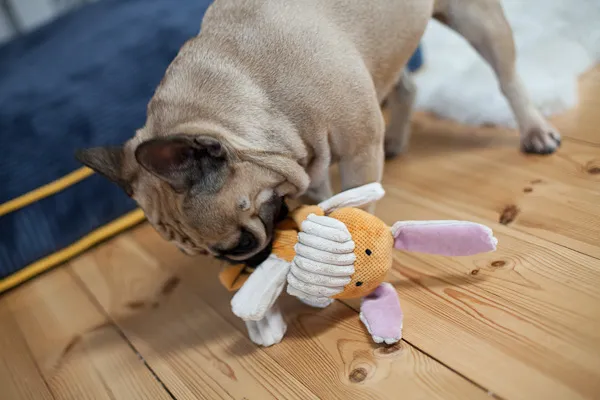
It is difficult to identify one ideal number of toys that will suit every dog. One companion may choose the same soft toy for many months, another may need varied forms of play, while a third is interested in an object mainly when their guardian is holding the other end.
The variety of functions, suitability for the dog’s style of play and the way individual items are made available are more important than the number alone. A dog does not need to have their entire collection in front of them twenty-four hours a day. Some toys can remain available permanently, others are best introduced during shared activities, while the rest can be put away and presented again after a period of time.
This system is known as toy rotation. It does not involve continually buying new items. Its purpose is to use the existing collection in a way that regularly gives the dog opportunities to choose and take part in varied activities.
What will you learn from this article?
• whether there is an ideal number of toys for a dog,
• how many toys can be left available at the same time,
• why variety is more important than quantity,
• which functions dog toys can fulfil,
• whether every toy should remain permanently available,
• what toy rotation involves,
• how often to change the available items,
• whether a dog can have too many toys,
• why a dog may ignore a full toy basket,
• which toys can be left with a dog without supervision,
• which toys should be used only during shared play,
• how to select toys for a puppy and a senior dog,
• how to organise toys in a home with several dogs,
• when a worn toy should be discarded,
• how to organise a collection of dog accessories.
Is there an ideal number of toys for a dog?
There is no scientifically established number of toys that every dog should have. A companion’s needs depend on factors including age, temperament, style of play, health and interest in objects. Some dogs enjoy playing independently. Others see a toy mainly as an invitation to interact with a person. There are also companions who pay little attention to objects for most of the day but respond enthusiastically when their guardian brings out a tug toy.
The fact that a dog owns a dozen toys does not mean that their needs are being met better than those of a companion with a smaller, carefully selected collection. What matters is whether the available items allow for different forms of activity and genuinely suit the preferences of the individual dog. As a practical starting point, you may leave approximately four to six different toys available at the same time. This is not a rigid rule, however. One dog may be perfectly content with three items, while another may enjoy having a wider selection. The remaining toys can be stored out of reach and introduced as part of a rotation.
Why is variety more important than quantity?
Five almost identical balls do not give a dog the same choice as five items designed for different types of play.
A thoughtfully selected collection may include:
• a toy for carrying,
• a tug toy,
• an item for fetching,
• a safe chew toy,
• a scent-based or food-dispensing toy,
• a soft toy,
• an item intended for shared activity.
Not every dog needs every type. A companion who does not enjoy fetching does not need several balls. A dog who is particularly interested in sniffing may remain engaged with a food-search toy for much longer than with another soft toy.
It is worth observing not only which toy your dog chooses, but also how they use it. One item may be carried around, another gently tossed, while a third is used exclusively for tugging together. You can read more about matching the type of toy to your companion’s needs in the article “How to choose the right toys for your dog?”.
Which toys should a dog have?
There is no compulsory list that needs to be completed during a single shopping trip. It is worth ensuring, however, that the collection allows your dog to enjoy several different forms of activity.
– toy for shared activity
This may be a tug toy, a ball or an object that the dog enjoys bringing to their guardian. Its greatest value does not necessarily come from its construction. The presence of another participant is often the most important part of the game. One example is the rope BULLET dog toy, which can be used for tugging, fetching and shared activities during a walk.
Playing tug with a dog does not automatically cause aggression or make the dog attempt to “dominate” their guardian. The game should, however, follow clear rules and be paused if the dog becomes excessively aroused or begins guarding the object. [5]
– toy for carrying
Many dogs enjoy carrying objects between rooms, bringing them to household members or placing them beside their resting area. Such a toy should be light enough to carry but large enough that the dog cannot easily swallow it. Some companions choose a soft toy for this purpose, such as the BAX dog toy or TOFFI dog toy.
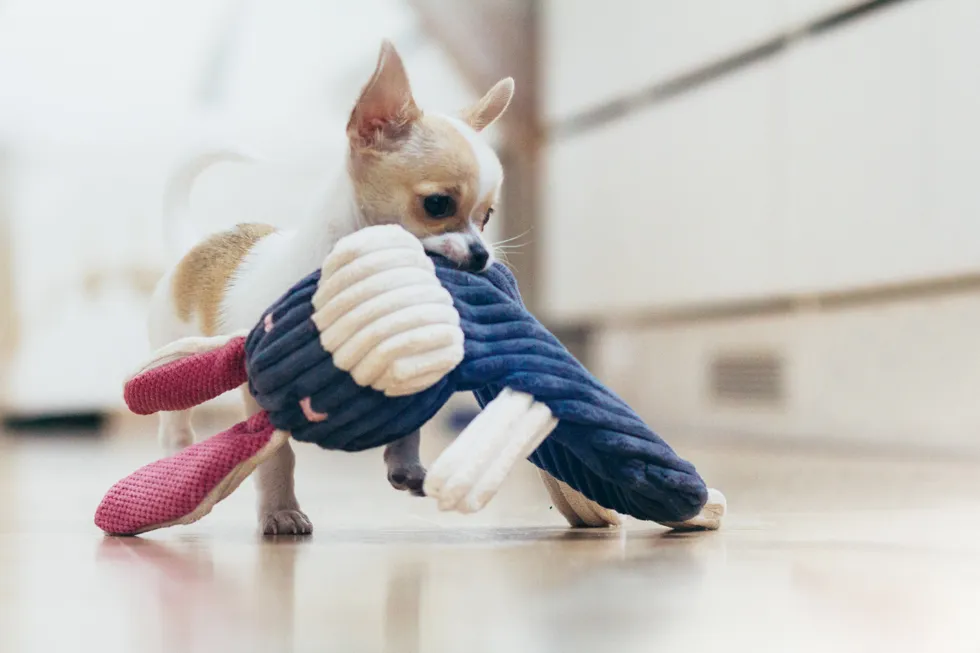
It should not be assumed that every dog will handle a soft toy gently. If your companion tears the material and pulls out the filling, the activity should take place under supervision.
– chew toy
Chewing is a natural canine activity, but the item should be suited to the dog’s size, jaw strength and way of using the toy. A dog who attempts to tear off and swallow pieces requires particularly careful supervision. No toy is completely indestructible, so claims of durability should never replace regular inspections of its condition.
– scent-based or food-dispensing toy
Toys that require a dog to remove food or treats can provide additional mental activity. The difficulty of the task should be matched to the companion’s experience.
If a toy is too complicated and the dog is unable to succeed, frustration may appear instead of interest. At the beginning, make the task easier and show your companion how food can be obtained. [4] Food-dispensing toys should be included when calculating the dog’s daily food allowance, particularly if the companion has a tendency to gain weight.
– favourite toy
Some dogs have one item to which they return far more often than the others. It may have a familiar scent, the right texture or associations with playing together.
There is no need to put away a favourite dog toy simply to force the dog to show interest in other items. If it is safe and the dog uses it calmly, it can remain a permanent part of the available collection. You can read more about individual preferences in the article “How does a dog choose their favourite toy?”.
How many toys should be available at the same time?
There is no need to place the entire collection on the floor. A dog can have access to several varied items, while the rest can be stored in a closed cupboard or container used for rotation. A practical collection available on a particular day might include:
• one favourite toy,
• one safe item for independent activity,
• one toy for carrying,
• one toy with a different texture,
• one item intended for shared play.
You do not need to follow this list exactly. The collection should reflect the way the individual dog likes to play. A dog who destroys soft items should not have unrestricted access to them without supervision. A companion who tends to guard toys may require an individual plan and the separation of particularly valuable objects.
Should every toy be permanently available?
No. Permanent access may be appropriate for a few familiar items that the dog uses safely and calmly. Other toys are best offered in specific situations:
• during shared activity,
• during a short training session,
• on a walk,
• when the dog is left alone and is known to use a particular toy safely,
• while settling after an active day,
• as part of the rotation system.
Some items become more attractive precisely because they signal interaction with the guardian. A tug toy put away after the activity may retain greater value than an object lying in the corner throughout the day. At the same time, every toy should not be removed and made available only as a reward for obedience. A dog should have opportunities for safe independent activity and the ability to make simple choices.
What is toy rotation?
Toy rotation involves periodically replacing some of the available items with toys the dog has not seen for a while. Research suggests that dogs may prefer a new object to familiar toys. In a small study involving 17 dogs, most animals chose the new toy when it was presented alongside two familiar items. [1]
A more recent study also found that the dogs observed spent more time interacting with new toys than with items they had previously encountered. [2] This does not mean that every dog will always abandon a favourite soft toy when something new appears. Interest in novelty differs between animals, and a particularly meaningful toy may retain its value for many years.
Rotation does, however, use a dog’s natural interest in change without requiring the guardian to continually buy new objects.
How often should dog toys be rotated?
There is no single correct schedule. Instead of changing the collection according to a rigid calendar, observe your dog’s level of interest. A useful starting point may be to replace some toys every few days or once a week. You do not need to exchange everything at the same time. A safe favourite item can remain available, while two or three less frequently used toys are replaced. A toy may return to the collection when:
• the dog has stopped showing interest in some of the available items,
• several days have passed since it was put away,
• a different type of activity is needed,
• the dog is in the mood for calmer or more energetic play,
• the circumstances once again allow it to be used safely.
If your dog continues to choose a particular object enthusiastically every day, there is no need to remove it simply because a week has passed.
How can you create a simple rotation system?
You do not need an elaborate plan or labels showing the date each toy was last used. A simple division of the collection is enough.
– step 1: gather all the toys
Remove items from beneath furniture, baskets and the places where your dog tends to leave them. Check how many toys are actually present in the home. Sometimes it becomes clear only after gathering everything together that the dog owns several very similar objects but lacks a toy designed for a different type of activity.
– step 2: check the condition of every toy
Put aside items that are:
• torn,
• cracked,
• fitted with loose elements,
• damaged along the seams,
• small enough to be swallowed,
• difficult to clean thoroughly.
A repair is appropriate only when the toy will once again be safe afterwards. Significantly damaged items should not be returned to use.
– step 3: divide toys according to their function
Separate items intended for:
• independent activity,
• shared play,
• carrying,
• chewing,
• searching for food,
• outdoor activity.
This makes it easier to include toys offering different experiences in each collection.
– step 4: create two or three collections
Each collection may consist of several toys. They do not need to contain exactly the same number of items. Your dog’s favourite object can remain available regardless of the rotation. Focus on replacing the toys that lose the dog’s interest more quickly.
– step 5: observe what your dog genuinely chooses
Do not assume that the most expensive or complicated toy must become the favourite. Pay attention to:
• how quickly the dog approaches it,
• how long they remain engaged,
• whether they return to it later,
• whether they attempt to invite their guardian to play,
• whether they use it in the intended way,
• whether the activity remains calm and safe.
These observations will help you prepare future collections more effectively.
Can a dog have too many toys?
A large collection is not necessarily harmful. There is no evidence that a specific number of toys automatically causes confusion or behavioural difficulties. It can, however, become impractical. When every item remains on the floor:
• it is more difficult to inspect their condition,
• damaged elements may go unnoticed,
• the toys become dirty more quickly,
• it is harder to determine which objects genuinely interest the dog,
• the space becomes less organised,
• new objects may stop standing out from the rest.
Simply giving a dog more toys does not guarantee improved welfare. In one study, a short-term increase in the number of toys provided to companion dogs did not lead to a clear improvement across all the welfare measures assessed. The authors noted that individual preferences, the way the toys were used and the duration of the change may all be important. [3] In practice, it is better to own a thoughtfully selected collection and use it consciously than to continually add new objects to an already full basket.
Why is my dog not interested in their toys?
A full basket does not guarantee that a dog will want to play. A lack of interest may have several causes.
– your dog needs a play partner
For some dogs, the greatest attraction is not the object itself but the shared interaction. A toy lying motionless on the floor may attract little attention, while the same item being moved by the guardian immediately becomes interesting.
– the available toys are very similar
If every item has a similar shape, texture and way of being used, the dog may not be receiving a genuine choice.
– the toy does not suit the dog’s style of play
An object that is too large may be difficult to hold, while one that is too small can be dangerous. The size should be suited not only to the dog’s body weight but also to the size of their mouth and the way they use the object. You can read more about this in the article “Does the size of a dog toy matter?”.
– the task is too difficult
A dog may give up on a food-dispensing toy if they are unable to obtain the reward for a long time. Begin with an easier version and gradually increase the difficulty.
– the dog is tired or unwell
A sudden loss of interest in favourite objects may accompany pain, weakness or another health problem. If your dog has become lethargic, is reluctant to walk, has a reduced appetite or behaves differently from usual, consult a veterinary surgeon.
– the dog simply prefers other activities
Not every companion is strongly interested in objects. Some dogs would much rather sniff, explore the surroundings, train with their guardian or rest nearby.
Toys are one way of enriching everyday life, but they should not replace walks, social contact, rest and opportunities to explore the world.
Which toys can be left with a dog without supervision?
This decision should be made individually. It depends not only on the type of toy but, most importantly, on the behaviour of the particular dog. An item left without supervision should:
• be appropriately sized,
• have no loose parts,
• not fall apart during normal use,
• not allow pieces to be bitten off easily,
• be familiar to the dog,
• not cause unsafe levels of arousal.
A dog who carries a soft toy gently may use it very differently from a companion who immediately tears the material. The same object may therefore be suitable for independent play for one dog and appropriate only under supervision for another. Toys containing ropes, filling, squeakers or small parts require particular caution.
Which toys should be used during shared play?
Items are best offered under supervision when they:
• are likely to be torn apart by the dog,
• contain elements that could be swallowed,
• are used for tugging,
• could become lodged in the mouth,
• cause very intense arousal,
• are intended for play in water or outdoors,
• require assistance when food is being obtained.
Shared play does more than improve safety. It also provides an opportunity to strengthen the relationship and teach the dog to begin and end an activity calmly. Do not pull the toy away by force or attempt to open the dog’s mouth. You can teach your companion to exchange the item voluntarily for a treat or another toy, using reward-based methods. [5]
How many toys should a puppy have?
A puppy does not need an entire basket immediately. At the beginning, it is better to prepare a few safe and varied items and observe how the young dog uses them. The collection may include:
• a lightweight toy for carrying,
• an item for supervised chewing,
• a soft toy for shared activity,
• a simple food-dispensing toy,
• a tug toy used together with the guardian.
Puppies explore objects with their mouths and may damage toys quickly. Check the seams, edges and all protruding elements regularly. Do not leave a young dog unsupervised with a toy until you know how they use it.
How should toys be selected for a senior dog?
An older dog can still gain a great deal of pleasure from play, although their needs may change with age. It may be worth considering:
• lighter objects,
• soft materials,
• toys that are easy to hold,
• simpler scent-based tasks,
• calm shared activities,
• shorter sessions suited to the dog’s condition.
A companion with dental, neck, spinal or joint problems may stop showing interest in a toy they previously enjoyed picking up. A sudden change should not be explained solely by age. Discuss it with a veterinary surgeon, particularly if the dog has difficulty eating, moving or opening their mouth.
How can toys be organised in a home with several dogs?
Dogs living together do not always want to use the same objects. One companion may quickly take possession of every toy, while another abandons the activity or attempts to avoid conflict. In a home with several dogs, it is worth:
• providing more than one similar object,
• observing how the dogs share the space,
• separating the dogs when they use particularly valuable toys,
• not leaving objects that create tension available without supervision,
• allowing each dog to play calmly on their own,
• not forcing the dogs to share a single toy.
If a dog stiffens, covers the object with their body, growls, shows their teeth or attempts to attack the other dog, do not punish the warning. Remove the opportunity for conflict and consult a qualified behaviourist who uses reward-based methods.
When should a dog toy be thrown away?
Even a favourite object should not remain in use once it is no longer safe. A toy should be removed when:
• the material is torn,
• the filling is visible or falling out,
• the squeaker has become accessible,
• a rope is unravelling into long fibres,
• the dog has bitten off a piece,
• the item has become small enough to swallow,
• sharp edges have appeared,
• the toy can no longer be cleaned thoroughly,
• the material has changed texture or begun to crumble.
It is worth checking toys regularly and after particularly energetic play. Do not wait until the dog destroys the object completely. Swallowing a fragment may lead to choking or an intestinal obstruction and require urgent veterinary assistance.
How should dog toys be stored?
Toys available on a particular day can be placed somewhere the dog can remove them independently, provided that they are safe to use without supervision. A practical solution is a basket for dog toys positioned in a quiet part of the home. Bowl&Bone Republic COTTON, RING and DOUBLE models are handmade from thick cotton cord and can hold the toys used in the current rotation.
Items intended only for shared activity, spare collections and food-dispensing toys should be stored separately, out of the dog’s reach. You can use two locations:
• an open basket containing the currently available collection,
• a closed cupboard or container holding toys waiting for the next rotation.
To teach your companion to carry objects to a chosen location, read the article “How to teach your dog to put their toys away in their own basket?”.
Do not count toys — observe the way your dog plays
A dog does not need a particular number of objects simply because other companions own a similar collection. A few carefully selected toys may provide greater variety than a full basket of items that all serve exactly the same purpose. As a practical starting point, approximately four to six toys with different functions can be left available at the same time. The remaining items can be stored and introduced gradually as part of a rotation. This is not, however, a universal rule. The final collection should be based on observations of the individual dog.
Pay attention to what your companion chooses, how long they remain interested, whether they need their guardian to take part and whether they use the object safely. A favourite toy may remain available permanently, while tug toys, delicate soft toys and more demanding items can appear only during shared activities. The Bowl&Bone Republic range includes dog toys designed for different forms of shared activity, together with handmade baskets that help organise the currently available collection.
The most important thing is not for the collection to grow continuously. A toy gains genuine value when it suits the dog’s needs, encourages safe activity and becomes part of the moments you spend together.
For more inspiration, knowledge and thoughtfully designed dog accessories, visit www.bowlandbone.com — a place created for dog guardians who wish to combine their companion’s everyday comfort with timeless style.
– the Bowl&Bone Republic team
FAQ, meaning the most frequently asked questions about the article –
How many toys should a dog have? Should they all be available at once?
How many toys should a dog have?
There is no single number suitable for every dog. It is more important for the toys to fulfil different functions and suit the companion’s style of play. As a practical starting point, approximately four to six items may be made available at the same time.
How many toys should be left available at once?
You can leave several safe and varied toys, such as a favourite item, a toy for carrying, one for calm independent activity and one for shared play. The remaining items can be stored as part of a rotation.
Should a dog have access to all their toys?
No. Delicate or damaged toys and items intended for tugging should be used under supervision. Part of the collection can be put away and exchanged periodically.
Can a dog have too many toys?
A large collection is not automatically harmful, but it can make it more difficult to inspect the condition of each item and organise the space. The number of toys alone does not guarantee that the dog will find them interesting.
What is toy rotation?
Toy rotation involves leaving some items available and putting the rest away. After several days, or when the dog’s interest decreases, selected toys are exchanged for others.
How often should a dog’s toys be changed?
There is no rigid rule. You can begin by replacing some of the items every few days or once a week and then adjust the frequency to the interest shown by the individual dog.
Do you need to put away your dog’s favourite toy?
No, provided that it is safe and the dog uses it calmly. A favourite toy can remain a permanent part of the collection while other items are rotated.
Why does my dog not play with toys?
The dog may need a play partner, prefer other activities or dislike the type of items available. A sudden loss of interest may also be associated with pain or feeling unwell.
Which toys are suitable to leave with a dog?
It is best to leave familiar items that are appropriately sized and do not contain loose parts. The dog’s individual style of play should always be considered.
Can a dog be left alone with a soft toy?
Only when you know that the dog does not tear the material or remove the filling. A companion who destroys soft toys should use them only under supervision.
How many toys should a puppy have?
A few varied items suited to the puppy’s size and style of play are enough at the beginning. Supervision and regular inspections are more important than the number of toys.
Can two dogs use the same toy basket?
They can, provided that no tension or guarding occurs. Each dog should also have opportunities to play calmly on their own, while particularly valuable toys should be made available under supervision.
Are new toys more interesting to dogs?
Research suggests that many dogs show more interest in a new object than in familiar toys. This does not apply to every companion, however, and does not mean that a new object will always replace a favourite toy.
When should a dog toy be discarded?
A toy should be removed when it is torn, cracked, fitted with loose elements or has exposed filling or pieces that could be swallowed.
Should a toy basket be accessible to the dog?
It can be accessible if it contains only toys that are safe for independent use. Items intended for supervised activity should be stored separately.
Sources and inspiration used to create the article
How many toys should a dog have? Should they all be available at once?
- Kaulfuss P., Mills D.S., “Neophilia in domestic dogs (Canis familiaris) and its implication for studies of dog cognition”, Animal Cognition, 2008. A study concerning dogs’ preference for new toys over familiar objects.
- Sommese A. et al., “Toy exploration in gifted word learner dogs and typical dogs”, 2026. A study comparing dogs’ interactions with new and previously familiar toys.
- Starinsky N.S. et al., “Here Puppy, Chew on This: Short-Term Provision of Toys Does Not Improve Welfare in Companion Dogs”, Animals, 2023. A study concerning the short-term provision of additional toys to companion dogs and the welfare measures assessed.
- American Veterinary Society of Animal Behavior, “A Guide to Using Food Puzzle Toys with Your Dog”. Guidance on introducing food-dispensing toys gradually and adjusting the difficulty of the task.
- American Veterinary Society of Animal Behavior, resources concerning shared play, exchanging objects and reward-based training.
This article is educational in nature and provides general information about play and the organisation of dog toys. If a dog swallows parts of objects, guards resources, suddenly loses interest in activity or displays other concerning behaviour, it is worth consulting a veterinary surgeon or qualified canine behaviourist.










 or CANADA
  PLEASE join us at