


You are sitting at the table, slicing an apple or preparing an egg for breakfast. Your dog appears beside you. He does not bark or beg insistently. He simply looks. First at you, then at your plate, and then back at you again. It is a look that almost every dog guardian knows.
At moments like these, one question often comes to mind: can I give him a piece? Many of the foods we keep in our kitchens can indeed be eaten by dogs. A carrot, a piece of apple, a cooked egg or a few blueberries can all make an interesting little treat. The problem is that something perfectly safe for humans is not always safe for dogs.

What matters enormously is not only what we give our dogs, but also how it has been prepared. A piece of plain cooked chicken is very different from chicken from our own dinner prepared with onion, garlic, salt and sauce.
So rather than sharing random leftovers from our plates, it is worth knowing which ingredients we can set aside for our dogs while preparing our own meals.
What will you learn from this article?
• what dogs can eat from our table,
• which types of meat you can give your dog,
• whether dogs can eat eggs,
• which vegetables dogs can eat,
• which fruits are safe for dogs,
• whether dogs can eat rice, grains and oats,
• whether dogs can eat yoghurt and other dairy products,
• how much food from our table we can give our dogs,
• how to prepare human food so that it is safe for dogs,
• which foods you should never give your dog,
• why chocolate, grapes, onions and xylitol are dangerous,
• what to do if your dog eats something he should not.
Can dogs eat human food?
Yes, but the term “human food” covers an enormous range of products. Dogs can safely eat many ingredients that also form part of our own diet. The problem begins when, instead of offering a single ingredient, we give them part of a prepared meal.
Imagine an ordinary chicken breast. Cooked or baked without seasoning or bones, it can be a small addition or an occasional treat for a healthy dog. The very same chicken breast prepared in a sauce containing onion and garlic, heavily salted or fried in a large amount of fat is no longer a good choice. The simplest rule is therefore:
share an ingredient with your dog, not a finished meal from your plate.
If you are chopping carrots while making dinner, you can set a few pieces aside for your dog. If you are cooking meat, you can prepare a small unseasoned piece for him. This way, you know exactly what is going into his bowl.
Meat – can you share it with your dog?
For many dogs, a piece of meat is probably one of the most exciting treats that can appear in the kitchen. A healthy dog can occasionally be given a small amount of:
• chicken,
• turkey,
• beef,
• rabbit,
• lamb.
The meat should be thoroughly cooked or baked, without seasoning, breadcrumbs, sauce or bones. It is also worth choosing leaner cuts. Of course, this does not mean that every dog will tolerate every type of meat equally well. If your dog has a food allergy, is following an elimination diet or receives a specialist veterinary diet, any additional foods should first be discussed with your veterinary surgeon.
There is one more important point: do not treat meat from your own meal as a way of balancing your dog’s diet yourself. A piece of chicken given as a treat is very different from preparing complete meals for your dog every day. If you would like to learn more about proper canine nutrition, read our article “What should a dog eat to stay healthy?”.
Can dogs eat eggs?
A thoroughly cooked egg can be given to a dog as a small addition to his diet or an occasional treat. However, do not add salt, pepper, mayonnaise, butter or any of the other extras that would normally find their way onto our plates. When preparing breakfast, you could simply cook one extra egg, cut part of it into small pieces and use them as treats.
Just remember to consider the size of your dog. A whole egg can already represent a fairly substantial portion of additional calories for a small dog. The fact that a food is safe does not mean that it can be offered without limits.
Which vegetables can dogs eat?
Vegetables are one of the easiest groups of foods to occasionally share with your dog. Many are relatively low in calories while also working very well as small treats.
– carrots
Many healthy dogs can eat carrots either raw or cooked. They are particularly convenient when you are already preparing carrots for your own meal and can set aside a few unseasoned pieces for your dog. Make sure they are cut appropriately for the size of your dog. A large, hard piece can present a choking risk, particularly if your dog tends to swallow food without chewing it properly.
– cucumber
A few pieces of fresh cucumber can make a light snack. Serve it without salt, sauces or seasoning. Plain fresh cucumber is a much better option for a dog than pickled cucumber or other preserved varieties because of the amount of salt and additional ingredients found in prepared products.
– green beans
Cooked green beans without seasoning can also be offered as an occasional addition. As with other vegetables, it is worth starting with a small amount and observing how your dog responds.
– courgette
Raw or cooked courgette without any additional ingredients can be another simple food to share with your dog while preparing your own meal.
– pumpkin
Cooked or baked pumpkin without salt, sugar or spices can be given in small amounts. If you use ready-made pumpkin purée, check the ingredients carefully — it should contain pure pumpkin without added sugar, sweeteners or spices.
– sweet potato
Dogs can also eat a small amount of cooked or baked sweet potato. Do not, however, serve it as chips or fries, or with salt and seasoning. If your dog enjoys vegetable snacks, you can also use them to make treats at home. You can find more information in our guide on how to make dried dog treats.

Which fruits can dogs eat?
Fruit can also be a tasty addition to a dog’s diet, but because it naturally contains sugar, it should be offered in small quantities.
– apple
A few pieces of apple can make a lovely crunchy treat. However, remove the core, seeds and stalk, and cut the fruit into pieces appropriate for the size of your dog.
– banana
Bananas are relatively sweet, so it is best to treat them as an occasional snack rather than an everyday addition. For a small dog, a very small piece really is enough.
– blueberries
A few washed blueberries can be given to your dog as small treats. With very small dogs, make sure the way you serve them does not create a choking risk.
– watermelon
During the summer, a piece of watermelon can be a refreshing little treat. Remove the seeds and hard rind and offer only the flesh in small portions.
Fruits and vegetables that are safe for dogs can be an interesting addition to their diet, but they should remain only a small part of what your dog eats each day.
Can dogs eat rice?
Plain cooked rice without salt, sauce, onion or seasoning can form part of a dog’s diet. However, there is no need to add it regularly to a complete dog food simply because it happens to be on our own plate. If you want to share some with your dog at dinner time, set aside a small amount of rice before seasoning the rest of the dish.
The same rule applies to many other foods: if you want to give something to your dog, the safest approach is to set his portion aside before the ingredients go into the pan with sauces, salt and seasoning.
Can dogs eat oats?
Cooked porridge oats prepared with water and without sugar can be safe in small amounts for many healthy dogs. Our own porridge, however, often contains ingredients that change the situation completely: sugar, chocolate, sweeteners, dried fruit or large amounts of milk. So do not simply give your dog a few spoonfuls from your own bowl without first considering everything that has gone into it.
Can dogs eat yoghurt?
Some dogs tolerate a small amount of natural yoghurt very well, while others respond to dairy products with diarrhoea, wind or other digestive problems. If you give your dog yoghurt, it should be plain and contain no added sugar or sweeteners. Always read the ingredients, particularly with products labelled “light”, “zero” or “sugar-free”.
Dairy is not something I would consider suitable for every dog without question. Individual tolerance is particularly important here. The ASPCA points out that many animals have difficulty digesting the lactose found in dairy products.
What about peanut butter?
Peanut butter deserves a separate mention because it is often used in dog toys designed for food or in homemade treats. If you want to give your dog peanut butter, always check the ingredients first. Some products intended for humans may contain xylitol.
Xylitol is dangerous for dogs. Among other things, it can cause a rapid drop in blood glucose levels and, in some cases, serious liver damage. So when it comes to peanut butter, the rule “it’s only one teaspoon” is not enough. Always read the label first.
The most important rule: no seasoning or extras
You may have noticed that almost every food mentioned above comes with the same condition: no additional ingredients. And this is precisely where the biggest difference lies between “an ingredient from our kitchen” and “food from our table”.

A dog can eat a piece of cooked chicken, but not necessarily chicken in a sauce. He can have a small amount of cooked rice, but not necessarily risotto. He can eat a piece of carrot, but not a carrot covered in butter and salt. He can try some egg, but he does not need a piece of scrambled egg prepared with onion and bacon.
If you know that you are likely to want to share some of your meal with your dog, set his portion aside while you are cooking, before you start seasoning the food. It really is the simplest solution.
How much food from our table can a dog have?
Even a safe food can stop being a good choice if it is given in excessive amounts. The World Small Animal Veterinary Association — WSAVA — advises that treats and additional snacks should provide no more than around 10% of a dog’s daily energy requirement. The remainder should come from an appropriately balanced diet.
This is particularly important for smaller dogs. A piece of cheese, half an egg, a little banana, a few pieces of meat while you are cooking and several treats during a walk may all seem insignificant from our perspective. By the end of the day, however, your dog may have received a fairly substantial amount of additional calories. It is therefore worth considering all treats and extras together rather than looking at each one separately.
What should dogs absolutely never eat from our table?
Some foods are not simply “less healthy”. They can be toxic or dangerous for dogs. The most important ones include:
• chocolate and cocoa,
• grapes,
• raisins,
• onions,
• garlic,
• leeks and chives,
• products containing xylitol,
• macadamia nuts,
• alcohol,
• drinks containing caffeine,
• raw yeast dough,
• cooked bones.
The ASPCA and WSAVA list chocolate, grapes and raisins, Allium plants such as onions and garlic, xylitol, alcohol and macadamia nuts among foods that should not be given to dogs.
Why can’t dogs eat grapes and raisins?
Grapes and raisins can lead to serious kidney damage in dogs. One of the problems is that we cannot assume that a small amount will be safe for a particular dog. So do not give your dog even “just one to try”, and pay attention to cakes, dried fruit mixtures and other foods in which raisins may be less obvious.
Why are onions and garlic dangerous for dogs?
Onions, garlic, leeks and chives belong to the Allium family. Among other effects, they can damage red blood cells. In practice, this also means that simply removing pieces of onion from a prepared sauce does not make the remaining food suitable for your dog. This is exactly why it is safer to set aside a portion of meat or vegetables before preparing our own meal, rather than picking pieces out of a finished dish afterwards.
Be careful with very fatty and salty foods too
Not every food that is non-toxic automatically belongs in your dog’s bowl. Fatty pieces of meat, fried food, fast food, crisps, very salty snacks, sauces or leftovers from a rich meal can cause digestive problems, and large quantities of fatty foods can be particularly dangerous for some dogs.
It is therefore useful to distinguish between “a dog can eat this” and “it is worth giving this to a dog”. They are not always the same thing.
What should you do if your dog eats something he shouldn’t?
If you suspect that your dog has eaten something potentially toxic, do not wait for symptoms to appear. Contact your veterinary surgeon and prepare as much accurate information as possible:
• what your dog ate,
• approximately how much he ate,
• when it happened,
• how much your dog weighs,
• whether any symptoms have already appeared.
If the product was packaged, keep the packaging and ingredient list. This can make assessing the situation much easier — particularly when products containing sweeteners are involved. Do not try to induce vomiting yourself unless instructed to do so by a veterinary professional. With some substances, this may not be appropriate.
What is the best way to give your dog food – by hand, in his bowl or on the floor?
The way in which we give a dog a piece of food also matters. One of the simplest and safest options is to offer a small piece from an open hand or place it in his dog bowl. This allows the dog to take the treat calmly while giving us more control over the size of the portion.
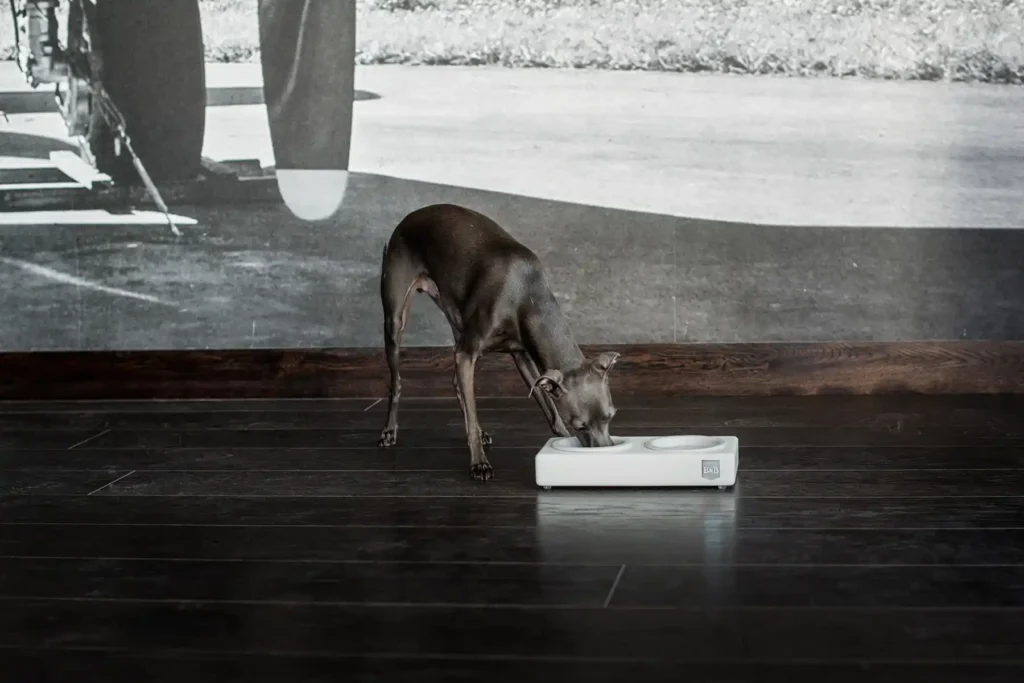
You can also place a piece of food on a clean floor or mat and allow your dog to find it himself. For many dogs, this can become a small scent-based activity at the same time. It is better, however, to avoid throwing food directly into your dog’s mouth, particularly if the piece is hard or large, or if your dog tends to gulp food quickly. Serving food in this way may increase the risk of choking and can also encourage a dog to snap quickly at food in the air.
Another useful habit is not giving your dog food directly from the table while you are eating. If you want to share a safe ingredient with your dog, it is better to set his portion aside beforehand and give it to him later in his bowl, from your hand, or use it as a reward during a short game or training session. This way, sharing food with your dog does not have to mean teaching him to beg at the table.
Can you share your food with your dog?
Yes — and it does not automatically mean encouraging bad habits or feeding your dog leftovers from dinner. Awareness is what matters most. The next time you are chopping a carrot or an apple, or preparing a boiled egg, and you notice that familiar canine gaze beside you, you can set aside a small piece. Not because your dog has successfully “begged for something from the table”, but because you know that the particular food is suitable for him.
These small gestures can bring our dogs enormous pleasure. Just remember that even the healthiest treat is still an extra. The basis of your dog’s diet should be complete, properly balanced nutrition suited to his age, size, activity level and individual health needs.
And if your dog develops a particular fondness for one of these safe foods? Perhaps it will become the inspiration for your next batch of homemade treats.
For more inspiration, knowledge and carefully designed accessories for dogs, visit www.bowlandbone.com — a place created for dog guardians who want to combine their dog’s everyday comfort with timeless style.
– Bowl&Bone Republic team
FAQ – frequently asked questions about the article –
What can dogs eat from our table? Safe foods you can share with your dog
What human foods can dogs eat?
A healthy dog can occasionally be given small amounts of certain foods eaten by humans, including cooked meat without bones or seasoning, egg, carrots, cucumber, courgette, pumpkin, apple without seeds, banana or blueberries. These foods should be served without salt, sugar, sauces or seasoning.
Can dogs eat food from our dinner?
It is better to give your dog individual ingredients that have been set aside before seasoning rather than leftovers from a finished meal. Food prepared for humans often contains salt, fat, onion, garlic, sauces and seasoning that may be unsuitable or dangerous for dogs.
Can dogs eat cooked chicken?
A healthy dog can have a small amount of thoroughly cooked chicken without bones, skin, breadcrumbs, salt, sauce or seasoning. If your dog has a food allergy or follows a specialist diet, introducing additional meat should be discussed with your veterinary surgeon.
Can dogs eat eggs?
A thoroughly cooked egg without salt or other additions can be an occasional treat for many healthy dogs. The portion should be adjusted to the size of the dog and included in the overall amount of additional calories he receives.
Can dogs eat carrots?
Yes. Many dogs can eat carrots raw or cooked. They should be clean, free from seasoning and cut into pieces appropriate for the size of the dog.
Can dogs eat apples?
Yes, in small amounts. Remove the core, seeds and stalk, and cut the apple into appropriately sized pieces.
Can dogs eat bananas?
Yes, but bananas contain a relatively high amount of naturally occurring sugar, so they are best treated as an occasional snack and served in small quantities.
Can dogs eat blueberries?
Yes. A few washed blueberries can make a small treat for a dog. Like all additional snacks, however, they should be given in moderation.
Can dogs eat rice?
Plain cooked rice without salt, sauces or seasoning can be safe for many healthy dogs. There is no need, however, to add it regularly to a complete dog food without a specific reason.
Can dogs eat natural yoghurt?
Some dogs tolerate small quantities of plain natural yoghurt, while dairy products can cause digestive problems in others. Yoghurt should not contain added sugar or sweeteners, particularly xylitol.
Can dogs eat peanut butter?
Peanut butter should only be given after carefully checking the ingredients. It must not contain xylitol, which is toxic to dogs. Because peanut butter is also highly calorific, it should only be offered in very small amounts.
Which foods from our table should dogs never eat?
Dogs should not be given chocolate, grapes, raisins, onions, garlic, leeks, chives, products containing xylitol, macadamia nuts, alcohol, caffeinated drinks or raw yeast dough, among other potentially dangerous foods.
Can dogs eat table scraps?
Regularly feeding your dog leftovers from our table is not a good idea. Prepared dishes may contain too much fat, salt and seasoning as well as ingredients that are dangerous for dogs. A better option is to set aside a small amount of a safe ingredient before seasoning your own meal.
How much human food can a dog have?
Additional foods and treats should account for no more than around 10% of a healthy dog’s daily energy requirement. The exact amount depends on the dog’s body weight, age, activity level, physical condition and overall diet.
What should you do if your dog eats chocolate, grapes or a product containing xylitol?
Contact your veterinary surgeon as quickly as possible. Do not wait for symptoms to appear. Be ready to provide information about the type of product, the approximate amount eaten, when it was consumed and your dog’s body weight. If possible, keep the product packaging.
Sources and inspiration used to write the article
What can dogs eat from our table? Safe foods you can share with your dog
- World Small Animal Veterinary Association (WSAVA), “Feeding treats to your dog”. Information on safely giving treats to dogs, dangerous foods and the recommendation that additional treats should account for no more than approximately 10% of a dog’s daily energy requirement.
- ASPCA Animal Poison Control Center, “People Foods to Avoid Feeding Your Pets”. Information on foods that can pose a risk to dogs, including grapes and raisins, onions and garlic, xylitol, alcohol and macadamia nuts.
- Merck Veterinary Manual, “Food Hazards” and “Xylitol Toxicosis in Dogs”. Resources covering food-related poisoning in dogs and the effects of xylitol, which can cause a rapid drop in blood glucose levels and liver damage.
- American Kennel Club, “People Food Dogs Can Eat and Can’t Eat” and “Fruits and Vegetables Dogs Can or Can’t Eat”. Resources covering the safe preparation of selected foods for dogs and fruits and vegetables that should be avoided.
- Bowl&Bone Republic, “How to make dried dog treats”. A guide to preparing homemade dried dog treats and storing them correctly.
- Bowl&Bone Republic, “What should a dog eat to stay healthy?”. An article covering the basic principles of canine nutrition and the components of a properly balanced diet.
This article is educational and provides general information about the nutrition of healthy dogs. Individual nutritional needs may vary depending on the animal’s age, body weight, activity level and health. If your dog has food allergies, a chronic health condition, follows a veterinary diet or you have any doubts about a particular food, consult your veterinary surgeon before offering it.











 or CANADA
  PLEASE join us at