


The first days with a puppy in a new home are filled with little rituals. Discovering new scents, first walks, falling asleep in an unfamiliar place and that moment in the evening when your little companion finally curls up in their bed and drifts off after a day full of new experiences. At that point, their bed may seem enormous. A few months pass. Their legs grow longer, their body changes, and the puppy who only recently occupied half of the bed suddenly stretches out on their side one day and… their back paws end up on the floor.
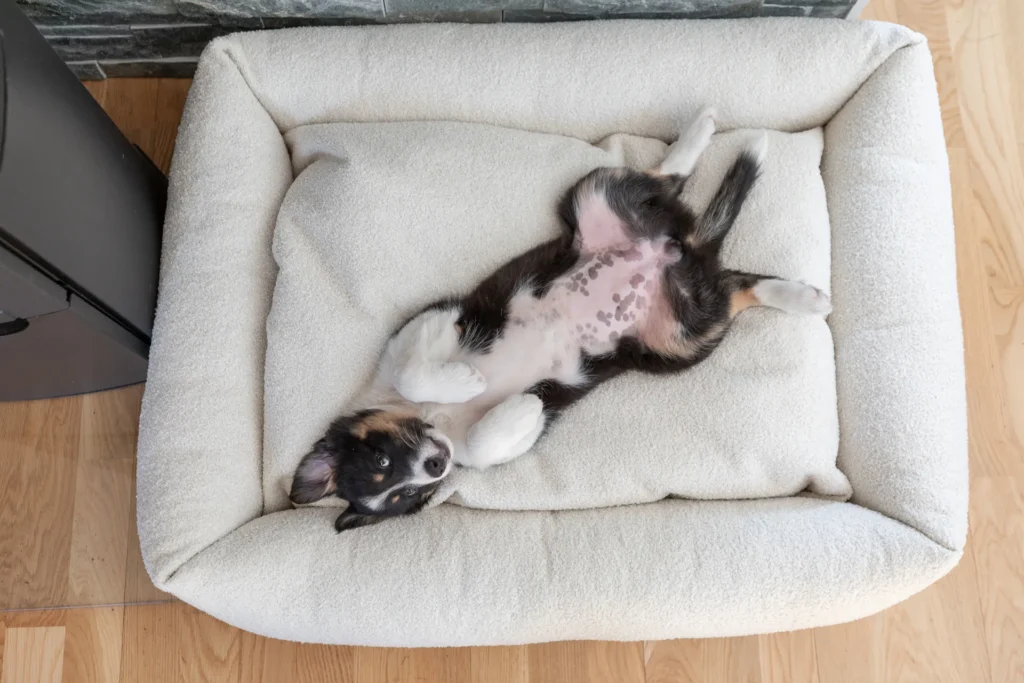
This is the moment when many dog guardians begin to wonder whether their puppy’s first bed should perhaps have been chosen a little differently from the start. Can you buy a puppy bed that is comfortable now, yet will still serve your dog well once they are fully grown? In many cases, absolutely.
The key, however, is not simply buying the largest bed available ‘just in case’. It is far more important to anticipate your dog’s adult size, understand the way they like to rest and choose a construction and materials capable of coping not only with the puppy months, but also with many years of life together.
What will you learn from this article? From this guide, you will learn:
- how to choose a puppy bed that can also serve your dog in adulthood,
- why you should not choose the size based solely on your puppy’s current dimensions,
- how to estimate the adult size of a growing dog,
- whether it is worth buying a dog bed ‘to grow into’,
- why your dog’s sleeping position matters when choosing a bed,
- when a larger bed is a good idea and when it may simply be too large,
- which materials and construction features can help extend the lifespan of a dog bed,
- whether an orthopaedic dog bed can also be suitable for a puppy,
- when one dog bed may last for years and when it is better to plan on replacing it later.
Puppies grow faster than we think
When putting together a puppy’s essentials, it is easy to look at the dog exactly as they are today. If they weigh three kilograms and fit comfortably on a small cushion, choosing a small bed seems perfectly natural. The problem is that during the first months of life, a dog’s body proportions can change remarkably quickly.
Growth rate depends, among other things, on breed and expected adult size. Smaller dogs usually reach their adult size sooner, while large and giant breeds may continue growing for considerably longer — sometimes until approximately 18–24 months of age.
That is why, when choosing the first dog bed for a growing puppy, it is worth asking not only: ‘How much space do they need now?’ but also: ‘How much space will they need once they reach their adult size?’ This small change in perspective can determine whether the bed is a purchase for just a few months or stays with your dog for years to come.
How can you predict your puppy’s adult size?
With a pedigree dog, this is relatively straightforward. You can look at the typical size of adult dogs of the breed, compare your puppy’s build with that of their parents and speak to the breeder. Of course, this does not mean that every dog of a particular breed will reach exactly the same dimensions.
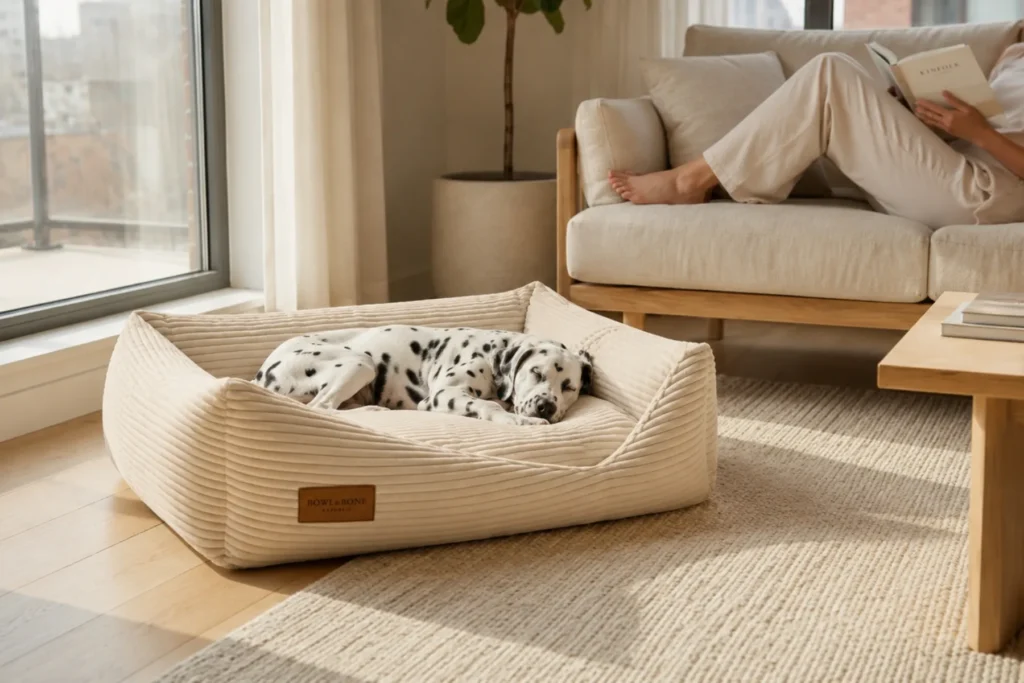
With crossbreeds, predicting adult size can be more difficult, particularly if you do not know the parents. You do not, however, need to predict your dog’s future length to the nearest centimetre. It is much more important to establish a general size range.
– consider the breed and the size of the parents
If you know your puppy’s parents, their size can provide a valuable indication of what your dog may look like once fully grown. It is also worth checking the typical height and weight of adult dogs of the breed.
– observe their growth rate
Weighing your puppy regularly during the first few months can help you see how quickly they are developing.
During routine veterinary appointments, you can also ask your veterinary surgeon about your puppy’s likely adult size. The aim is not to obtain a perfect prediction, but to avoid buying the smallest possible bed for a dog who may be twice the size only a few months later.
– think about the adult dog, not only the puppy
If you know that your few-month-old puppy is likely to become a medium-sized adult dog, there is little point in choosing a bed based solely on their current measurements. It is worth looking at the available sizes of our dog beds with the future in mind.
Is it worth buying a larger dog bed for a puppy to grow into?
This is one of the most common questions. The answer is: yes, but with a sensible amount of extra space. A puppy bed should be neither too small nor unnecessarily enormous. For small breeds and many medium-sized breeds, it is often perfectly possible to choose a size from the beginning that will also suit the adult dog.
The situation is different with large and giant breeds. A tiny puppy who may weigh 40 or 50 kilograms in another year or so does not necessarily need an enormous bed designed for an adult dog of their breed right from the start. In this situation, buying a smaller bed for the first stage of life may be entirely reasonable. The most important thing is to find the right balance between comfort today and tomorrow’s needs.
Do not buy the largest dog bed simply because your puppy will grow
Buying a bed ‘to grow into’ does not mean choosing ‘the biggest one possible’. Puppies often seek out places that feel cosy and warm and allow them to rest against a soft surface. The Royal Society for the Prevention of Cruelty to Animals (RSPCA) notes that dogs who curl up when sleeping may prefer beds with raised sides, while dogs who tend to sleep stretched out may feel more comfortable on a more open sleeping surface.
This is why the way an individual dog rests should be just as important as their size. If you would like to calculate the amount of space your dog needs more precisely, take a look at our guide on how to choose the right size dog bed.

Observe how your puppy sleeps
Your puppy will not read a size chart. But they will very quickly show you what they need. Simply observe their naps for a few days. Do they usually curl up into a little ball? Do they rest their head on the edge? Do they press their back against the side of the bed? Or do they sleep on their side with their paws stretched out almost to their full body length? Dogs sleep in many different positions, and some require considerably more space than others.
– if your puppy likes to curl up
In this case, a classic dog bed with soft sides can work very well. The raised edges create a more enclosed, cosy space while also giving your puppy somewhere to rest their head or back.
It is important, however, that the internal sleeping area still provides enough room once the dog reaches their adult size.
– if your puppy sleeps stretched out on their side
Here, the length of the actual sleeping surface becomes particularly important. Your dog should be able to straighten their body and paws freely without having to slide onto the floor.
– if your dog frequently changes position
This is very common. Your companion may start the night curled up like a little croissant, stretch out on their side after a while and then turn in the opposite direction later on. In this case, it is better to allow a little more room.
Internal dimensions matter, not only external measurements
This is particularly important with dog beds that have raised sides. Two models may have similar external widths while providing very different amounts of actual sleeping space. Why? Because the soft sides also take up room. That is why it is always worth checking the internal dimensions of the sleeping area before buying.
If you are choosing between two sizes and you know your puppy is still growing rapidly, the larger option will often be the more future-proof choice. This does not mean automatically choosing the largest size available. The comfort of the individual dog remains the most important factor.
A good puppy bed should survive… puppyhood
Size is only half the story. The other half begins after the first walk in the rain. Then come sand, mud, fur, crumbs from treats, wet paws and the occasional puppy accident. A young dog’s bed is simply used very intensively.
If it is meant to last for years, it is worth considering not only how it looks on the first day but also how easy it will be to care for after the hundredth walk.
– a removable cover makes everyday life much easier
Being able to remove the cover makes keeping a dog bed clean considerably easier. Instead of trying to wash an entire large bed, you can remove the outer cover and clean it according to the manufacturer’s care instructions. With a puppy, this very quickly stops feeling like a minor detail. It becomes one of the most practical features of the bed.
– fabric quality matters
A dog bed used every day is subjected to far more wear than you might expect. Your dog turns around, stretches, rubs against the sides and gets in and out of the bed many times throughout the day. The fabric should therefore be chosen not only for its appearance, but also for its durability and ease of care.
– replaceable components can extend the life of the bed
If one element becomes worn after several years of intensive use, being able to replace it is a far better solution than having to dispose of the entire dog bed. Features like these are what allow a product to genuinely stay with your dog for longer.
Which type of dog bed should you choose for a growing puppy?
There is no single model that will suit every puppy. The construction should be matched to the way your dog likes to rest.
– dog bed with soft sides
This can be a good choice for a dog who likes to rest their head against something, snuggle into the edge or sleep curled up. Our soft corduroy dog beds DECO are a good example of this type of construction. Their filled sides create a cosy resting space, while several available sizes allow you to choose an option with your dog’s future adult size in mind.
– dog cushion
For a dog who loves stretching out while resting, an interesting alternative may be a dog cushion bed. Without high sides, it offers more freedom to change position. This can be particularly practical for dogs who enjoy stretching their paws beyond the edge of their sleeping place.
– orthopaedic dog bed
Another option is a stable mattress using foam that adapts to the shape of the dog’s body. And this brings us to another question.
Does a puppy need an orthopaedic dog bed?
For many years, orthopaedic dog beds were associated primarily with senior dogs and dogs experiencing mobility problems. Today, they are increasingly chosen by guardians of younger dogs as well.
Does a healthy puppy need an orthopaedic dog bed? No. But they can certainly use one.
A good orthopaedic dog bed provides a stable and comfortable resting surface. If you also choose a size that takes your dog’s expected adult dimensions into account, it can be a solution that stays with them throughout different stages of life.
At Bowl&Bone Republic, our orthopaedic mattress consists of two layers — a supportive base and a layer of memory foam that adapts in response to the dog’s body weight and temperature. This type of construction can serve a young dog during everyday rest, an adult dog after an active day and, with time, become even more valuable for a senior companion. There is, however, one important point to remember: an orthopaedic dog bed is not a treatment for joint or spinal conditions.
If your dog is in pain, has difficulty standing up, moves differently than usual or you notice any concerning change in their behaviour, the appropriate next step is to consult a veterinary surgeon.
Should you buy one dog bed for years or replace it as your puppy grows?
Much depends on the dog’s expected adult size.
– small breeds
With small breeds, the difference between the size of a several-month-old puppy and an adult dog is often not large enough to require several successive beds. This is where choosing a slightly larger, final-size bed from the beginning can make particular sense.
– medium-sized breeds
A sensible compromise can often be found in this group as well. Estimate your dog’s expected adult size, allow enough additional space and observe how your companion likes to rest.
– large and giant breeds
Here, the situation is more complicated. The difference between an eight-week-old puppy and a fully grown dog can be enormous. In this case, choosing a smaller, cosier bed for puppyhood and replacing it later with the final adult size is not a mistake. On the contrary, it may be the more practical solution.
What about a made-to-measure dog bed?
If your dog’s expected adult dimensions do not fit comfortably within a standard size chart, or your companion has an unusual body shape, you can also consider an individually made solution.
It is not always necessary, but in certain cases it allows you to avoid compromising between a bed that is too small and one that is considerably too large.
You can read more about this option in our article ‘Made-to-measure dog bed — is it worth it? Pros, cons and practical tips’.
Remember that the dog bed itself is not everything
Even a perfectly chosen dog bed may remain unused if it is positioned in the wrong place or your dog does not feel comfortable there. The People’s Dispensary for Sick Animals (PDSA), a British veterinary charity, and the Royal Society for the Prevention of Cruelty to Animals (RSPCA) recommend providing dogs with a calm, comfortable place where they can rest without being disturbed. It is therefore worth positioning the bed:
- away from busy walkways through the home,
- somewhere free from draughts,
- in a place where your dog can settle and relax,
- while still allowing them — if they prefer — to remain close to members of the household.
A puppy who has only recently left familiar surroundings may have a particularly strong need for security. This is why, on the first day, it is not simply about how soft the bed feels. Where their new resting place is positioned matters too. If your companion avoids their bed despite it being the right size, you may also find our article ‘Why does your dog not want to sleep in their bed, and how can you encourage them to use it?’ helpful.
One permanent resting place can become particularly meaningful to a dog
Over time, a dog bed stops being a new object. It begins to smell like home. This is where your companion sleeps after their morning walk. It is where they carry their favourite toy. It is where they settle in the evening as the house gradually becomes quieter. After a few months, it becomes part of their everyday life.
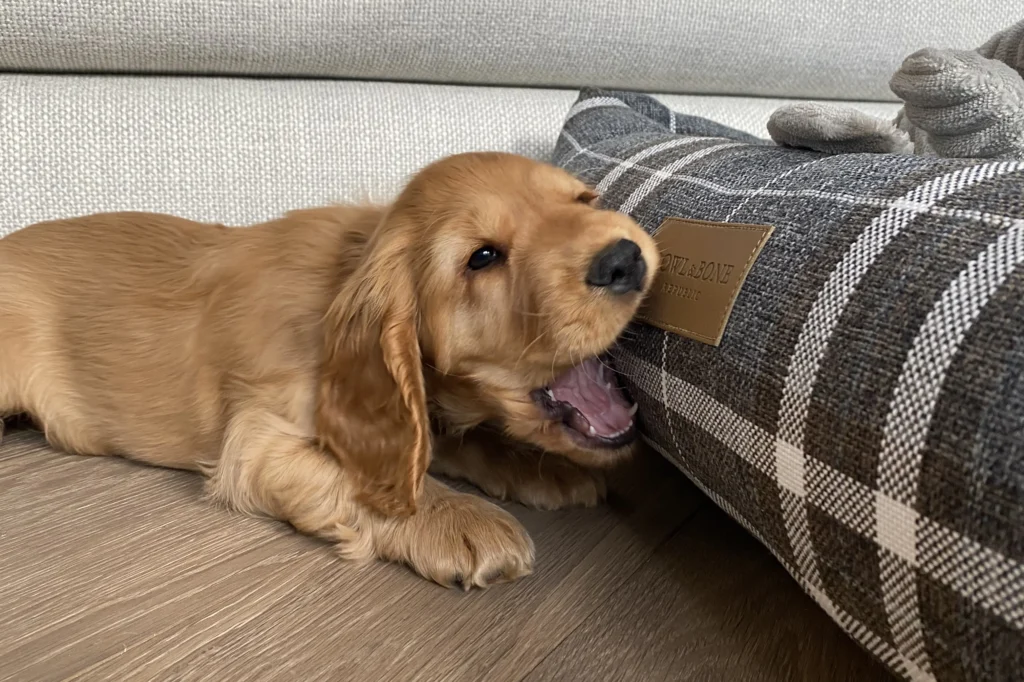
This is another advantage of choosing a bed that can remain with your dog after the growth period is over. They do not have to say goodbye to a familiar place simply because they have outgrown it. Of course, this does not mean that there should only ever be one dog bed in your home. In many homes, several resting places work very well — for example, a main bed in the living room, a cushion in the bedroom and a mat in a quieter part of the house. You can read more about this in our article ‘How many beds should a dog have? One bed or several places to rest?’.
Which puppy bed should you choose? The key rules at a glance
If you want your puppy’s first bed to continue serving them once they are fully grown, there are several things worth checking before you buy.
– estimate your dog’s adult size
Do not choose a bed based solely on your puppy’s current measurements.
– observe how they sleep
A dog who curls up may need a different type of bed from one who sleeps with their paws stretched out to their full length.
– check the internal sleeping area
External dimensions do not always tell you how much usable space your dog will actually have.
– allow a sensible amount of extra space
A growing dog should still be able to change position freely in several months’ time.
– look for a removable cover
Particularly during puppyhood, being able to keep the dog bed clean easily will be a major advantage.
– choose a durable construction
If you are buying a product intended to last for several years, being able to replace or refresh individual components can significantly extend its usable life.
– match the dog bed to your dog, not only to your interior
Design matters — particularly when the bed stands in the living room and becomes part of your interior. But even the most beautiful dog bed will not fulfil its purpose if your dog does not feel comfortable in it. The best choice combines both.
A dog bed that stays for longer
Puppyhood passes surprisingly quickly. Today, your dog falls asleep curled into a tiny ball after a day filled with first discoveries. In a few months, they will be confidently exploring familiar walking routes, holding their head a little higher and taking up considerably more space in their bed. And one day, you will look at them and find it hard to believe they were ever so small.
A good puppy bed can be part of that entire story. It does not physically have to grow with your dog. You simply need to look a little further ahead than their current measurements when choosing it. Choose not only for the puppy you see today, but also for the dog they are about to become. It is this perspective that allows you to combine comfort, functionality and a thoughtful purchase designed to last for years.
For more inspiration on thoughtful dog care, rest and everyday comfort, explore the Bowl&Bone Republic guides and discover our dog beds, created in Poland with dogs and the interiors they share with their guardians in mind.
– the Bowl&Bone Republic team
FAQ, meaning the most frequently asked questions from the article –
Which dog bed should you choose for a puppy so it will still suit them once they are fully grown?
Should a puppy have a dog bed suited to their current size?
Not always. If you can estimate your dog’s expected adult size, it is worth taking this into account when choosing their first bed. Particularly with small and medium-sized breeds, a thoughtfully chosen larger bed can serve both the puppy and the adult dog. It should not, however, be excessively large and should still provide a comfortable resting space for a young puppy.
Is it worth buying a larger dog bed for a puppy to grow into?
Yes, but the additional space should be sensible. The bed should allow the adult dog to change position freely and stretch out comfortably, but there is no need to automatically choose the largest size available. For large and giant breeds, replacing the first bed later may be the more practical solution.
How can you predict how big a puppy will become?
For pedigree dogs, the typical size of adult representatives of the breed and the size of the parents can provide useful guidance. With crossbreeds, you can consider body shape, current weight, growth rate and information about the parents if available. A veterinary surgeon may also help estimate the dog’s likely adult size.
How should you measure a puppy for a dog bed?
It is best to observe your puppy while they are resting and measure the space they occupy in one of their most stretched-out natural sleeping positions. With a puppy, you should also take their expected growth into account. A bed should not be selected so that the dog only just fits.
Can a puppy bed be too large?
It can be poorly matched to the puppy’s individual preferences. A very small puppy may feel more comfortable in a cosier, more enclosed space than on a huge open surface. This is why size should be considered together with the construction of the bed — for example, soft sides that the puppy can rest against.
What type of dog bed is most practical for a puppy?
Models made from durable materials and featuring a removable cover for easier cleaning are particularly practical. If the bed is intended to last for many years, it is also worth considering the quality of the filling and whether individual elements can be replaced or refreshed.
Is an orthopaedic dog bed suitable for a puppy?
A healthy puppy does not need an orthopaedic dog bed, but they can certainly use one. A stable surface and appropriately selected mattress can provide comfortable support during rest. If you choose the right adult size, the same bed may also serve your dog in adulthood and later in their senior years.
Should a puppy have a dog bed with raised sides?
It depends on how they sleep. Dogs who enjoy curling up, resting their head against something or pressing their back into the edge may feel comfortable in a bed with soft raised sides. Dogs who usually sleep fully stretched out may prefer a more open sleeping surface.
When should you replace a puppy’s bed with a larger one?
It is worth doing so when your dog can no longer change position freely or stretch out comfortably, or when a significant part of their body regularly lies outside the sleeping area. Another indication may be your dog increasingly choosing the floor or other larger resting places instead of their bed.
Can one dog bed last throughout a dog’s entire life?
It may serve your dog for many years if it is appropriately sized from the beginning, has a durable construction and allows individual elements to be kept in good condition. A dog’s needs can change with age, however, so particularly in their senior years it is worth reassessing the height, firmness and ease of access to the bed.
Is it better to choose the larger or smaller size when a puppy falls between two options?
If your dog is still growing and both options are currently comfortable, the larger size will generally be the more future-proof choice. You should still take the construction of the bed and your individual dog’s preferences into account.
Where is the best place to position a puppy’s bed?
A calm, dry and draught-free location where your dog can rest without being continually disturbed is ideal. During the first period after arriving in a new home, many puppies feel more secure when their resting place is relatively close to their guardians.
This article is intended for educational purposes and does not replace consultation with a veterinary surgeon. If your dog experiences pain, difficulty moving or standing up, or a sudden change in behaviour while resting, it is worth consulting a veterinary professional.
Sources and inspiration used to create the article
Which dog bed should you choose for a puppy so it will still suit them once they are fully grown?
- VCA Animal Hospitals – ‘Puppy Growth and Maturity’ – information concerning growth rates and maturity in dogs of different sizes.
https://vcahospitals.com/pediatric/puppy/behavior-training/when-will-my-puppy-mature - Royal Society for the Prevention of Cruelty to Animals (RSPCA) – ‘Choosing the Perfect Dog Bed’ – guidance on matching the type of bed to a dog’s size and resting style.
https://www.rspca.org.uk/adviceandwelfare/pets/dogs/environment/dogbeds - Royal Society for the Prevention of Cruelty to Animals (RSPCA) – ‘Caring For Your Puppy – 6 weeks to 12 months’ – recommendations on creating a calm and comfortable resting place for a puppy.
https://www.rspca.org.uk/adviceandwelfare/pets/dogs/health/puppycare - People’s Dispensary for Sick Animals (PDSA) – ‘Making your home dog friendly’ – information concerning comfortable resting places and allowing dogs to stretch out and change position freely.
https://www.pdsa.org.uk/pet-help-and-advice/looking-after-your-pet/puppies-dogs/making-your-home-dog-friendly - People’s Dispensary for Sick Animals (PDSA) – ‘First day and night with puppy’ – guidance on preparing a sleeping area and establishing consistent resting routines for a puppy.
https://www.pdsa.org.uk/pet-help-and-advice/looking-after-your-pet/puppies-dogs/first-day-and-night-with-puppy - VCA Animal Hospitals – ‘Dog sleeping positions decoded’ – information concerning the different positions dogs adopt while sleeping and resting.
https://vcahospitals.com/resources/behavior-dog/dog-sleeping-positions-decoded - Bowl&Bone Republic – ‘How to choose the right size dog bed? Complete guide’ – a guide to measuring your dog and matching the actual sleeping area of a bed to their size and resting style.
https://www.bowlandbone.com/how-to-choose-the-right-size-dog-bed-complete-guide/ - Bowl&Bone Republic – ‘Why does your dog not want to sleep in their bed, and how can you encourage them to use it?’ – information concerning the influence of size, construction, position and associations on whether a dog chooses to use their bed.
https://www.bowlandbone.com/why-does-your-dog-not-want-to-sleep-in-their-bed/ - Bowl&Bone Republic – ‘Made-to-measure dog bed — is it worth it? Pros, cons and practical tips’ – information concerning individually tailored dog bed dimensions.
https://www.bowlandbone.com/made-to-measure-dog-bed-is-it-worth-it-pros-cons-and-practical-tips/ - Bowl&Bone Republic – the team’s experience in designing and creating dog beds and accessories in Poland.









 or CANADA
  PLEASE join us at