


As evening falls, the home gradually grows quiet. Your dog returns from the final walk of the day, wanders around the room for a moment, adjusts their bed, settles down comfortably, lowers their head and suddenly lets out a long ‘Ufff…’ Sound familiar? Some guardians interpret such a sigh as a sign of complete contentment. Others begin to wonder whether their dog might be sad, bored or worried about something.

And then there are those who get the impression that their companion is very deliberately informing everyone in the household: ‘Well… if nobody is going to play with me any more, I suppose I’ll just go to sleep.’ Interestingly, each of these interpretations may contain a little truth in the right circumstances. A dog’s sigh does not have one single meaning. It may appear during relaxation, rest, frustration, anticipation of attention or stress. At the same time, sighing itself is also a natural part of the respiratory system. That is why the answer to the question ‘why does a dog sigh?’ cannot be found in the sound alone.
We need to look at the entire situation: the dog’s posture, eyes, ears, tail, muscle tension and what happened just moments before. And that is exactly what we are going to explore in this article.
What will you learn from this article? From this guide, you will learn:
- why dogs sigh,
- why dogs often sigh specifically when they lie down,
- whether a dog’s sigh can indicate contentment,
- whether a dog can sigh out of frustration or boredom,
- why dogs sigh while being stroked,
- whether sighing can occur during stress,
- why a sigh alone is not enough to assess a dog’s emotions,
- how to distinguish a calm sigh from worrying breathing problems,
- when frequent or unusual sighing should be discussed with a veterinary surgeon.
Why do dogs sigh at all?
Let us begin with something that is easy to forget. A sigh is not simply an ‘emotional message’. It is also part of the physiology of breathing. When sighing, a dog takes a deeper breath than during normal, calm breathing, followed by a more pronounced and often audible exhalation.
Research into respiratory physiology shows that sighs in mammals help maintain normal lung function. A deeper breath helps to reopen small pulmonary alveoli — tiny structures responsible for the exchange of oxygen and carbon dioxide. Studies conducted in dogs have also suggested that sighs may temporarily improve lung compliance.
This tells us something very important: not every dog sigh necessarily has to ‘mean something’ emotionally. Sometimes a dog simply takes a deeper breath. In everyday life, however, guardians tend to notice sighs most when they occur in particular situations. For example, when their dog is settling down to sleep.
Why does a dog sigh when lying down?
This is probably the most characteristic situation. Your dog walks around the room for another moment, perhaps circles their bed, may adjust it with a paw, then lies down, lowers their head and lets out a deep sigh. In most cases, if their body is soft and relaxed at the same time, this behaviour fits perfectly with the transition from activity to rest.
The American Kennel Club, an American canine organisation involved, among other things, in education about canine health and behaviour, notes that a dog who settles comfortably in their resting place and sighs after lying down may simply be signalling that they are ready to rest.
You could say that it is the canine equivalent of the moment when, after a long day, we sit down on the sofa, rest our head and slowly let out a breath. Of course, this does not mean that a dog thinks in exactly the same way as a human. But their body also changes as they move into a calmer state. Breathing becomes slower and deeper, muscles lose tension and the dog prepares for sleep or a peaceful nap.
What does the sigh of a contented dog look like?
The ‘uff’ alone is not enough. Everything happening around it tells us much more. If your dog:
- settles comfortably,
- has a relaxed body,
- shows no tension in the facial muscles,
- holds their ears in a natural position,
- lets their tail rest loosely,
- has soft or slightly closed eyes,
- remains calmly in place after sighing,
the overall picture fits very well with a state of relaxation. The American Kennel Club notes that soft eyes, a loose posture and neutral body position are important elements when interpreting a dog’s calm emotional state. At the same time, no individual signal should ever be interpreted in isolation from the rest of the dog’s body language.
That is why it is better not to think: ‘My dog sighed, so they are happy.’ Instead, think: ‘My dog sighed, settled comfortably, relaxed their body and partly closed their eyes — it looks as though they are winding down.’ The second interpretation is much closer to the way canine communication should be understood.
Sighing before sleep can be part of a dog’s ritual
Every dog has their own little resting rituals. One simply walks into their bed and falls asleep. Another turns around twice before lying down. A third kneads the soft surface with their paws. A fourth rests their head on the edge of the bed, sighs deeply and only then closes their eyes. If you are interested in the way dogs prepare their resting place, have a look at our article ‘Why does a dog knead his bed before sleep?’.
It is worth observing these everyday rituals. Not so that we can assign a hidden meaning to every movement, but so that we can become more familiar with our own dog’s normal behaviour. Knowing their everyday habits is precisely what helps us notice later when something begins to look different from usual.
Why does a dog sigh while being stroked?
Imagine another scene. Your dog is lying beside you on the sofa. You gently scratch their neck or stroke their side. After a few moments, your companion partly closes their eyes, relaxes their body and lets out a long sigh. Can this be interpreted as a sign of pleasure? If the rest of their body language indicates relaxation — very possibly.
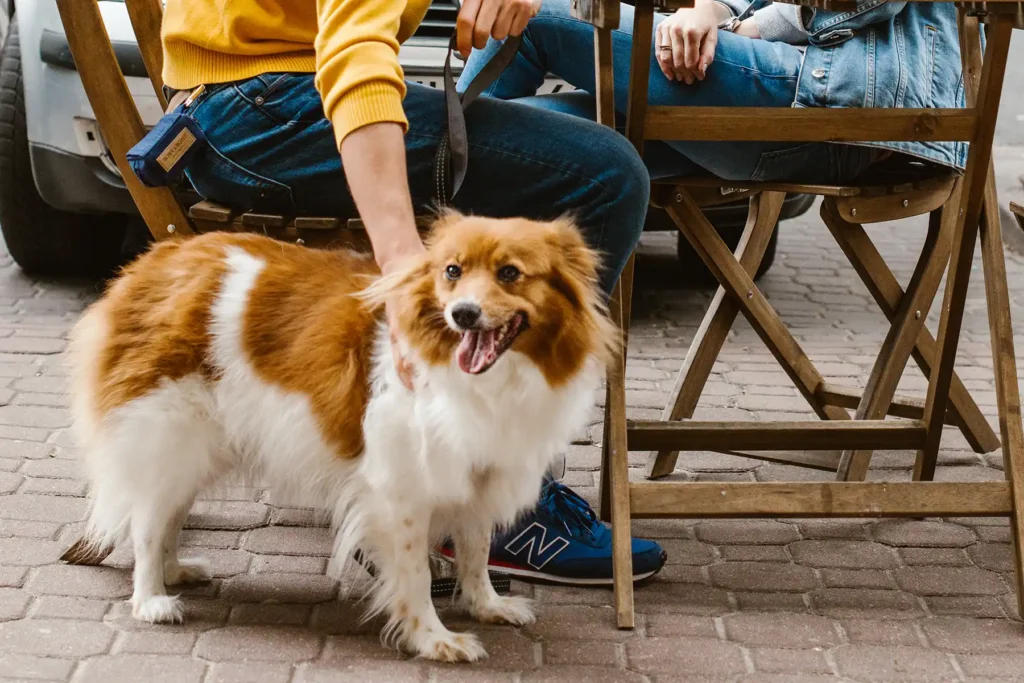
Context, however, is what matters most. A dog who genuinely feels comfortable will usually remain in contact voluntarily. They do not try to move their head away, tense their body or show signals suggesting that they would like more distance. If, on the other hand, your dog:
- turns their head away,
- licks their nose or lips,
- becomes stiff,
- tries to move away,
- pins their ears back,
- avoids contact,
the sigh itself should not be interpreted as proof of pleasure. A dog’s entire body always tells us more than a single sound.
Can a dog sigh because they are bored?
Yes, they can. But once again, it is best not to treat sighing as a standalone test for boredom. The American Kennel Club points out that sighing may also occur in situations involving frustration or insufficient stimulation.
Imagine an active dog who has been watching the rain through the window all morning. They have only been out for a short walk. The ball is lying beside you. Your dog looks at the ball. Then at you. Then back at the ball. And after a moment, they rest their head on their paws and let out a very deliberate sigh. Is it possible that they are disappointed because nothing interesting is happening? Yes. If this picture repeats itself frequently, it is worth considering whether your dog’s daily routine includes an appropriate amount of:
- walks,
- opportunities for free sniffing,
- contact with their guardian,
- calm exploration,
- play,
- mentally engaging activities,
- but also rest.
Remember, however, that a dog does not need to be occupied constantly. The ability to rest calmly is just as important as activity.
Can a dog sigh to get attention?
This is also possible. Dogs quickly learn the relationship between their own behaviour and a person’s response. Imagine that every time your dog sighs loudly, you immediately turn towards them: ‘What’s the matter?’ Then you stroke them. Sometimes you pick up a toy. On another occasion, you give them a treat.
From the dog’s point of view, the pattern may become very simple: I sigh → the human reacts. If a particular behaviour regularly produces the desired result, it may begin to occur more often. The American Kennel Club lists attention-seeking as one of the possible reasons for repeated sighing in dogs. This certainly does not mean that your dog is sitting in their bed developing an elaborate plan to manipulate you. They are simply learning from the consequences of their behaviour.
Does a dog sigh because they are sad?
This is one of those questions where it is particularly easy to enter the world of human interpretation. People sigh when they are tired, disappointed, sad, stressed or simply trying to gather their thoughts. So we automatically assign similar meanings to dogs.
The problem is that a single sigh does not allow us to conclude that a dog is sad. Your dog’s behaviour over a longer period is much more important. If, apart from sighing, your dog:
- enjoys going for walks,
- remains interested in their surroundings,
- rests calmly,
- eats normally,
- seeks contact in their usual way,
- maintains their normal daily routine,
there is no reason to assume that every deep ‘uff’ is an expression of sadness. If, however, their behaviour has clearly changed, they have become apathetic, avoid activities or act differently from usual, it is worth looking for the reason behind the entire behavioural change rather than analysing the sigh alone.
Dog sighing and stress
This is where context becomes particularly important. A dog may also sigh when experiencing tension. If a sigh occurs in a calm home while your dog is settling comfortably into their bed, its interpretation will be different from the same behaviour occurring:
- in a crowded waiting room,
- during a noisy family gathering,
- in a new place,
- in a conflict situation,
- during contact the dog is trying to avoid.
The American Kennel Club points out that, in situations involving anxiety, sighing may be accompanied by signs such as lip licking, yawning, a tucked tail, ears held back, trembling or increased panting. So once again, we return to the most important rule: do not interpret the sigh. Interpret the dog. If you would like to become better at recognising subtle signs of discomfort, read our guide ‘What signals does a dog give when he feels unsure?’.
Why does a dog sigh after a walk?
This is another very natural situation. Your dog returns home. They drink some water. For a few moments, they continue to observe what is happening around them. Then they go to their resting place, settle down and take a deep breath out.
If the walk was appropriately matched to their needs, this behaviour may accompany the transition from activity to rest. During a walk, a dog is not only physically active. They sniff, analyse scents, observe their surroundings, make small decisions and process an enormous amount of information.
After returning home, they need time to wind down. That is why it is worth creating conditions in which they can genuinely rest. We wrote more about this in the article ‘How to help your dog rest after an active day?’.
Why does a dog sigh in their bed?
This is exactly where we notice the behaviour particularly often. Not because the bed itself ‘causes’ sighing. Rather, because a well-chosen resting place is a space where the dog can stop monitoring everything happening around them. They lie down. Change position. Rest their head. Relax their muscles. Breathe more calmly.
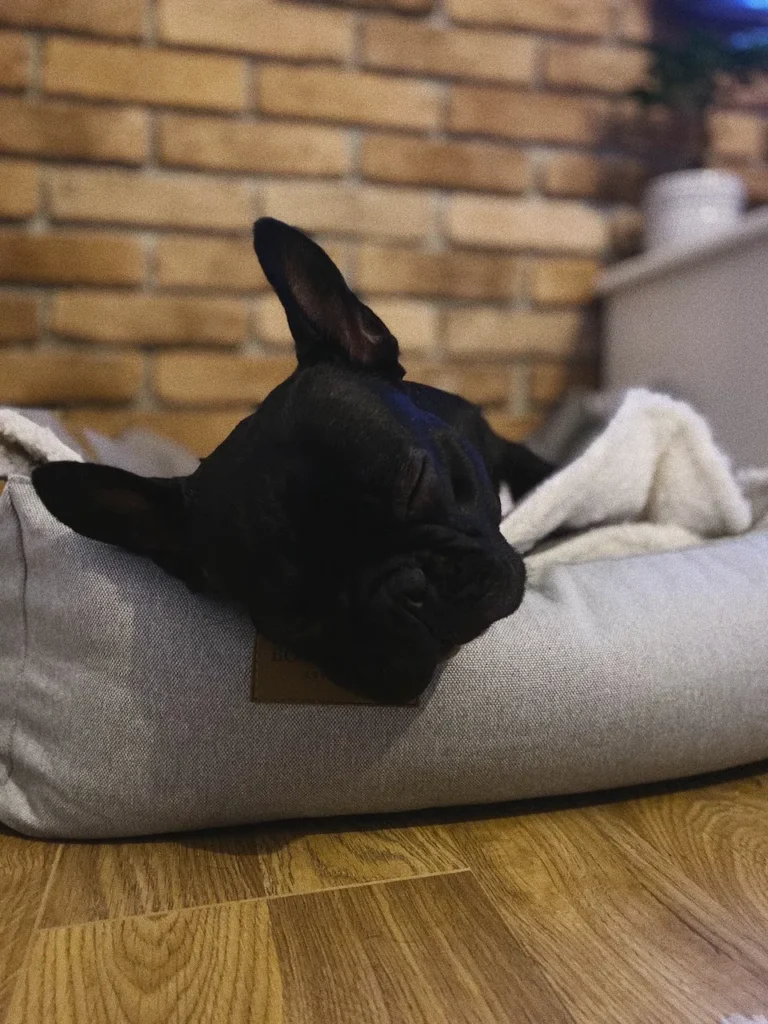
And that is when we may hear a deeper exhalation. This is one of the reasons why a good dog bed should be matched not only to the dog’s size but also to the way they genuinely like to rest. Some dogs curl themselves tightly into a ball. Others sleep on their side. Others still need plenty of room because they stretch out almost to their full body length while sleeping. If you would like to learn more about what the way your dog lies down may tell you, take a look at our article ‘Dog’s sleeping positions – what do they mean?’.
What if a dog sighs and cannot settle?
Then it is worth looking at the situation more carefully. The sound itself still does not necessarily indicate a problem. However, if your dog:
- repeatedly lies down and gets back up,
- walks around the room,
- changes resting place every few minutes,
- pants heavily despite no exercise or high temperature,
- cannot find a comfortable position,
- whimpers,
- behaves noticeably differently from usual,
we are no longer looking only at ‘sighing’. We are looking at a whole group of symptoms. Particularly in an older dog, difficulty finding a comfortable resting position may require consultation with a veterinary surgeon. We should not automatically assume that our companion is ‘being fussy’ or is ‘simply getting old’. A change in the way a dog rests can be important information.
Can an older dog sigh more often?
Age itself does not mean that a dog should suddenly begin sighing excessively. At the same time, the way they rest may change with age. An older dog may need more time to find a comfortable position. They may also change position more frequently or seek a surface that provides different support from the one they preferred a few years earlier.
If, after finding a comfortable position, your dog lets out a deep breath and peacefully falls asleep, this does not necessarily need to be a cause for concern. If, however, you also notice:
- difficulty getting up,
- stiffness,
- reluctance to move,
- a noticeable reduction in exercise tolerance,
- frequent panting at rest,
- coughing,
- difficulty breathing,
it is worth consulting a veterinary surgeon.
When should a dog’s sighing be a cause for concern?
This is a very important distinction. A normal sigh and difficulty breathing are not the same thing. Cornell University College of Veterinary Medicine notes that worrying signs of respiratory distress in dogs can include rapid breathing, breathing with obvious effort, pronounced abdominal movement while breathing, extending the head and neck, unusual breathing sounds, weakness or bluish discolouration of the mucous membranes.
The Merck Veterinary Manual also lists coughing, shallow breathing, shortness of breath and pain associated with breathing among signs that require attention. So do not wait to see how the situation develops if your dog:
- is breathing noticeably faster or more heavily than usual while resting,
- breathes with their mouth open without an obvious reason,
- uses their abdominal muscles strongly with every breath,
- stretches their neck in an attempt to take in air,
- makes new wheezing or rasping sounds while breathing,
- develops blue gums or tongue,
- becomes weak or loses consciousness.
Breathing difficulties can be an emergency and require urgent veterinary attention.
How can you distinguish an ordinary sigh from a breathing problem?
The simplest approach is to look at what happens before and afterwards.
– a calm sigh
The dog:
- settles comfortably,
- takes one deeper breath in and out,
- remains relaxed,
- continues breathing calmly afterwards,
- behaves normally.
– a signal requiring closer attention
The dog:
- repeatedly makes unusual sounds while breathing,
- appears unsettled,
- cannot lie down comfortably,
- breathes with visible effort,
- pants heavily while resting,
- coughs,
- becomes weak,
- behaves differently from usual.
The difference is therefore not simply about how loud the sigh is. The dog’s overall condition is what matters most.
What should you do if your dog sighs frequently?
First — observe. Not every behaviour needs to be changed immediately. Over the next few days, pay attention to: When does your dog sigh? After a walk? Before sleep? While being stroked? When you stop playing with them? In a new or stressful place? Does it always happen in the same situation? And above all: What does the rest of their body look like at that moment?
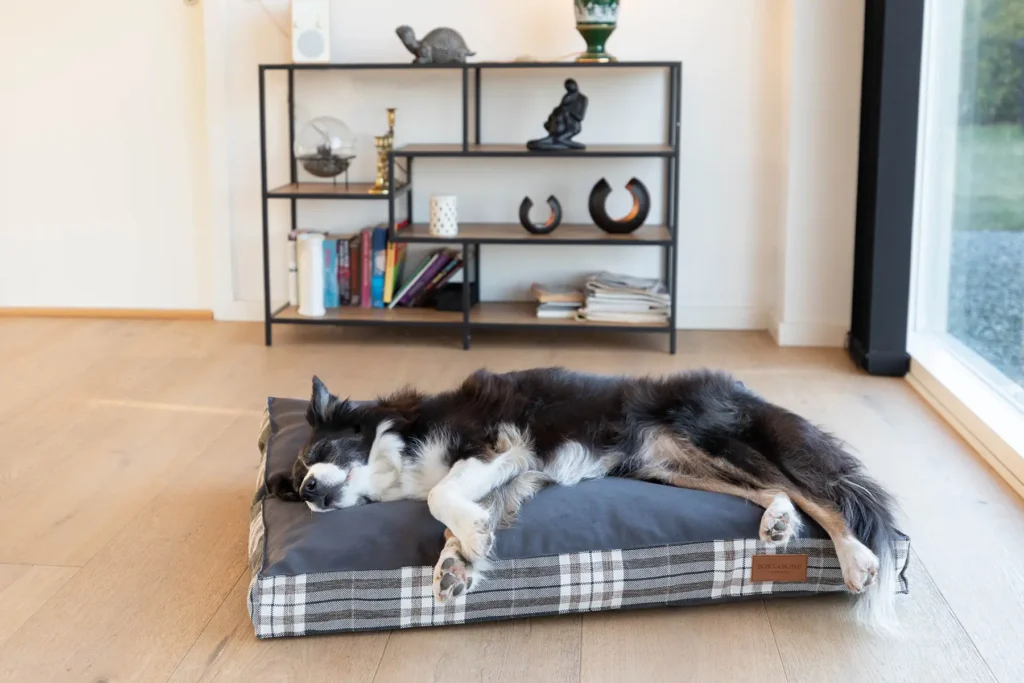
These observations will tell you far more than the number of sighs alone. If your dog sighs while settling down to sleep, their body is soft and relaxed, and moments later they peacefully fall asleep, you are most likely simply observing one element of their winding-down process. If the sigh appears alongside a tense posture, constant movement or other signs of discomfort, it is worth looking for the underlying reason.
Your dog does not communicate with just one signal
This is perhaps the most important lesson to take from dog sighing. It would be easy if we could create a simple dictionary:
sighing = contentment
yawning = tiredness
wagging tail = happiness
But canine communication is far more interesting than that. The same signal can appear in different situations. So instead of trying to translate every movement as if it were a single word, it is worth observing the whole ‘sentence’. What does your dog’s body look like? What are their ears doing? Are the muscles tense? Where is the tail? What happened just moments before? What does your dog do immediately afterwards?
The better we know our companion, the easier it becomes to notice these subtleties. And sometimes the answer turns out to be wonderfully simple. Your dog is simply settling down in their favourite place in the evening. They stretch. Rest their head against the soft edge of the bed. Let out a long: ‘Ufff…’ And fall asleep.
Not every canine mystery needs to be complicated. Sometimes it is simply the sound of a good rest beginning.
For more inspiration on thoughtful dog care, behaviour, rest and everyday comfort, explore the Bowl&Bone Republic guides and discover our dog beds, created in European Union with dogs and the interiors they share with their guardians in mind.
– the Bowl&Bone Republic team
Frequently Asked Questions (FAQ) about the article –
Why does a dog sigh when lying down? What does dog sighing mean?
Why does a dog sigh?
A dog may sigh for a variety of reasons. A sigh is a natural part of breathing, but it can also appear during relaxation, rest, frustration, stress or in situations where the dog has learnt that sighing attracts their guardian’s attention. Its meaning is best assessed by looking at the whole situation and the dog’s body language.
Why does a dog sigh when lying down?
If a dog relaxes their body after lying down, calmly rests their head and then falls asleep or rests, the sigh usually fits with the transition from activity into relaxation. The sound alone, however, is not enough to assess the dog’s emotional state.
Does dog sighing mean contentment?
It can indicate contentment or relaxation, particularly when accompanied by a soft body posture, calm eyes, neutral ears and tail, and no other signs of tension. A sigh should not, however, be interpreted without taking the dog’s other signals into account.
Why does a dog sigh while being stroked?
If a dog remains relaxed while being stroked, voluntarily maintains contact and appears calm, sighing may accompany relaxation. If the dog simultaneously turns their head away, licks their lips, becomes tense or tries to leave, it is important to consider the possibility that they may be uncomfortable.
Can a dog sigh because they are bored?
Sighing can occur during frustration or insufficient stimulation, but on its own it is not proof of boredom. It is worth looking at your dog’s daily activity, opportunities to sniff, play, interact with their guardian and their general behaviour.
Can a dog sigh to get attention?
Some dogs may learn that a particular behaviour produces a reaction from a person. If every loud sigh is immediately followed by play, stroking or a treat, the behaviour may begin to occur more frequently over time.
Can a dog sigh because of stress?
Yes. In a stressful situation, sighing may be accompanied by other signals such as a tense posture, lip licking, yawning, a tucked tail, ears held back, trembling or excessive panting. This is why the dog’s overall behaviour should always be observed.
Why does a dog sigh before sleeping?
A deeper breath may occur as a dog winds down and enters a calmer state. If the dog settles comfortably, their body is relaxed and they fall asleep shortly afterwards, such a sigh is usually not a cause for concern.
Why does my dog sigh so often?
Frequency alone does not provide a clear answer. What matters most is when the dog sighs and whether they otherwise behave normally. If sighing is accompanied by behavioural changes, difficulty resting, coughing, unusual breathing sounds or obvious effort while breathing, it is worth consulting a veterinary surgeon.
Can dog sighing indicate pain?
Sighing itself is not a characteristic sign of pain. However, if the dog is also having difficulty finding a comfortable position, appears restless, limps, is reluctant to move, pants heavily or shows a clear change in behaviour, a veterinary surgeon should be consulted.
Can an older dog sigh more often?
An older dog may settle differently and need more time to find a comfortable resting position. Sighing after lying down is not necessarily concerning in itself. Any new difficulty moving, breathing, getting up or resting should, however, be discussed with a veterinary surgeon.
When is a dog’s sighing a cause for concern?
The main causes for concern are signs suggesting difficulty breathing: rapid or laboured breathing at rest, pronounced abdominal effort, stretching the neck while breathing, wheezing, weakness, loss of consciousness or blue discolouration of the gums or tongue. These symptoms require urgent veterinary attention.
This article is intended for educational purposes and does not replace consultation with a veterinary surgeon. If your dog’s breathing pattern changes suddenly, they have difficulty taking in air or other worrying symptoms appear, contact a veterinary surgeon.
Sources and inspiration used to create the article
Why does a dog sigh when lying down? What does dog sighing mean?
- American Kennel Club – ‘Why Do Dogs Sigh?’ – material prepared with input from a veterinary behaviour specialist, covering physiological and behavioural reasons for sighing in dogs.
https://www.akc.org/expert-advice/health/why-dogs-sigh/ - American Kennel Club – ‘How to Read Dog Body Language’ – material on interpreting canine behaviour based on the complete set of signals, including body posture, eyes, ears and tail.
https://www.akc.org/expert-advice/training/how-to-read-dog-body-language/ - Cornell University College of Veterinary Medicine – ‘Recognizing and responding to canine respiratory distress’ – material concerning normal canine breathing and symptoms that may indicate respiratory distress requiring urgent veterinary attention.
https://www.vet.cornell.edu/departments-centers-and-institutes/riney-canine-health-center/canine-health-topics/recognizing-and-responding-canine-respiratory-distress - Merck Veterinary Manual – ‘Introduction to Lung and Airway Disorders of Dogs’ – an overview of respiratory system function and symptoms of airway and lung disorders in dogs.
https://www.merckvetmanual.com/en/dog-owners/lung-and-airway-disorders-of-dogs/introduction-to-lung-and-airway-disorders-of-dogs - Severs L.J. et al. – ‘The psychophysiology of the sigh: I: The sigh from the physiological perspective’ – a scientific review of the physiological function of sighing and its importance for normal lung function.
https://pmc.ncbi.nlm.nih.gov/articles/PMC9204854/ - Balsys A.J., Lindsey D.C. – ‘Effects of sighs and different tidal volumes on compliance, functional residual capacity, and arterial blood gases in dogs’ – a study examining the effects of sighs on respiratory mechanics in dogs.
https://pubmed.ncbi.nlm.nih.gov/7428388/ - Bowl&Bone Republic – ‘Why does a dog knead his bed before sleep?’ – an article about behaviours that appear while dogs prepare their resting place.
https://www.bowlandbone.com/why-does-a-dog-knead-his-bed-before-sleep/ - Bowl&Bone Republic – ‘How to help your dog rest after an active day?’ – material concerning winding down, recovery and creating suitable conditions for a dog to rest.
https://www.bowlandbone.com/how-to-help-your-dog-rest-after-an-active-day/ - Bowl&Bone Republic – ‘Dog’s sleeping positions’ – a guide to the different ways dogs position themselves while sleeping and resting.
https://www.bowlandbone.com/dogs-sleeping-positions/ - Bowl&Bone Republic – the team’s experience in observing dogs’ needs and designing resting spaces and accessories that support their everyday comfort.










 or CANADA
  PLEASE join us at