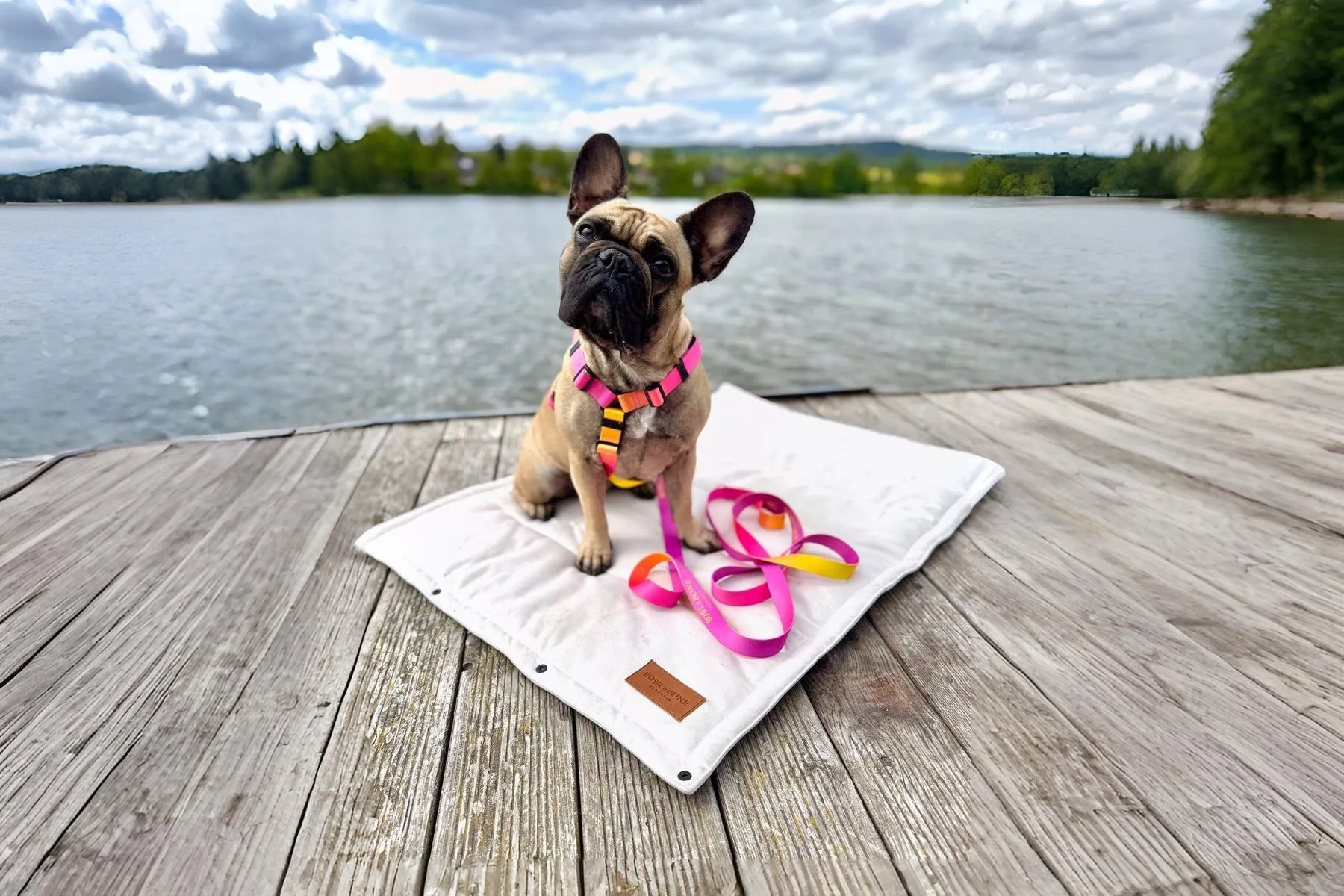
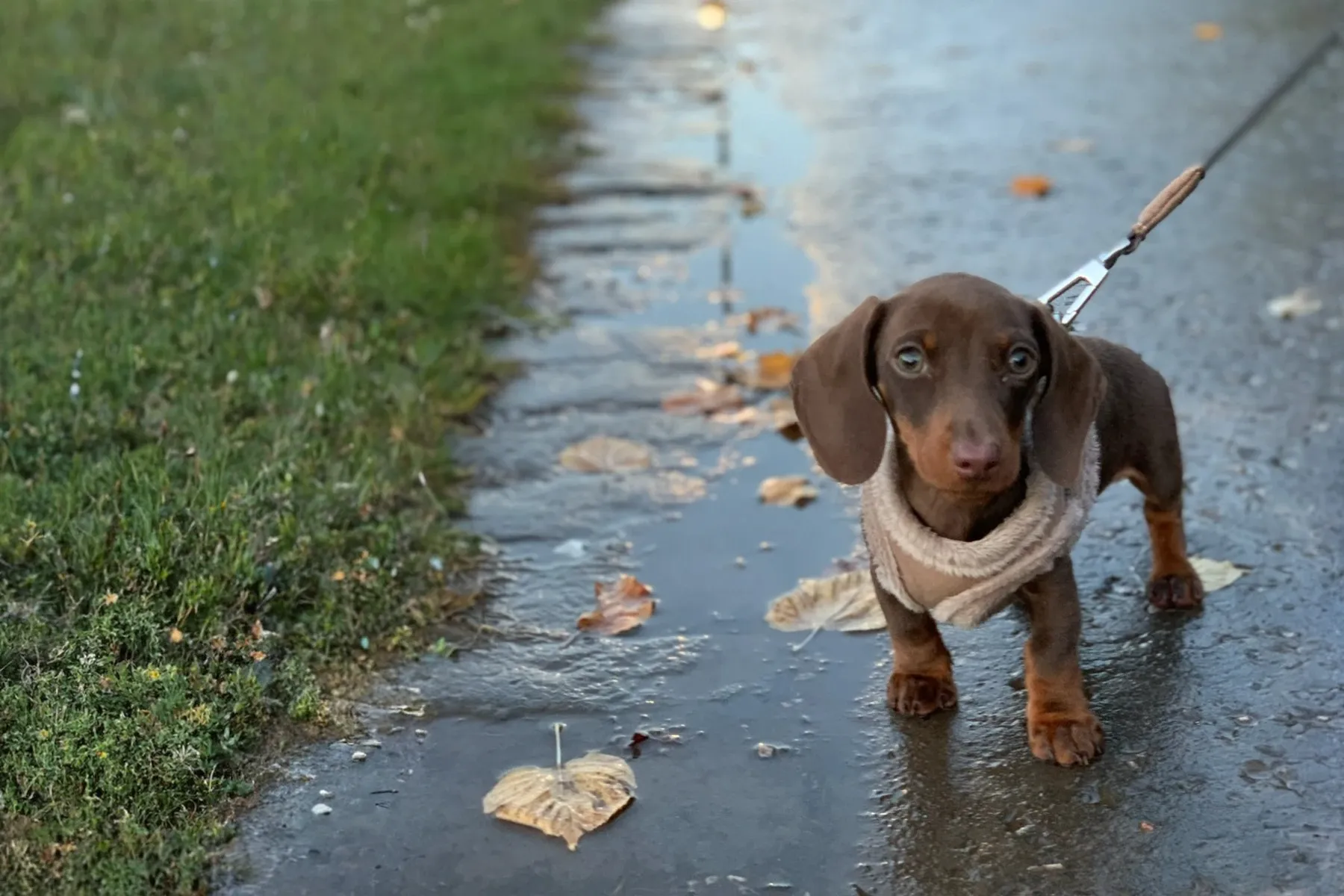
Dog zoomies are a type of reaction to a situation or event a dog finds themselves in, whether positive or negative. A dog may then run around in circles almost continuously, bumping into people or objects. Today, however, we know much more about this behaviour, and instead of treating every burst of frantic activity as a problem, it is worth understanding what so-called zoomies actually are and when they genuinely require our response.

Do you know what emotions your dog may be experiencing when zoomies suddenly take over? Interestingly, dogs may use this kind of activity both to express happiness and to release tension or excess arousal. The technical term for these episodes is Frenetic Random Activity Periods (FRAPs – sudden, brief periods of intense activity), although you are far more likely to come across the term “zoomies”. [1]
Typical dog zoomies are usually a normal, brief episode of very intense activity. The most important thing is to keep your dog safe and to recognise situations in which similar running may be linked to fear, pain or a health problem. [1]
What will you learn from this article? From this guide, you will learn:
- what dog zoomies are and what the term means,
- why a dog suddenly runs around like crazy,
- why a dog runs in circles,
- how a dog behaves during zoomies,
- what can cause dog zoomies,
- why puppies experience zoomies more often,
- why a dog may go wild in the evening or after a bath,
- how to respond when your dog has zoomies,
- how long typical zoomies can last,
- at what age dogs tend to become calmer,
- how to help your dog release emotions and energy,
- what zoomies can be confused with,
- when running in circles requires consultation with a veterinary surgeon.
Dog zoomies
Do you ever find yourself in a situation where your dog suddenly starts running around and going wild, while you have no idea how to bring the situation under control? I am sure every dog guardian knows exactly what I mean. So-called dog zoomies are a very common phenomenon. Unfortunately, I have noticed that relatively little is still said about what they actually mean and when they should genuinely be a cause for concern.
The question is whether we should simply accept zoomies as something normal and not respond at all. In most cases, typical zoomies do not need to be stopped at all costs, but that does not mean doing absolutely nothing either. It is important to secure the surroundings, observe your dog’s body language and pay attention to the circumstances in which the behaviour appeared. Cornell University College of Veterinary Medicine points out that FRAPs are normal and may help release accumulated energy or tension. [1]
This is why I want to explain what dog zoomies are, what causes them and how you should respond to your dog in such a situation. It is also worth knowing where normal zoomies end and behaviour that should not be ignored begins.
What are dog zoomies?
Let us now consider what dog zoomies actually are. How does your dog behave in this state? Of course, it is worth noting that every dog may behave slightly differently during a bout of zoomies.
Zoomies, or FRAPs, are sudden bursts of intense movement. A dog may start sprinting almost without warning, race around a room or garden, make tight turns, stop suddenly and then set off again. Cornell University College of Veterinary Medicine states that this behaviour is particularly common in puppies and young dogs, although some dogs continue to experience occasional zoomies throughout their lives. [1]
– dog runs around like crazy
Usually, a dog in this situation races around the house or whatever space they happen to be in at remarkable speed. What is more, a dog in the middle of zoomies may pay far less attention to whether something is in the way. They can charge straight into an object or person, almost knocking them over.
As you can see, this alone can become dangerous. First of all, your dog can hurt themselves. They may run into furniture, knock over an object in the room or slip on a smooth floor. It is therefore not the zoomies themselves that pose the greatest risk, but the environment in which the dog suddenly starts running. Cornell recommends keeping dogs away from stairs, slippery surfaces, obstacles and roads during FRAPs. [1]
A dog racing around during zoomies may also run into a person, causing them to lose their balance and fall. If a larger dog collides with a small child, the situation can become dangerous. It is therefore worth giving your dog as much free space as possible rather than attempting to physically stop them at full speed.
– dog runs in circles
Running in circles is one of the most characteristic signs of zoomies. A dog may suddenly begin making fast laps around the living room, garden or lawn, repeatedly changing direction at speed. This is precisely why dog guardians so often search Google for questions such as “why does my dog run in circles?” or “why does my dog run around like crazy?”.
If your dog makes several fast laps, changes direction, has a loose body and returns to normal behaviour after a short while, you are most likely watching ordinary zoomies. [1] Persistent walking or circling in the same direction looks different, particularly when accompanied by balance problems, disorientation, stumbling or changes in awareness. This type of behaviour should not automatically be considered zoomies. [6]
– dog does not respond to commands
Very often during zoomies, a dog does not respond to the commands you give. When you try to stop and calm them, the words you are saying may have considerably less significance to them at that particular moment.
Your dog is going wild, and attempts to make contact usually do not work particularly well. Interestingly, even very obedient dogs can react in a similar way during zoomies. Have you ever tried giving your dog a command while they were racing around in the middle of a bout of zoomies? If so, I suspect the result was far from what you expected.
This does not mean that your dog is deliberately ignoring you or has suddenly forgotten the command. During very high arousal, their attention may be focused primarily on movement. For this reason, it is better to create a safe space and wait for the intensity of the behaviour to decrease rather than chase your dog and repeatedly give the same commands.
– dog mouths and bumps into people
Unfortunately, zoomies are sometimes more than simply running around the house and ignoring commands. In some cases, a highly aroused dog may mouth, jump up or try to grab a person’s hands or clothing. However, this behaviour should not automatically be described as genuine aggression.
You know your dog and you know what their behaviour looks like during play. If, however, your dog behaves this way around a stranger, that person has every right to feel threatened by your pet. This can easily become the source of unpleasant situations.
What is more, if an excited dog runs into a child during zoomies or starts mouthing them, they may accidentally cause harm. This is why it is important to know how to safely manage the environment in which your dog experiences zoomies.
If, in addition to mouthing, you notice pronounced body stiffness, persistent fear, growling that sounds different from play growling or behaviour that does not subside once the running has finished, do not automatically treat it as ordinary zoomies.
What causes dog zoomies?
There may be several reasons why your dog experiences zoomies. Interestingly, this kind of behaviour may suggest that both positive and negative emotions are involved. We therefore cannot state categorically that it always results from happiness or always from nervousness.

No single specific cause of FRAPs has been established. According to Cornell, they may help release accumulated energy, appear after insufficient stimulation or occur during moments of very high excitement. [1] It is therefore worth looking not only at the running itself, but also at what happened immediately beforehand.
– your dog is expressing joy
As I mentioned earlier, your dog’s zoomies may appear because they are experiencing joy and enormous excitement. This may be triggered by meeting a particular person or by a specific situation.
This is also a moment when it can sometimes be difficult to interpret your dog’s reaction and determine whether they are simply delighted or whether typical zoomies have just started. It is perfectly normal for your dog to react enthusiastically to pleasant things that happen in their life.
A guardian returning home is one example of a situation in which FRAPs can occur. Cornell also lists play, exciting events, late evening, highly arousing training sessions and even the period immediately after defecation. [1]
– dog is nervous
Dog zoomies may also appear when your dog is nervous about something or very highly aroused. It is not always easy to immediately interpret what your dog is trying to communicate, which is why observing their entire body language is so important.
If you would like to learn more about what your dog is telling you, have a look at our article about dog body language and calming signals. Context is crucial here. A relaxed dog happily racing around the garden looks very different from a dog whose body remains tense, whose tail stays tightly tucked and whose ears remain pulled back even after they stop. [1]
– dog has too much energy
This type of behaviour may result from a large amount of energy your dog has built up. Through zoomies, your dog may be trying to release it. Perhaps you have noticed your dog behaving this way after spending a long time home alone or after a period of limited activity.
This does not mean, however, that every case of zoomies proves that your dog is not getting enough walks. Dogs can also experience zoomies after activity, an exciting meeting or play. It is worth looking at your dog’s entire daily routine: the amount of exercise, opportunities to sniff, training, play, rest and overall arousal level.
Why does a dog get zoomies?
The behaviour known as “zoomies” is a moment when a dog suddenly seems incredibly excited and starts racing around, often making turns, jumps and rapid changes of direction.
The causes of zoomies can vary. Sometimes they are an expression of excess stored energy, particularly in young dogs and puppies. They can also be a way of expressing joy and enthusiasm, especially after a period of calm or in an appropriately stimulating situation. [1][2]
Zoomies can also occur after an experience that was highly arousing for the dog. Your dog may feel happy, excited or simply full of energy and express this through fast running. Zoomies sometimes appear after a bath, late in the evening, during play, after defecation or after meeting a person or another dog. [1][2]
Why does a puppy run around like crazy?
Puppies and young dogs experience zoomies more frequently because they have high energy levels and are particularly prone to becoming excited. Cornell states that FRAPs are most commonly observed in puppies and young dogs. [1]
This does not mean, however, that whenever a puppy races around the house like crazy they always need another long walk. A young dog also needs a great deal of rest, and their activity should be suited to their age and stage of development. People’s Dispensary for Sick Animals (PDSA – a UK veterinary charity providing care and advice for pets) highlights the importance of gradually increasing exercise for growing dogs and protecting their developing joints. [4]
Why does a puppy get zoomies in the evening?
Evening zoomies are very common in young dogs. The American Kennel Club describes a puppy suddenly racing around in the evening as a typical example of FRAPs. [2]
A young dog may have plenty of energy, but they may also be highly aroused after an entire day full of new experiences. Adding another round of intense activity is not always the best solution. Sometimes a puppy needs a calmer environment and an opportunity to move from a state of arousal into rest.
If, after an intense day, your dog wanders around the house, keeps looking for something else to do and cannot settle, have a look at our guide How to help your dog rest after an active day?.
Why does a dog get zoomies after a bath?
Bath time is one of the situations most commonly associated by dog guardians with a sudden burst of “madness”. Your dog comes out of the shower or bath and then starts racing around the house, rubbing against furniture and completing fast laps.
This kind of episode may result from high arousal or the release of tension after a situation that was not necessarily pleasant for the dog. The American Kennel Club identifies bathing as an example of a stressful event after which zoomies may occur. [2] If, however, your dog’s body is loose and they return to normal behaviour after a short while, there is usually no reason for concern.
How long do dog zoomies last?
This question also appeared in the comments under the original version of this article. The duration of zoomies varies, but what is characteristic of typical FRAPs is that they are a brief episode of very intense activity, after which the dog returns to normal behaviour. [1][2]
For one dog, this may mean several dozen seconds of fast running; for another, it may be several short laps. There is little value in becoming attached to one specific number of minutes. What matters much more is whether the behaviour subsides on its own and whether your dog behaves completely normally afterwards.
If, however, the episode lasts unusually long, the behaviour appears repetitive and compulsive or is accompanied by balance problems, disorientation, tremors, pain or changes in awareness, it is worth discussing the situation with a veterinary surgeon.
How can you calm a dog during zoomies?
You are probably wondering how you should behave when your four-legged friend suddenly gets the zoomies. I have prepared several useful tips and points for you.
The most important change compared with older advice is that typical zoomies do not need to be stopped at all costs. If your dog is in a safe place and their body language suggests happy FRAPs, concentrate primarily on the surroundings. Prevent access to the road, secure stairs, remove obstacles and allow your dog to finish their short burst of activity. [1]
Give your dog opportunities to use their energy
As I mentioned earlier, dogs often experience zoomies when they have a great deal of unused energy. If you know that your dog particularly enjoys being active, make sure you provide exercise and stimulation suited to their age, health and temperament.
If your dog has no opportunity to use their energy, they may more often need a way of releasing it. In this situation, it is worth providing walks, opportunities to sniff, training and active play. PDSA emphasises, however, that exercise requirements depend on factors including age, breed, health, physical condition and personality. [3]
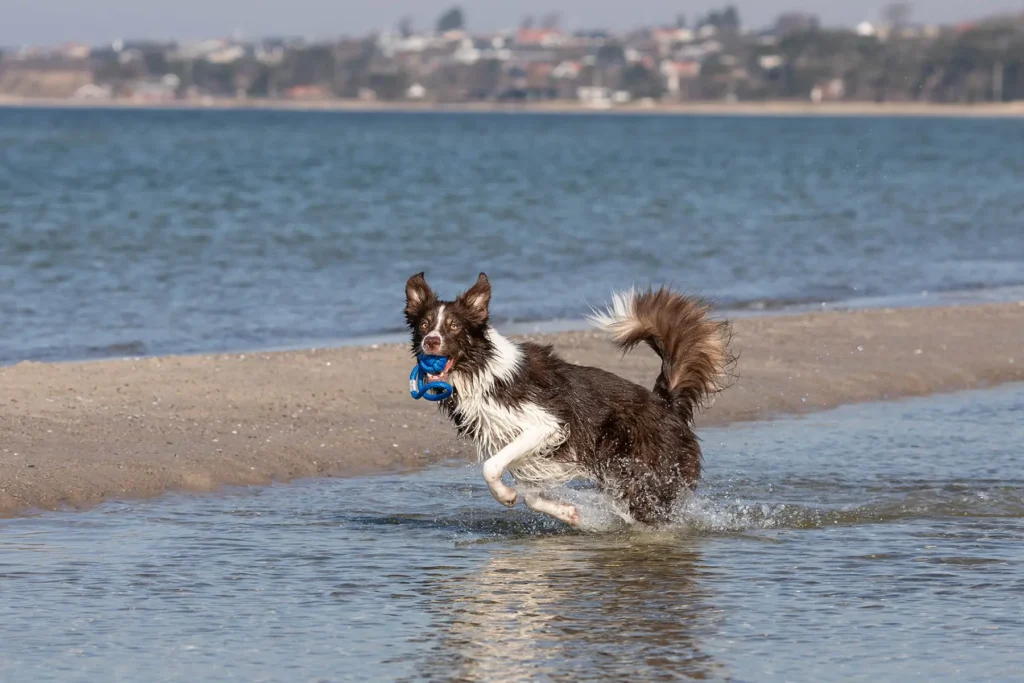
You can also enjoy active play together in the park, such as tugging with a suitable toy. For this type of game, I can recommend the BULLET blue dog toy from Bowl&Bone Republic, designed for fetching, throwing and tugging.
Do not add even more intense emotion
When a dog is already highly excited, it is not worth increasing the level of arousal further by suddenly chasing them, shouting or very enthusiastically encouraging another game. Calm behaviour from the guardian primarily makes it easier to manage the situation safely.
This does not mean, however, that zoomies are simply a reflection of human emotions. Nor can we assume that a calm guardian will automatically “switch off” the zoomies. FRAPs have different causes and in many cases are simply a natural canine behaviour. [1]
Do not try to catch your dog while they are running at full speed
In the older version of this article, I advised responding to zoomies as if they were behaviour that should be stopped as quickly as possible. Today, this advice needs to be clarified.
If your dog is experiencing typical zoomies in a safe place, do not chase them or try to catch them while they are running at full speed. You may unnecessarily increase their arousal, and either the dog or a person may accidentally be knocked over.
If, however, your dog is approaching a road, stairs or another dangerous area, you obviously need to react. This is precisely why a well-practised recall and the ability to physically secure the environment are so important.
How can you help your dog release emotions?
Regular physical activity plays an important role in helping dogs use accumulated energy. Walks, running suited to the dog’s capabilities and play can help maintain a healthy level of activity. Interactive games such as fetching can provide both physical and mental challenges.
Training exercises, particularly those that engage your dog’s mind, can also be an excellent way of helping them process emotions. Games that require thinking can challenge the canine mind while also giving your dog a sense of satisfaction.
It is worth remembering, however, that “tiring your dog out” should not simply mean adding more and more kilometres to every walk. Slow sniffing, exploring, learning new skills and nose work can all be highly engaging for dogs. PDSA points out that training, exploratory walks, play and mental activity are all valuable elements of a dog’s everyday routine. [3]
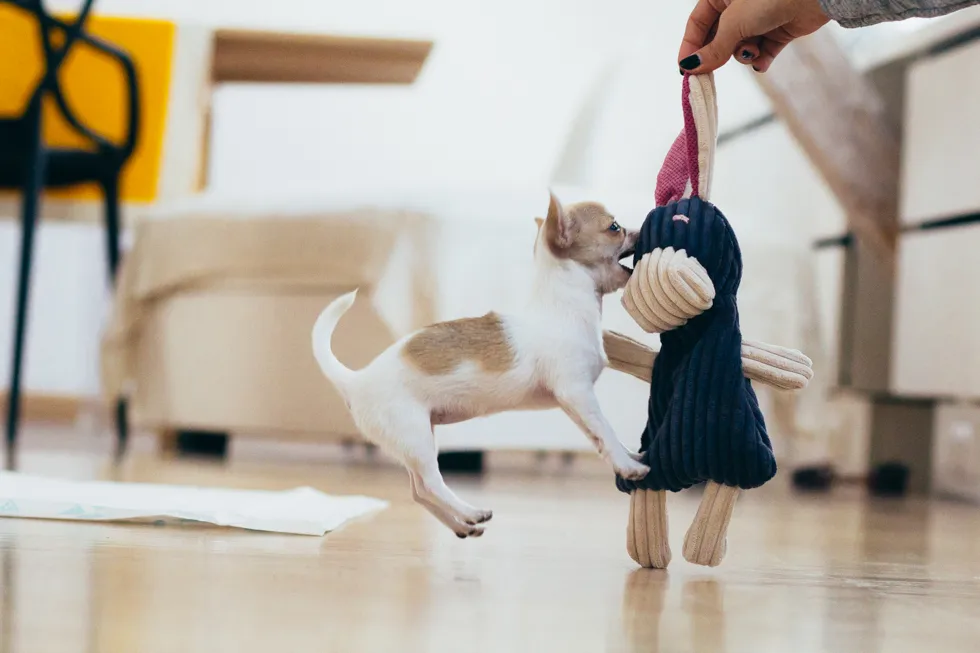
You can make shared play more varied by choosing appropriately matched dog toys. It is equally important, however, that after a period of activity your dog also has an opportunity to rest calmly.
Dog runs around like crazy with a tucked tail – are they frightened?
Not always. During typical FRAPs, many dogs characteristically lower their hindquarters and tuck their tail while sprinting. A tucked tail during a fast turn alone does not necessarily mean that your dog is terrified. [1]
What matters is how your dog’s entire body looks during and after they stop. Cornell describes a happy dog experiencing zoomies as loose and bouncy, often performing play bows. A frightened dog, by contrast, is more tense and may have wide eyes, a lowered head, ears pulled back and a tail held tightly against the abdomen even after stopping. [1]
If your dog runs with their tail tucked, do not assess the situation on the basis of this one body part alone. Look at the entire behaviour and the context.
At what age does a dog become calmer?
The process of maturing and becoming calmer is individual and depends on many factors, including breed, size, genetics, activity level and the dog’s individual personality. In most cases, you can observe dogs gradually becoming calmer as they grow older.
During the transition into adulthood, youthful impulsiveness often begins to decrease gradually, but there is no single age that applies to all dogs. Some breeds mature later, and a very energetic dog may continue to have a strong desire for activity well into adulthood.
Older dogs often tend to adopt a calmer pace of life. Although individual differences in canine temperament are always present, many guardians notice that as their dogs age they become less inclined towards frequent bursts of energy and more willing to choose calm walks and rest.
This does not mean, however, that an adult dog cannot have zoomies. The American Kennel Club states that the behaviour occurs in adult dogs too, although the younger the dog, the more frequently it tends to be seen. [2] Cornell also notes that some dogs continue to experience occasional episodes throughout their lives. [1]
Does every dog get zoomies?
If you bring a dog into your life, is it certain that you will have to deal with zoomies? Not necessarily. Zoomies are more common in young dogs and puppies, which often have a great deal of energy. Older dogs can also have these moments from time to time, although they are usually observed less frequently. [1][2]
Dogs may experience zoomies after a bath, after a walk, after play, in the evening, after defecation, after their guardian returns home and sometimes for no reason that is obvious to us. [1]
Factors influencing whether your four-legged friend experiences zoomies include age, activity level, temperament and the particular situation. Puppies and young dogs have zoomies more frequently because of their higher energy levels. Dogs that do not receive enough exercise or stimulation may also more often need a way of releasing accumulated energy. [1]
What can dog zoomies be confused with?
Dog zoomies in the general sense are usually fairly harmless. However, similar behaviours may indicate health or behavioural problems. Seizures can involve convulsions and altered awareness, while neurological disorders may cause unusual movements and sudden behavioural changes that require consultation with a veterinary surgeon.
Anxiety or fear can also trigger sudden running or attempts to escape. Pain or severe discomfort may likewise cause abrupt behaviours that at first glance look like the dog is simply “going crazy”.
If your dog’s behaviour seems unusual, lasts a long time or is accompanied by other symptoms, it is worth consulting your dog’s veterinary surgeon to rule out more serious problems.
When should a dog running in circles be a cause for concern?
This is a particularly important distinction because not every case of running in circles is zoomies.
During typical FRAPs, a dog usually runs quickly, changes direction dynamically, has a loose body and returns to normal behaviour after a short period. Persistent circling in the same direction looks very different.
MSD Veterinary Manual notes that neurological problems can present with signs including circling in one direction, balance problems, stumbling, falling, changes in awareness or seizures. [6]
Contact a veterinary surgeon if your dog:
- persistently circles in only one direction,
- appears disorientated,
- loses balance or falls over,
- experiences tremors or a seizure,
- behaves as if they are in pain,
- appears extremely frightened,
- suddenly begins behaving this way despite never having done so before,
- takes a long time to return to normal after the episode ends.
If you are unsure, it is better to have the behaviour assessed than to assume that every unusual bout of running is harmless zoomies.
My dog is going crazy
I understand that dog zoomies can be tiring, particularly when your dog is large or decides to perform their wild laps in a small flat. You now know, however, what can cause dog zoomies. It is very important to understand why your dog behaves in this way. Knowledge of canine behaviour is essential in everyday life with a four-legged companion.
You do not need to eliminate typical zoomies at all costs. If your dog is in a safe place, their body is relaxed and they return to normal behaviour after a short burst of running, you can usually simply allow them to finish the episode. Your role is primarily to keep them safe and observe their behaviour.
Does your dog sometimes get bouts of zoomies? Do they race around the house without stopping? You now know that in many cases this is a perfectly normal element of canine behaviour, as well as which signs should make you more cautious.
Remember to maintain a balance between activity and rest. Regular walks, sniffing, shared play and well-chosen dog toys can help your dog meet their needs, but having an opportunity to settle calmly after an emotion-filled day is equally important.
– the Bowl&Bone Republic team
FAQ – frequently asked questions about the article –
Dog zoomies – why does your dog run around like crazy and how can you manage them?
What are dog zoomies?
Dog zoomies are sudden and usually brief episodes of very intense activity. A dog may race around the house or garden, make fast laps and change direction rapidly. The technical name for this behaviour is Frenetic Random Activity Periods (FRAPs). [1]
Are dog zoomies normal?
Yes, typical zoomies are usually normal canine behaviour, particularly common in puppies and young dogs. It is important, however, that your dog is in a safe space and returns to normal behaviour after the episode. [1]
Why does my dog run around like crazy?
A dog may race around like crazy because of very high excitement, accumulated energy or tension. Zoomies may appear during play, in the evening, after defecation, when the guardian returns home or following other exciting events. [1]
Why does my dog run in circles?
If your dog makes fast laps and repeatedly changes direction, it may be part of normal zoomies. Persistent circling in the same direction, particularly when accompanied by disorientation or balance problems, requires greater attention. [6]
Why does my dog run around the house like crazy?
The home may be a place where your dog feels safe enough to release accumulated excitement. Zoomies often occur after a period of calm, during play or at moments of high arousal.
Why does my puppy run around like crazy in the evening?
Evening zoomies are common in puppies. A young dog may have a lot of energy or find it difficult to settle after a day full of stimulation. It is important to provide both appropriate activity and sufficient rest. [2][4]
How long do dog zoomies last?
Typical zoomies are brief episodes. For some dogs they last several dozen seconds, while others may complete several short rounds. The most important factor is whether your dog returns to normal behaviour afterwards. [1][2]
Should you stop a dog during zoomies?
Usually not, provided your dog is in a safe place and is showing typical happy zoomies. It is worth securing stairs, slippery surfaces, obstacles and access to the road. [1]
Can you calm a dog during zoomies?
It is best not to try physically catching your dog while they are running at full speed. Stay calm, avoid adding further stimulation and secure the surroundings. A typical episode should subside by itself.
Why does my dog get zoomies after a bath?
Bathing can be a highly arousing or stressful experience for a dog. A brief burst of fast running afterwards may help release accumulated tension or excitement. [2]
Can a dog get zoomies after a walk?
Yes. A walk provides dogs with many stimuli, scents and emotions. Sometimes a dog remains highly aroused for a short while after returning home and zoomies appear.
Why does my dog get zoomies after doing a poo?
Cornell University College of Veterinary Medicine lists the period after defecation as one of the situations in which dogs may experience FRAPs. [1]
Can an adult dog get zoomies?
Yes. Zoomies are more common in puppies and young dogs, but they can also occur in adults, and some dogs experience them occasionally throughout their lives. [1][2]
At what age do dogs become calmer?
There is no single age that applies to every dog. The rate of maturation depends on factors including size, breed, temperament and individual development. In many dogs, the frequency of sudden bursts of energy gradually decreases with age.
Do zoomies mean my dog is not getting enough exercise?
Not always. Too little exercise or stimulation may contribute to accumulated energy, but zoomies also occur in active dogs during moments of joy or intense excitement. [1]
Is a dog with a tucked tail during zoomies frightened?
Not always. Dogs may characteristically tuck their hindquarters and tail while running quickly. If, however, the tail remains tightly tucked after the dog stops, the body is tense and the dog appears frightened, this may indicate fear. [1]
Does every dog get zoomies?
No. Zoomies are very common, particularly in young dogs, but not every dog will display them regularly.
When should a dog running in circles be a cause for concern?
The main warning sign is persistent circling in one direction combined with disorientation, loss of balance, falling, tremors, seizures or altered awareness. These symptoms should be assessed by a veterinary surgeon. [6]
When should you take a dog with zoomies to the vet?
It is worth consulting a veterinary surgeon if your dog appears frightened or in pain during the episode, the behaviour is unusual, suddenly appears for the first time, lasts a very long time or is accompanied by neurological signs or signs of pain. [1][6]
Sources and inspiration used to write the article
Dog zoomies – why does your dog run around like crazy and how can you manage them?
- Cornell University College of Veterinary Medicine, “What are zoomies?” – material covering Frenetic Random Activity Periods (FRAPs), causes of zoomies, situations in which they typically occur, differences between happy FRAPs and fear, and safety during sudden bursts of running.
https://www.vet.cornell.edu/departments-centers-and-institutes/riney-canine-health-center/canine-health-information/what-are-zoomies - American Kennel Club, “Why Does My Puppy Go Wild at Night?” – material covering zoomies in puppies, evening episodes of intense activity, the dog’s age and safe responses to FRAPs.
https://www.akc.org/expert-advice/training/why-does-my-puppy-go-wild-at-night/ - People’s Dispensary for Sick Animals (PDSA), “Exercise for dogs” – guidance on matching the amount and type of exercise to a dog’s age, breed, health, physical condition and personality, as well as the importance of walks, training, play and mental stimulation.
https://www.pdsa.org.uk/pet-help-and-advice/looking-after-your-pet/puppies-dogs/how-much-exercise-does-your-dog-need - People’s Dispensary for Sick Animals (PDSA), “Exercising your puppy” – guidance on safe activity for puppies, protecting developing joints and gradually increasing physical exercise.
https://www.pdsa.org.uk/pet-help-and-advice/looking-after-your-pet/puppies-dogs/exercising-your-puppy - Bowl&Bone Republic, “Dog body language – calming signals” – internal material used to complement the section on observing the dog’s entire body language and the importance of context when interpreting behaviour.
https://www.bowlandbone.com/dog-body-language-calming-signals/ - MSD Veterinary Manual, “The Neurologic Evaluation of Dogs” – veterinary material used to distinguish typical zoomies from neurological signs such as persistent circling in one direction, loss of balance, stumbling or impaired coordination.
https://www.msdvetmanual.com/dog-owners/brain-spinal-cord-and-nerve-disorders-of-dogs/the-neurologic-evaluation-of-dogs