


In the morning, you find your dog resting in the sunlight streaming through the balcony window. In the afternoon, they move closer to the desk where you are working. In the evening, they return to their bed in the living room, rest their muzzle on its soft side and quietly watch the home around them before closing their eyes.
A dog may have one favourite bed and still choose other places to rest throughout the day. This does not mean they dislike their bed. Their needs change, as do the temperature, the rhythm of life at home and their desire to remain close to their guardian.
Sometimes they look for peace and quiet. At other times, they want to see everything happening around them. They may need soft support at one moment and, a few hours later, choose an open cushion or a lightweight mat laid beside an armchair. So, does a dog need one bed or several?
There is no single number that is right for every dog. In many homes, the best solution is one main bed and one or two additional resting places suited to different parts of the day. Not every one of them needs to be a large bed. An additional resting zone may take the form of a cushion, a travel mat or a second bed placed in a quieter room.
Why is one resting place not always enough for your dog?
A home is not one unchanging environment for a dog. In the morning, the living room may be quiet and cool, while in the afternoon it may be filled with conversations, footsteps and everyday activity. The bedroom, which feels calm at night, may remain empty during the day. A spot beside the window may be pleasant on a cooler day but quickly become too warm in summer.
A dog chooses where to rest depending on factors including:
• temperature,
• the presence of household members,
• noise levels,
• access to a peaceful, sheltered space,
• the opportunity to observe their surroundings,
• their stage of life and physical condition,
• the type of surface they wish to lie on.
Research into canine rest suggests that dogs’ sleep may vary depending on location, daily routine and the presence of people and other dogs. The choice of a resting place is therefore part of a broader pattern of behaviour rather than a random decision. [1][2]
A dog may love their main bed but still wish to move closer to you during the day. They may also look for a cooler surface or a quieter room when guests arrive in the living room. An additional resting place does not compete with the main bed. It complements it.
How many beds should a dog have?
The simplest answer is: as many resting places as genuinely help them relax peacefully — without unnecessarily filling the entire home.
In a small flat, one comfortable dog bed and a lightweight mat that can be moved to another room may be enough. In a larger home, it may be practical to have a main bed in the living room, a cushion in the home office or bedroom, and a mat used on the terrace and during trips.
Your everyday lifestyle also plays an important role.
| Situation | Practical solution |
|---|---|
| Small flat | one main bed and a portable mat |
| A dog who follows their guardian | a bed in the living room and a cushion in the workspace or bedroom |
| A multi-storey home | at least one easily accessible resting place on the most frequently used floors |
| A senior dog | a stable orthopaedic bed and an additional resting place without a high entrance |
| Frequent travel | a main bed at home and a familiar mat taken on trips |
| A dog who enjoys different sleeping positions | a bed with supportive sides and a more open cushion |
The most important thing is therefore not to buy several similar products. The aim is to create different resting zones, each of which responds to a different need.
The main dog bed – a place your dog returns to
A dog’s own bed can serve a special purpose. It is a permanent feature of the home. It smells familiar, remains in the same place and allows your dog to quietly observe everyday life. It is where they can return after a walk, playtime, a meal or a day filled with new experiences.
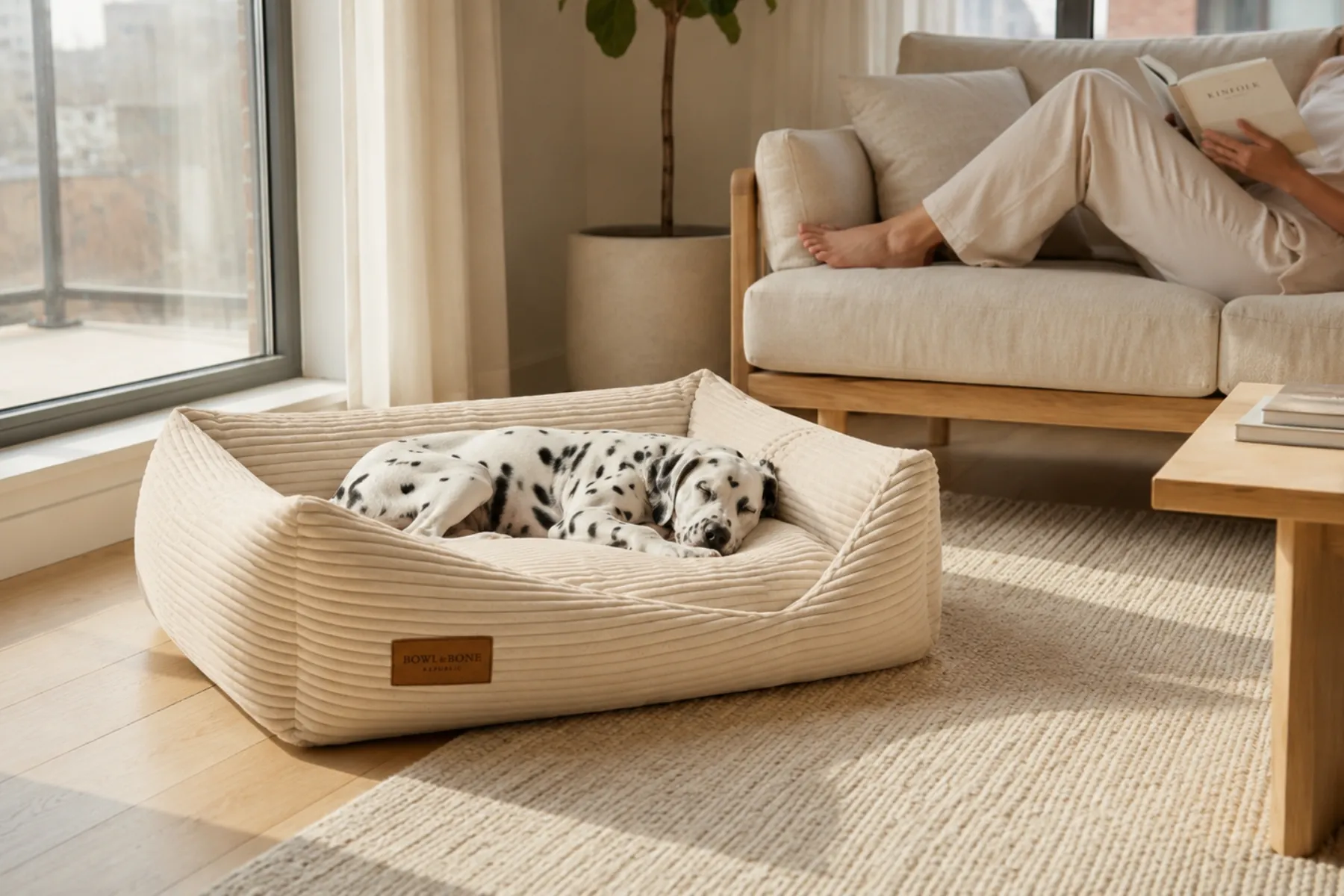
The main bed should be large enough for the dog to change position freely, while also suiting the way they most enjoy resting. Dogs who curl up and like to rest their muzzle on a raised surface often choose models surrounded by soft sides. The DECO corduroy dog bed can create exactly this kind of space. Its soft sides provide comfortable head support, while the characteristic lowered entrance makes it easier to step inside. This can be particularly important for puppies, senior dogs and companions who are reluctant to climb over high edges.
The wide, soft corduroy gives the bed a cosy character, allowing it to become not only a place where the dog rests but also a harmonious part of the living room. Removable covers also make it easier to keep the bed clean during everyday use. DECO can become the central point of the dog’s resting zone — a place chosen not only for a short nap, but for regular night-time sleep and peaceful recovery.
A dog cushion – resting where everyday life happens
Not every dog always wants to curl up between the sides of a bed. Some love to stretch out to their full length, place their paws beyond the edge and observe the home without any restrictions. For them, a dog cushion may be a natural addition to their main bed.
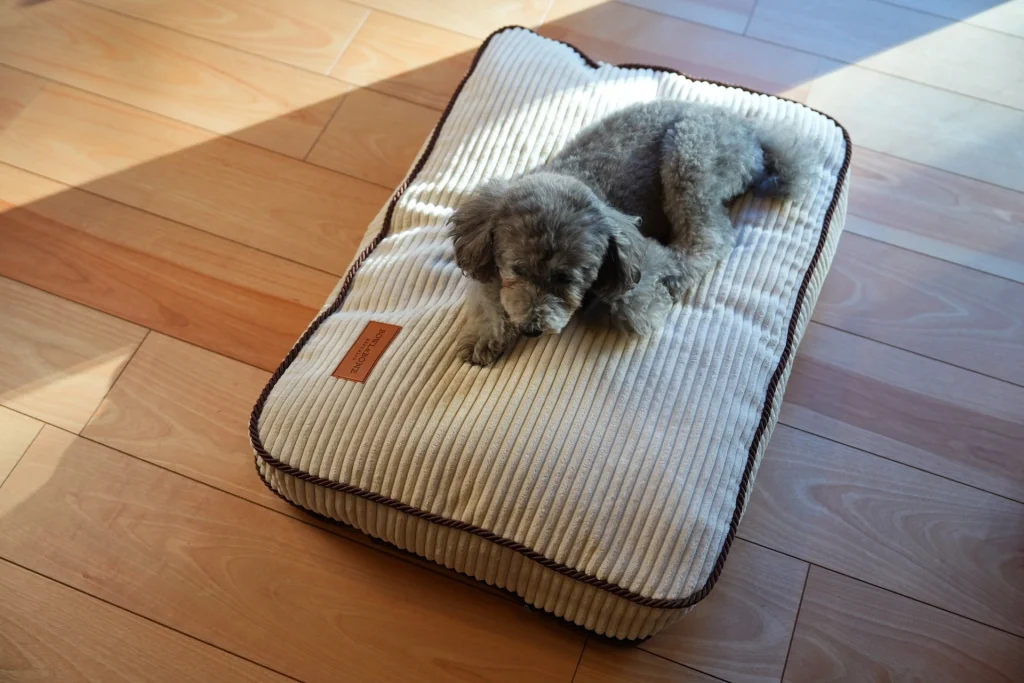
Its open shape gives the dog greater freedom to position their body. The cushion can be placed in the home office, bedroom or the part of the living room where the dog likes to spend time during the day.
Imagine an ordinary afternoon. You are working at the table, while your dog, rather than returning to the bed on the other side of the house, settles on a cushion beside your chair. They are not asking for attention. Your presence is enough. It is in moments like these that a second resting place makes the most sense. Not because the first one is uncomfortable, but because it allows the dog to rest close to their guardian without lying directly on a cold floor.
A cushion is particularly suitable for dogs who:
• sleep on their side,
• often stretch out fully,
• enjoy observing the room,
• do not need high sides,
• follow their guardian from room to room.
Bowl&Bone Republic dog cushions combine an open shape with pleasant-to-touch fabrics, allowing the cushion to complement the main bed visually and create a harmonious whole.
A travel dog mat – a familiar place You can take with You
Not every resting place needs to remain permanently at home. Sometimes, the most important advantage is the ability to take a small part of a familiar space with you.
A travel mat for dogs can accompany your companion:
• during a weekend trip,
• in a hotel or guesthouse,
• when visiting family,
• in a dog-friendly restaurant,
• in the office,
• on a terrace or balcony,
• during a quiet break in a journey.
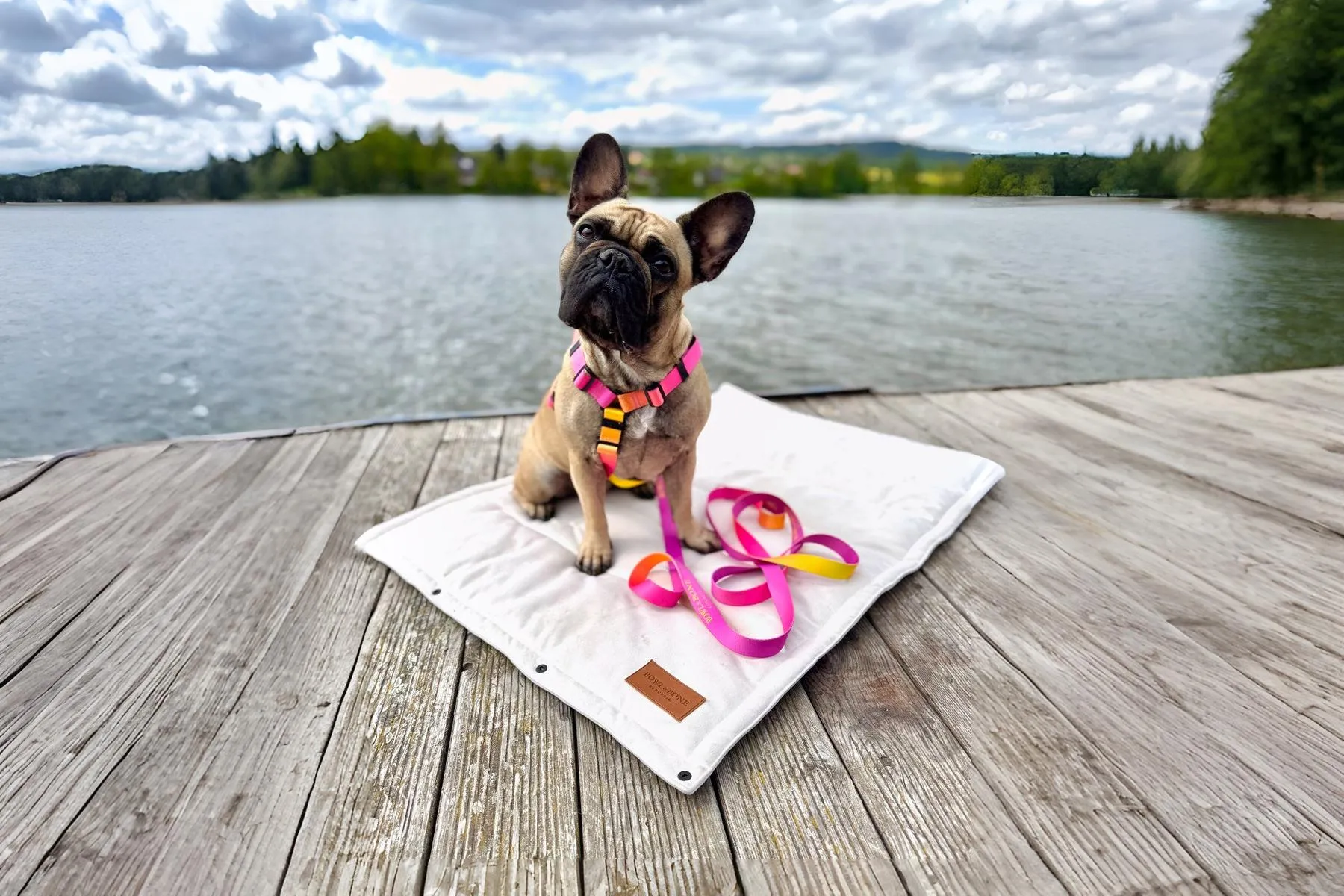
Once unfolded, it creates a clearly defined, soft place where the dog can lie down. The familiar surface and scent may help them find their own resting spot even in an unfamiliar environment.
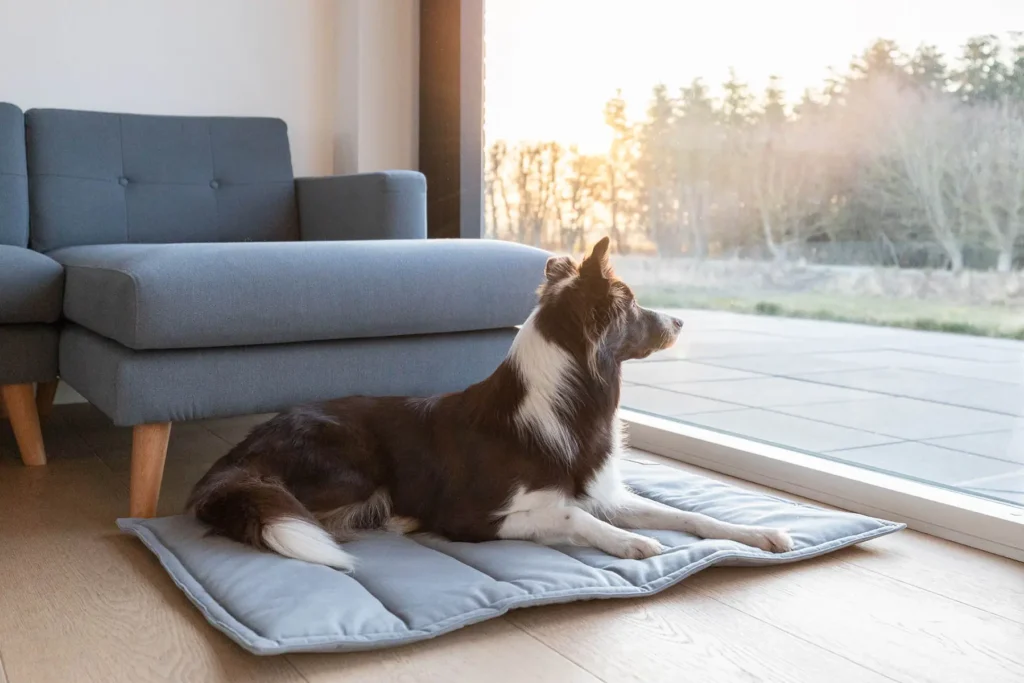
The mat does not need to replace a full-sized dog bed for regular night-time sleep. Its greatest advantage is its portability. You can move it wherever you are spending time together and then fold it away after use. At home, it can work well as an additional resting zone in the kitchen, on the balcony or beside your desk. During a trip, it becomes one of the few items that smells exactly like the place your dog knows from everyday life.
An orthopaedic dog bed – when stable support becomes particularly important
A dog’s way of resting may change with age. They may lower themselves more slowly, reposition their body more frequently or need more time to stand up. More stable support can also be valuable for large dogs, highly active companions and those who need effective recovery after daily exercise. In such cases, an orthopaedic dog bed may become the main resting place.
A properly selected mattress creates an even, stable surface that does not sink excessively beneath the dog’s weight. For a senior dog, easy access is also important, as is placing the bed somewhere that does not require frequent use of the stairs. Veterinary organisations mention a comfortable orthopaedic bed as one possible modification to the home environment that can support older animals with limited mobility. [3]
An orthopaedic bed is not, however, a form of treatment or a way to solve health problems without professional support. If a dog has difficulty standing up, avoids movement, limps or is clearly unable to find a comfortable position, a veterinary surgeon should be consulted. Additional resting places for a senior dog should be equally accessible. Even the best bed placed one floor above will not serve its purpose if the dog does not want to or cannot reach it safely.
Where should You place Your dog’s resting areas?
The number of beds matters less than where they are placed. Three beds arranged next to one another in the living room will not provide three genuinely different options.
Each place should fulfil a specific function.
– close to household members, but not in a walkway
Many dogs want to observe their family and feel their presence. A bed can therefore be placed in the living room, but not directly between doorways, beside chairs that are constantly being moved or along the main route to the kitchen.
A dog should be able to rest without someone repeatedly stepping over them.
– away from draughts and intense sources of heat
Do not place the bed directly beside a radiator or in a location where cold air constantly flows through. A dog should be able to choose between a warmer and cooler surface rather than being limited to one temperature.
– in a quieter room
If the living room is noisy for most of the day, it may be worth preparing a second resting place in the bedroom or home office. It may prove useful when guests visit, during family gatherings or at other more stimulating moments.
– on a stable surface
The bed should not slide whenever the dog steps inside. This is particularly important for senior dogs and companions who have difficulty maintaining their balance.
– where the dog genuinely wants to rest
A dog guardian may choose the most beautiful corner of the living room, but a dog has their own map of the home. Before placing a second bed, observe where they most often settle by themselves.
They may consistently choose a space beside the sofa, a section of floor near your desk or a spot from which they can see the entrance to the room. This is where an additional cushion or mat has the greatest chance of becoming part of everyday life.
Several resting places do not have to create clutter
Additional beds are often associated with random blankets and cushions scattered throughout every room. It does not have to be this way.
It is worth treating your dog’s resting places in the same way as the other elements of your home. They may differ in form while remaining visually consistent thanks to:
• a similar colour palette,
• repeated fabric textures,
• minimalist shapes,
• designs suited to the style of individual rooms.
The main DECO corduroy dog bed can become a soft, distinctive feature in the living room. A cushion in a similar shade can be placed in the home office, while a folded mat waits in the cupboard until it is needed. In this way, you can give your dog several options without giving up an organised, elegant interior.
Will a dog use all the resting places prepared for him?
Not always immediately. A new bed may smell different from a familiar blanket or armchair. A dog may need time to accept it as their own space. They should not be placed inside the bed by force or constantly sent back to their designated place. It is better to let them explore the product calmly and build positive associations.
The following may help:
• placing the bed where the dog already chose to rest,
• laying a familiar blanket on it,
• leaving the dog undisturbed when they settle there by themselves,
• gently rewarding calm behaviour when they step onto the bed,
• avoiding moving the bed several times a day.
Remember that different places may be used at different times. A cushion beside the desk may be chosen only on working days, while a mat on the balcony may be used exclusively on cooler mornings. This still means that they are serving their purpose well.
When can one dog bed be enough?
Not every dog needs several full-sized beds. One well-chosen bed may be sufficient when:
• the flat is small,
• the dog spends most of the day resting in the same room,
• the temperature throughout the home remains consistent,
• the dog willingly and regularly returns to their own place,
• they have no difficulty reaching the bed,
• resting near their guardian does not require moving between rooms.
Even then, a travel mat used during visits, trips or shared time on the balcony can be a practical addition. The aim is not to suggest that every home must be filled with dog beds. What matters is creating a space that reflects the real rhythm of life shared by the dog and their guardian.
Signs that the current resting place may not be enough
Pay attention to your dog’s everyday choices. An additional or differently designed resting place may be helpful if the dog:
• regularly leaves their bed and lies on a hard floor in another room,
• tries to fall asleep directly beneath your chair,
• constantly carries a blanket between rooms,
• cannot fit comfortably in the current bed,
• looks for a cooler place during the day,
• does not want to remain alone in the room where the bed is placed,
• has difficulty stepping inside,
• cannot change position comfortably,
• avoids the stairs leading to their bed as they grow older.
Changing where a dog rests does not always mean you need to purchase another product immediately. First check the temperature, noise levels, size and position of the existing bed. Sometimes moving it by just a few metres is enough.
However, if the dog needs to rest in several different parts of the home every day, a separate cushion or mat may be more comfortable than continually moving the main bed.
The home through a dog’s eyes
For a person, the living room, bedroom and home office are separate spaces with specific functions. For a dog, they may simply be the next stages of the day. In the living room, they rest in the evening while listening to familiar conversations. In the home office, they wait for you to finish working. In the bedroom, they fall asleep at night, while on a mat taken on a weekend trip, they rediscover the scent of their own home.
One main dog bed gives them consistency. An additional dog cushion allows them to remain closer to you. A travel dog mat brings a small part of familiar space along on the journey. An orthopaedic dog bed can provide more stable support when the body begins to need particular care.
It is not about the number of products. It is about giving your dog a place at different moments of the day where they can quietly rest their head, relax their body and feel that they no longer need to do anything.
For more inspiration, knowledge and thoughtfully designed dog accessories, visit www.bowlandbone.com — a place created for dog guardians who wish to combine their companion’s everyday comfort with timeless style.
The Bowl&Bone Republic team
FAQ – frequently asked questions about the article –
How many beds should a dog have? One bed or several resting places?
How many beds should a dog have?
There is no single number that is right for every dog. In many homes, one main bed and one or two additional resting places, such as a cushion or mat, work well. The number should be suited to the size of the home, the household’s lifestyle, the dog’s age and the rooms in which they spend the most time.
Does a dog need a bed in every room?
Usually, this is not necessary. Resting places should primarily be prepared where the dog genuinely spends time. This may include a main bed in the living room and a cushion in the home office or bedroom. Additional beds in other rooms may simply remain unused.
Can two beds confuse a dog?
No. A dog can freely use several resting places depending on the time of day, temperature and presence of household members. It is important that at least one of them remains in a permanent position, is placed in a peaceful location and is always available.
Should the second bed be the same as the first?
Not necessarily. Different forms can meet different needs. A main bed with supportive sides can be used for night-time sleep, while an open cushion may be more suitable for daytime rest. A mat, meanwhile, works well as a lightweight, portable option.
Where is the best place for a dog’s main bed?
The best location is a quiet place away from draughts, radiators and the main walkway through the room. Many dogs also like to see household members, so the bed should not be completely isolated from everyday life.
Why does my dog not sleep in their bed?
Possible reasons include an unsuitable size, excessive warmth, unstable or overly soft filling, an inconvenient location or the strong scent of laundry products. A dog may also prefer to rest closer to their guardian or may simply need time to accept a new bed.
Can a mat replace a dog bed?
A mat works well as an additional or travel resting place. For regular night-time sleep, however, many dogs require a thicker, appropriately sized and stable surface. The best choice depends on the individual dog’s needs, age and preferred sleeping position.
Should a dog have a separate bed upstairs?
This can be very practical, particularly for a senior dog, a large dog or a companion who has difficulty using the stairs. It means they do not need to move repeatedly between floors simply to reach a comfortable resting place.
Can an orthopaedic bed be a dog’s only bed?
Yes, it can serve as the dog’s main resting place. An additional cushion or mat may nevertheless make it easier for the dog to remain close to their guardian in other rooms. An orthopaedic bed is not a substitute for diagnosis or treatment of health problems.
Can a dog choose where their second bed should be?
A dog’s everyday choices provide a very useful indication. If they regularly settle in the same place beside the sofa or desk, this may be the ideal spot to try a cushion or mat. You should simply make sure that the chosen area is safe, peaceful and free from draughts.
Sources and Inspiration for the Article –
How Many Beds Should a Dog Have? One Bed or Several Places to Rest?
- Kinsman R. et al., “Sleep Duration and Behaviours: A Descriptive Analysis of a Cohort of Dogs up to 12 Months of Age”, Animals, 2020, 10(7), 1172. A study describing, among other things, sleep duration, settling behaviour and the places dogs choose for rest.
- Kortekaas K. et al., “Social Context Influences Resting Physiology in Dogs”, Animals, 2020, 10(12), 2214. A publication examining the influence of social context on canine rest and levels of alertness.
- American Animal Hospital Association, “How to Assess Your Senior Pet’s Quality of Life”, 2024. A resource describing changes to the home environment, including the use of orthopaedic bedding for older animals with limited mobility.
- Tooley C., Heath S.E., “Sleep Characteristics in Dogs; Effect on Caregiver-Reported Problem Behaviours”, Animals, 2022, 12(14), 1753. A study concerning canine sleep characteristics and their significance in everyday functioning.
- Bowl&Bone Republic, product information concerning DECO dog beds, dog cushions, travel mats and orthopaedic dog beds. The brand’s products are designed as different forms of rest suited to the home, travel and the individual needs of dogs.
This article is educational in nature and provides general guidance on organising resting places for dogs. It is not a substitute for an individual consultation with a veterinary surgeon or an experienced canine behaviourist.










 or CANADA
  PLEASE join us at