In the evening, everything seems settled. Your dog curls up in their bed, rests their head on the soft edge and closes their eyes. You go to sleep too. A few hours later, you wake up and notice that your companion is no longer there. They are lying on the cool floor in the hallway. Towards morning, you find them beside your bed, and when you get up, it turns out that they spent the final part of the night sleeping on the rug in the living room.

Sound familiar? Many guardians then begin to wonder why their dog changes sleeping spots at night when they have their own comfortable bed. Are they uncomfortable? Are they afraid of something? Do they want to be closer to their guardian? Or could constantly changing resting places mean that we should take a closer look at their health?
Most often, the answer is much simpler. Dogs do not always spend the entire night in exactly the same position and in exactly the same place. Research into canine sleep shows that their night-time rest includes different sleep stages as well as periods of waking, while sleeping location, daytime activity and time of day may influence sleep structure.
That is why a dog who falls asleep in their bed in the evening and is lying two metres away on the floor by morning is not necessarily telling you that something is wrong. Sometimes they are simply adjusting their sleeping place to their current needs. It is worth knowing, however, what may be behind this behaviour.
What will you learn from this article? In this guide, you will learn:
- why a dog changes sleeping spots at night,
- whether moving around during the night is normal for a dog,
- why a dog may sleep in their bed at first and later move onto the floor,
- how temperature influences the choice of resting place,
- why a dog may move closer to their guardian during the night,
- whether having more than one sleeping place is natural for a dog,
- when frequently changing places may indicate an uncomfortable bed,
- which behaviours may suggest pain or stiffness,
- why an older dog may walk around the home more often at night,
- when night-time restlessness should be discussed with a veterinary surgeon.
Is it normal for a dog to change sleeping spots at night?
In many cases — yes. Simply moving from a bed to a rug, from a rug to the floor or from the living room to the bedroom is not in itself a sign of a problem.
Veterinary Centers of America (VCA), a network of veterinary hospitals and practices in the United States and Canada, points out that some dogs change their resting place several times during a single night. They may initially sleep in one place, later move to a cooler surface and then choose the sofa or another location in the home.
Much more important than the movement itself is the question: what does the dog do after changing places? If they settle calmly, fall asleep again shortly afterwards, their body is relaxed, they are not panting or whining, and they behave normally in the morning, they have most likely simply chosen a more suitable resting place.
If, however, your dog repeatedly gets up, walks around the home, cannot settle and appears restless, it is worth looking at the situation more closely.
Why does a dog change sleeping spots at night? 9 reasons
There is no single answer that applies to every dog. Moving around at night may be caused by something as simple as temperature, but it may also reflect changing needs as a dog grows older.
– 1. they are too warm
This is one of the most obvious reasons. Your dog starts the night curled up in a soft dog bed. After a few hours, however, their body temperature, the warmth retained by the fabric and the temperature of the room may encourage them to look for a cooler surface.
They get up, walk a short distance and lie down on wooden flooring, tiles or the cool bathroom floor. Veterinary Centers of America notes that some dogs leave a soft sleeping place simply because they become too warm and prefer resting on a cooler floor.
Temperature can also influence sleeping position. Dogs trying to release more body heat may stretch out more freely and expose their belly. So a dog who is curled up in their bed at 10 p.m. but stretched out on a cool floor at 2 a.m. may simply be regulating their own thermal comfort. If you would also like to understand the positions dogs adopt while resting, read our article ‘Dog’s sleeping positions – what do they mean?’.
– 2. they have become too cold
The same mechanism can work in the opposite direction. A dog may begin the night on a cool floor but, towards morning, move onto a rug, the sofa, into their own warm dog bed or closer to a person. Dogs with short coats and little undercoat may be particularly sensitive to cooler conditions.
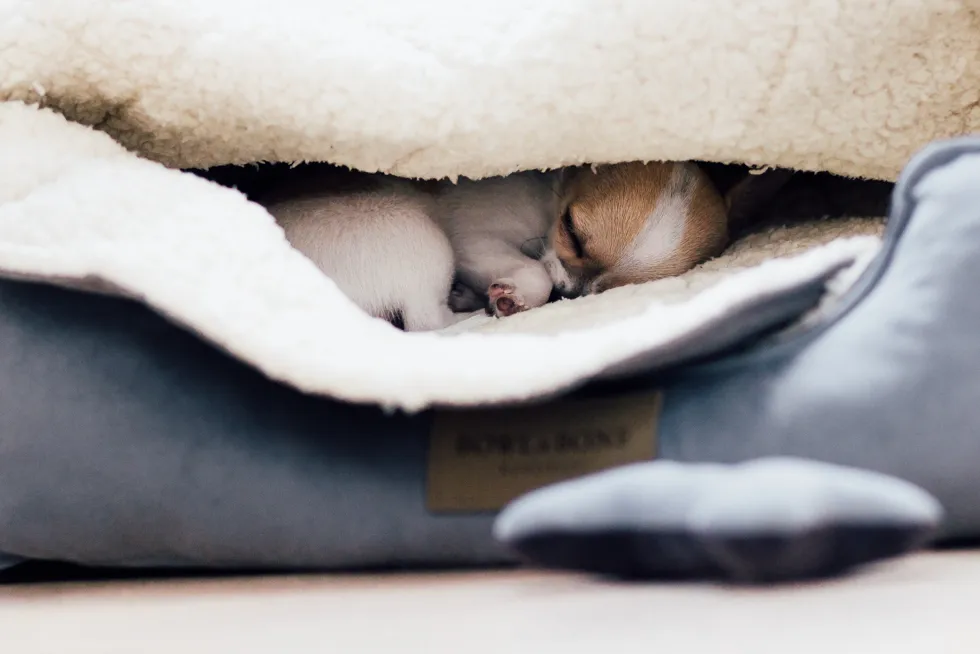
Looking for a warmer place, curling up into a ball or snuggling into a soft surface may help reduce heat loss. Veterinary Centers of America describes temperature regulation as one of the factors that can influence how dogs prepare their resting place.
It is therefore worth observing not only where your dog moves during the night, but also whether the new place is warmer or cooler than the previous one. This often provides an important clue.
– 3. they want to change position and type of support
Try sleeping for eight hours in exactly the same position. You would probably soon feel the need to turn over, adjust your pillow or move the duvet. Dogs also change their body position while resting.
Sometimes turning around within the same bed is enough. At other times, your dog may prefer a completely different surface. During the first part of the night they may sleep curled up with their head resting against the soft side of their bed. Later, they may want to stretch out completely and choose a larger dog cushion or a rug. Later still, they may lie on their side on a cooler floor. Changing sleeping spots may therefore simply reflect the fact that a different body position feels more comfortable at different times of the night.
If, however, your dog regularly leaves their bed because they cannot turn around freely or fully stretch their legs, it is worth checking its size. Our guide ‘How to choose the right size dog bed? Complete guide’ may help.
– 4. they want to be closer to you
A dog does not choose their resting place solely on the basis of how soft the mattress is. Where their human is located may also matter. In the evening, everyone is in the living room, so that is where the dog falls asleep. Later, the household moves to the bedroom. After some time, your dog gets up, walks through the home and settles beside the bedroom door or next to the bed.
This does not necessarily indicate anxiety or difficulty resting independently. For many dogs, simply remaining close to their social group is important. This is why, in some homes, having several available resting places can work very well.
In our article ‘How many beds should a dog have? One or several?’, we explain that a dog may use one main bed while also choosing additional resting places depending on temperature, time of day and where members of the household are spending their time.
– 5. you may be disturbing their sleep
This point may be slightly less comfortable for the guardian. Sometimes a dog comes into the bedroom, settles beside you and then, an hour later, leaves. Why? Perhaps you are not the one who needs a quieter sleeping place. Perhaps your dog does.
People move while sleeping, adjust the duvet, get up, snore or shift their legs. Veterinary Centers of America notes that a restless sleeper can disturb a dog’s sleep and may be one reason why the dog later chooses another place.
So if your dog starts the night beside your bed but later moves to the quiet living room, it does not have to mean anything negative about your relationship. Perhaps they simply like you very much but prefer to sleep three metres away.
– 6. conditions in the room have changed
The environment does not remain exactly the same throughout the night. The heating comes on, the air conditioning switches off, light from a streetlamp begins to enter through the window, somebody returns home late or the lift can be heard through the wall. Sometimes it starts raining or there is simply more noise outside.
Dogs may respond to sounds far more subtle than those capable of waking a person. If a particular place is no longer peaceful, your companion may simply move somewhere where it is easier to continue resting. On bowlandbone.pl, we have previously pointed out that an overly noisy, hot, cold or brightly lit location can interfere with rest and cause a dog to change position more frequently.
It is therefore worth looking at your dog’s bed from the dog’s perspective rather than your own. A place that seems quiet to us in the evening may feel very different at four o’clock in the morning.
– 7. they simply like having a choice
This is an important reason because we often look for a problem where there simply is not one. A dog can have an excellent bed and still sometimes choose the floor, a rug, a cushion or a place beneath a desk. Using several different resting places does not automatically mean that the dog has rejected their bed.
In many homes, a practical arrangement is one main bed together with an additional resting surface in another room — for example a cushion, mat or mattress. Particularly if the dog follows household members from room to room during the day, having a choice allows them to rest where they feel most comfortable at that particular moment.
So a night-time journey of dog bed → rug → bedroom → dog bed may simply be part of that particular dog’s normal way of resting.
– 8. something is uncomfortable or they are in pain
Here we move on to reasons that deserve closer attention. If your dog has always changed places two or three times during the night and otherwise behaves normally, there is usually no reason for concern. The situation is different if the behaviour suddenly changes.
Perhaps your dog previously slept peacefully through most of the night but now repeatedly gets up, spends a long time searching for another position, lies down and then gets up again, avoids lying on one particular side, suddenly prefers either very soft or very hard surfaces, has difficulty lying down or standing up, or moves stiffly in the morning.
Veterinary Centers of America lists difficulty lying down and getting up, as well as changes in sleeping patterns, among behaviours that may accompany pain, particularly in older dogs.
People’s Dispensary for Sick Animals (PDSA), a British veterinary charity providing care for animals, also notes that stiffness after rest is a common problem, particularly among older dogs. In such a situation, it is better not to assume that your dog has simply become bored with their bed. A change in behaviour should be discussed with a veterinary surgeon.
– 9. an older dog may have a different sleep pattern
Age can affect more than just the joints. Some older dogs may also experience cognitive changes and disturbances in their sleep–wake cycle. Research into dogs with cognitive dysfunction describes, among other things, sleep difficulties, increased night-time walking and vocalisation. People’s Dispensary for Sick Animals also describes similar changes in dogs with dementia and recommends providing senior dogs with a consistent, easily accessible and comfortable resting area.
This certainly does not mean that every older dog who walks around at night has cognitive problems. That would be too far-reaching a conclusion.
However, if a senior dog previously slept peacefully but now spends long periods wandering around the home, appears disorientated, stops in unusual places, vocalises at night, sleeps more during the day or begins having problems with orientation, it is worth discussing these changes with a veterinary surgeon.
Your dog moves from their bed onto the floor – is the bed unsuitable?
Not necessarily. This is one of the most common interpretation mistakes. We buy our dog a beautiful, soft bed and, in the middle of the night, they move 40 centimetres away and lie down on the bare floorboards. The guardian looks at them in disbelief: ‘Really? But it is hard there.’
At that moment, however, something completely different may matter more to the dog — temperature, for example. A hard floor may be cooler than soft fabric. Veterinary Centers of America notes that dogs may indeed choose a hard, cool surface, although for animals with mobility problems such flooring may not always be the best place for prolonged rest. So leaving the bed once does not mean that it needs replacing immediately. Look for a pattern.
If your dog falls asleep in their bed, moves onto the cool floor after a few hours and later returns to the bed, they may simply be regulating their comfort. If, however, they regularly avoid the bed altogether, it is worth checking its size, location, construction and material.
You can read more about this in our guide ‘Why does your dog not want to sleep in their bed, and how can you encourage them to use it?’.
Is it worth giving a dog two different places to sleep?
In many homes, yes. They do not have to be two identical beds. In fact, two different resting places may meet different needs. You might have a soft bed with raised sides in the living room and a flat cushion in the bedroom, a mat where the dog rests during the day, or a mattress for a dog who prefers a more open surface. For dogs who like to stretch out fully, a dog cushion can be a comfortable solution.

An older dog or one who finds it difficult to settle comfortably may, on the other hand, benefit from more stable support. People’s Dispensary for Sick Animals notes that memory foam dog mattresses may provide a comfortable option for dogs with conditions such as arthritis.
In such situations, it may be worth considering an orthopaedic dog bed or an orthopaedic dog mattress, while remembering that bedding itself is not a treatment for pain or joint disease. If your dog’s behaviour suggests discomfort, veterinary assessment should be the first step.
Should a dog sleep in one place all night?
There is no need for this. The goal should not be to teach your dog: ‘you chose your bed at 10 p.m., so you have to stay there until 7 a.m.’
What matters much more is whether your dog has suitable conditions for peaceful and safe rest. If several places are available and the dog moves between them by choice, there is usually no reason to interfere.
Research indicates that both sleeping location and activity before rest can influence the structure of canine sleep. It is therefore worth looking at the situation slightly differently. Instead of asking only: ‘Why didn’t my dog spend the whole night in their bed?’, consider: ‘Do the different places my dog chooses tell me something about their needs?’ This often leads to much more interesting and accurate observations.
How can you work out why your dog changes places at night?
For the next few nights, try not to change anything. Simply observe.
– where do they fall asleep?
Do they choose their bed, a place beside you, the sofa or somewhere else?
– where do they move first?
Do they go onto a cool floor, into the bedroom or to another soft resting place?
– what time do they move?
Is it usually at roughly the same time? Does the heating come on then? Does somebody return home?
– how quickly do they fall asleep again?
This is very useful information. If your dog moves, turns around once and is asleep a minute later, they have probably found what they needed. If they spend another 20 minutes walking around the home and trying to settle in several different places, the situation looks different.
– is the behaviour new?
This is one of the most important questions. A dog who has slept in three different places every night for eight years probably simply has that habit.
If, however, your dog has always slept peacefully through the night but has suddenly started getting up repeatedly over the past week and cannot find a comfortable place, it is worth treating that change as useful information.
When should changing sleeping spots at night be a cause for concern?
It is not the movement itself that should concern us so much as the symptoms accompanying it. Contact a veterinary surgeon if your dog:
- has suddenly started walking around the home frequently at night,
- repeatedly tries to lie down and then immediately gets up,
- clearly struggles to find a comfortable position,
- pants despite there being no high temperature or physical exertion,
- whines,
- limps,
- moves stiffly,
- has difficulty getting up,
- coughs or breathes differently from usual,
- appears disorientated,
- has started sleeping much more during the day and walking around at night,
- behaves noticeably differently from before.

A change in the way a dog rests may be one of the more subtle signs of pain or another health problem.
Do not force your dog to remain in one place
If your dog changes places because of temperature, the need for more space or a preference for a quieter place to rest, forcing them to remain in one bed offers no benefit. It is much better to give them a choice. You can create several different resting areas around the home: a soft main bed, a more open cushion, a quiet place in the bedroom and, in a larger home, an additional mat in a room where you often spend time.
The idea is not to fill the entire home with dog beds. It is simply to give the dog a choice between places offering slightly different qualities.
Sometimes moving around at night simply means: ‘I am more comfortable here right now’
Your dog falls asleep in their bed in the evening. After a while, they become too warm and move onto the floor. Later, they hear you going to the bedroom, so they get up and settle closer to you. Towards morning it becomes cooler, and they return to their soft bed. From our perspective: ‘the dog keeps changing places all night’. From their perspective, it may be much simpler: ‘I want to be here now’.
This is why we should not interpret every change of sleeping place as a problem. Look at the whole dog: their posture, how quickly they fall asleep again, the temperature, the time of night, their age and whether the behaviour has always been present or has appeared suddenly.
If your dog moves around calmly and simply chooses another place to sleep, they are probably making use of something we value ourselves: the freedom to find the place that feels most comfortable at that particular moment.
For more inspiration, knowledge and carefully designed dog accessories, visit www.bowlandbone.com — a place created for guardians who want to combine their dog’s everyday comfort with timeless style.
– the Bowl&Bone Republic team
Frequently Asked Questions (FAQ) about the article –
Why does a dog change sleeping spots at night? 9 most common reasons
Why does a dog change sleeping spots at night?
A dog may change places because of temperature, the need to position their body differently, noise, the presence of household members or individual preferences. Many dogs use several different places during a single night, and this alone does not necessarily indicate a problem.
Is it normal for a dog to walk from place to place at night?
If a dog moves somewhere else, settles calmly and falls asleep again, this behaviour may be completely normal. More attention is needed if the dog spends a long time walking around the home, appears restless, pants, whines or cannot find a comfortable position.
Why does a dog leave their bed and sleep on the floor?
One common reason is temperature. The floor may be cooler than a soft bed. A dog may also prefer a firmer or more open surface in a particular sleeping position.
Why does a dog move into their guardian’s bedroom at night?
They may simply want to rest closer to their guardian or other household members. If the dog is calm and is also able to rest independently in other places, moving closer to a person does not necessarily indicate a problem.
Why does a dog sometimes sleep in their bed and sometimes on the floor?
Different places offer different qualities. A bed may be warmer and more enveloping, while the floor is cooler and provides a more open surface. A dog’s preferences may change depending on temperature and body position.
Should a dog have more than one place to sleep?
It is not essential, but in many homes one main dog bed together with an additional resting place, such as a cushion or mat, works very well. This gives the dog a choice depending on temperature, their need for closeness and the way they prefer to sleep.
Does frequently changing places mean the dog bed is uncomfortable?
Not always. However, if your dog hardly ever uses their bed, spends a long time trying to settle in it, does not have enough room to stretch out or immediately leaves it, it is worth checking its size, construction, temperature and location.
Why does an older dog frequently change places at night?
An older dog may need different support because of stiffness or pain, but night-time walking can have other causes as well. Some senior dogs also experience changes in their sleep–wake cycle associated with cognitive changes. A sudden change in behaviour should be discussed with a veterinary surgeon.
Can an orthopaedic mattress help a dog who changes position frequently?
A stable surface and appropriate support may improve resting comfort, particularly for older dogs or those with musculoskeletal problems. An orthopaedic mattress is not, however, a treatment for pain or joint disease. If a dog clearly struggles to find a comfortable position, veterinary advice is needed.
When should a dog walking around at night be a concern?
It is worth consulting a veterinary surgeon if the behaviour appears suddenly or is accompanied by panting, whining, stiffness, lameness, difficulty getting up, coughing, unusual breathing, disorientation or a clear change in the dog’s day–night rhythm.
Does a dog change places at night because they are sleeping badly?
Not necessarily. Changing places in itself does not mean poor-quality sleep. A dog may wake briefly, change surface and quickly fall asleep again. What matters more is whether their rest is peaceful and whether any sudden changes have appeared in their behaviour.
Should I move my dog from the floor back into their bed?
If your dog is healthy, has chosen the floor themselves and is resting peacefully, there is usually no need to move them. Exceptions may include situations where a veterinary surgeon has recommended a particular type of sleeping surface or where the dog has mobility problems for which a hard surface is unsuitable.
This article is intended for educational purposes and does not replace consultation with a veterinary surgeon. If your dog’s resting behaviour suddenly changes, they cannot find a comfortable position, appear to be in pain or develop other worrying symptoms, it is worth seeking professional veterinary advice.
Sources and inspiration used to create the article
Why does a dog change sleeping spots at night? 9 most common reasons
- Veterinary Centers of America (VCA) – ‘Should My Dog Sleep in My Bed?’ – material discussing, among other things, dogs changing resting places during the night and the influence of temperature and human movement on their choice of sleeping location.
https://vcahospitals.com/know-your-pet/should-my-dog-sleep-in-my-bed - Veterinary Centers of America (VCA) – ‘Why Dogs Turn Around Before Lying Down’ – material discussing preparation of a resting place and the influence of temperature on behaviours preceding sleep.
https://vcahospitals.com/know-your-pet/why-dogs-turn-around-before-lying-down - Bunford N. et al. – ‘Differences in pre-sleep activity and sleep location are associated with variability in daytime/nighttime sleep electrophysiology in the domestic dog’, Scientific Reports – a study examining the influence of time of day, activity and sleeping location on canine sleep structure.
https://pmc.ncbi.nlm.nih.gov/articles/PMC5940857/ - Kinsman R. et al. – ‘Sleep Duration and Behaviours: A Descriptive Analysis of a Cohort of Dogs up to 12 Months of Age’ – a study examining sleep and resting patterns in dogs.
https://pmc.ncbi.nlm.nih.gov/articles/PMC7401528/ - Veterinary Centers of America (VCA) – ‘How to Recognize Pain in Aging Dogs’ – material covering behavioural changes, difficulties lying down and getting up, and other subtle signs of pain in older dogs.
https://vcahospitals.com/know-your-pet/behavior-changes-and-pain-in-aging-dogs - People’s Dispensary for Sick Animals (PDSA) – ‘Arthritis in dogs’ – material discussing resting comfort for dogs with joint problems, including the use of appropriately supportive surfaces.
https://www.pdsa.org.uk/pet-help-and-advice/pet-health-hub/conditions/arthritis-in-dogs - Mondino A. et al. – ‘Sleep and cognition in aging dogs. A polysomnographic study’, Frontiers in Veterinary Science – a study examining sleep changes in older dogs and the relationship between cognitive dysfunction and sleep.
https://www.frontiersin.org/journals/veterinary-science/articles/10.3389/fvets.2023.1151266/full - Bowl&Bone Republic – ‘How many beds should a dog have? One or several?’ – material discussing different resting places around the home and giving dogs the opportunity to choose between them.
https://www.bowlandbone.com/how-many-beds-should-a-dog-have/ - Bowl&Bone Republic – ‘Why does your dog not want to sleep in their bed, and how can you encourage them to use it?’ – material discussing the influence of location, temperature, size and bed construction on a dog’s choice of resting place.
https://www.bowlandbone.com/why-does-your-dog-not-want-to-sleep-in-their-bed/ - Bowl&Bone Republic – ‘How to choose the right size dog bed? Complete guide’ – material discussing how to match the sleeping surface to a dog’s size and preferred sleeping position.
https://www.bowlandbone.com/how-to-choose-the-right-size-dog-bed-complete-guide/ - Bowl&Bone Republic – ‘Dog’s sleeping positions – what do they mean?’ – material discussing positions chosen by dogs while resting and the influence of temperature on the way they position their body.
https://www.bowlandbone.com/dogs-sleeping-positions/ - Bowl&Bone Republic – the team’s experience in designing dog beds, cushions and mattresses and observing dogs’ different everyday resting needs.