


You are sitting on the sofa, working at your computer or preparing dinner. Suddenly, your dog appears. They are carrying their favourite ball, soft toy or tug toy in their mouth. They come closer, look at you and wait. Sometimes they place the toy right beside you. At other times, you reach towards it and they immediately jump back. Sound familiar?
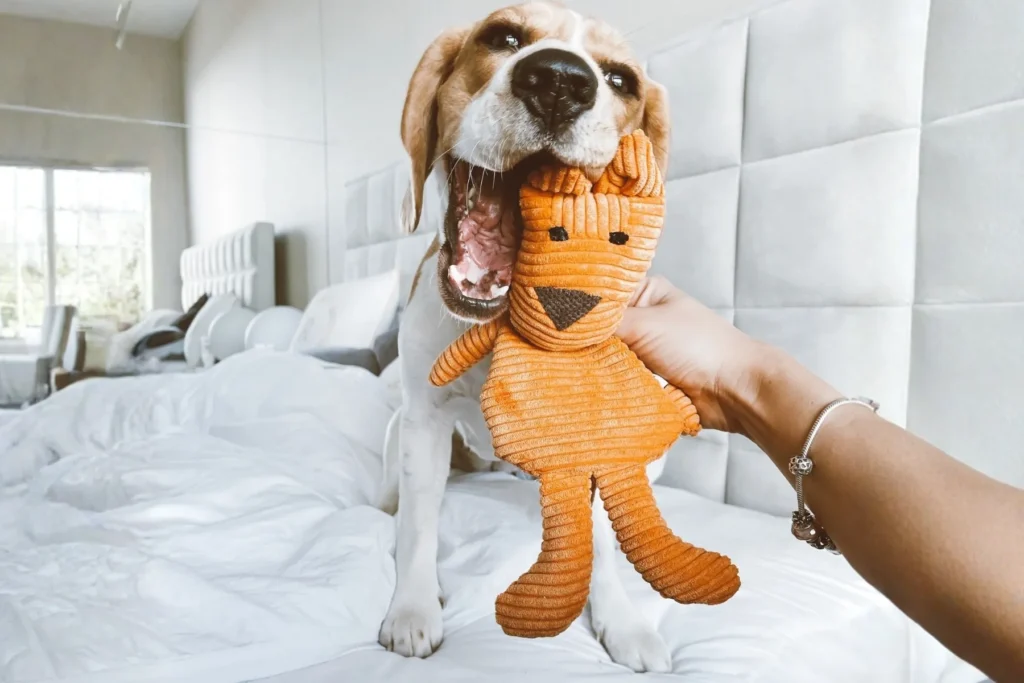
The simplest explanation is: ‘the dog wants to play’. Very often that is indeed the case, but not always. Bringing a toy may be an invitation to a shared activity, a way of attracting your attention again, part of a greeting ritual or simply a behaviour your dog has learnt because it has previously produced an interesting response from you.
Research into shared activities between dogs and humans reveals something even more interesting. When a joint play session was interrupted, dogs were more likely to offer the toy to the person who had actually been playing with them moments earlier than to a passive observer standing nearby. This suggests that an object may become a way for a dog to re-engage a particular partner in an interaction [1].
So instead of looking only at the toy itself, it is worth observing the whole situation. What was your dog doing moments earlier? How are they moving? Do they give you the object? Do they jump away? Do they look at your face? And what happens when you respond?
What will you learn from this article? From this guide, you will learn:
- why your dog brings their toy to their guardian,
- whether it always means an invitation to play,
- why a dog brings a toy but does not want to give it up,
- whether this can be a way of attracting attention,
- why a dog brings a toy when you return home,
- what it means when they stand in front of you holding a toy and look at you,
- whether bringing an object is a sign of trust,
- whether a dog treats a toy as a gift,
- whether you should respond to every invitation to play,
- how to distinguish relaxed play from resource guarding.
Why does my dog bring me a toy? The short answer
Most often, because they want to begin or continue an interaction. They may be expecting a game of fetch, tug, chase or simply your attention. A dog may also repeat a behaviour that has proved effective before: I bring the toy → the human looks at me → something interesting starts happening.
Research into fetching shows that dogs are sensitive to human attention. In an experiment involving repetitive fetching, dogs’ behaviour changed depending on whether their guardian was actively watching them [2].
However, every approach with an object should not be treated as an unambiguous message. The clearest picture comes from considering the toy together with the dog’s body language and what they do next.
Why does a dog bring their toy to their guardian? 7 possible reasons
One dog almost always brings a ball because they want to play fetch. Another approaches with a soft toy mainly when they want contact. A third may show you an object, jump back and wait several seconds for you to take up the invitation to play. The meaning of this behaviour can therefore vary.
– 1. they are inviting you to play together
This is the most obvious explanation.
Your dog picks up a toy, approaches you, watches your reaction and may place the object in front of you or perform a play bow. If they know the pattern ‘I bring the ball → the human throws it → I run → I come back’, they quickly learn how to start another round.
The toy then becomes more than an object lying on the floor. It becomes part of a shared activity. Dogs Trust identifies playing together with objects as one way of enriching a dog’s everyday life and providing activity [4].
It is worth remembering this when choosing a dog toy. Not every toy needs to be intended solely for independent chewing or carrying around the home. Many have their greatest value precisely when there is a person on the other side of the game.
– 2. they want to continue an interrupted interaction
You have been playing together for several minutes. Suddenly, you put the toy down and return to your phone or computer. Your dog watches for a moment, picks up the object and brings it back to you. It may not be a coincidence.
In a study published in Animal Cognition, after a shared activity was interrupted, dogs were more likely to direct their attention towards and offer the toy to their previous play partner than to another person nearby who had previously remained passive [1].
This does not, of course, mean that the dog is forming the human sentence ‘please, let’s continue exactly the same game’ in their head. It does show, however, that they can associate a particular object, a particular person and an earlier shared activity. So if you have just stopped playing fetch and a minute later the ball lands beside your foot again, the explanation may be fairly simple.
– 3. they have learnt that a toy is an effective way to attract your attention
Your dog approaches with a soft toy. You immediately look away from your computer. You speak to them, reach out your hand and moments later the game begins. If the same sequence has happened many times, your dog may learn that bringing a toy is an extremely effective way to initiate contact.
There is no ‘manipulation’ here in the human sense of the word. It is simply the result of learning from the consequences of their own behaviour. Research also shows that dogs adjust behaviour related to fetching according to whether their guardian is actually paying attention to them [2].
If your companion also frequently seeks your attention in other situations and follows you from room to room, read our guide ‘Why does your dog follow you everywhere?’ [5].
– 4. the toy has become part of your shared ritual
Dogs are very good at learning everyday patterns. Perhaps every evening after dinner you spend a few minutes playing on the rug. Maybe the same soft toy always appears after a walk. Or perhaps your dog regularly brings you a ball while you are having your morning coffee.
Over time, the object can become part of a predictable sequence. This does not mean that your dog is carefully analysing their decision every time. They simply know from experience that, in this particular situation, you usually do something together.
These rituals can be a very enjoyable part of your relationship. It is worth maintaining some balance, however, so that outside your shared activities your companion is also able to rest calmly and does not expect a game every time you sit down on the sofa.
– 5. they bring a toy when greeting you
Some guardians know this scene very well. You open the door after returning home. Your dog runs over to greet you, suddenly turns back towards the living room and, several seconds later, appears in front of you again — this time with a toy in their mouth. Do they necessarily want you to throw it? Not necessarily.
Bringing a toy may be part of an established greeting ritual and a behaviour associated with high levels of excitement. For an individual dog, the object may become part of the sequence: human comes home → I run for a toy → I approach the human. In this situation, it is particularly useful to observe what happens next. If, after a short while, your dog puts the object down, settles and goes to rest, there is no reason to assume that they necessarily wanted to begin a long play session.
If, on the other hand, they stand in front of you holding the ball, jump back, return and repeat the behaviour, they may indeed be using your return as an opportunity to initiate a shared activity.
– 6. they simply want to be close to you
Sometimes a dog brings a toy but nothing else really happens. They come over, lie down beside you, hold the soft toy between their paws or carry it in their mouth for a while. They do not try to give it to you. They do not encourage you to chase them. They do not appear to expect you to throw it either.
In this situation, there is no need to force the interpretation ‘play with me’. Your dog may simply be enjoying an object they like while also spending time close to a person around whom they feel comfortable.
Bringing objects can also form part of a wider range of behaviours associated with shared activity. In our article ‘How does a dog show trust in their guardian? 10 subtle signs’ we describe different behaviours that may occur within a secure relationship between a dog and a person [6]. This does not mean that the toy itself is proof of trust. A relationship should always be assessed through many different behaviours rather than one gesture.
– 7. they are checking whether you will engage
Your dog stands in front of you with a toy and looks at you. They do not place it on the floor. They do not run away. They simply watch your face. This is an interesting part of the situation because dogs pay attention to a person’s availability and behaviour during interactions. An experiment involving repetitive fetching found that the guardian’s attention influenced the dogs’ behaviour during the task [2].
It is therefore possible that your dog is, in a sense, ‘checking’ whether you are responding and whether an interaction is likely to begin. We do not need to translate this literally as ‘will you play with me now?’. It is enough to notice that the toy, looking at the person and waiting for a response are happening together.
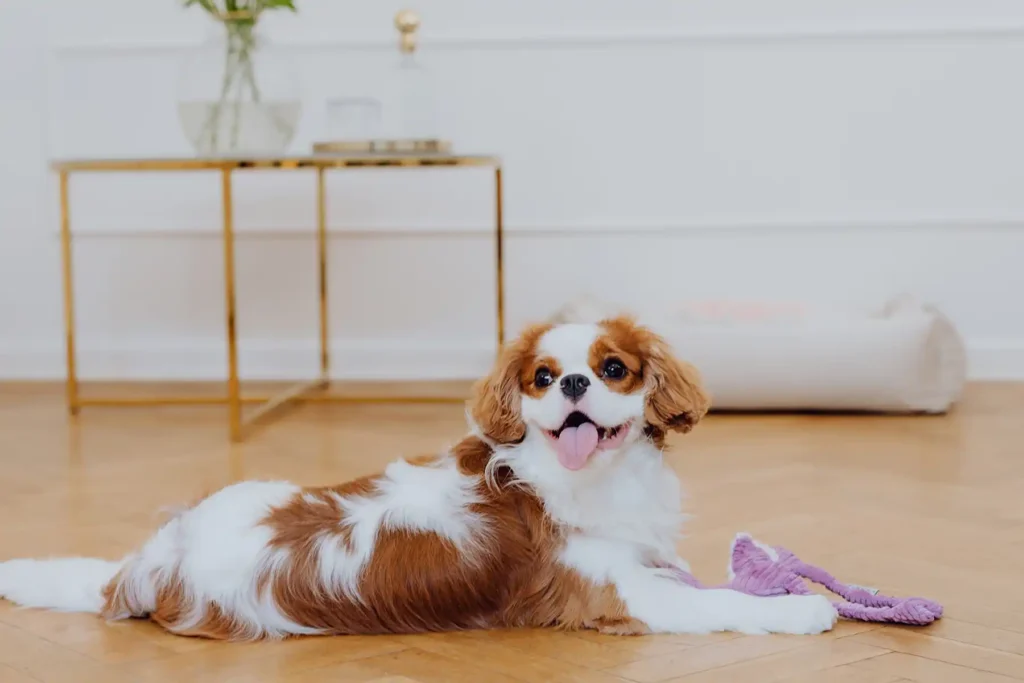
Why does a dog bring a toy but refuse to give it up?
This is one of the most interesting versions of the behaviour. Your dog approaches with a ball. You reach out your hand. They immediately move their head away. You withdraw your hand — the dog approaches again. You try once more and they take another step backwards. From a human perspective, this may seem illogical: ‘If you brought it to me, why don’t you want to give it to me?’
Because bringing an object does not necessarily mean ‘take it’. It may mean ‘let’s do something together’. The dog may be expecting a game of tug, chase or continued play during which the object remains in their mouth. This is why body language is so important. If the dog’s body is loose, they jump away, return, perform a play bow and clearly encourage another response, it is probably part of play.
The situation looks different if the dog stiffens, leans over the object, watches an approaching hand closely, turns their head away with the toy, growls or shows their teeth. This may be resource guarding. Dogs Trust recommends remaining calm in this situation, increasing distance and not taking the object by force [3].
Does a dog bring you a toy as a gift?
This is an appealing explanation, which is why it often appears online: ‘your dog gives you their favourite toy because they want to share something precious with you’. It sounds lovely, but there is no basis for assuming that a dog understands the concept of a gift in exactly the same way as a person and has this particular intention every time.
What we do know is that dogs use objects during social interactions with people and may direct a toy towards a specific partner from an earlier play session [1]. It is therefore safer to say that your dog may bring you a toy because you are an important partner in shared activities. We do not need to call it a gift for the behaviour to remain an interesting part of your relationship.
Does bringing a toy mean that your dog trusts you?
It may occur within a good, secure relationship, but on its own it is not proof of trust. A dog who willingly initiates play with you, feels comfortable around you and regularly invites you to take part in shared activities is showing an important aspect of your everyday relationship.
Trust, however, is broader than this. It can also be seen in the way a dog rests around a person, voluntarily seeks contact, displays relaxed body language and behaves in less comfortable situations. We describe more of these signals in a separate Bowl&Bone Republic guide [6]. Bringing a soft toy can therefore be treated as one piece of a larger puzzle, but not as a single ‘test of love’ or trust.
Why does a dog walk around the house with a toy in their mouth?
Carrying an object around the home does not always have anything to do with a person. A dog may simply enjoy holding, moving or exploring a toy. They may take it with them from room to room or carry it to the place where they want to rest. Only when they regularly bring it specifically to you, watch your reaction or try to begin a familiar shared activity does it make sense to interpret the behaviour as part of a social interaction.
Do you always have to play when your dog brings you a toy?
No. The fact that your dog is proposing an interaction does not mean every invitation must immediately turn into a game. If you have the time and feel like it, several minutes of shared activity can be a great part of the day. Dogs Trust identifies shared games and activities involving objects as one form of enrichment in a dog’s everyday life [4].
However, if you are working, eating or simply need some peace and quiet, you do not have to accept the invitation every time. It is good to maintain balance in everyday life: sometimes the dog initiates play, sometimes the human does, and at other times your companion simply rests.
How should you respond when your dog brings you a toy?
First, observe for a few seconds. Does your dog put the toy in front of you? Are they still holding it? Do they jump away? Do they perform a play bow? Do they calmly lie down beside you? Do they look at your face and wait? These small differences often tell you more than the simple fact that a toy has been brought over.
If you begin a shared activity, adapt it to what your particular dog actually enjoys. Not every dog wants to play fetch. One may love tug, another will happily run after a ball, while a third most enjoys carrying the toy and encouraging their guardian to take part in a short chase.
There is also no need to make a huge number of objects available to your dog at the same time. In the article ‘How many toys should a dog have? Should they all be available at once?’ we discuss the different functions of toys and the principles of rotating them [7]. And if, after playing, you would like to use the object for some simple training, have a look at our guide ‘How to teach your dog to put their toys away in their own basket?’ [8].
Is it worth teaching your dog the ‘drop’ cue?
Yes, particularly if you often play together with objects held in the mouth. Calmly releasing a toy can be useful during fetch or tug, but also if your dog picks up something they should not have.
Training should not, however, involve repeatedly pulling objects out of the dog’s mouth. It is better to build an association that releasing an item can lead to a reward or even to the game continuing. During play, you can ask your dog to release the object, reward the correct response and then begin the game again. This way, ‘drop’ does not always have to mean ‘you lose the toy and the fun is over’.
If your dog guards objects, stiffens or growls, do not force them to give something up. Trying to pull the toy away can increase tension and the risk of conflict [3].
Can a dog bring you a toy because they are bored?
They may be looking for activity in this way, but the act of bringing a toy alone is not enough to conclude that your dog is bored. Look more broadly at their day. Have they had a walk? Have they had opportunities to sniff and explore? Have they had contact with you? Can they settle calmly afterwards? Do they bring a toy occasionally, or do they spend most of the day trying to use it to initiate any form of activity?

A dog can have an entire basket of objects and still be most interested in them when they can use them together with a person. So rather than thinking only ‘I need to buy more toys’, it is often better to look at the variety of the whole day and the way those objects are actually being used [7].
When should behaviour around a toy attract your attention?
Frequently bringing toys is not usually a cause for concern. More attention is needed if the behaviour changes suddenly or clear tension appears. Pay attention if your dog:
- stiffens when a person approaches the toy,
- covers or blocks the object with their body,
- walks away with it and closely monitors people’s behaviour,
- growls or shows their teeth when someone approaches,
- attempts to bite,
- cannot disengage from the activity and remains extremely aroused,
- suddenly loses all interest in toys despite previously playing with them regularly.
Resource guarding can involve toys. Dogs Trust emphasises that in such a situation you should not shout at, punish or chase the dog, nor corner them [3]. If the behaviour is intense or becoming more frequent, it is worth consulting a veterinary surgeon and a suitably qualified animal behaviour specialist.
Sometimes a toy simply means: ‘let’s do something together’
Your dog picks up a soft toy from the floor, walks across the living room and stops in front of you. They look at you for a moment. They may place it beside your foot. They may jump away when you reach out your hand. Or they may simply settle beside you with the toy between their paws. Each of these situations is slightly different.
So instead of looking for one universal answer to the question ‘why does my dog bring me a toy?’, observe the entire sequence: what happened beforehand, what the dog’s body looks like, whether they want to give up the object, what they do after you respond and what your shared activity usually looks like.
The toy does not have to be a gift. Nor does it have to be simply a request for a game of fetch. Very often, it is simply a convenient way of initiating contact with a person who is an important partner in the dog’s everyday activities.
For more inspiration about canine behaviour, shared activities and choosing accessories thoughtfully, visit www.bowlandbone.com. Discover our dog toys, designed and made in Poland with shared moments between dogs and their guardians in mind.
– the Bowl&Bone Republic team
Frequently Asked Questions (FAQ) about the article –
Why does a dog bring their toy to their guardian?
Why does my dog bring me a toy?
Most often, they want to begin or continue an interaction. They may be inviting you to play fetch, tug or chase, or simply trying to attract your attention. The meaning is best assessed together with the dog’s body language and what they do after bringing the object [1][2].
Why does my dog bring me a toy but refuse to give it up?
Because bringing an object does not necessarily mean ‘take it’. The dog may be inviting you to play tug or chase and expecting the interaction to continue while the toy remains in their mouth.
Why does my dog bring me a toy when I come home?
It may be part of an established greeting ritual or a way of initiating interaction after your return. If your dog puts the toy down after a short while and settles, it does not necessarily mean they are asking for a long play session.
Why does my dog bring me a toy and look at me?
They may be checking your reaction and trying to engage you in a shared activity. Research shows that during tasks involving toys, dogs pay attention to whether a person is watching them [2].
Does my dog give me a toy as a present?
We cannot confirm that dogs understand the concept of a gift in exactly the same way as humans. We do know, however, that they use toys during social interactions and may direct an object towards a particular partner from an earlier play session [1].
Does bringing me a toy mean that my dog trusts me?
It may be part of a good, relaxed relationship, but on its own it is not definitive proof of trust. It is worth observing other signals in the dog’s behaviour as well [6].
Why does my dog walk around with a toy in their mouth?
Carrying an object can be an enjoyable activity in itself. A dog may also move a toy somewhere else, rest with it or use it to initiate contact with members of the household.
Why does my dog keep bringing me a ball?
If you have repeatedly played fetch together, your dog may have learnt a very effective pattern: bringing the ball causes it to be thrown again. The behaviour is then regularly reinforced by the human response.
Do I have to play with my dog every time they bring me a toy?
No. You can respond to some invitations, but your dog should also be able to rest without constantly involving you. It is worth maintaining a balance between activity and peaceful rest.
Does my dog bring me a toy because they are bored?
They may be looking for something to do, but bringing a toy alone does not necessarily mean boredom. You need to consider the dog’s entire daily routine, walks, opportunities for sniffing, shared activity and their ability to rest [7].
How can I teach my dog to give up a toy?
The best approach is to use a calm exchange and reward the release of the object. You can ask your dog to give up the toy, reward the response and then restart the game so that releasing the object does not always mean that play is over.
When is a dog guarding a toy?
Possible signs include a stiff body, covering the object, closely watching an approaching person, growling, showing teeth or attempting to bite. In such a situation, you should not pull the object away or punish the dog for growling [3].
This article is intended for educational purposes and does not replace consultation with a veterinary surgeon or suitably qualified animal behaviour specialist. If your dog’s behaviour around toys suddenly changes, resource guarding, aggression or other concerning signs appear, it is worth seeking professional advice.
Sources and inspiration used to write the article
Why does a dog bring their toy to their guardian?
- Byrne M. et al. – ‘Pet dogs (Canis familiaris) re-engage humans after joint activity’, Animal Cognition, 2023 – a study concerning dogs re-engaging a person after a shared activity was interrupted. Dogs offered the toy more frequently to their previous play partner than to a passive observer. Digital Object Identifier (DOI): 10.1007/s10071-023-01774-1.
https://link.springer.com/article/10.1007/s10071-023-01774-1 - Kiss O. et al. – ‘Behavioral and Neurophysiological Correlates of Dogs’ Individual Sensitivities to Being Observed by Their Owners While Performing a Repetitive Fetching Task’, Frontiers in Psychology, 2020 – a study concerning the influence of a guardian’s attention on a dog’s behaviour during fetching. Digital Object Identifier (DOI): 10.3389/fpsyg.2020.01461.
https://www.frontiersin.org/journals/psychology/articles/10.3389/fpsyg.2020.01461/full - Dogs Trust – ‘Resource Guarding in Dogs: How to Keep Everyone Safe’ – recommendations concerning the guarding of toys and other resources and how guardians should respond safely.
https://www.dogstrust.org.uk/dog-advice/training/unwanted-behaviours/resource-guarding-food-and-toys - Dogs Trust – ‘Enrichment activities to keep your dog entertained’ – guidance concerning shared play with toys and enriching a dog’s everyday life.
https://www.dogstrust.org.uk/dog-advice/life-with-your-dog/enrichment/enrichment-activities-for-dogs - Bowl&Bone Republic – ‘Why does your dog follow you everywhere?’ – material concerning seeking contact, attention and closeness to a guardian.
https://www.bowlandbone.com/why-does-your-dog-follow-you-everywhere/ - Bowl&Bone Republic – ‘How does a dog show trust in their guardian? 10 subtle signs’ – material concerning behaviours that may occur within a secure relationship between a dog and a person.
https://www.bowlandbone.com/how-does-a-dog-show-trust-in-their-guardian/ - Bowl&Bone Republic – ‘How many toys should a dog have? Should they all be available at once?’ – material concerning the number, functions and rotation of dog toys.
https://www.bowlandbone.com/how-many-toys-should-a-dog-have/ - Bowl&Bone Republic – ‘How to teach your dog to put their toys away in their own basket?’ – a guide to using toys during simple training exercises.
https://www.bowlandbone.com/how-to-teach-your-dog-to-put-their-toys-away-in-their-own-basket/ - Bowl&Bone Republic – ‘How to choose the right toys for your dog?’ – older material concerning toy selection and the interpretation of canine behaviour involving objects.
https://www.bowlandbone.com/how-to-choose-the-right-toys-for-your-dog/ - Bowl&Bone Republic – the team’s experience in observing dogs’ everyday behaviour and designing accessories intended for shared activities.











 or CANADA
  PLEASE join us at