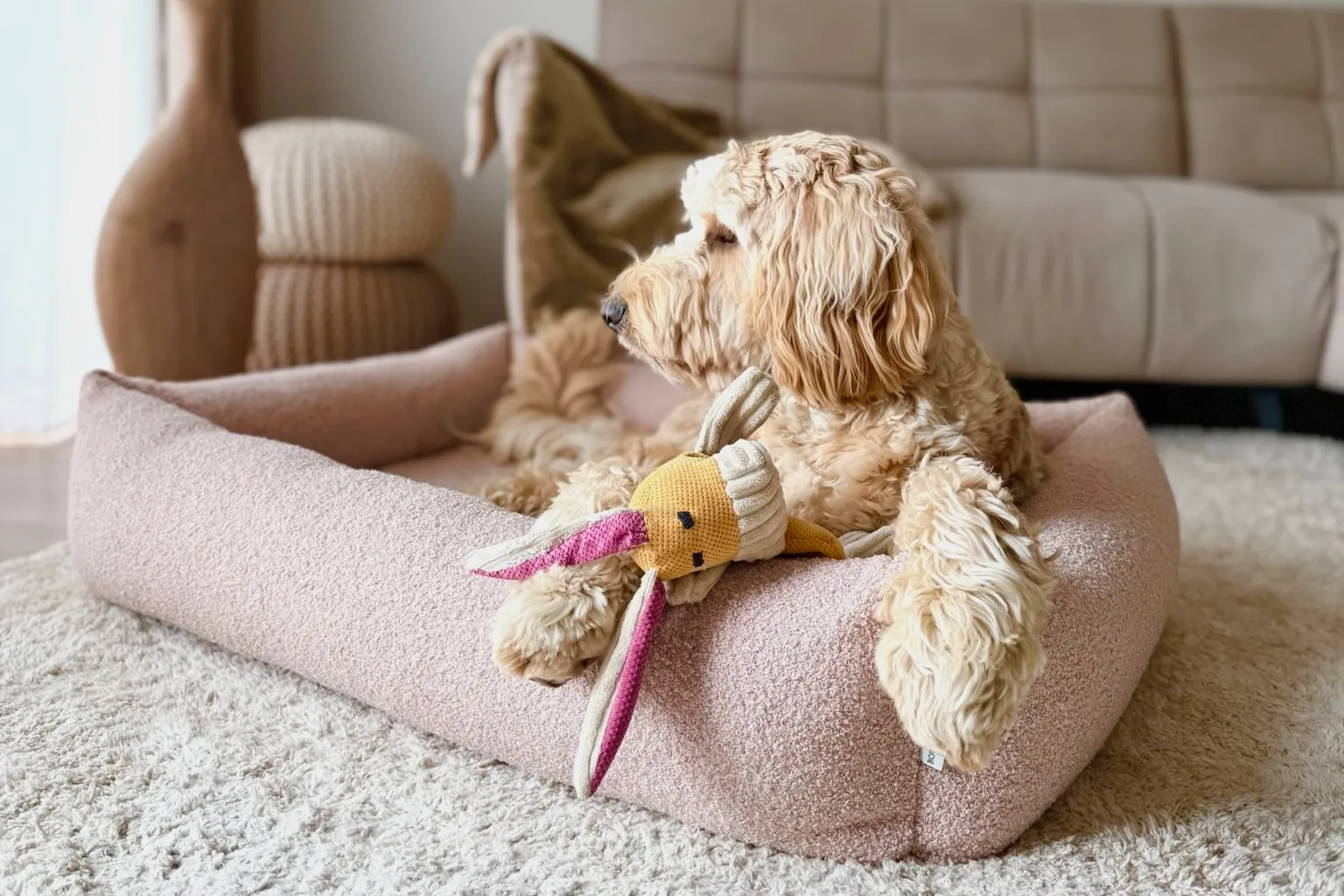
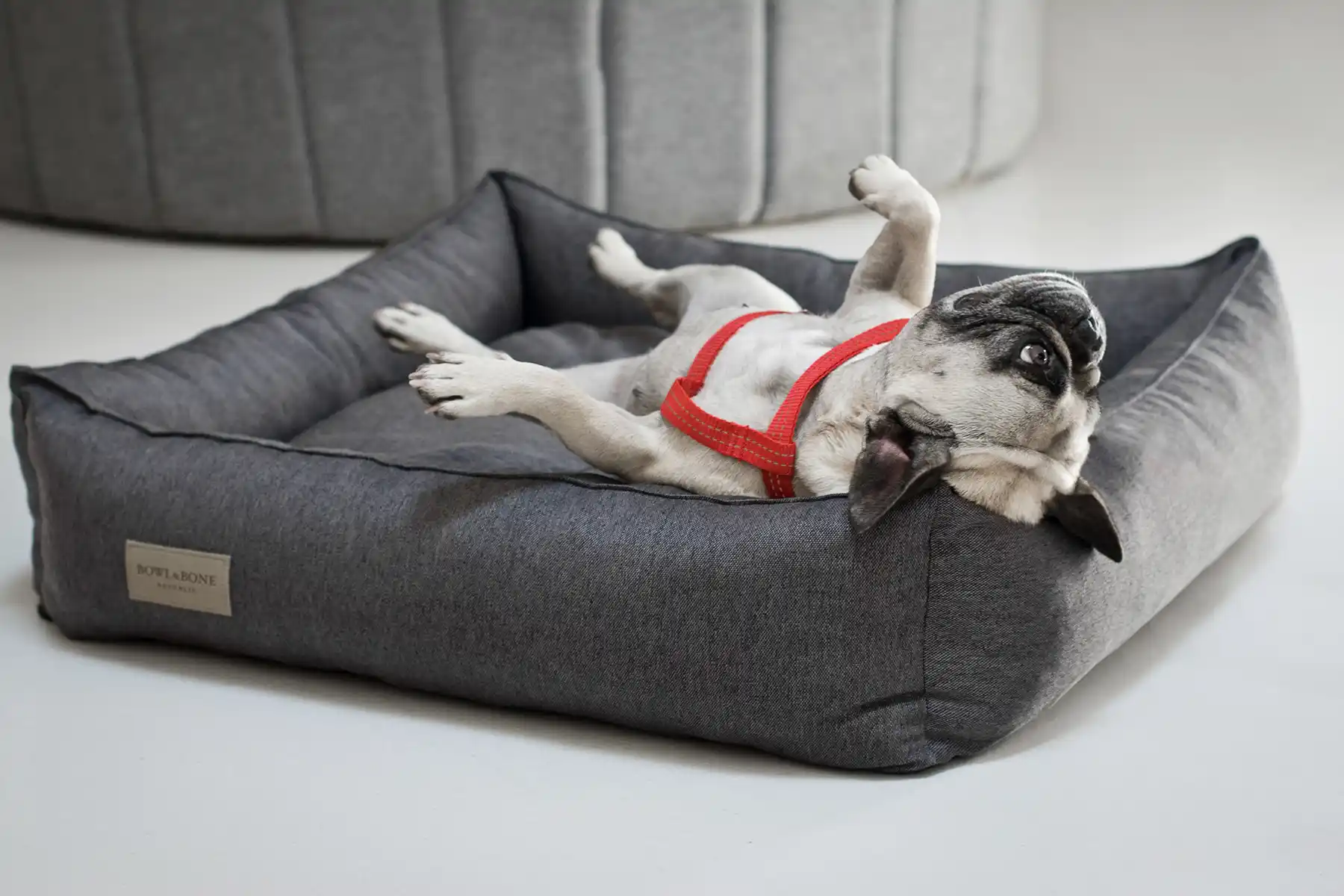
The living room is usually one of those places in the home where much of everyday life happens. In the evening, you relax on the sofa, someone reads a book, someone watches a film, and your dog settles down a few steps away and soon falls asleep. It is hardly surprising, then, that many dog guardians choose to create a permanent resting place for their companion right here.

There is, however, a challenge. A dog bed placed in the living room is no longer something hidden away in a less visible part of the home. It becomes part of the interior – just like an armchair, rug, coffee table or cushions on the sofa. It therefore needs to meet your dog’s needs, but ideally it should also work harmoniously with its surroundings.
A good dog bed for the living room should combine four things: your dog’s comfort, the right size, practicality in everyday use and a look that suits the interior. The order matters. First, choose a bed that is right for your dog, and only then, from among the models that meet those requirements, look for the one that best suits your living room.
You do not have to choose between your dog’s comfort and the aesthetics of your home. With the right approach, the two can work very well together.
What will you learn from this article? From this guide, you will learn:
- which dog bed is likely to work best in the living room,
- where to position a dog bed so your dog can rest peacefully,
- why the size of the living room should not determine the size of the bed,
- how to choose a dog bed shape that suits the way your dog sleeps,
- when a classic bed with raised sides may be better and when a cushion may be more suitable,
- how to match the colour of a dog bed to your living room,
- which colours work well in light, dark, minimalist and loft-style interiors,
- why a removable cover is particularly practical in a living room,
- when it is worth ordering a made-to-measure dog bed,
- how an individual size can help you fit a bed more precisely to both your dog and the space available,
- which mistakes to avoid when arranging your dog’s resting area.
Which dog bed should you choose for your living room? The most important features at a glance
If you want the short answer, start with your dog rather than the interior design.
| What should you consider? | Why does it matter in the living room? |
|---|---|
| Suitable sleeping area | your dog should be able to adopt their natural resting position freely |
| Position in the room | it should allow your dog to rest without people continually walking past |
| Construction | it should suit the way your dog likes to sleep |
| Removable cover | makes the bed easier to keep clean |
| Durable fabric | a living-room dog bed is usually used intensively and remains highly visible |
| Colour | it can complement the sofa, rug, wood or decorative accessories |
| Timeless form | makes the bed easier to integrate even after parts of the interior are changed |
| External dimensions | show how much space the product will occupy in the room |
| Internal dimensions | show the actual sleeping area available to your dog |
| Made-to-measure option | allows the bed to be matched more precisely to your dog and the available space |
When choosing a dog bed for the living room, you therefore need to consider two types of fit: the bed must suit your dog, while its external dimensions, form and colour should also work well within the space itself.
Choose the place in the living room first, then choose the dog bed
Before comparing colours and models, think about where the bed will actually stand.
The People’s Dispensary for Sick Animals (PDSA) points out that a dog should have a comfortable resting place in a quiet part of the home where they will not be continually disturbed [1]. Dogs Trust also highlights the importance of providing a calm space where a dog can retreat when they need to rest [2].
The living room can therefore be a very good place for a dog bed, provided it is not positioned directly in the middle of the busiest part of the room.
A good location might be a space against the wall beside the sofa, a quiet corner, or somewhere your dog can observe the household without lying directly on the route between the kitchen, sofa and hallway.
It is also worth observing your dog. Some companions enjoy resting very close to people and naturally choose a place beside the sofa. Others prefer to move to a quieter part of the room when they want deeper sleep. If your dog has long chosen a particular corner of the living room for naps, this may be a useful clue when deciding where to position their new bed.
Do not choose the size of the dog bed simply to fit the space under a table
This is one of the easiest mistakes to make. There is a 70 cm-wide space in the living room, so you start looking for a bed that fits neatly into it.
The order should be the opposite.
First establish how much resting space your dog needs, and only then find the right place in the living room for a suitably sized bed.
Two dogs of the same weight may position their bodies completely differently while sleeping. One curls tightly into a ball, another sleeps on their side, while a third stretches their front and back legs as far as the bed will allow.
In addition, with a traditional bed featuring soft raised sides, the overall dimensions are not the same as the sleeping area available to the dog. For example, the CLASSIC graphite dog bed in size M has external dimensions of 75 × 60 cm, while the internal sleeping area measures 55 × 45 cm. It is primarily the second measurement that should be compared with your dog’s needs. (Dog Shop Bowl&Bone Republic)
If you are unsure how to measure your dog, take a look at our detailed guide “How to choose the right size dog bed? Complete guide”. There, we explain how to measure your dog, the difference between internal and external dimensions and how much additional room to allow for changing position.
A dog bed with raised sides or a cushion – which is better for the living room?
The form of the bed can have a significant effect both on the way your dog rests and on the appearance of the room.
A traditional dog bed with soft, raised sides can work particularly well for dogs who like to snuggle in, rest their head against an edge or relax in a more enclosed space. This type of construction also creates a clearly defined resting area for the dog within the room.
One example is the CLASSIC beige dog bed. Its simple rectangular form and understated colour palette allow it to be treated as a permanent part of the living-room furnishings, while the soft sides give your dog somewhere comfortable to rest their head.
A dog cushion bed, on the other hand, can be a good solution for a companion who loves stretching out fully and does not need high edges around their resting space. Its simple shape may also work particularly well in interiors where you want the furnishings to feel visually light and minimalist.
An example is the SCOTT graphite dog cushion bed.
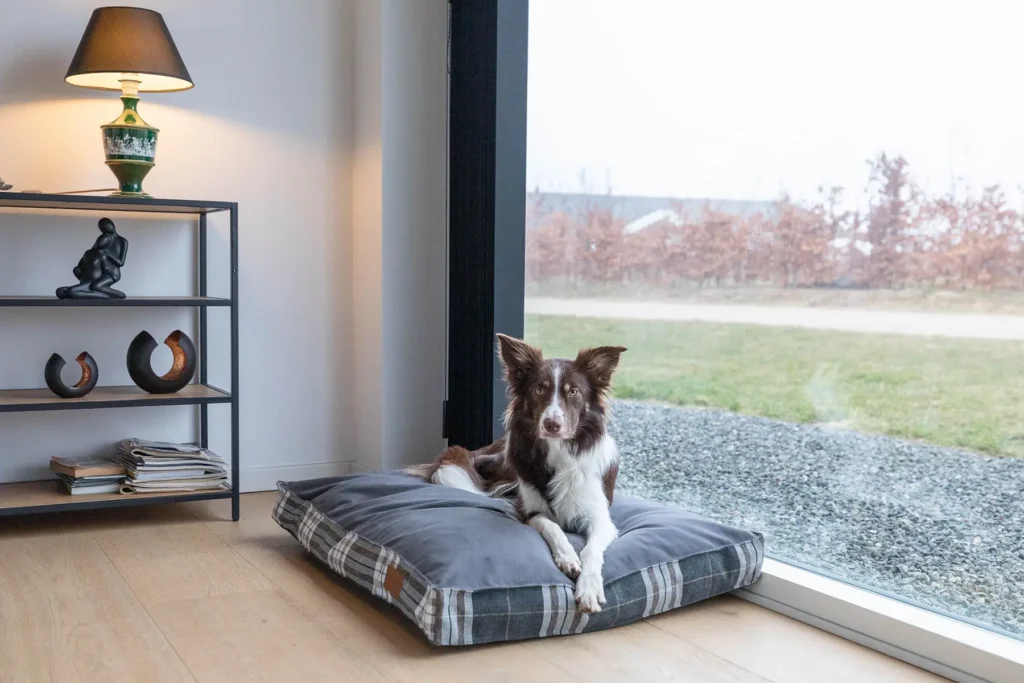
Do not choose a cushion simply because it appears to take up less visual space, or a bed with raised sides solely because it looks better beside your sofa. The form of the bed should primarily suit the natural way your individual dog likes to rest.
How should you match the colour of a dog bed to your living room?
Once the right size and construction have been established, you can move on to something that matters particularly when the bed will be placed in the living room – its appearance.
The simplest approach is to treat the dog bed in much the same way as another textile element of the room. It does not have to be exactly the same colour as your sofa. Sometimes a shade that echoes the rug, curtains, decorative cushions, wood or other accessories creates a far more interesting result.
A light living room – beige, cream and soft greys
In light interiors based on white, natural wood, beige and warm grey, calm, neutral shades tend to work particularly well.
The CLASSIC beige dog bed can work subtly with wooden flooring, a pale sofa or textiles in natural shades. If you do not want the bed to dominate the room visually, choosing a colour from a similar tonal family is a safe approach.
A modern and minimalist living room – graphite and grey
Graphite and various shades of grey are easy to combine with white, black, concrete, glass, metal and both light and dark wood.

The CLASSIC graphite dog bed has a simple, classic form, while the LOFT graphite dog bed can be an interesting choice for a more industrial or loft-inspired interior. The LOFT graphite model is also listed in the current dog-bed collection on the English site.
A living room where the dog bed becomes an accent
A dog bed does not always need to disappear into the background. If most of the living room is decorated in neutral shades, the bed can play a similar role to an armchair, pouffe or decorative cushion and introduce a stronger colour.
The current Bowl&Bone Republic collection includes, among others, red, coral, pink, light blue and navy dog beds. In this case, it can be useful to repeat the chosen shade in at least one smaller part of the interior – perhaps a cushion, artwork or piece of ceramics. This can make the dog bed look like part of a consciously designed arrangement rather than an object that happens to have been placed in the room.
Interior style matters, but your dog should not have to adapt to the design
You could spend a long time wondering whether a beige or graphite bed looks better with an oak floor, but from your dog’s perspective, what matters more is whether they can lie down comfortably.
A sensible order of priorities is therefore:
- the way your dog rests,
- suitable sleeping space,
- construction,
- ease of everyday use and care,
- only then colour and compatibility with the interior.
Design should be one of the criteria when choosing a dog bed for the living room, but it should never require a compromise on your dog’s comfort.
This is why, at Bowl&Bone Republic, we design dog beds in a range of forms and colours without abandoning the practical qualities that a dog’s resting place needs.
A dog bed in the living room should be easy to keep clean
The living room may be a more presentable part of the home, but a dog is still a dog. They return from walks with sand between their paws, shed fur, occasionally jump into their bed with a damp coat and generally do not spend too much time wondering whether their bed matches your freshly vacuumed rug.
For a dog bed that remains permanently visible, practicality therefore quickly becomes just as important as colour.
Bowl&Bone Republic dog beds have removable covers, and individual elements can be cleaned according to the care instructions provided for each model. Additional covers are also available for selected collections. This can be useful not only while the main cover is being washed – choosing another colour can also refresh the look of the bed without replacing the entire product.
If ease of cleaning is one of your main priorities, we will not repeat the whole subject here. We have prepared a separate guide, “Which dog bed should you choose so that it is easy to keep clean?”, in which we discuss covers, filling, washing and practical solutions for everyday use in detail.
Think about your dog’s fur before choosing a strongly contrasting colour
The colour of a dog bed affects more than just the appearance of the interior. It also has a very practical consequence – how visible your dog’s fur will be. If a white or cream dog sheds heavily, individual hairs will generally be more visible on graphite or navy fabric. With a black or dark-brown dog, the opposite may be true, with the fur standing out much more clearly against a very pale bed.
This does not mean that you need to choose a bed solely to match your dog’s coat. If you would like loose fur to be less noticeable between vacuuming sessions, it is worth avoiding a very strong contrast between your dog’s coat colour and the cover. This can matter particularly in the living room because the bed remains visible throughout the day.
Can a dog bed stand beside the sofa?
Yes – and for many dogs this can be a very appealing position. Your companion remains close to their guardians, can observe what is happening in the room and still has a place of their own.
It is worth considering, however, what happens around that particular spot throughout the whole day. A place that seems calm in the evening may be directly on the route between the kitchen and the front door in the morning. The People’s Dispensary for Sick Animals (PDSA) emphasises the importance of providing a calm place where a dog can rest without disturbance [1][3]. Dogs Trust also points to the importance of being able to retreat to their own space [2].
If people are constantly walking beside the sofa, children play on the floor nearby or a loudspeaker is positioned there, it may be better to move the dog bed a metre or two rather than choose that location simply because it looks best within the arrangement.
Avoid places where peaceful rest may be difficult
There is no single perfect location for every dog and every living room, but some places deserve careful consideration.
A bed positioned directly in a walkway will be surrounded by continual movement. Close to patio or balcony doors, there may be draughts or strong sunlight depending on the time of day. A location very close to a source of heat may, in turn, simply become too warm for your dog.
The goal is not to create laboratory-perfect conditions. Your dog’s own behaviour is often one of the best clues. If they repeatedly leave their bed and lie half a metre away, it is worth asking why. They may be looking for somewhere quieter, a cooler surface or simply a better place from which to observe the room.
If the issue is broader and your dog consistently avoids their bed, take a look at our guide “Why does your dog not want to sleep in their bed, and how can you encourage them to use it?”.
A made-to-measure dog bed – when a standard size does not fit your living room
Standard sizing works well in many homes, but it does not always allow you to match a bed both to your dog and to a particular place in the living room. One size may offer too little sleeping space, while the next may be considerably larger than necessary or may not fit comfortably beside the sofa, against a wall or between pieces of furniture. An unusual alcove or a specific length of wall can create the same problem.
In situations like these, a made-to-measure dog bed allows its dimensions to be matched both to your dog’s genuine needs and to the space available in your living room.
Bowl&Bone Republic offers dog beds made to individual dimensions. One example is the CLASSIC made-to-measure dog bed, so you do not have to limit yourself exclusively to standard size options.
When does a made-to-measure dog bed make particular sense?
The first situation concerns the dog themselves. Not every companion fits neatly into standard proportions. A dog may be particularly long or stocky, or simply prefer a sleeping position that requires more room in one specific direction. An individual size may allow the actual resting surface to be matched more precisely to their needs.
The second situation concerns the living room. If the space beside your sofa has a particular width, or you would like the bed to sit between a chest of drawers and a wall, a standard model may leave an unnecessary gap or project into a walkway. A made-to-measure bed allows the available space to be used more effectively without reducing the sleeping area your dog needs simply to make a standard product fit.
It can also make a difference aesthetically. In a living room, even a few or a dozen centimetres can determine whether a dog bed looks like a natural part of the furniture arrangement or an object placed wherever space happened to be available. Individual dimensions give you more flexibility.
It is important, however, that “made to measure” does not mean “as small as possible”. First establish how much space your dog requires, and only then adapt the external dimensions of the bed to the room. The aim of an individual order is to combine your dog’s comfort with the layout of the living room more successfully, not to gain a few centimetres of floor space at the expense of comfort.
Before ordering, measure both your dog and the place intended for the bed carefully. It can be helpful to mark the planned outline on the floor using masking tape. This lets you see the real scale of the bed, check the amount of room available for walking around the furniture and assess whether the chosen dimensions will work comfortably in everyday life.
If you would like to explore this option in more detail, see our guide “Made-to-measure dog bed — is it worth it? Pros, cons and practical tips”, where we look more closely at situations in which individual dimensions offer an advantage over standard sizing. This English URL is also referenced by the current English-language Bowl&Bone Republic articles.
A small living room does not mean your dog needs a small bed
This is particularly important in flats where every metre of space is carefully considered. If your dog needs a larger sleeping area, buying a bed that is too small should not be the solution. It is better to reconsider its form, position or perhaps have a product made to individual dimensions.
In a smaller living room, for example, a simple dog cushion positioned against a wall may work well. If your dog needs a bed with raised sides, compare the external measurements of several models carefully and check which one provides sufficient internal sleeping space without occupying unnecessary room.
This is precisely where the distinction between external and internal dimensions becomes so important. If no standard model fits well, a made-to-measure option may allow you to use the available space much more precisely.
Is one dog bed in the living room enough?
Not necessarily. The living room may be your dog’s main daytime resting place, but your companion does not have to use only one bed.
The People’s Dispensary for Sick Animals (PDSA) notes in its material on canine sleep that providing several places to nap can give a dog the opportunity to choose the space that best suits their current needs [3]. In practice, a dog may spend the evening resting close to the family in the living room, choose a place in the bedroom at night and move to a mat beside your desk while you work.
This is why a main designer dog bed can stand in the living room, while simpler resting areas can be created elsewhere using a cushion, mat or blanket. You can read more in our article “How many beds should a dog have? One or several?”.
Which dog bed suits a Scandinavian, loft or classic living room?
There are no rigid rules assigning a particular dog bed to a particular interior style, but a few general directions can make the choice easier.
Scandinavian living room
With light wood, white, beige and soft textiles, understated greys, creams and beige shades tend to work well. One example that can fit beautifully into this type of space is the BLISS beige dog bed. Bowl&Bone Republic describes the BLISS beige model as combining a modern form with minimalist design.
Loft or industrial living room
Concrete, brick, black elements, metal and raw wood work naturally with graphite and darker shades of grey. The LOFT graphite dog bed was created with a contemporary loft aesthetic in mind.

Classic living room
In timeless interiors, a simple form and neutral colour are easy to use. Grey, graphite, beige and brown are not tied to one passing trend and may continue to work even after you replace the rug, curtains or sofa. The elegant form of the CLASSIC beige dog bed can complement this type of space naturally.
Modern living room
Here you can take a more adventurous approach. A minimalist interior can accommodate a stronger colour accent or a clear contrast between a light room and a darker dog bed.
What matters most, however, is not choosing a product solely because it has been associated with a particular interior style. The best dog bed for a living room is one your dog genuinely wants to rest in and which, at the same time, does not look like a random object placed in the room.
Timeless design can be more practical than a passing trend
A good-quality dog bed is purchased with longer-term use in mind. During that time, your living room may change. You may buy a new rug, repaint the walls, replace the curtains or choose a different sofa.
If you want greater freedom when changing the interior, neutral colours and a relatively simple form may be the most versatile solution. Beige, grey, graphite and brown are generally easier to combine with future changes than a highly distinctive pattern.
It is also worth remembering that, in selected Bowl&Bone Republic collections, you can purchase an additional cover. This means that changing the colour scheme of the living room does not necessarily require replacing the entire bed.
It may seem like a small detail, but with a product that stands in one of the most visible rooms in the home, it can make a considerable difference.
Check the practical details before buying a dog bed online
A lifestyle photograph can show you how a product may look in a beautiful interior. It cannot answer every important question. Before buying, check:
- external dimensions,
- dimensions of the actual sleeping area,
- height of the sides,
- cover material,
- type of filling,
- whether the cover can be removed,
- washing instructions,
- availability of an additional cover,
- whether the bed can be made to individual dimensions.
Pay particular attention to the relationship between photographs and actual measurements. A large dog bed photographed in a spacious living room may appear much smaller than it will in your own home.
If you are planning to buy without seeing the product in person first, our guide “Buying a dog bed online? 8 things worth checking before you buy” may be helpful. (Dog Shop Bowl&Bone Republic)
So how should you choose the ideal dog bed for your living room?
Start by observing your dog. Look at where they prefer to rest and whether they tend to sleep curled up, stretched out, on their side or with their head resting against something raised. Establish the sleeping area they need and choose a construction that suits their behaviour.
Next, choose the location in the living room. It should allow your dog to remain close to the household if that is what they prefer, while still giving them enough peace to rest without constant movement around the bed.
Only then should you start matching the bed to the interior. Look at the colour of the sofa, wood, rug and other textiles. Decide whether you would like the bed to blend subtly into the room or become one of its more visible design accents.
If standard sizes do not allow you to combine your dog’s needs with the space available, consider a made-to-measure dog bed prepared specifically for your living room. Being able to adjust the dimensions by several or a dozen centimetres can determine whether the bed genuinely works within the space without compromising your dog’s comfort.
Finally, check the practical details: washability, removable covers, durability of the fabric and the actual dimensions of the product.
Your dog’s comfort and a thoughtfully designed interior do not have to be mutually exclusive. The best dog bed for the living room should look as though it has always belonged there – and be comfortable enough that your dog genuinely wants to use it.
You share the living room together
A home shared with a dog naturally becomes their space too. A favourite toy appears on the floor, the lead waits near the door, and a place emerges in the living room where your companion rests during ordinary evenings together.
There is no reason why everything belonging to your dog should need to be hidden away. Their accessories can be comfortable and functional while still fitting naturally into the way you choose to furnish your home.
In the Bowl&Bone Republic collection, you will find dog beds in different forms, sizes and colours, as well as dog cushion beds if your companion prefers a more open resting surface. If you need a non-standard size, you can also choose the CLASSIC made-to-measure dog bed or take advantage of the possibility of having a model made specifically to your dog’s needs.
Choose the solution that is right for your dog first, then find the version that becomes a natural part of your living room.
Because the best place for your dog at home does not have to be hidden away in a corner. It can be exactly where you spend your days together.
– the Bowl&Bone Republic team
FAQ – frequently asked questions about the article –
Which dog bed should you choose for your living room?
Which dog bed works best in the living room?
The best dog bed for a living room should first suit your dog’s size and preferred way of resting, have a practical cover that is easy to care for and fit the space where it will be positioned. Only once these needs have been met should you choose the colour and form that work best with your interior.
Where should you put a dog bed in the living room?
It is best to choose a quiet part of the living room where your dog can rest without household members continually walking past, while still remaining close to the family if that is what they prefer. The People’s Dispensary for Sick Animals (PDSA) and Dogs Trust recommend providing dogs with a calm space where they can retreat and rest without being continually disturbed [1][2][3].
Can a dog bed stand next to the sofa?
Yes. A place beside the sofa can work well for a dog who enjoys remaining close to their guardians. You should, however, make sure the bed is not positioned in a busy walkway and that your dog can sleep there without continual disturbance.
What colour dog bed should you choose for the living room?
You can match the colour to the dominant palette of the interior or deliberately use the dog bed as an accent. Beige, grey, graphite and brown are relatively versatile, while a stronger colour can work beautifully in a neutral room. From a practical point of view, you can also consider the colour of your dog’s coat, as loose fur will be more visible on a highly contrasting fabric.
Which dog bed suits a light living room?
Beige, cream, pale grey and other natural shades often work well in light interiors. This is not a strict rule, however – a dark graphite bed can create an attractive contrast in a white or beige room.
Do you need to buy a smaller dog bed for a small living room?
No, not if the smaller size would fail to provide enough resting space for your dog. The size of the bed should first be matched to the dog. In a small living room, you can then consider a different construction or position, or choose a model made to individual dimensions.
Can you order a made-to-measure dog bed for the living room?
Yes. Bowl&Bone Republic offers dog beds made to individual dimensions. This can be particularly useful when a dog needs a non-standard sleeping area or when the bed needs to fit a particular place in the living room. Individual sizing should not, however, be used to make the bed smaller at the expense of your dog’s comfort – establish your dog’s needs first and then match the product to the available space.
When is it worth choosing a made-to-measure dog bed?
It is worth considering when your dog does not fit standard sizes well, falls between two options or has an unusual build or sleeping style. A made-to-measure bed can also be practical when it needs to stand in a specific place between pieces of furniture, against a wall or within an alcove.
Is a dog bed with raised sides or a cushion better for the living room?
It depends primarily on the dog. Raised sides may suit a companion who likes to snuggle in or rest their head against a soft edge. A cushion provides a more open sleeping surface and can be a good choice for dogs who often sleep fully stretched out.
Should a dog bed have a removable cover?
A removable cover is a very practical feature, particularly when the dog bed stands in the living room and is used intensively. It makes regular cleaning easier, while the option of purchasing another cover can also allow you to change the look of the bed without replacing the entire product.
Can a dog’s main bed be in the living room?
Yes. The living room can be your dog’s main resting place if the chosen area allows them to sleep peacefully. This does not prevent you from creating additional nap areas in the bedroom, home office or elsewhere in the house [3].
Can a dog bed be part of the living-room interior design?
Yes. Once your dog’s needs regarding size, construction and comfort have been met, you can consciously choose a colour, texture and form that work with the interior. This means the dog bed does not have to look like a random object – it can become a coherent part of the room.
Sources and inspiration used to write the article
Which dog bed should you choose for your living room?
- People’s Dispensary for Sick Animals (PDSA) – “Top tips for looking after your pets’ Mental Health” – material concerning providing a dog with their own calm and safe space where they can rest without being continually disturbed.
https://www.pdsa.org.uk/press-office/latest-news/top-tips-for-looking-after-your-pets-mental-health - Dogs Trust – “The Importance of Safe, Stress-Free Environments”, Happy Place Index – material concerning the importance of providing a safe and calm environment and giving dogs an opportunity to retreat to a place where they can rest.
https://docs.dogstrust.org.uk/happy-place-index.pdf - People’s Dispensary for Sick Animals (PDSA) – “Dogs and sleep: Our top tips for your furry friend” – material concerning dogs’ sleeping needs, choosing a calm resting location and the possibility of providing several places to nap around the home.
https://www.pdsa.org.uk/what-we-do/blog/dogs-and-sleep-our-top-tips-for-your-furry-friend - Dogs Trust – “Resource Guarding in Dogs: How to Keep Everyone Safe” – material concerning the importance of a dog having their own space and respecting their need to rest without unnecessary disturbance.
https://www.dogstrust.org.uk/dog-advice/training/unwanted-behaviours/resource-guarding-food-and-toys - Bowl&Bone Republic – “How to choose the right size dog bed? Complete guide” – material concerning measuring a dog, determining the required sleeping area and understanding the difference between the external and internal dimensions of a dog bed.
https://www.bowlandbone.com/how-to-choose-the-right-size-dog-bed-complete-guide/ - Bowl&Bone Republic – “Which dog bed should you choose so that it is easy to keep clean?” – material concerning removable covers, cleaning methods, dog-bed construction and practical features that make a resting place easier to maintain.
- Bowl&Bone Republic – “Buying a dog bed online? 8 things worth checking before you buy” – material concerning comparing dimensions, the sleeping area, construction, materials and other parameters worth checking before purchasing a dog bed online.
https://www.bowlandbone.com/buying-a-dog-bed-online/ - Bowl&Bone Republic – “How many beds should a dog have? One or several?” – material concerning creating several resting areas around the home and giving dogs the opportunity to choose a place that suits their current needs.
https://www.bowlandbone.com/how-many-beds-should-a-dog-have/ - Bowl&Bone Republic – “Why does your dog not want to sleep in their bed, and how can you encourage them to use it?” – material concerning the influence of a bed’s position, construction, size and surrounding conditions on whether a dog chooses to use it.
https://www.bowlandbone.com/why-does-your-dog-not-want-to-sleep-in-their-bed/ - Bowl&Bone Republic – “Made-to-measure dog bed — is it worth it? Pros, cons and practical tips” – material concerning individually tailoring the dimensions of a dog bed to the dog’s size, preferred resting style and the space available at home.
https://www.bowlandbone.com/made-to-measure-dog-bed-is-it-worth-it-pros-cons-and-practical-tips/ - Bowl&Bone Republic – “CLASSIC made-to-measure dog bed” – product page used to confirm the possibility of producing a dog bed in an individual size and using this solution for a dog with non-standard needs or for a specific space within the living room.
https://www.bowlandbone.com/dog-bed-classic-made-to-measure/ - Bowl&Bone Republic – “Dog beds” – the current dog-bed range used to verify available models, constructions, colour options, removable covers and the possibility of matching a bed to the character of an interior.
https://www.bowlandbone.com/dog-bed/ - Bowl&Bone Republic – the team’s experience in designing and making dog beds, cushion beds and other resting spaces for dogs, including models made to individual dimensions, as well as observations concerning how to combine a dog’s needs with the functionality and aesthetics of home interiors.