


The lead is already attached, the door is open, and your Border Collie knows exactly what is about to happen. Even before leaving the house, they watch their guardian attentively. The moment they cross the threshold, they are ready to investigate every scent, observe movement in the street and head towards their favourite route.
For such an active dog, a harness is not merely an attractive addition to their walking accessories. It should remain stable on the body, avoid shifting during sudden changes of direction and prevent rubbing, even during longer outings.
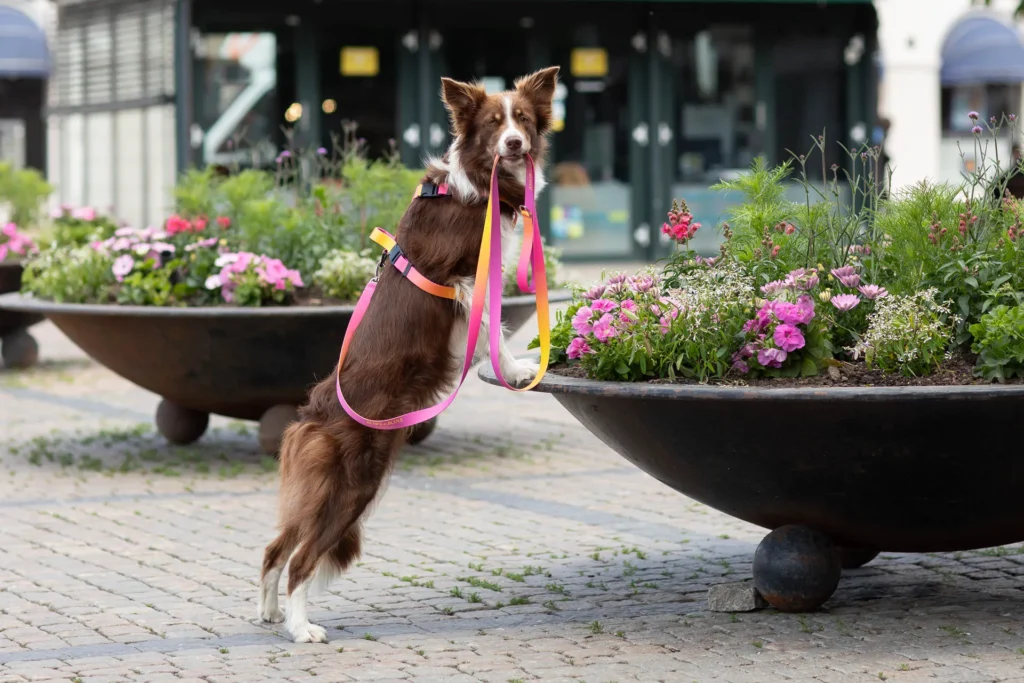
Which harness is best for a Border Collie? In most everyday situations, a properly fitted guard harness is a good starting point. It should not, however, be chosen solely according to breed, approximate weight or an M or L size label. Border Collies can vary in the shape of their chest, the length of their torso, coat density and physical condition. Individual measurements and checking the harness on the dog, both while standing and moving, are essential.
What will you learn from this article?
• which harness to choose for a Border Collie for everyday walks,
• why the right style is important for an active dog,
• whether a guard harness is suitable for a Border Collie,
• when a step-in harness may be worth considering,
• which harness size to choose for a Border Collie,
• how to measure your dog correctly before buying,
• how to recognise a harness that is too tight or too loose,
• how to check whether the shoulders can move freely,
• whether a harness can teach a dog not to pull,
• which is better for a Border Collie: a collar or harness,
• which harness to choose for a Border Collie puppy,
• which materials, adjustments and fastenings to look for,
• when a made-to-measure harness may be worthwhile.
Why is choosing the right harness for a Border Collie so important?
The Border Collie was originally bred as a herding dog. The breed standard published by the Fédération Cynologique Internationale describes the Border Collie as a well-proportioned, balanced and agile dog whose appearance conveys endurance. [1]
In everyday life, representatives of this breed often move very dynamically. They accelerate quickly, stop suddenly, turn and change the position of their body. Poorly fitted accessories can rotate around the torso during these movements, slide into the armpits or cause pressure in particular areas.
A Border Collie harness should therefore:
• remain stable during movement,
• not pass directly across the shoulder joint,
• not cut into the area behind the front legs,
• not place pressure on the neck or trachea,
• allow the front legs to extend freely,
• not rotate when the lead becomes taut,
• be fitted to the dog’s current measurements,
• be made from durable, body-friendly materials.
It is worth remembering that even a well-designed harness may influence the way a dog moves if it is poorly selected or incorrectly adjusted. Research into different harness constructions does not support the claim that one particular style is completely neutral for every dog. [2][3]
You should therefore assess not only the name of the harness style, but above all how the particular model fits the individual Border Collie. You can find more information about the breed’s character and needs in the article “Border Collie – the most crucial information about the breed”.
Which harness should you choose for a Border Collie?
For everyday walks, it is usually worth beginning your search with a lightweight, adjustable guard harness. Its construction allows the front and rear parts of the harness to be adjusted separately to the dog’s chest. This does not mean that every model described as a guard harness will automatically be suitable. Important factors include the length of the strap running beneath the sternum, the position of the chest strap and the distance between the rear strap and the front legs.
The harness should create a stable structure, but it must not be adjusted so tightly that it restricts breathing or the natural movement of the body.
Is a guard harness a good choice for a Border Collie?
A guard harness usually consists of two loops connected by straps running along the back and beneath the chest. When viewed from the front, correctly positioned straps will generally create a shape resembling the letter Y.
This construction is often chosen for Border Collies because it makes it possible to:
• adjust the harness to a slim or more developed chest,
• position the rear strap at a suitable distance from the armpits,
• distribute lead tension more evenly across the torso,
• leave open space around the shoulder joint,
• make adjustments according to the length and density of the coat.
Models with four adjustment points may be particularly useful. They make it easier to fit the harness to a dog whose neck is relatively slim while the chest is noticeably broader. The Bowl&Bone Republic collection includes guard-type dog harnesses from the BREEZE, BLOOM and GRADIENT ranges.
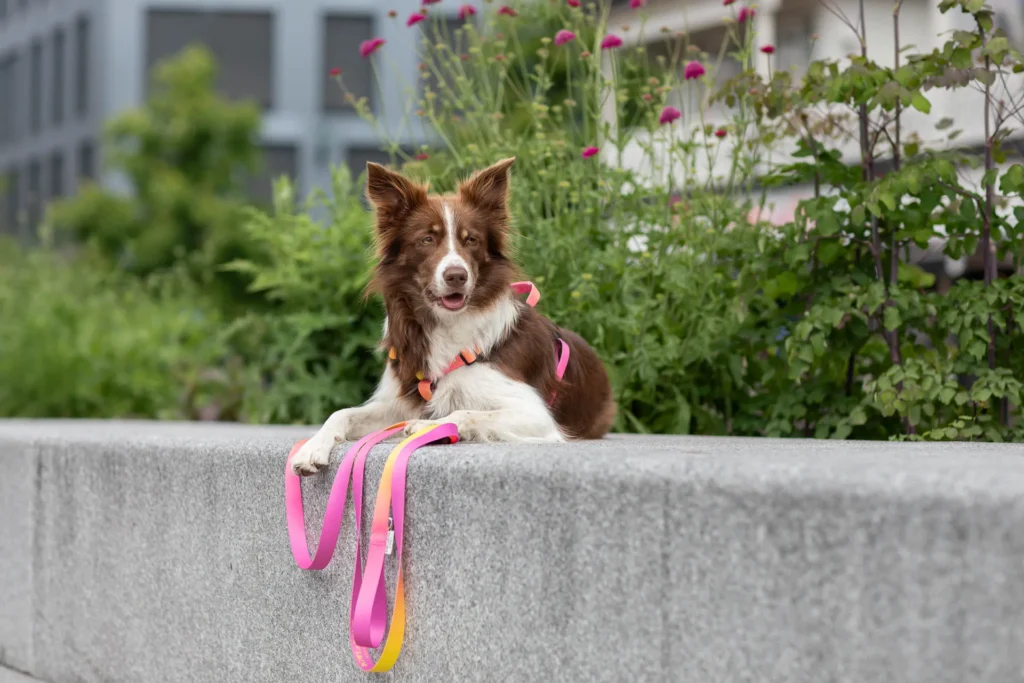
One example is the blue BREEZE dog harness, which is made from durable materials and available in several sizes. Before choosing, always compare your Border Collie’s measurements with the size chart for that particular product. The breed name alone is not sufficient to determine the correct size. You can read more about the construction of this style in the article “Guard-type dog harness – what is worth knowing about it?”.
Is a step-in harness suitable for a Border Collie?
A step-in harness is placed around the dog’s front legs and then fastened on the back. It can be a practical choice for a dog who dislikes having accessories passed over their head.
You should not, however, assume that every step-in model will automatically provide complete freedom of movement. The position of the front section is important. If a strap or panel runs horizontally across the shoulder joint, it may influence the way the front leg extends.
Before choosing a model, check:
• whether the harness overlaps the shoulder blades,
• whether the front section places pressure on the neck,
• whether the lining creases during movement,
• whether the rear edge slides into the armpits,
• whether the dog can move their front legs freely,
• whether the harness rotates after the lead is attached.
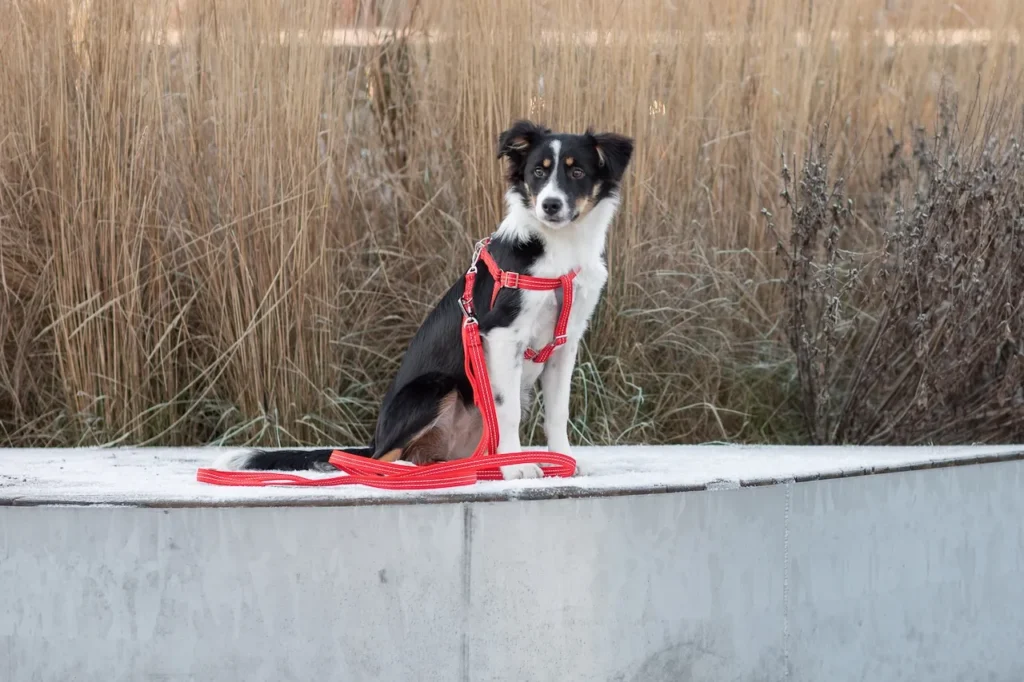
The Bowl&Bone Republic range includes the ACTIVE step-in harness. It has three adjustment levels, a soft lining and reflective stitching. It may suit a dog whose measurements correspond with the product chart and who feels comfortable in this type of construction.
Which harness size should you choose for a Border Collie?
There is no single harness size that fits every Border Collie. Even adult dogs of the same sex may differ considerably in build. Do not base your decision solely on:
• the dog’s weight,
• their age,
• the assumption that most Border Collies wear size M,
• the size of a harness from another brand,
• an estimated assessment of coat thickness.
S, M, L and XL labels are not standardised. A size M from one brand may correspond with completely different measurements from an M offered by another manufacturer. Different collections produced by the same brand may also have separate size charts. The most accurate answer to the question of which harness size to choose for a Border Collie is therefore: the size that corresponds with the dog’s current measurements and the chart for the specific model.
How should you measure a Border Collie for a harness?
Prepare a soft measuring tape. The dog should stand naturally on a level surface. Do not take measurements while they are sitting, lying down or strongly tensing their body. Different models may require different measurements. The following are most commonly needed:
– chest circumference
Measure around the widest part of the chest, guiding the tape behind the front legs. Do not position it directly in the armpits. The tape should lie against the coat without compressing it tightly. With a Border Collie who has a thick coat, do not add a large allowance “for the fur”, as this may make the harness too loose once adjusted.
– neck or base-of-neck circumference
For a guard harness, the neck measurement is usually taken lower than it would be for a traditional collar. The measuring tape should follow the position in which the front section of the harness will sit. Always use the measuring diagram supplied for the selected model.
– length of the upper and lower connecting straps
With some harnesses, the distance between the neck loop and chest strap is particularly important. A lower strap that is too short may pull the rear loop into the armpits. One that is too long may cause the entire construction to move and become unstable.
– sufficient space for the head
If the harness is placed over the head, also check the widest circumference of the dog’s head. They should be able to pass their head through the opening comfortably, without rubbing their ears or feeling strong pressure. You can find further measuring guidance in the article “How to choose a comfortable harness for your dog?”.
How can you check whether a Border Collie’s harness fits correctly?
Carry out the first fitting at home. Then observe the dog during a short walk, while walking freely and when turning calmly. A well-fitted harness:
• remains centred on the back,
• does not slide towards one side,
• does not lift when the lead becomes taut,
• does not cut into the area behind the front legs,
• does not place pressure on the neck,
• does not obstruct the shoulder blades,
• does not cause the dog to shorten their stride,
• does not leave redness or worn patches of coat,
• does not allow the dog to reverse out of it.
You should usually be able to slide one or two fingers beneath the straps, depending on the width of the webbing, the dog’s build and the manufacturer’s instructions. The “two-finger rule” alone does not replace careful observation. If the harness moves during a walk, it is probably still too loose or its proportions are unsuitable. After fitting the harness, ask the dog to walk a few steps. Observe them:
• from the front,
• from the side,
• from above,
• while turning in both directions.
Buckles and adjusters should not sit where they repeatedly strike the elbow or place pressure on the body during movement.
How can you recognise a well fitted Border Collie harness?
Incorrect fit may become apparent after only a few minutes or may not be noticeable until after a longer walk. Pay attention if your dog:
• stops moving after the harness is fitted,
• walks stiffly,
• shortens the stride of their front legs,
• is reluctant to run despite previously enjoying it,
• tries to bite or scratch the straps,
• frequently shakes their body without another obvious reason,
• develops rubbing behind the front legs,
• has flattened, worn or tangled fur,
• coughs when the lead becomes taut,
• can move an elbow through the harness and reverse out of it.
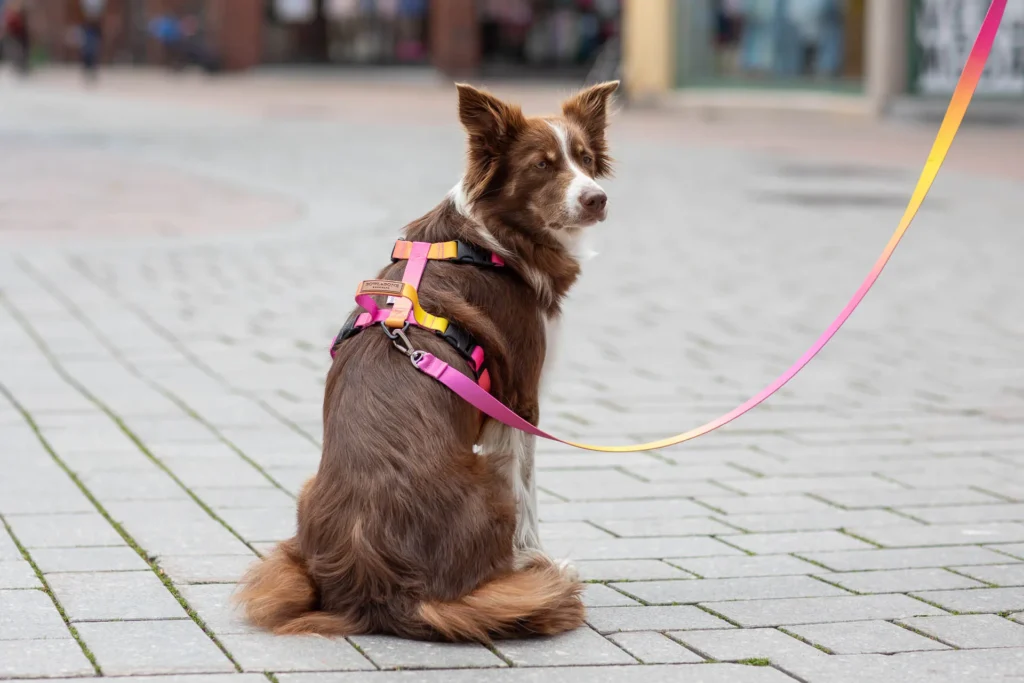
Shaking once after a new accessory is fitted does not necessarily indicate a problem. If the behaviour is repeated regularly or the dog clearly avoids the harness, check its size, construction and method of fitting again.
How far should the harness sit from the armpits?
The rear chest strap should not run directly behind the front legs. During movement, it could rub the skin and coat. There is no single distance in centimetres suitable for every Border Collie. The correct position depends on:
• the dog’s size,
• the length of their torso,
• the construction of the harness,
• the width of the webbing,
• the way the dog moves.
Check that when the front leg is fully extended, the strap remains behind the armpit and does not slide into its hollow.
Will a harness teach a Border Collie not to pull?
A harness does not teach a dog to walk calmly on a loose lead by itself. It is an accessory that provides a connection between the dog and the lead, but it does not replace training. Some dogs may pull just as strongly in a harness, or even apply more force than they would in a collar, because the tension is distributed across a larger part of the body. Research comparing dogs’ behaviour in different walking accessories indicates that a harness with a rear lead attachment should not be treated as an automatic method of preventing pulling. [4] This does not mean that a harness “teaches a dog to pull”. A dog may pull because:
• they want to reach an interesting place more quickly,
• they have learnt that a taut lead allows them to move towards their goal,
• they are highly aroused,
• the human walking pace is too slow for them,
• they do not yet understand the rules of the walk,
• they need more opportunities to explore.
Loose-lead walking should be taught separately, using rewards, an appropriate distance from distractions and opportunities to sniff. You can find further guidance in the article “Walking your dog – how to do it right?”.
Collar or harness for a Border Collie?
You do not need to choose one accessory for every situation. A Border Collie may wear a lightweight collar carrying an identification tag while being walked in a well-fitted harness. A harness may be a comfortable option during:
• everyday walks,
• longer excursions,
• exploration on a longer lead,
• recall training,
• walks with a dog who reacts dynamically to their surroundings.
A collar may be used for:
• carrying an identification tag,
• a short outing with a dog who walks calmly on the lead,
• situations in which the harness needs to be removed temporarily.
If a Border Collie suddenly pulls against the lead, a collar concentrates the force around the neck. A harness distributes contact over a larger part of the torso, but only when it is fitted correctly. It is also incorrect to assume that a collar is always necessary when teaching a dog to walk at heel. The method of training determines the dog’s behaviour, not the accessory alone.
Which harness should you choose for a Border Collie puppy?
A Border Collie puppy can wear a lightweight, correctly fitted harness if they are introduced to it gradually and calmly. When selecting a model, look for:
• a low overall weight,
• a soft finish,
• a wide adjustment range,
• no hard components behind the front legs,
• simple fitting,
• stability during movement,
• the possibility of making frequent size adjustments.
A young dog grows quickly, so their harness should be checked much more frequently than that of an adult Border Collie. A harness that fitted one month earlier may suddenly become too tight around the chest or too short beneath the torso. Do not deliberately buy a very large harness “for future growth”. An excessively loose harness may rotate, cause rubbing and allow the puppy to reverse out of it.
– how should you introduce a puppy to a harness?
Place the harness on the floor and allow the dog to investigate it calmly. Reward them for approaching voluntarily. Then:
• lift the harness for a short moment,
• reward the dog for remaining calm,
• gradually move the opening closer to the head or paws,
• do not put the harness on by force,
• initially fasten it for only a few seconds,
• gradually increase the amount of time it is worn at home,
• keep the first walks in the new model short.
If the puppy moves backwards, turns their head away, freezes or attempts to escape, return to an easier stage. Dogs Trust recommends introducing a dog to a harness gradually and using treats to build positive associations. [5]
Which features should a good Border Collie harness have?
– precise adjustability
Border Collies often have a relatively slim neck and a clearly defined chest. Several adjustment points make it easier to fit both sections without tightening one excessively.
– durable material
The harness should withstand everyday use, moisture, contact with the coat and sudden lead tension. Regularly inspect the webbing, stitching, buckles and the points where metal components are attached.
– soft finishing
Material that remains in prolonged contact with the body should not have sharp edges. This is particularly important behind the front legs, across the sternum and around the neck.
A soft lining may improve comfort, but it cannot correct an unsuitable construction. Even a heavily padded harness may rub when a strap is positioned incorrectly.
– reliable buckles and fittings
After fastening the harness, gently pull each buckle and check that it remains closed. Inspect the stitching around the ring used to attach the lead.
The components should not have cracks, sharp edges or signs of significant wear.
– visibility-enhancing elements
Reflective stitching or details can help make a dog more visible after dark. They do not replace lighting or appropriate caution when walking beside a road.
– easy cleaning
A Border Collie who enjoys woodland and countryside walks may quickly make their harness dirty. Check the manufacturer’s washing instructions and allow the accessory to dry completely before using it again.

Made-to-measure harnesses for Border Collies
Standard sizing does not always suit a dog with unusual proportions. The neck measurement may correspond with one size while the chest fits the next. A made-to-measure harness may be worth considering when:
• the dog falls between standard sizes,
• standard models rotate around the torso,
• the rear strap repeatedly slides into the armpits,
• the Border Collie has an exceptionally slim or broad chest,
• the length of the torso makes it difficult to position the loops correctly,
• you need a fit that accounts for the dog’s individual build.
Bowl&Bone Republic offers the option of ordering an ACTIVE harness made to your dog’s measurements. Before an individual order is produced, accurate measurements must be provided in accordance with the instructions for the particular model.
Which harness colour should you choose for a Border Collie?
Once the construction and size have been selected, you can focus on appearance. Border Collies occur in many coat colour varieties. Strong shades such as red, yellow, blue or mint can look particularly striking against a black-and-white coat. With brown or merle colouring, you may also consider cream, beige, grey and navy.
The colour should primarily appeal to the guardian and suit the style of your shared walks. It is worth remembering, however, that light-coloured accessories may need more frequent cleaning, while vibrant shades may make the dog easier to notice in their surroundings. The Bowl&Bone Republic dog harness collection includes models in different constructions and colours that can be combined with a matching lead and other walking accessories.
Which harness will be best for a Border Collie?
The best harness for a Border Collie is not necessarily the one that appears most frequently in breed-specific recommendations. The right model is one that fits the dog’s body, way of moving and type of shared activity. For many Border Collies, an adjustable guard harness will be a good option. It can leave open space around the shoulder joints and make it possible to position the rear strap away from the armpits.
A step-in harness may suit a dog who dislikes having an accessory placed over their head, but its front section must also allow freedom of movement. Before buying:
• measure your dog,
• check the size chart for the particular collection,
• do not choose a size according to breed alone,
• observe the position of the harness during movement,
• check the armpits and coat after the first walks,
• regularly inspect the adjustment and condition of all components.
When selecting a harness, functionality can be combined with elegant design. Bowl&Bone Republic accessories are designed and made in European Union with careful attention to the dog’s comfort, durable construction and timeless appearance. A correctly fitted harness should not distract the dog during a walk. Your Border Collie should be able to sniff, walk, turn and explore freely, while you can feel confident that the harness remains securely in position.
For more inspiration, knowledge and thoughtfully designed dog accessories, visit www.bowlandbone.com — a place created for dog guardians who wish to combine their companion’s everyday comfort with timeless style.
– the Bowl&Bone Republic team
FAQ, meaning the most frequently asked questions about the article –
Which harness should you choose for a Border Collie? A practical guide
Which harness should you choose for a Border Collie?
An adjustable guard harness is a good starting point. It should remain stable on the torso, stay away from the armpits and avoid passing across the shoulder joints. The final choice should be based on the measurements of the individual dog.
Is a guard harness suitable for a Border Collie?
Yes. A correctly fitted guard harness may work well for everyday walks with an active dog. All straps must be positioned correctly, and the shoulder blades should be able to move freely.
Which harness size is suitable for a Border Collie?
There is no single size suitable for the entire breed. Before buying, measure the dog’s chest circumference and any other dimensions requested by the manufacturer, then compare them with the chart for the particular model.
Does a Border Collie wear size M?
Some Border Collies may wear size M, while others will need L or a made-to-measure model. Size labels differ between manufacturers and collections, so they should never be selected according to breed alone.
How should you measure a Border Collie for a harness?
Measure the dog while they are standing naturally. The most important measurement is usually the widest part of the chest. Depending on the style, you may also need the circumference at the base of the neck, the length of the back strap and the circumference of the head.
How tight should a Border Collie’s harness be?
It should sit securely without placing pressure on the body. You should generally be able to slide one or two fingers beneath a strap. The harness must not rotate, cut into the armpits or allow the dog to reverse out of it.
Where should the rear harness strap sit?
The strap surrounding the chest should be positioned behind the front legs but not directly in the armpits. The exact distance depends on the dog’s size, torso length and the construction of the model.
Can a harness restrict a Border Collie’s movement?
Yes, particularly when it is poorly fitted, too tight or passes across the shoulder joint. The dog’s movement should be assessed rather than relying solely on the name of the harness style.
Is a step-in harness suitable for a Border Collie?
It may be suitable if it fits the body correctly and does not restrict the front legs. This style can be practical for a dog who dislikes having accessories placed over their head.
Collar or harness for a Border Collie?
A harness is often chosen for everyday walks, while a collar may be used for carrying an identification tag. The decision should reflect the dog’s behaviour, the type of walk and the correct fit of the accessory.
Will a harness teach a Border Collie not to pull?
No. A harness does not teach loose-lead walking by itself. Training based on rewarding the desired behaviour and gradually teaching the dog to move calmly is still necessary.
Which harness should you choose for a Border Collie puppy?
Choose a lightweight, soft and stable model with a wide adjustment range. The puppy should be introduced to it gradually, and their measurements should be checked regularly.
Can you buy a larger harness for a puppy to grow into?
It should not be noticeably too large. A loose harness may rotate, cause rubbing and increase the risk of the puppy reversing out of it.
How can you tell that a harness is too small?
It may cause redness, place pressure on the neck, slide into the armpits or restrict the dog’s stride. The dog may also avoid moving, bite the straps or resist having it fitted.
How can you tell that a harness is too large?
It may rotate around the torso, sit away from the body, move when the lead becomes taut or allow the dog to move a front leg through the opening and reverse out.
Is a made-to-measure Border Collie harness worthwhile?
Yes, particularly when standard models do not fit the neck, chest and torso length at the same time. A made-to-measure harness can provide a more accurate fit for an individual body shape.
How often should you check the fit of a harness?
For an adult dog, check it regularly, particularly following a change in body weight, coat grooming or washing the harness. For a growing puppy, the fit should be checked much more frequently.
Should a Border Collie wear their harness all day?
There is no need. The harness can be removed after a walk so that the skin and coat do not remain beneath the straps for many hours and to prevent the harness becoming caught on household objects.
Sources and inspiration used to create the article
Which harness should you choose for a Border Collie? A practical guide
- Fédération Cynologique Internationale, “FCI Standard No. 297 – Border Collie”. The official breed standard covering the Border Collie’s build, proportions and general appearance of endurance.
- Cavalli C. et al., “Review of Collars, Harnesses, and Head Collars for Walking Dogs”, 2025. A review of research into how different walking accessories affect dogs’ movement, pressure and behaviour.
- Lafuente M.P. et al., “Effects of restrictive and non-restrictive harnesses on shoulder extension in dogs at walk and trot”, 2019. A study examining the effect of two harness constructions on the range of movement of the front limbs.
- Shih H.Y. et al., “Dog Pulling on the Leash: Effects of Restraint by a Neck Collar vs. a Chest Harness”, 2021. A study comparing dogs’ pulling behaviour when wearing a collar and a rear-attachment chest harness.
- Dogs Trust, “How to train your dog to wear a harness”. Guidance on gradually introducing a dog to a harness and building positive associations.
- The Royal Kennel Club, “Border Collie breed standard” and information concerning the breed’s needs.
- Bowl&Bone Republic, “Dog harnesses for puppies, small and large breeds”. Current information about the available harness collections, adjustment options and models.
- Bowl&Bone Republic, “ACTIVE beige dog harness”. Information about the construction, three adjustment levels, soft lining and reflective stitching.
This article is educational in nature and provides general guidance on choosing and fitting a dog harness. In cases involving an abnormal gait, pain, lameness, rubbing or particular orthopaedic needs, the choice of walking accessories should be discussed with a veterinary surgeon or veterinary physiotherapist.









 or CANADA
 PLEASE join us at