


In the evening, your dog jumps onto the sofa, circles for a moment, arranges the blanket with their paws and then disappears almost completely underneath it. At other times, they may try to push their nose beneath the cushion in their bed or find a spot between the duvet and mattress. If this scene sounds familiar, you probably have a dog who simply loves resting while wrapped in soft fabric.

This raises a practical question: is a dog sleeping bag or a classic blanket the better choice? Both can provide your dog with a comfortable place to rest, but they serve slightly different purposes. A sleeping bag creates a more structured, partially enclosed resting place that your dog can enter on their own, while a blanket provides much more freedom – you can use it to cover your dog, line their bed, place it on the sofa or take it in the car.
After more than 10 years of designing premium dog accessories and thanks to the opinions and experiences of thousands of Bowl&Bone Republic customers, one thing has become very clear to us: there is no single type of bedding that is perfect for every dog. The best choice is the one that matches the way your dog actually sleeps. So rather than starting with the appearance of the product, spend a few evenings observing your dog first.
What will you learn from this article? In this guide, you will learn:
- why some dogs like sleeping under the covers,
- how a dog sleeping bag differs from a dog blanket,
- when a sleeping bag is the better choice,
- when a blanket is more practical,
- what to choose for a dog that burrows under the duvet,
- whether a dog can safely sleep under a blanket,
- how to avoid your dog overheating,
- what type of material works well for resting,
- how to choose the right size of sleeping bag and blanket,
- what to choose for the sofa, dog bed and travel,
- whether it is worth having both a blanket and a sleeping bag at home.
Why does my dog like sleeping under a blanket?
Not every dog likes being covered, but for some dogs it is a very clear preference. The European Food Safety Authority (EFSA) notes that in colder conditions dogs also use behaviours that help to reduce heat loss: they seek sheltered places, curl their bodies and may burrow into blankets or cushions [1]. Ambient temperature can also affect canine sleep – a study by Schork and colleagues found an association between environmental conditions and the length of dogs’ resting periods [2].
However, warmth is not the only possible reason why a dog goes under a blanket. Some dogs simply prefer more sheltered places to rest. The American Kennel Club, referring to animal behaviour specialist Dr Mary Burch, identifies seeking warmth and a cosy, enclosed resting place among the possible reasons for this behaviour [3].
In practice, the best approach is simply to observe your dog. If they slide under a blanket every day, crawl beneath the duvet or try to create a tunnel in their bed, they are giving you a very clear indication of their sleeping preferences.
Dog sleeping bag or blanket – the most important difference
Put simply, a dog sleeping bag combines a place to lie down with the option of being covered, whereas a blanket remains an accessory whose use can be changed each time by either the dog or their guardian.
This is the most important difference when making a purchase.
| Dog or guardian’s need | Dog sleeping bag | Dog blanket |
|---|---|---|
| dog likes going underneath fabric on their own | very good choice | good choice |
| dog likes “digging tunnels” in their bedding | very good choice | depends on how it is arranged |
| you need one permanent sleeping place | better choice | more of an addition |
| you only want to cover your dog occasionally | possible | better choice |
| you want to line a sofa or dog bed | less versatile | very good choice |
| the product will often travel in the car | good choice | very good choice |
| dog frequently changes resting places | good choice | very good choice |
| you want a more enclosed “hideaway” | better choice | provides less enclosure |
| you need a versatile accessory | less versatile | better choice |
If your dog mainly wants to burrow underneath something on their own, I would start with a sleeping bag. If you want one product for covering your dog, lining their bed, using on the sofa and taking on trips, a blanket will be more versatile.
When is a dog sleeping bag worth choosing?
A dog sleeping bag is particularly well suited to dogs that do not wait for their guardian to cover them with a blanket, but actively look for a way to hide beneath the fabric themselves. If your dog crawls under the duvet, squeezes between cushions or arranges a blanket to create a tunnel, a sleeping bag gives them a similar option within their own resting place.
At Bowl&Bone Republic, we design sleeping bags with exactly this kind of behaviour in mind. A dog can lie on top of one just like a traditional bed, and when they want to feel more wrapped up, they can slide beneath the upper layer. For the guardian, the benefit is that their dog has a dedicated place to burrow into instead of rearranging the sofa cushions every evening or disappearing beneath your duvet.
A good example is the DREAMY grey dog sleeping bag. Its open construction allows your dog to decide independently whether they want to rest on top or hide inside. It is also lightweight and easy to move, so you can take a familiar resting place with you when travelling.

If you would like to compare the construction, sizes and everyday use of the individual models in more detail, read our guide How to choose the right dog sleeping bag.
DREAMY or BLISS – two different ways to wrap your dog in comfort
It is worth knowing that even within the same category, dog sleeping bags can have different constructions. This matters because one dog may want to slide almost completely beneath the fabric, while another prefers only a light covering over their back.
DREAMY has the form of an open envelope that allows your dog to slide inside. BLISS, meanwhile, has a more cushion-like construction with a space where your dog can hide. This means you can choose a product not only according to your dog’s size, but also according to how they actually position themselves while sleeping.
For example, the BLISS pink dog sleeping bag features a removable cushion filled with certified synthetic down and a soft section that allows your dog to snuggle in while resting. For the guardian, this means combining a comfortable sleeping place with the possibility of hiding away, while the product has also been designed so that it can be kept clean in accordance with the manufacturer’s care instructions.
When is a dog blanket the better choice?
A dog blanket is definitely the more versatile option. You can place it in a dog bed, use it to cover your dog on the sofa, protect a place in the car or take it to a hotel or restaurant. If your dog sometimes sleeps under a cover but just as often lies on top of it, a blanket gives them more choice.
This solution also works particularly well when your dog already has a favourite bed and you do not want to replace it. You simply add a soft layer beneath which your dog can hide whenever they feel like it. For the guardian, this is a straightforward way to increase the functionality of an existing resting place without buying another complete bed.
A more plush option is the MILO brown furry dog blanket, available in 70 × 90 cm and 90 × 110 cm sizes, as well as made to measure. Its dense, soft texture works equally well as an addition to a dog bed or for relaxing together on the sofa. For the guardian, another benefit is that it can be washed according to the product care instructions, while its timeless colouring means the blanket does not look like a random pet accessory placed in the middle of your interior.
Dog blanket for a dog bed – when does it make the most sense?
If your dog already has a comfortable bed but often tries to push their nose beneath its cushion or squeeze under a throw, a blanket may be the simplest solution. You are not changing a place your dog already knows and enjoys – you are simply giving them the additional option of wrapping themselves up.
In our design experience, we often see that dogs do not use a blanket in only one way. One day they sleep on top of it, the next they burrow their nose underneath it, and another day they push it completely to one side. This freedom of choice is one of the biggest advantages of a blanket.
If softness and easy portability are your main priorities, take a look at the NAP brown dog blanket. If your dog needs a thicker, double-layered option, the ROYAL dog blanket is an interesting alternative. Meanwhile, the lighter ZEN grey dog blanket works well as a versatile addition to a dog bed or something to take away with you.

We describe the differences between the various types in more detail in our guide How to choose the best blanket for your dog.
What should you choose for a dog that always goes under the duvet?
If your dog finds their own way under the duvet almost every evening, a sleeping bag will usually be the more natural first choice. It gives them the opportunity to repeat a familiar behaviour in their own resting place without having to wait for their guardian to arrange a blanket over them.
This is precisely the kind of dog for whom designs such as DREAMY and BLISS were created. Your dog decides how deeply they want to hide and whether they need to be covered at all on a particular day. Good bedding should not force one sleeping position – it should allow your dog to adapt their resting place to their own needs.
A blanket will work too, but particularly small dogs may need some help arranging it in a way that allows them to get underneath easily. So if your dog’s main behaviour is burrowing underneath fabric independently, a sleeping bag has a functional advantage.
What about a dog that likes being covered by their guardian?
Here, the situation is reversed. If your dog does not go underneath fabric on their own but comes onto the sofa in the evening, curls up beside you and rests peacefully when you lightly cover them, a blanket will be more practical.
You can adjust how much of your dog is covered according to the temperature and their reaction. If they push their paws out after a while or come out from beneath the blanket completely, nothing restricts them. A blanket also gives you greater control over how much of the dog’s body is covered.
For this kind of use, softness, an appropriate size and easy washing are more important than an especially thick construction. This is a product that is likely to be moved regularly between the sofa, dog bed and car, so high-quality workmanship makes a real difference in everyday use.
Can a dog safely sleep under a blanket?
Many dogs regularly sleep under blankets without any problems, but there are a few simple rules worth following. The American Kennel Club advises paying particular attention to coverings that are too heavy or tightly tucked in, as these could make it difficult for the dog to get out on their own [3]. PetMD also recommends choosing lightweight, breathable materials and giving the dog enough room to exit freely [4].
The most important rule is that your dog must be able to get out from underneath the covering on their own. Do not wrap them tightly and do not use heavy weighted blankets designed for people. Puppies, very small dogs, senior dogs and animals with limited mobility may require particular care.
Keep an eye on temperature as well. If your dog begins panting, fidgeting or repeatedly coming out from underneath the blanket, they probably do not need any more covering. In situations like this, it is best to leave the choice to them.
Can a dog overheat under a blanket or in a sleeping bag?
Yes, excess warmth can be a problem, which is why neither a blanket nor a sleeping bag should be treated as something your dog must use throughout the night. PetMD highlights the risk of overheating beneath excessively warm coverings, particularly in warmer conditions [4].
Room temperature, coat type, age, size and the dog’s individual tolerance all matter. A short-haired dog may seek additional warmth much more readily than a dog with a dense undercoat, but differences can exist even between dogs of the same breed.
For this reason, do not choose a sleeping bag or blanket simply because “the dog should be warm”. Look at your dog’s behaviour. A dog who voluntarily goes underneath the fabric and falls asleep peacefully is giving you very different information from a dog who comes out after a minute and chooses the cool floor instead.
What size dog sleeping bag should you choose?
A sleeping bag should allow your dog to lie down comfortably, turn around and easily slide beneath the upper layer. One that is too small may restrict their choice of sleeping position, while one that is excessively large can lose some of its cosy form and take up unnecessary space.
Bowl&Bone Republic DREAMY and BLISS models are available in several standard sizes, while selected options can also be ordered made to measure. This is particularly practical for dogs with unusual proportions or when the sleeping bag needs to fit perfectly into a specific space in the home.
Choose the size for the individual dog, not for the dog’s breed. Two dogs of the same breed can differ in body length, weight and favourite sleeping position. It is therefore worth measuring your dog in the position in which they most often rest.

How large should a dog blanket be?
With a blanket, you can allow yourself a little more flexibility. If its main purpose is covering your dog, it should be large enough to comfortably cover their body without needing to wrap them tightly. If it is going to be placed in a bed, it is also worth matching it to the bed’s surface area.
For a dog that likes burrowing, a slightly larger size can be more comfortable because it leaves more fabric for the dog to arrange independently. There is no need to overdo it, though – a very small dog does not need an enormous, heavy blanket that makes it difficult to move around freely.
This is precisely why MILO is available in two sizes, while some Bowl&Bone Republic products can also be made to individual measurements. The guardian then gets a product suited to the way it will actually be used every day, rather than a random piece of fabric that needs to be folded over repeatedly.
Dog sleeping bag or blanket for the sofa?
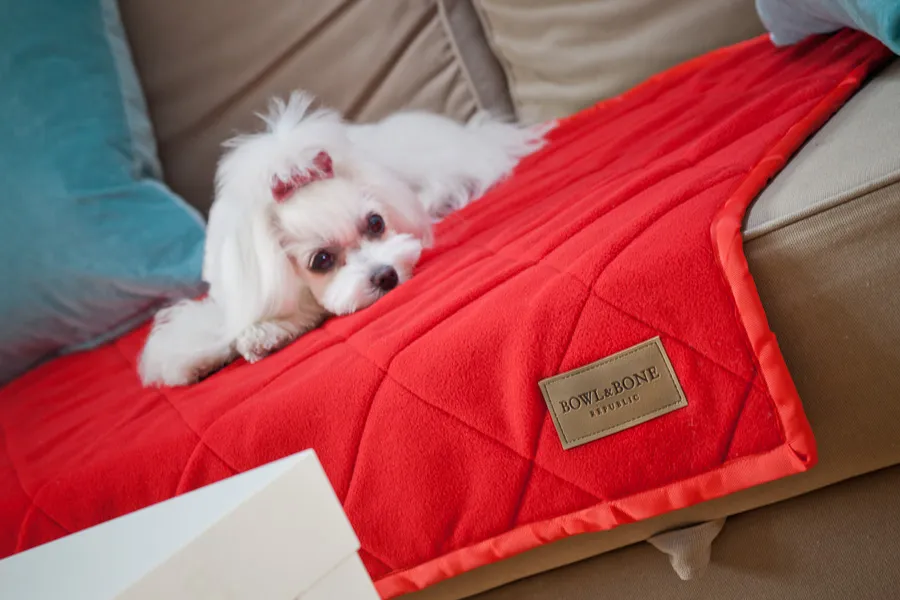
A blanket will usually have the advantage on the sofa. You can spread it over your dog’s favourite spot and, when your dog feels like being covered, use the same product as a light wrap. At the same time, the blanket reduces direct contact between fur, small amounts of dirt and the upholstery, which is another practical benefit for the guardian.
A sleeping bag can still make sense if you want to give your dog one clearly defined place on the sofa. A lightweight DREAMY can be moved from the floor onto the sofa to create a separate relaxation zone for your dog. Once the nap is over, it can easily be moved somewhere else again.
The choice therefore depends on whether you value versatility more or prefer a permanent, recognisable place where your dog can burrow in.
Dog sleeping bag or blanket for travelling?
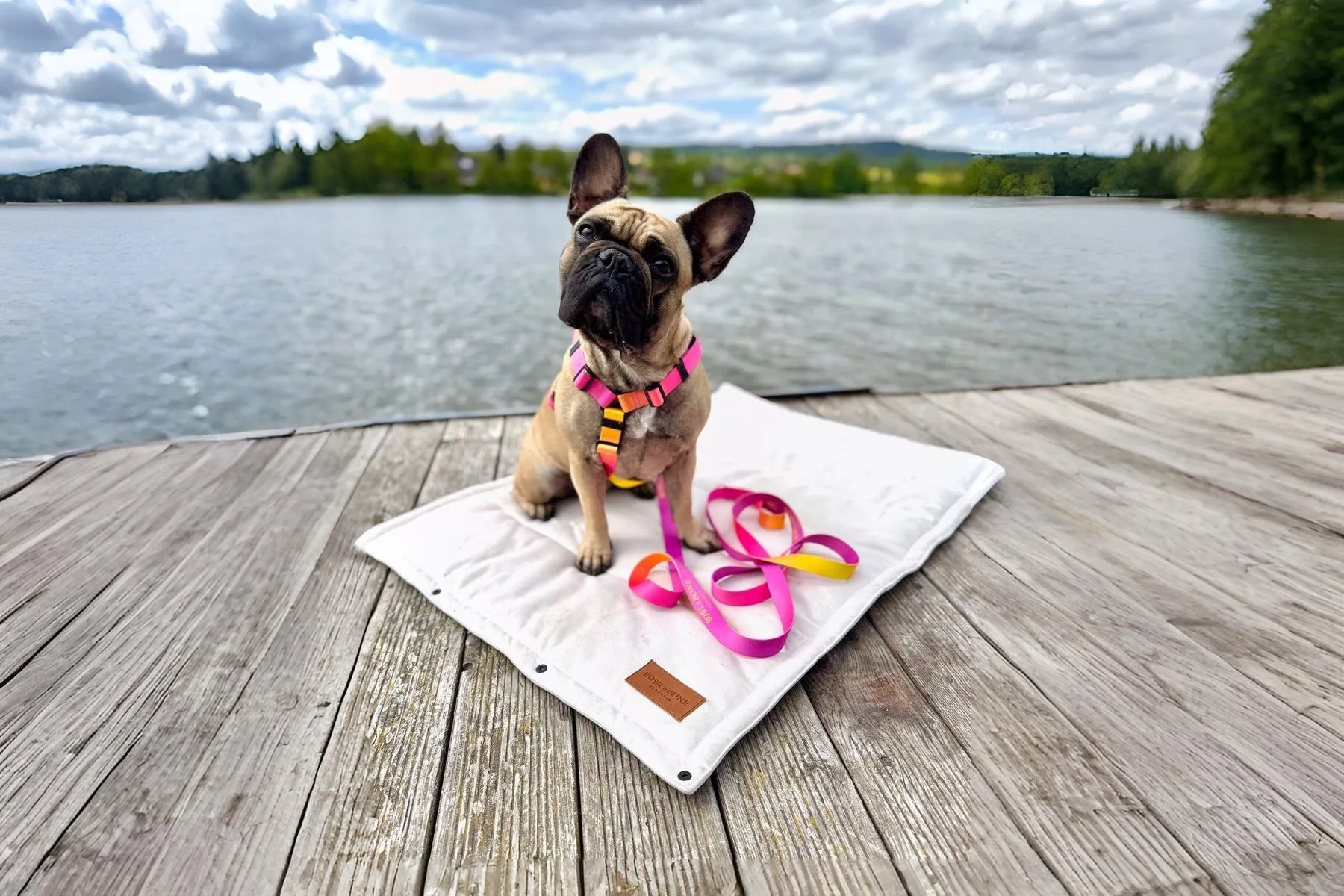
Both products work very well for travel, but in slightly different ways. A blanket takes up little space, is easy to fold and can be spread out in the car, hotel, restaurant or on a mat. This makes it a very practical part of your dog’s travel kit.
A sleeping bag offers something more – it becomes a complete resting place in the new environment. For a dog that uses it regularly at home, it may be a more easily recognisable space to settle down in during a trip. This does not mean the product itself will automatically eliminate stress associated with a new place, but a familiar part of the daily routine may simply be easier for the dog to accept.
If you travel very frequently, an interesting option is to have a sleeping bag as your dog’s main resting place and a lightweight blanket as an additional accessory. This combination provides plenty of flexibility without having to take a large traditional dog bed with you.
Can a dog blanket replace a sleeping bag?
It can, if your dog mainly needs a light covering. A blanket can be placed partly over the dog bed, leaving a loose section underneath which the dog can slide. In many cases, that will be entirely sufficient.
However, if your dog regularly builds tunnels out of their blanket, pulls it off themselves while trying to get underneath or cannot easily find their way under it, the construction of a sleeping bag will be more convenient. The upper layer is already connected to the sleeping surface, so the whole thing does not move around as easily.
The point is not that one product is “better”. A blanket provides greater flexibility, while a sleeping bag makes it easier for your dog to use an enveloping design independently.
Can a dog sleeping bag replace a traditional dog bed?
For some dogs, yes. This is particularly true if your dog enjoys soft, flatter sleeping places and willingly uses the upper surface of their sleeping bag. Other dogs, however, will prefer a traditional dog bed with clearly defined sides and treat the sleeping bag as a second resting place.
This is exactly why, when designing Bowl&Bone Republic accessories, we do not assume that every dog should have an identical set-up. Feedback from thousands of customers shows us just how different dogs’ resting rituals can be. One dog sleeps exclusively curled up beneath fabric, another changes position throughout half the night, while another uses their sleeping bag only during the colder months.
Observation is therefore the best guide: if your dog chooses the sleeping bag for most naps and can comfortably change position inside it, it may serve as their primary place to rest. If they regularly return to a traditional bed, it is worth giving them access to both.
Dog sleeping bag or blanket for a puppy?
For a puppy, ease of cleaning, material safety and supervision are particularly important. A young dog may bite, pull and test new objects with their teeth, so you should observe how they use both a sleeping bag and a blanket.
PetMD recommends closer supervision of puppies using blankets than of adult animals [4]. If a young dog tries to tear the material intensively and swallow pieces of it, they should not be left alone with the product.
If, on the other hand, the puppy calmly snuggles into the soft material, both options can be useful parts of their starter kit. A blanket is more versatile, while a sleeping bag provides a ready-made place for resting and burrowing.
Dog sleeping bag or blanket for an older dog?
A senior dog may have different needs from a young, highly mobile dog. If mobility is limited, it is best to avoid a design that would be difficult for the dog to leave independently. A lightweight blanket placed on a comfortable bed may be the simpler option.

On the other hand, older dogs with short coats may seek warm places more frequently. The American Kennel Club notes that additional covering can be particularly useful for senior dogs and some short-haired dogs [5]. This does not mean every older dog should be covered – individual comfort is what matters.
If your senior dog enjoys using a sleeping bag, choose a sufficiently large model that is easy to get out of. If they begin having difficulty moving around, it is also worth discussing their resting arrangements with your vet and, above all, ensuring appropriate support for their body.
What should you look for when buying a dog sleeping bag or blanket?
Look at your dog’s behaviour first. Colour, trends and product photography come later. This is a principle we also follow when designing Bowl&Bone Republic accessories.
In practice, check above all:
- whether the material is soft and pleasant to the touch,
- whether the product is easy to keep clean,
- whether your dog can freely get underneath and out from under the covering,
- whether the size matches the way your dog sleeps,
- whether the construction is not too heavy,
- whether the material is suitable for intensive everyday use,
- whether the product will also work where you actually intend to use it – for example on the sofa or while travelling.
With Bowl&Bone Republic products, we place great importance on the quality of the fabrics, durability of construction and ease of everyday care. The benefit for the dog is clear – they receive a soft, carefully designed place to rest. For the guardian, it is equally important that a premium product does not need to be hidden away when guests arrive, complements the interior and can serve for a long time when properly cared for.
Dog sleeping bag or blanket – which should you ultimately choose?
If your dog goes under the duvet, burrows into their bedding and actively looks for tunnels made from fabric, I would choose a dog sleeping bag first. Its construction fits this style of resting particularly well and allows your dog to decide independently whether they want to sleep on top or underneath the cover.
If your dog likes being covered from time to time, frequently changes resting places or you need one product for the sofa, dog bed, car and travel, a dog blanket will be more practical. It is easier to carry and offers a wider range of uses.
And if your dog really loves soft, enveloping places? There is nothing wrong with having both. The sleeping bag can remain their permanent sleeping place, while the blanket can be used on the sofa, in a traditional bed and when travelling. The best set is not the one that looks the most impressive, but the one your dog genuinely uses.
After more than a decade of designing premium dog accessories and observing the experiences of thousands of Bowl&Bone Republic customers, we know that these small differences are what determine whether a product becomes an everyday favourite. That is why our collection includes both dog sleeping bags and dog blankets with different constructions and levels of softness. Choose the option that best matches the way your individual dog likes to rest.
– the Bowl&Bone Republic team
FAQ – frequently asked questions about the article –
Dog sleeping bag or blanket – which should you choose for a dog that likes sleeping under the covers?
Why does my dog like sleeping under a blanket?
A dog may go under a blanket because they are looking for warmth or prefer a more enclosed resting place. EFSA notes that in colder temperatures dogs may seek shelter and burrow into blankets or cushions [1]. The behaviour is individual, however, and not every dog will enjoy sleeping under a cover.
Can a dog sleep under a blanket?
Yes, many dogs sleep comfortably beneath a lightweight blanket. It is important that the material is not too heavy and that the dog can get out from underneath it independently [3][4]. You should also watch for signs that your dog is becoming too warm.
Can a dog suffocate under a blanket?
With an ordinary lightweight, breathable blanket, the risk is low, but your dog should always be able to get out freely. Do not wrap your dog tightly or use heavy weighted blankets designed for people [3][4].
Should you cover your dog with a blanket at night?
If your dog enjoys being covered and can get out from underneath the blanket independently, a lightweight cover can form part of their resting routine. You should not force a dog to stay covered, however. If they regularly come out from underneath the blanket, they probably prefer sleeping without it.
Does every dog need a blanket?
No. A blanket is not an essential accessory for every dog. It is primarily an additional source of comfort and a versatile accessory that can be used in a dog bed, on the sofa or while travelling.
Is a dog sleeping bag better than a blanket?
There is no single option that is better for every dog. A sleeping bag is more convenient for a dog that likes to burrow underneath fabric independently, while a blanket is more versatile and easier to use in different places. Your choice should depend primarily on the way your dog likes to rest.
What type of dog is a sleeping bag best for?
A sleeping bag is particularly well suited to dogs that enjoy going under the duvet, burrowing beneath cushions or creating tunnels from blankets. It may also appeal to dogs that seek warmer and more sheltered places to rest.
Which dog sleeping bag should you choose?
Consider the size, construction, softness of the materials, ease of washing and the way your dog likes to burrow. A sleeping bag should allow your dog to enter, leave and change position freely.
Which dog blanket should you choose?
Choose the size according to your dog and how you intend to use the blanket. A blanket used for covering your dog should be lightweight and sufficiently large, while one used in a dog bed should also fit the bed’s surface. Softness and ease of regular washing are important too.
Can you use a dog blanket in a dog bed?
Yes. This is one of the most practical ways to use a dog blanket. It can increase the softness of the resting place while still allowing your dog to go underneath the material if they feel like it.
Can a sleeping bag replace a dog bed?
For some dogs, yes. If your dog rests comfortably in it, can freely change position and regularly chooses the sleeping bag for sleep, it can serve as their primary resting place. Other dogs will treat it as an additional option alongside a traditional dog bed.
What is better for a dog in winter – a blanket or sleeping bag?
For a dog that frequently seeks warmth and likes burrowing, a sleeping bag may provide a more convenient way to wrap themselves up independently. A blanket gives greater flexibility and makes it easier to adjust the amount of covering. In both cases, it is important to watch for overheating.
What is better to take when travelling with a dog – a blanket or sleeping bag?
A blanket is the most versatile option and takes up little space. A sleeping bag, meanwhile, gives the dog a more complete resting place. If you travel frequently, the two products can complement each other very well.
Does a short-haired dog need a blanket?
Not every short-haired dog does, but dogs with short coats may seek additional warmth more frequently than animals with very dense undercoats [3][5]. The most important factors are the individual dog, room temperature and their behaviour.
Can a puppy sleep under a blanket?
A puppy can use a lightweight blanket, but young dogs should be supervised more closely, particularly if they bite or tear materials [4]. Do not leave a damaged blanket with a puppy if pieces of it could be swallowed.
Can you use a weighted blanket for a dog?
Heavy weighted blankets designed for humans should not be used as an ordinary cover for a dog. They can make it difficult for a small or less mobile dog to get out from underneath independently [3][4].
Sources and inspiration used to write the article Dog sleeping bag or blanket – which should you choose for a dog that likes sleeping under the covers?
- European Food Safety Authority (EFSA), “Scientific and technical assistance on welfare aspects related to housing and health of cats and dogs in commercial breeding establishments” – a report concerning the welfare of dogs and cats, including thermoregulation and canine behaviour in colder conditions; used for information about seeking sheltered places, curling the body and burrowing into blankets and cushions.
https://pmc.ncbi.nlm.nih.gov/articles/PMC10500269/ - Schork Ivana Gabriela, Manzo Isabele Aparecida, De Oliveira Marcos Roberto Beiral et al., “How environmental conditions affect sleep? An investigation in domestic dogs (Canis lupus familiaris)”, Behavioural Processes, 2022 – a study concerning the effects of temperature, light and sound on sleep-related behaviour in dogs; used to demonstrate the importance of the resting environment.
https://pubmed.ncbi.nlm.nih.gov/35644428/ - American Kennel Club, Stephanie Gibeault, MSc, CPDT, “Why Does My Dog Crawl Under The Covers?” – an article featuring certified animal behaviour specialist Dr Mary Burch, discussing why dogs go under blankets and the principles of safe use of coverings.
https://www.akc.org/expert-advice/advice/dog-crawl-under-covers/ - PetMD, Barri J. Morrison, DVM, “Blanket Safety for Pets” – veterinary guidance concerning the safe use of blankets by dogs, including the risks of overheating and entanglement and the importance of allowing the animal to get out from underneath independently.
https://www.petmd.com/dog/general-health/blanket-safety-for-pets - American Kennel Club, “Does My Dog Need a Blanket? Best Dog Blankets” – a guide discussing the use of blankets for dogs, including additional warmth for puppies, senior dogs and some short-haired dogs, as well as choosing a lightweight and safe covering.
https://www.akc.org/expert-advice/home-living/dog-blankets/










 or CANADA
 PLEASE join us at