


Your dog has a comfortable bed and enjoys resting in it, yet you may still wonder whether it is worth adding a soft blanket. It is a very natural question. Some dogs immediately arrange the blanket in their own way, snuggle their muzzle into it and fall asleep, while others push it straight out of the bed and choose the smooth surface underneath.
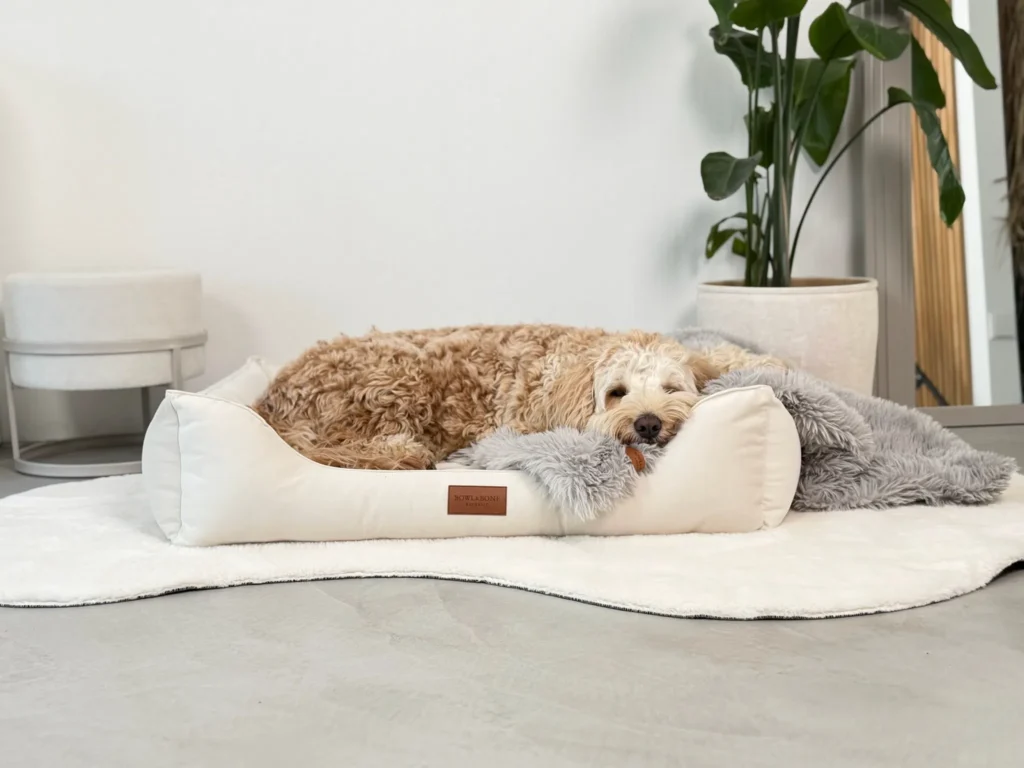
That is why a dog blanket for a dog bed can be a very good idea, but it is not an essential part of every dog’s resting space. It offers the greatest benefits when the dog willingly uses it, can freely move somewhere else or come out from underneath it, and the material is safe and easy to keep clean. Observing the individual dog is far more important than simply deciding that every bed should contain a blanket.
A blanket can create an additional soft layer in the bed, make it easier to refresh the dog’s most frequently used resting surface and serve as a portable accessory that can move to the sofa, car or holiday destination. It should not, however, replace a properly chosen dog bed simply because your dog enjoys soft materials.
What will you learn from this article? In this guide, you will find out:
- whether it is worth putting a blanket in your dog’s bed,
- whether every dog needs a blanket,
- how to tell whether your dog genuinely likes this kind of addition,
- when a blanket may get in the way rather than improve comfort,
- whether you should cover your dog while they sleep,
- whether a dog can safely sleep under a blanket,
- whether a blanket can be used in summer and winter,
- how to arrange a blanket in a dog bed,
- what blanket size is practical,
- whether puppies and senior dogs can use blankets,
- how often to wash a blanket used in a dog bed,
- how a blanket differs from a dog sleeping bag,
- when a blanket can serve as a portable resting surface.
Should you put a blanket in your dog’s bed? The short answer
Yes, if your dog likes soft materials and has the freedom to decide whether they want to use the blanket. An additional layer can increase comfort, allow your dog to arrange their resting place in their own way and make it easier for the guardian to keep the most intensively used surface clean.
Not every dog will need a blanket, however. Some dogs prefer direct contact with the surface of their bed, regularly choose a cool floor or quickly push additional material aside. The RSPCA points out that dogs can have very different preferences when it comes to resting and that it is worth giving them a choice [1].
The simplest rule is therefore: put a blanket in the bed and observe. If your dog regularly chooses it, settles on it or slides underneath it by themselves, it is probably a valuable addition for them. If they consistently push it out of the bed, there is no need to keep putting it back every time.
Why might a dog like a blanket in their bed?
Every dog has their own resting habits. One falls asleep only when tightly curled into a ball, another stretches their legs across the entire surface, while a third turns around, scratches at the bedding and moves everything inside before finally lying down.
A soft blanket gives your dog another element that they can arrange according to their own preferences. Dogs Trust notes that a comfortable bed and additional blankets can be used when creating a calm space for a dog, while the area itself should be adapted to the individual animal and allow them to enter and leave freely [3].
– a blanket creates an additional soft surface
Even if the dog bed itself is comfortable, some dogs enjoy having a surface with a different texture. A blanket can be spread across the middle, gathered into one corner or arranged by the dog into something resembling a small nest.
This does not mean that a soft blanket is automatically more comfortable than a well-made dog bed. It is simply another option. PDSA points out that a dog should have a comfortable, calm place to rest and that, in colder conditions, some dogs may also benefit from additional blankets [2].

– your dog can decide how they want to use it
This is one of the greatest advantages of a simple blanket. You do not have to cover your dog with it. You can place it in the bed and let your dog decide whether they want to sleep on it, cuddle into it, gather it underneath their head or move it completely out of the way.
Having this choice can be particularly valuable because a dog’s needs may change even during a single night. Your dog may fall asleep curled up on a soft surface and then, a few hours later, move onto a cooler floor. We discuss this behaviour in more detail in “Why Does a Dog Change Sleeping Spots at Night? 9 Most Common Reasons”.
– a blanket can make it easier to keep the resting area clean
A blanket placed directly on the surface of the bed collects some of the hair, sand and small amounts of dirt brought in by the dog. If it can be removed easily and washed, everyday care of the dog’s resting place becomes simpler.
This does not mean, of course, that a blanket replaces regular cleaning of the bed itself. VCA Animal Hospitals points out that dog beds, blankets and towels can collect dirt, allergens, bacteria and parasites, which is why they should be cleaned regularly according to the care requirements of the particular product [5].
For the guardian, however, being able to remove the blanket quickly can be extremely practical. This is especially useful after an autumn walk, during periods of heavy shedding or when your dog regularly brings toys into their bed.
Does every dog need a blanket in their bed?
No. A blanket is an addition to a dog’s resting place, not an essential part of every dog bed.
This is important because you may come across the belief that every dog should have their own blanket. In practice, an individual approach makes much more sense. Some dogs genuinely love soft fabrics, others are indifferent to them, while others push away anything placed on the surface of their bed.
– some dogs prefer a cooler surface
A dog can have an extremely comfortable bed and still spend part of the night sleeping on wooden flooring or tiles. VCA Animal Hospitals points out that some dogs leave a soft sleeping place when they become too warm and choose a cooler floor instead [6].
If your dog regularly pushes the blanket away, leaves their soft bed and stretches out on a cooler surface, another layer of fabric is probably unnecessary at that particular moment. It is worth respecting their choice rather than repeatedly putting the blanket back into place.
– not every dog likes being wrapped up
Some dogs will push their nose underneath any available fabric. Others immediately come out from underneath a blanket. Both behaviours can be entirely normal.
The American Kennel Club points out that there is no single type of blanket suitable for every dog and that very warm, fluffy materials may not be appropriate during hot weather for animals prone to overheating [4]. A blanket should therefore increase the number of options available to your dog rather than limiting their choice.
– sometimes the dog bed itself is perfectly sufficient
If your dog has a properly selected, comfortable dog bed, enjoys resting in it and does not seek out additional fabrics, there is no need to change a solution that already works well.

The RSPCA points out that suitable bedding should first and foremost allow the dog to adopt their natural resting positions [1]. A blanket can complement this space, but it should not be used to mask problems caused by a bed that is too small, worn out or poorly suited to the dog.
How can you tell whether your dog really likes a blanket in their bed?
Your dog will give you the best answer. You do not need a complicated test – simply observe for several days what they do when the blanket is in their bed and how they behave when it is not there.
If your dog uses their bed in exactly the same way as before, the blanket may simply be a neutral addition. If they clearly choose its surface, move it around, gather it up or slide their muzzle underneath it, this type of resting arrangement probably suits them.
– your dog chooses the surface of the blanket
The clearest sign is regularly choosing to lie on it. Your dog may have the whole bed available and still position their body precisely on the part covered with the blanket several times a day.
This does not automatically mean that they are cold. They may simply like the softness or texture of the fabric. It is not worth drawing overly broad conclusions from a single observation.
– your dog arranges the blanket themselves
You may carefully spread the blanket across the whole dog bed in the morning, only to find it gathered into a little pile underneath your dog’s muzzle five minutes later. That does not necessarily mean you have done anything wrong.
For some dogs, moving the fabric is simply part of preparing their own resting place. If your dog does this calmly, does not tear the blanket and settles down afterwards, you can allow them to create their own arrangement.
– your dog slides underneath the fabric by themselves
Some dogs are particularly keen to find a way of hiding part of their body underneath a soft fabric. If your dog regularly tries to crawl underneath the blanket, it may suggest that they prefer a more enveloping style of rest.
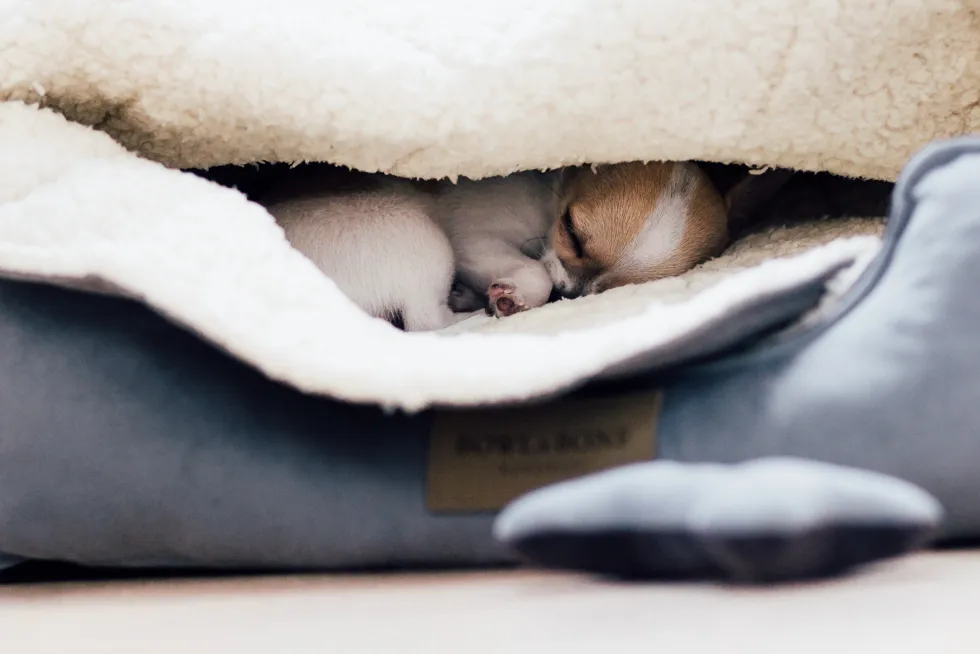
It may then be worth considering a dog sleeping bag, whose construction has been designed to let the dog rest either on the surface or underneath the upper layer. We discuss the differences in more detail in “How to Choose the Right Dog Sleeping Bag”.
When is it better not to put a blanket in a dog bed?
A blanket is a simple accessory, but its presence should still suit the behaviour of the individual dog. In several situations, it is better to remove it or allow your dog to use it only under supervision.
Safety and freedom of movement are the priorities. If the blanket creates a problem, there is no reason to leave it in the bed simply because it looks cosy.
– when the dog chews and swallows pieces of fabric
This is the most important exception. If your dog does not merely knead or move the blanket but tears the fabric and tries to swallow pieces of it, they should not be left alone with it.
Swallowed pieces of fabric can behave as foreign bodies in the gastrointestinal tract. The Merck Veterinary Manual states that gastrointestinal obstruction is an emergency and can be associated with ingestion of foreign material [7]. The AKC also recommends removing the blanket if a dog persistently chews it and consumes pieces of fabric [4].
Particular care is advisable with puppies going through an intensive chewing phase and dogs that habitually destroy textiles.
– when the blanket makes the dog too warm
If your dog starts panting heavily, repeatedly comes out from under the fabric or quickly moves to the coolest place in the room, they may not need the additional layer.
Do not try to keep your dog underneath a blanket. They should be free to come out and choose a cooler surface [3][4]. This is particularly important on warm days, in heated rooms and with very fluffy materials.
– when the material repeatedly restricts movement
A blanket that is too large, heavy or heavily bunched up can begin to occupy a significant part of a small dog bed. If your dog has to struggle with the material simply to lie down comfortably, the additional layer is no longer serving its purpose.
With older dogs or dogs that have mobility difficulties, pay particular attention to whether the fabric forms high, unstable folds that make entering or leaving the bed more difficult. If your dog has mobility problems or appears to be in pain, it is worth discussing their resting arrangement with a veterinary surgeon.
Should you cover your dog with a blanket at night?
No. You do not need to cover your dog simply because they are going to sleep.
A much better approach is to leave the blanket in a way that allows your dog to decide whether they want to lie on it, partly slide underneath it or rest without any covering at all. Dogs Trust emphasises the importance of allowing dogs to enter and leave their safe space freely and adapting that space to the individual animal’s preferences [3].
If you know that your dog enjoys being covered and settles calmly once a blanket is placed over them, you can do so gently. You should still make sure that your dog can come out from underneath the material without difficulty and that they are not becoming too warm.
In our article “Dog’s Sleeping Positions”, we explain that resting underneath a blanket can be associated, among other things, with a desire for warmth or shelter, but the dog should always be able to leave freely and the risk of overheating should be considered.
Can a dog sleep under a blanket?
For a healthy dog that chooses to go underneath a light blanket and can come out freely, this behaviour is generally not a problem in itself. You should not, however, wrap the dog tightly or prevent them from changing position or moving elsewhere.
Observe both the temperature in the room and your dog. If they regularly come out from underneath the blanket, lie down on a cool surface or clearly do not want to be covered again, respect that choice.
Particular caution is advisable with animals that have health problems, mobility difficulties or breathing disorders. If you have any concerns about your individual dog, discuss the way their sleeping area is arranged with a veterinary surgeon.
Does a blanket in a dog bed make sense in summer?
Blankets are most often associated with colder months, but the season itself does not determine whether one should be placed in a dog bed. The indoor temperature, type of fabric, your dog’s preferences and the way they use the blanket all matter.
During summer, some dogs may still enjoy resting on a lightweight fabric but will not necessarily want to be covered by it. Others will consistently choose cool tiles and avoid soft bedding during the warmest part of the day.
The AKC points out that lightweight materials can be more practical in warmer months, while fluffy blankets may be too warm for dogs prone to overheating [4]. Rather than following the calendar, observe the actual conditions and your dog’s response.
Is a blanket in a dog bed more useful in winter?
During colder months, an additional layer may be particularly pleasant for a dog that clearly seeks out more enveloping resting places. PDSA notes that when temperatures fall, some dogs may benefit from additional blankets or a warmer resting space [2].
This does not mean that every dog automatically needs several layers of fabric during winter. Dogs differ in coat type, build, age, health and individual tolerance of temperature. Even in winter, a dog may start the night on soft bedding and later move onto a cooler surface.
We discuss preparing the whole resting area for colder months in our article “Winter Dog Bedding – What to Choose and How to Prepare It?”. In that context, a blanket is just one of several possible elements, alongside choosing an appropriate location and suitable bed construction.
Which dog blanket for a dog bed is practical?
It would be easy to move into a subject that we have already covered more broadly on our blog, so here we will focus only on the criteria directly connected with using a blanket in a dog bed. If you want to look more closely at materials, sizes and different uses, read “What Should I Consider Choosing a Blanket for a Dog?”.
For everyday use, it is worth choosing a material that feels pleasant against the body, is durable and can be cleaned regularly. The finish matters too – elements such as fringes that can easily be bitten off or loose decorations will not be a good choice for a dog that tends to chew textiles [4].
– pay attention to ease of washing
A blanket used in a dog bed will regularly come into contact with hair, paws, saliva and dirt carried in from outside. Being able to refresh it easily is therefore one of the most practical features of this accessory.
Always follow the care instructions for the specific product. Do not automatically choose the highest washing temperature because different fabrics require different cleaning methods.
With Bowl&Bone Republic dog blankets, care information is provided for each model. This makes it possible to consider not only appearance and texture but also a practical solution for everyday use.
– match the texture to your dog’s preferences
If your dog loves fluffy, enveloping surfaces, you may want to look at the MILO brown furry dog blanket. Its main fabric has a weight of 420 g/m², is made from 100% polyester, has a declared abrasion resistance exceeding 100,000 Martindale cycles and complies with OEKO-TEX STANDARD 100.
For the dog, this means a soft, distinctly cosy surface that they can choose as an additional layer in their bed. For the guardian, the durability of the material and the option of washing it by hand or on a delicate washing-machine programme make regular use easier without compromising the appearance of the home interior.
If you prefer something with a more versatile character, the NAP brown dog blanket is another good example. It can accompany your dog in their bed, on the sofa and while travelling.
Does the blanket have to be the same size as the dog bed?
There is no universal rule stating that a blanket should correspond exactly to the surface area of the bed. From a practical point of view, it should be large enough for the dog to rest on comfortably or partly snuggle into, but not so unwieldy that thick folds of fabric occupy most of a small bed.
When choosing one, consider not only the dimensions of the blanket but also the sleeping surface of the bed and the way your dog rests. A dog that curls into a small ball will use the fabric differently from a large dog that stretches all four legs while sleeping.
If you require a very specific size, selected Bowl&Bone Republic blankets can also be prepared as an individual order. This can be useful when you want to match the accessory to a particular bed or an unusual space.
A blanket for a puppy’s bed – what should you watch out for?
A blanket can be a comfortable part of a young dog’s resting area, but with a puppy it is especially important to observe how they use it. Young dogs explore many objects with their mouth, and during teething they may also chew textiles intensively.
If your puppy calmly lies on the blanket, kneads it or moves it without tearing it, the blanket can remain part of their bed. If they start pulling threads, biting through the fabric or swallowing pieces of material, remove it and offer a safe item intended for chewing. The risk associated with swallowing foreign objects is more important here than additional softness [4][7].
It is also worth remembering that a young dog changes quickly. Do not assume after the first few days that they will always sleep in exactly the same way – their preferences may change as they grow.
What about a blanket for a senior dog?
An older dog may appreciate a soft, calm resting surface, but the blanket itself should not replace a properly fitted bed. The RSPCA notes that older dogs and dogs experiencing pain or joint problems may benefit from a supportive bed that is easy to enter and leave [1].

If your senior dog has difficulty getting up, also make sure that the blanket does not gather underneath their paws into high, unstable folds. The material should be arranged so that the dog can enter and leave the bed safely.
A sudden change in resting behaviour – getting up frequently, avoiding their usual bed or struggling to find a comfortable position – should not automatically be attributed to age. In situations like these, it is worth consulting a veterinary surgeon.
Dog blanket or dog sleeping bag – which is better?
These are two different solutions. A blanket provides the greatest flexibility: you can put it in the dog bed, move it to the sofa, take it in the car or fold it into a travel bag. Your dog can use it in many different ways.
A sleeping bag is a more defined form of bedding. The dog can rest on its surface or slide underneath the upper layer. It may therefore be particularly suitable for a dog that regularly tries to hide underneath blankets.
If your dog simply likes lying on soft material, I would start with a blanket. If, however, they constantly look for a way to get underneath fabric and create a more enveloping resting place, a sleeping bag may be worth considering.
Can a blanket replace a dog bed?
In some situations, it can serve as a temporary or additional surface for lying down – for example during a short visit to family, while travelling or when resting on the sofa. This does not mean, however, that a single thin blanket is equivalent to a comfortable, properly fitted dog bed for everyday use.
PDSA and Dogs Trust emphasise the importance of a comfortable, calm and accessible space intended for a dog’s rest [2][3]. If a dog regularly sleeps for many hours in one place, they should have access to a surface that supports comfort and allows them to adopt natural sleeping positions.
A blanket is therefore best treated as a flexible addition to the dog’s equipment. You can take it to places where a full-size bed would be impractical, while at home it is still worth providing your dog with a permanent resting area.
Almost 15 years of designing dog accessories has shown us that every dog uses a blanket differently
At Bowl&Bone Republic, we have been designing PREMIUM dog accessories for almost 15 years. During this time, we have received hundreds of opinions, stories and practical suggestions from dog guardians, while feedback from thousands of satisfied customers has allowed us to observe how differently dogs use exactly the same type of product.
One dog carefully gathers their blanket inside the bed and only then lies down. Another uses it mainly on the sofa. A third chooses it throughout winter but consistently pushes the material aside as warmer days arrive. There are also dogs that clearly prefer the enveloping construction of a sleeping bag to a traditional blanket.
This is why, when designing accessories, we aim to combine the dog’s comfort with practical everyday use for the guardian. A high-quality material should feel pleasant during rest while also being durable, carefully finished and suitable for regular care.
For the dog, this means greater freedom to choose how they want to rest. For the guardian, it means a functional accessory that can complement the dog bed, protect frequently used surfaces and blend elegantly with the home interior.
Our design experience does not, however, change the most important principle: the behaviour of the individual dog should determine whether the blanket stays in their bed.
How often should you wash a blanket used in a dog bed?
There is no single washing frequency suitable for every dog. A blanket used by a dog that sheds heavily, returns from walks with damp paws or likes eating chews in their bed will need refreshing more often than one belonging to a dog that uses it only while sleeping at night.
VCA Animal Hospitals points out that dog blankets, beds and towels can collect dirt, bacteria, allergens and parasites and should therefore be cleaned regularly [5]. In practice, the best approach is to combine regular inspection with the manufacturer’s care instructions.
If the blanket is visibly dirty, damp, has developed a strong smell or has collected a large amount of hair, do not wait for a particular day in the calendar. Wash it according to the recommendations for the specific material and allow it to dry thoroughly before returning it to the bed.
How should you arrange a blanket safely in a dog bed?
There is no need to make things complicated at first. Spread the blanket across part of the bed or place it loosely where your dog most often settles. Then allow them to decide what they want to do with it.
Do not wrap your dog tightly, block the entrance to their bed or create an arrangement that could restrict their ability to leave freely. Dogs Trust states that a dog’s safe space should allow them to enter and leave independently [3].
If, after a few minutes, your dog pulls the blanket out of the bed and lies down beside it, you have still received an answer. Perhaps they do want to use the accessory – simply in a different way from the one you had planned.
A blanket in the dog bed and your dog’s sleeping position
The way your dog sleeps can give you clues about how to prepare their resting area, but it is not worth creating rigid rules based on sleeping positions alone. A dog that sleeps curled into a ball may enjoy a more enveloping space, while a dog that sleeps on their side or back will need more room to stretch out freely.
If a large blanket occupies half the bed and limits your dog’s ability to stretch their legs, try folding it differently or choosing a smaller model. The dog bed itself should still allow your dog to adopt natural resting positions [1].
You can find more about the way dogs position themselves while resting in “Dog’s Sleeping Positions”.
Does it make sense for a dog to have two blankets?
It can, particularly if one remains in the dog bed while the other is used on the sofa, in the car or when travelling. This means you do not need to keep moving the same accessory between several different places.
A second blanket can also be practical while the first is being washed. Your dog still has access to a soft surface they enjoy, while the guardian does not need to wait for the material to dry completely.
This does not mean that every dog should have two or three blankets. If your dog uses only one resting place and a single blanket meets their needs, there is no reason to multiply accessories unnecessarily.
Dog blanket for a dog bed – when is it really worth adding one?
Start with a simple experiment. Put a soft, clean blanket over part of the bed and observe your dog for a few days. Do not keep rearranging it, do not cover your dog against their will and do not try to persuade them to use the fabric.
If your dog chooses the blanket themselves, lies on it or uses it to create a more enveloping resting space, leave it as part of the bed. If the material is constantly pushed out, your dog probably does not need it in that particular place.
The best dog blanket for a dog bed is therefore not the one that looks cosiest to us, but the one that the individual dog genuinely chooses to use.
If you decide to add another layer to your dog’s resting place, explore the Bowl&Bone Republic dog blanket collection. You will find models with different textures and characters – from the soft NAP to the fluffier MILO line – allowing you to match the additional surface both to the way your dog rests and to the style of your home.
If, on the other hand, you are creating the whole sleeping area from the beginning, it is worth starting with the right foundation and exploring the Bowl&Bone Republic dog bed collection. A well-chosen bed should provide the foundation for comfort, while a blanket acts as an addition that gives your dog more options and lets them rest in exactly the way they prefer.
For more inspiration, practical knowledge and carefully designed dog accessories, visit www.bowlandbone.com – a place created for dog guardians who want to combine their dog’s everyday comfort with timeless style.
– the Bowl&Bone Republic team
FAQ (Frequently Asked Questions) –
Dog Blanket for a Dog Bed – Is It a Good Idea?
Does a dog need a blanket in their bed?
Not every dog needs a blanket. It can provide an additional soft layer and allow your dog to arrange their resting place in their own way, but individual preferences are the most important factor. If your dog regularly pushes the blanket out of the bed, there is no need to make them use it.
Is it worth putting a blanket in a dog’s bed?
Yes, particularly if your dog likes soft materials, arranges the blanket themselves or willingly rests on it. A blanket can also make it easier to keep the surface of the dog bed clean. It should, however, be safe, suitable for regular washing and must not restrict your dog’s ability to move somewhere else.
Should I cover my dog with a blanket at night?
No. You do not need to cover your dog simply because they are settling down for the night. If your dog enjoys being covered, you can gently place a light blanket over them, but they should be able to come out from underneath it independently and move to a cooler place.
Can a dog sleep under a blanket?
A healthy dog can rest underneath a light blanket if they choose to do so and can come out freely. Watch for signs that they are becoming too warm. Particular care is advisable in warm rooms and with dogs that have health problems.
Can a blanket in a dog bed make a dog too warm?
It can increase the amount of retained heat, which is why a dog should never be forced to remain underneath it. If your dog pants, comes out from under the fabric or moves onto a cooler surface, allow them to regulate their own thermal comfort [4][6].
Which blanket should I choose for a dog bed?
Look primarily for a soft, durable material, careful finishing and ease of washing. The size should allow your dog to use the blanket comfortably without thick folds taking up the entire sleeping surface. If your dog chews textiles, avoid loose elements and regularly inspect the condition of the blanket [4].
Should a dog blanket be larger than the dog bed?
There is no need for it to be larger. What matters most is that it is practical for the individual dog and the way they use it. Too much fabric in a small bed can reduce the space available for comfortably stretching out.
Can a puppy have a blanket in their bed?
Yes, provided they use it calmly. With a puppy, it is particularly important to monitor chewing. If the puppy tears the blanket and tries to swallow pieces of fabric, it should be removed because of the risk of ingesting a foreign object [4][7].
Should a senior dog have a blanket in their bed?
They can if they enjoy that type of surface. With a senior dog, make sure that the material does not form high folds that make entering or leaving the bed more difficult. If the dog has joint problems, pain or difficulty standing up, the priority should be a properly selected bed and consultation with a veterinary surgeon.
How often should you wash a dog’s blanket?
The frequency depends on how intensively it is used, the amount of hair and dirt, and whether the dog brings moisture indoors. The blanket should be cleaned according to the manufacturer’s instructions when it becomes dirty, damp or needs refreshing. Regular washing helps remove accumulated dirt and allergens [5].
Dog blanket or dog sleeping bag – which should you choose?
A blanket is more versatile and can easily be moved between a dog bed, sofa and car. A sleeping bag is better suited to dogs that particularly enjoy sliding underneath material and resting in an enveloping space. The choice should depend on the dog’s actual behaviour.
Can a blanket replace a dog bed?
For a short period or while travelling, a blanket can create an additional resting surface, but at home it should not automatically replace a properly selected dog bed. A dog should have a comfortable place that allows them to adopt natural sleeping positions freely [1][2][3].
Sources and inspiration used to write the article
“Dog Blanket for a Dog Bed – Is It a Good Idea?”
- RSPCA – Royal Society for the Prevention of Cruelty to Animals, “Choosing the Perfect Dog Bed” – information about different resting preferences in dogs, dog bed size, natural sleeping positions and the needs of older dogs.https://www.rspca.org.uk/adviceandwelfare/pets/dogs/environment/dogbeds
- PDSA – People’s Dispensary for Sick Animals, “Making your home dog friendly” – information about providing a calm resting place, appropriate temperature and the use of additional blankets in colder conditions.https://www.pdsa.org.uk/pet-help-and-advice/looking-after-your-pet/puppies-dogs/making-your-home-dog-friendly
- Dogs Trust, “Creating a safe space for your dog” – guidance on creating a calm space, using beds and blankets and allowing a dog to enter and leave freely.https://www.dogstrust.org.uk/dog-advice/life-with-your-dog/at-home/creating-safe-space
- American Kennel Club, “Do Dogs Benefit From Blankets? Choosing the Right Dog Blanket” – information about the benefits of blankets for dogs, choosing size and material, ease of washing and safety, including risks associated with overheating, chewing, tangling and excessively heavy blankets.https://www.akc.org/expert-advice/home-living/dog-blankets/
- VCA Animal Hospitals, “Safe spring cleaning with your dog” – information about hygiene of dog beds, blankets and towels, including the need to remove dirt, bacteria, allergens and parasites regularly.https://vcahospitals.com/resources/lifestyle-dog/hazards-safety/safe-spring-cleaning-with-your-dog
- VCA Animal Hospitals, “Should My Dog Sleep in My Bed?” – information about individual sleeping preferences, choosing cooler surfaces and changing resting places during the night.https://vcahospitals.com/know-your-pet/should-my-dog-sleep-in-my-bed
- Merck Veterinary Manual, “Gastrointestinal Obstruction in Small Animals” – information about gastrointestinal obstruction, including cases associated with dogs ingesting foreign objects.https://www.merckvetmanual.com/digestive-system/surgical-problems-of-the-gastrointestinal-tract-in-small-animals/gastrointestinal-obstruction-in-small-animals









 or CANADA
 PLEASE join us at